
An HOA management contract is the written agreement between a homeowners association and its management company. It spells out what the manager will do, what the board keeps for itself, how the company is paid, how long the arrangement lasts and how either side can end it. A good one covers the eight topics listed below and leaves no doubt that the board remains in charge.
The contract deserves as much attention as the choice of company. Many disagreements between boards and managers come down to something the contract did not say clearly: a service the board assumed was included, a fee it did not expect, or a termination clause nobody read.
Why a written HOA management contract matters
Some managers offer to work without a contract, or on a short letter agreement. That may sound flexible, but it leaves both sides guessing. Without written terms it is hard to hold the company to a scope of work, to object to a price increase or an unexpected charge, or to get records and funds back in an orderly way when the relationship ends.
Directors have a duty to act carefully with the association’s money, and hiring the company that will handle that money on a handshake is hard to defend if something goes wrong. A clear, fair contract protects the owners, the board and the manager.
Before the contract: choosing a management company
The contract will only be as good as the match behind it. Before you ask for proposals, write down what you need:
- Scope. Full management, or accounting and collections only? How many site inspections each month? Attendance at how many board meetings? Will the manager deal with owners directly?
- Special needs. Major projects, aging buildings, on-site staff, heavy delinquencies or a recent history of disputes all call for specific experience.
- Reporting. What financial and management reports does the board expect, and by what date each month?
Give every company the same written scope so the proposals can be compared line by line. A lower price often means fewer services, or more of them billed as extras. Ask each company who would actually be assigned to your community and how many other associations that person handles. Call references at associations of a similar size, including, if you can, one that has left the company. Ask about credentials, and ask for disclosure of any business relationships with vendors.
For background on the services themselves, see what HOA management companies do. Our page on comparing HOA management options covers the service models and how to evaluate a company, and managing outside vendors has general vetting tips.
Eight topics an HOA management contract should cover
Templates are easy to find, and most management companies will hand you their own standard form. Treat either one as a starting point. The agreement has to fit your governing documents and state law, and the association’s attorney should review it before the board signs. Whatever form you start from, it should address these eight topics.

Share this infographic: Pinterest · Facebook · LinkedIn · Email · Download
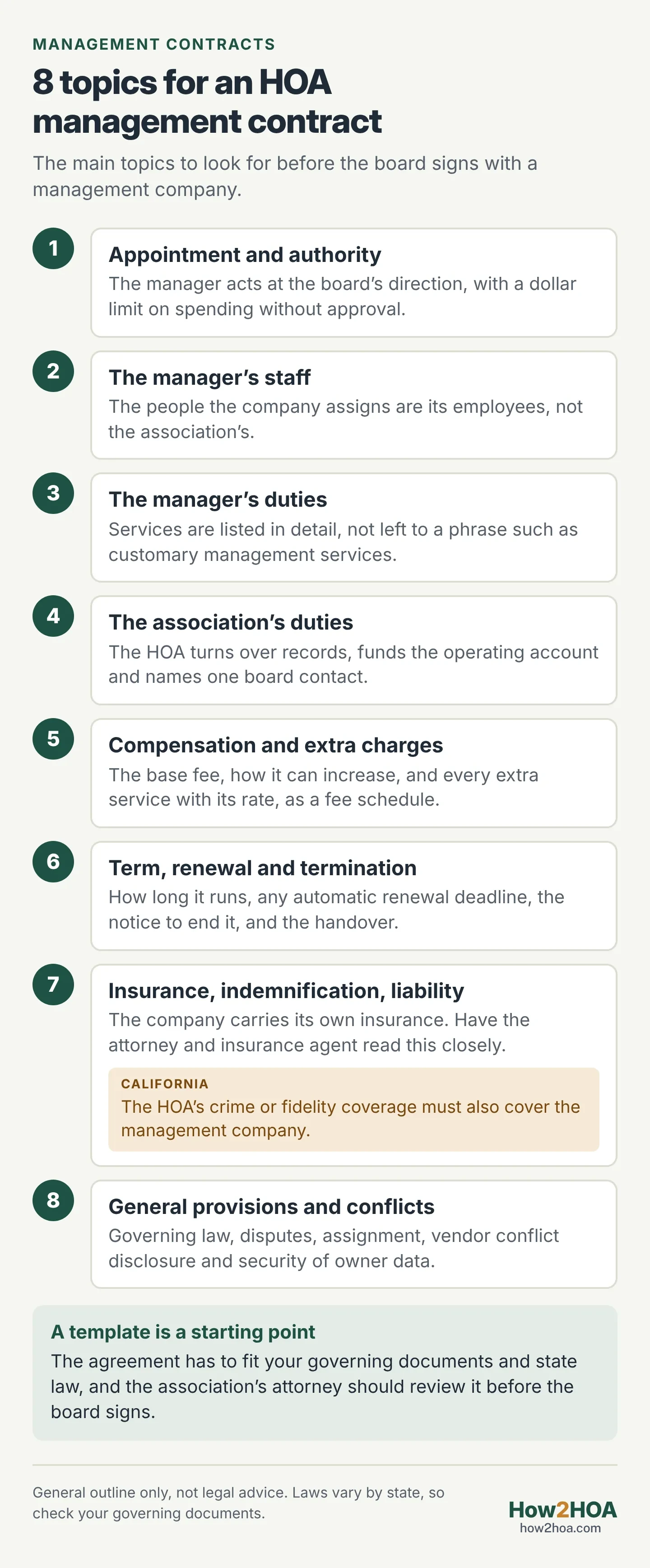
1. Appointment and authority
The contract appoints the company as the association’s managing agent and defines the limits of that role. It should say that the manager acts at the direction of the board, set a dollar limit on spending without board approval (with an exception for true emergencies), and make clear what the manager may not do alone, such as signing contracts, changing vendors, starting legal action or settling claims.
2. The manager’s staff
The management company is an independent contractor, and the people it assigns are its employees, not the association’s. The contract should say who is responsible for hiring, supervising, paying and insuring them, and how on-site staff are handled if the community has any. It is reasonable to ask for a named community manager, notice before that person is replaced, and a say in the replacement.
3. The manager’s duties
This is the heart of the agreement, and it should be specific. List the services in detail instead of relying on a general phrase such as customary management services. Typical duties include:
- Financial: billing and collecting assessments, paying approved invoices, reconciling accounts, preparing monthly financial reports and a draft budget, following the board’s collection policy on delinquent accounts, and assisting the outside CPA with the year-end review or audit and the tax returns
- Administrative: preparing meeting notices and agendas, attending meetings, keeping records, and handling owner correspondence and required mailings
- Property: inspecting the common area on a set schedule, obtaining bids, supervising vendors and responding to emergencies
- Compliance support: sending violation notices and tracking architectural requests under the board’s policies
Add service standards where they matter to you, such as response times for owner inquiries and the date each month the financial report is due. The contract should also say where association funds are held, in whose name, and who can sign or release payments.
4. The association’s duties
The association has obligations too: turning over records and account information at the start, keeping enough money in the operating account to pay the bills, giving timely decisions and approvals, and carrying its own insurance. The contract should name the board’s point of contact, often the president or another officer, so the manager is not taking conflicting instructions from several directors.
5. Compensation and extra charges
The contract should state the base management fee, when it is paid and how it can increase. It should then list every service billed in addition to the base fee, with the rates. Common extras include additional or unusually long meetings, oversight of large construction projects, insurance claim handling, special mailings, copying and postage, and records storage. Ask for this fee schedule as an exhibit to the contract.
Also ask what the company charges owners and buyers directly, such as fees for resale documents or collection letters, and whether it receives commissions, markups or referral fees from vendors. None of this is necessarily improper, but the board should know about all of it before signing.
6. Term, renewal and termination
This section states how long the agreement lasts and how it ends. Read it closely for:
- Length and renewal. Many agreements run for a year or more and renew automatically unless one side gives notice by a deadline. Put that deadline on the board calendar.
- Termination without cause. Look for the right of either party to end the agreement on written notice without a penalty, and check how many days’ notice is required.
- Termination for cause. The contract should allow a faster exit for serious breaches, with a short period to fix the problem where that makes sense.
- Termination fees. Know what, if anything, the association owes if it leaves early.
- Transition. The contract should state that all records, data and funds belong to the association and must be turned over within a set number of days after termination, including bank account access, owner ledgers, electronic files and website logins. It should also say what, if anything, the manager may charge for the handover.
7. Insurance, indemnification and liability
The contract should require the management company to carry its own insurance (general liability, professional liability, workers’ compensation and a fidelity or crime policy covering theft of client funds) and to provide certificates each year. It should also say which of the association’s policies must cover the manager.
Indemnification clauses decide who pays if the association or the manager is sued because of the other’s conduct. Some standard forms have the association indemnify the manager broadly while limiting the manager’s own liability. This is the section to have the association’s attorney and insurance agent read most closely. Our article on the five core HOA insurance policies explains the association’s own coverages.
8. General provisions and conflicts of interest
The closing sections cover the mechanics: which state’s law governs, how disputes will be resolved, whether the company can assign the contract to another firm (for example if it is sold), how the agreement can be amended, and a statement that the written contract is the entire agreement. Look for two more items here. The first is a conflict of interest clause requiring the company to disclose any ownership interest in, or payments from, vendors it recommends. The second is confidentiality and data security for owner information.
In California
California law adds several requirements that affect management contracts:
- Disclosures before signing. Under Civil Code section 5375, a prospective managing agent must give the board a written statement as soon as practicable, and no more than 90 days, before entering into a management agreement. It covers the company’s owners or, for a corporation, its directors, officers and shareholders holding more than 10 percent; their relevant licenses and professional certifications; any business in which the manager or firm has an ownership interest, profit-sharing arrangement or other monetary incentive; and whether it receives a referral fee or other monetary benefit from a third-party provider that distributes the association’s resale disclosure documents.
- Conflicts of interest. Section 5375.5 requires a manager or management firm to disclose in writing any potential conflict of interest when presenting a bid for service to the board, including referral fees and ownership or profit-sharing interests in service providers.
- Handling of funds. Civil Code section 5380 requires a managing agent that receives association funds to deposit them in a trust fund account at a bank, savings association or credit union in California, unless they go into escrow or an account under the association’s control. The agent must keep separate records of receipts and disbursements and may not commingle association funds with its own money or anyone else’s.
- Who counts. Section 5385 says that, for the managing agent provisions in sections 5375 to 5380, a managing agent does not include a full-time employee of the association.
- Transfers. Section 5502 bars transfers from reserve or operating accounts without prior written board approval unless the amount is less than the lesser of $10,000 or 5 percent of the estimated income in the annual operating budget. For associations with 50 or fewer separate interests, the threshold is the lesser of $5,000 or 5 percent.
- Fidelity coverage. Under Civil Code section 5806, if the association uses a managing agent or management company, the association’s crime or fidelity coverage must also cover dishonest acts by that company and its employees.
California also regulates the title of certified common interest development manager in Business and Professions Code sections 11500 to 11506. The certification comes from professional associations, not from a state agency. To use the title, a person certified on or after July 1, 2003 must have completed at least 30 hours of coursework in specified subjects and passed an examination (section 11502).
Section 11504 requires a manager to disclose to the board every year whether they are certified and by which organization, where their primary office is located, and whether they hold an active real estate license, and to disclose before entering into or renewing a contract whether their fidelity insurance covers the association’s operating and reserve funds. Under section 11505, it is an unfair business practice to use the certified title without meeting the requirements or to fail to make the required disclosures. Ask for these disclosures in writing and keep them with the contract.
Finally, for incorporated associations, Corporations Code section 7210 allows the board to delegate the management of the corporation’s activities to a management company, provided the activities and affairs are managed and all corporate powers are exercised under the ultimate direction of the board. A contract cannot change that.
Is a management company right for your association?
Not every association needs full management. Some hire a company for accounting only, and many small communities manage themselves; see how to self-manage your HOA. If you do hire a company, the contract is how the board keeps control of the relationship, so read every page, negotiate the terms that matter to you, and review the agreement before each renewal. More articles on working with managers are in our HOA management section.
The Law Behind This Article
Every legal point in this article comes from the official text. Each link below opens it in a new tab.
Civil Code sections: 5375 · 5375.5 · 5380 · 5385 · 5502 · 5806
Corporations Code sections: 7210
Business and Professions Code sections: 11500 · 11502 · 11504 · 11505
This article is general educational information, not legal advice. Laws vary by state and your association’s governing documents control many of these questions, so check with your association’s attorney or another qualified professional about your situation.