
In California, owners can recall an HOA board member by petitioning for a special membership meeting and then winning a secret ballot vote. The petition needs signatures from at least 5 percent of the members, no reason has to be given, and the board must schedule the vote within deadlines set by statute. This article covers California law, written for owners considering a recall and for boards that receive a petition. Other states use different thresholds and procedures, so check your own state’s law and your bylaws if you are outside California.
Before you start: is a recall the right tool?
A recall is slow, expensive for the association and hard on a community. It takes months, requires a full secret ballot election run by an independent inspector, and often fails for lack of a quorum. Consider the alternatives first:
- Ask the director to resign. A direct conversation sometimes resolves it.
- Wait for the next election. California associations must hold an election for each seat when its term ends and at least once every four years. If the seat is up within a few months, a campaign is simpler than a recall.
- Adopt term limits. A bylaw amendment addresses long tenure generally.
- Use dispute resolution. If the complaint is about one decision, internal dispute resolution may fix it without removing anyone. See HOA dispute resolution.
If the problem is conflict among directors, our article on battling board members may be more useful than a recall.
Step 1: The petition
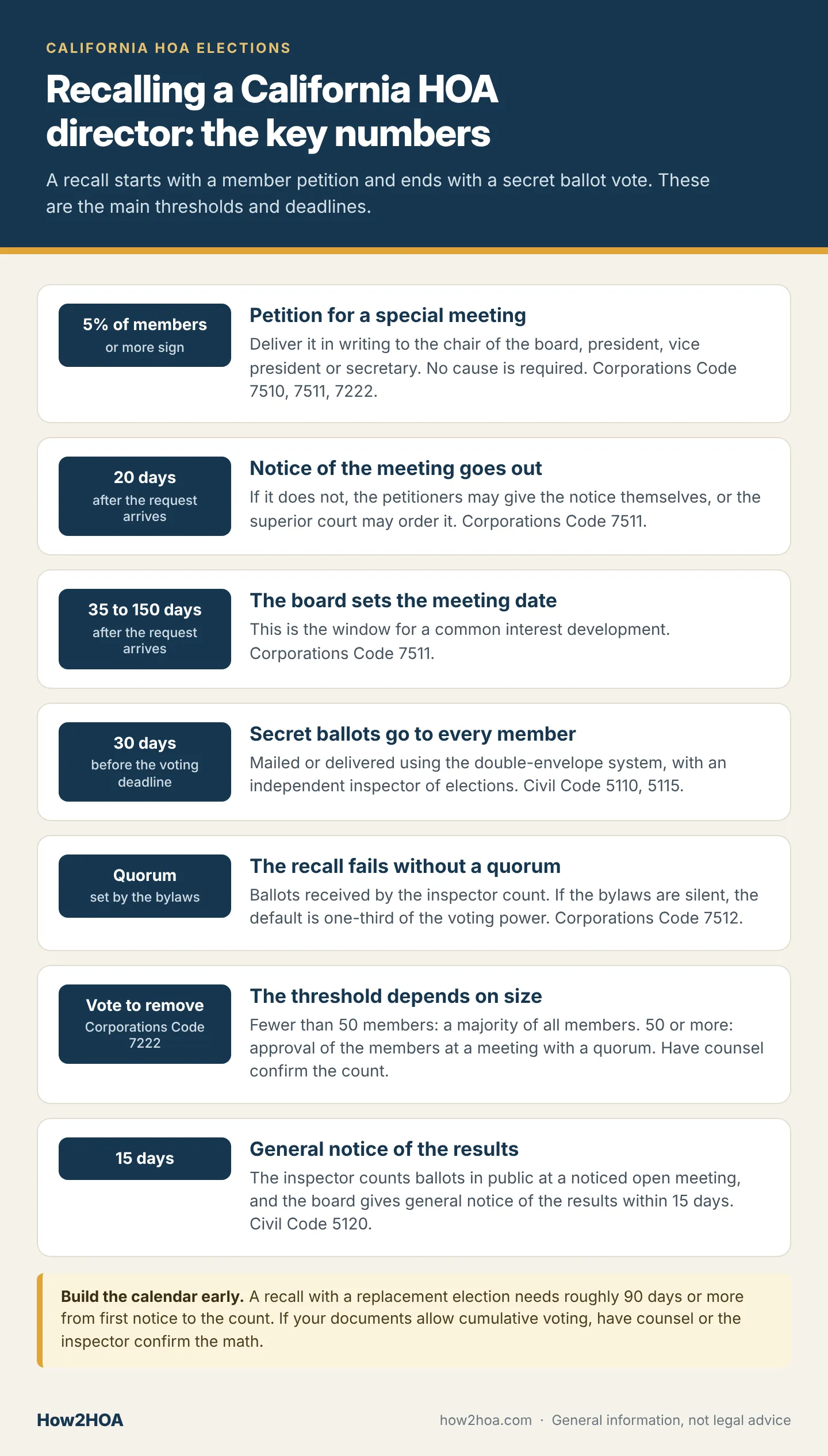
Corporations Code section 7510(e) allows 5 percent or more of the members to call a special meeting of the members for any lawful purpose, and removing directors is one. Read the bylaws too, because they may add details about how a petition is delivered.
A workable petition:
- States the purpose precisely. Name each director to be removed, or state that the purpose is removal of the entire board. The purpose matters because a special meeting can only take up the business described in its notice. Most petitions also call for electing replacements if the recall succeeds.
- Carries enough valid signatures. Count one per membership (usually one per home), print each signer’s name and address, and collect a margin above 5 percent in case some are challenged.
- Is delivered in writing to an officer. Corporations Code section 7511(c) calls for a written request to the association addressed to the attention of the chair of the board, president, vice president or secretary. Use a delivery method with proof, and keep a copy.
No cause is required. Section 7222 allows removal “without cause,” so the petition does not have to prove misconduct.
Owners gathering signatures may request the membership list for that purpose. See HOA records requests for how that works and the limits on using the list.
Step 2: The board sets the meeting
Once a valid petition arrives, the board’s role is administrative. It does not get to decide whether a recall is a good idea.
Under Corporations Code section 7511(c):
- The board sets the date. For a common interest development, the meeting must be held not less than 35 and not more than 150 days after the request is received. Other nonprofit mutual benefit corporations have a 90-day outer limit.
- Notice goes out within 20 days. If notice of the meeting is not given within 20 days after the request is received, the petitioners may give the notice themselves, or the superior court may order it.
Boards should verify signatures against the membership roster promptly, hire the inspector of elections, and put the scheduling decision on an open board meeting agenda.
Step 3: The secret ballot election
Civil Code section 5100 requires elections regarding the removal of directors to be held by secret ballot under the Davis-Stirling election rules, regardless of what the governing documents say. The main requirements:
| Requirement | Rule | Source |
|---|---|---|
| Inspector of elections | One or three independent third parties, who cannot be directors, candidates, their relatives, or a person or company under contract with the association for other paid work | Civil Code 5110 |
| Notice of the election | General notice at least 30 days before ballots are distributed, with the ballot return deadline and address, the date, time and place of the count, and the candidate names | Civil Code 5115(b) |
| Nominations (if replacements are elected) | General notice of the nomination procedure and deadline at least 30 days before nominations close | Civil Code 5115(a) |
| Ballots | Mailed or delivered to every member at least 30 days before the voting deadline, using the double-envelope system | Civil Code 5115(c) |
| Election rules | Delivered with the ballots, and not amended less than 90 days before the election | Civil Code 5105 |
Added together, a recall that includes a replacement election needs roughly 90 days or more from the first notice to the count, which fits inside the 150-day window but leaves little slack. Have the inspector or the association’s attorney build the calendar. Ballots are counted by the inspector in public at a noticed open meeting, and the board must give general notice of the results within 15 days (Civil Code section 5120).
Two campaign rules also apply under Civil Code section 5105. If any candidate or member advocating a point of view is given access to association media such as a newsletter or website during the campaign, equal access must be given to all, including those the board does not endorse. And all candidates and advocates must be allowed to use common area meeting space at no cost for election-related purposes.
Step 4: Quorum and the vote required
Quorum
The recall fails if the quorum required by the bylaws is not met. Ballots received by the inspector count toward the quorum. If the bylaws are silent, Corporations Code section 7512 sets a default of one-third of the voting power. Civil Code section 5115 now allows a reduced 20 percent quorum at a reconvened meeting, but the statute’s wording refers to the election of directors. Whether it reaches a removal vote is a question for the association’s attorney.
Votes needed to remove
Corporations Code section 7222 sets the threshold:
- Fewer than 50 members. Removal requires approval by a majority of all members.
- 50 or more members. Removal requires “approval of the members,” which generally means a majority of the votes cast at a meeting where a quorum is present, with the yes votes also equal to at least a majority of the required quorum.
The cumulative voting protection
If the governing documents allow cumulative voting, section 7222 adds a safeguard for individual directors. A director cannot be removed, unless the entire board is removed, when the votes cast against removal would have been enough to elect that director under cumulative voting, assuming the same total number of votes and a full slate of seats being filled.
As a rough illustration, on a five-seat board where 100 members vote, each member has five votes, for 500 in total. Guaranteeing one seat takes more than one-sixth of those votes, or 84. If 17 members vote against removal, their 85 votes are enough, and the director stays even though 83 members voted to remove. The exact math depends on your documents and turnout, so have counsel or the inspector confirm it.
This protection does not apply when the whole board is removed. That is why some petitions seek removal of the entire board, with members free to re-elect the directors they want to keep.
Step 5: Filling the vacancy
Under Corporations Code section 7224, a vacancy created by removing a director is filled by the members, unless the articles or a bylaw approved by the members gives the board that power. In practice, most recall ballots have two parts: the removal question, and an election of replacements that takes effect only if the removal passes. Replacements typically serve the rest of the removed directors’ terms, depending on the bylaws.

Share this infographic: Pinterest · Facebook · LinkedIn · Email · Download
If the board ignores the petition
If notice is not given within 20 days:
- Petitioners may give notice of the meeting themselves. Section 7511(c) allows it. Running a compliant secret ballot election without the association’s cooperation is difficult, so get legal advice first.
- Petitioners may ask the superior court to order the meeting. The court can set the time, place, record date and form of notice.
- Members may sue over election violations. Civil Code section 5145 allows a member to bring an action within one year. A prevailing member is entitled to reasonable attorney’s fees and court costs, and the court may impose a civil penalty of up to $500 for each violation.
Removal by the board (without a member vote)
A board cannot vote a fellow director off because of a disagreement. Corporations Code section 7221 allows the board to declare a seat vacant only in limited cases:
- Court finding or felony. The director has been declared of unsound mind by a final court order or convicted of a felony.
- Missed meetings. The director has missed the number of board meetings specified in the bylaws, if the bylaws contained that provision when the director was elected.
- Failed qualification. The director does not meet a qualification in the articles or bylaws that was in effect at the start of the director’s current term. This takes a majority of the directors who do meet the qualifications.
Separately, Civil Code section 5105 provides that a director who ceases to be a member is disqualified from continuing to serve. A superior court can also remove a director for fraud, dishonesty or gross abuse of authority under Corporations Code section 7223.
Boards can remove an officer (such as the president) from that office by board vote under most bylaws, but the person remains a director. See the rules for an HOA board of directors.
Advice for boards facing a recall
- Call the association’s attorney immediately. The 20-day clock starts when the petition is received.
- Stay neutral in the process. Verify the petition fairly and run the election by the book.
- Do not spend association money on campaigning. Civil Code section 5135 bars using association funds for campaign purposes in board elections, and boards should treat a recall the same way. Communicate facts about the process, and give both sides equal access to association media.
- Listen to the complaint. A petition signed by 5 percent of owners is information. Addressing the underlying issue in an open meeting sometimes ends the recall.
For more on director duties and elections, see how to conduct effective HOA elections and the board member hub.
The Law Behind This Article
Every legal point in this article comes from the official text. Each link below opens it in a new tab.
Civil Code sections: 5100 · 5105 · 5120 · 5135 · 5145
Corporations Code sections: 7221 · 7222 · 7224 · 7510 · 7511 · 7512
This article is general educational information, not legal or financial advice. Laws vary by state and your association’s governing documents control many of these questions, so check with your association’s attorney or another qualified professional about your situation.