
When HOA board members fight, the way out depends on what the fight is really about: power, reform, personal dislike or personal gain. Identify the cause, bring the dispute back inside the board’s normal procedure (debate, vote, move on), and get neutral help before the conflict spills over into the membership.
Boards are elected by the owners to run the association, and they decide by majority vote. Most of the time that works smoothly. An item comes up, the directors discuss it, they vote, and the majority’s decision becomes the board’s decision. Trouble starts when the vote does not end the argument.
What Is the Fight About?
Sometimes a director on the losing side will not accept the result, or wants to reopen it at every meeting. When a dispute among board members keeps going, there is usually one of four causes behind it:
- A power play. A director wants more control over the board, often by pushing aside the president or another officer.
- Reform. A newly elected director arrives with a list of changes and wants all of them made immediately.
- A simple disagreement or a personal grudge. One or more directors dislike how a vote went, or dislike another director, and want the result changed.
- Personal gain. A director is using the board to advance a private interest.

Share this infographic: Pinterest · Facebook · LinkedIn · Email · Download
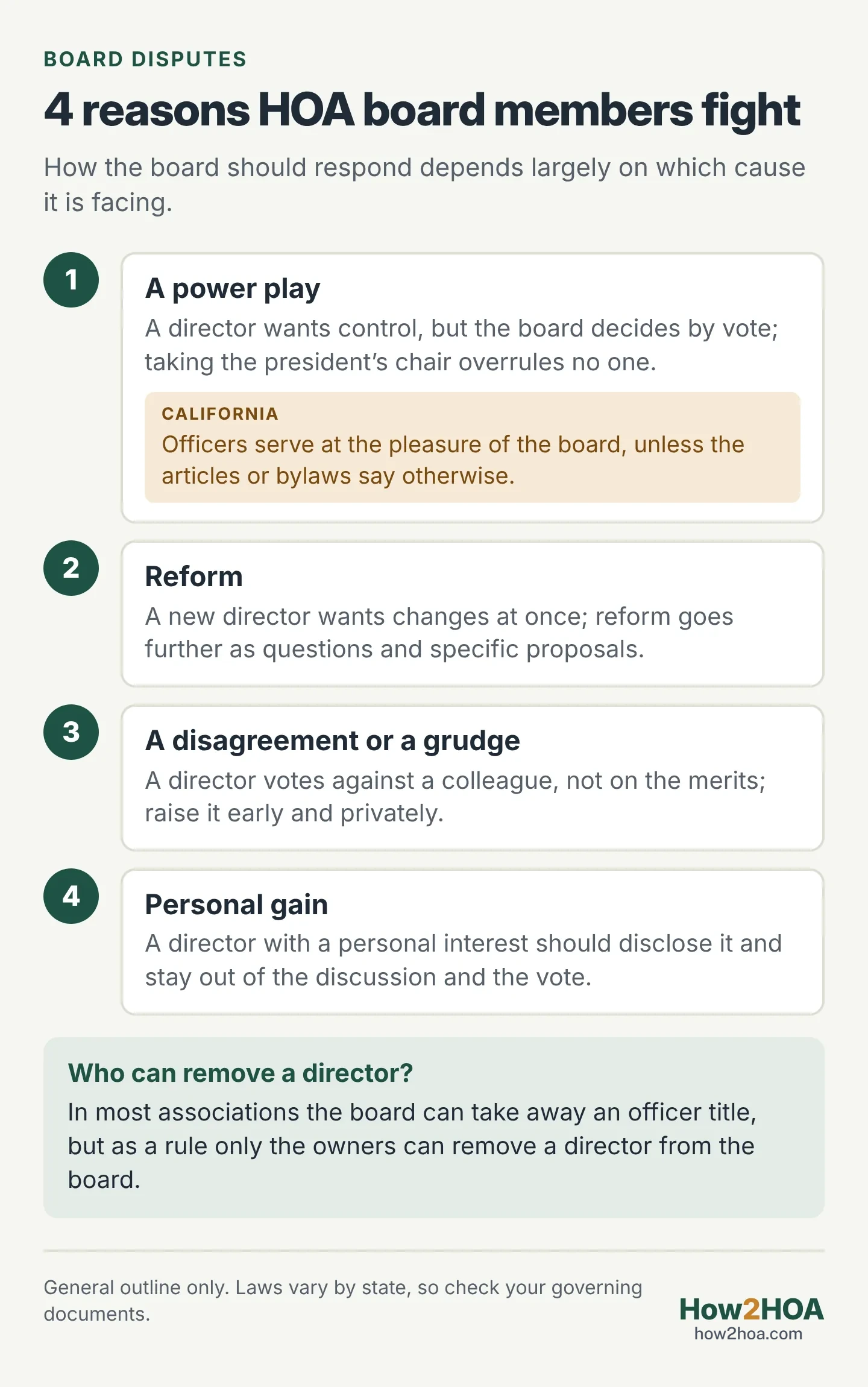
How the board should respond depends largely on which of these it is facing.
The Power Play
A director who starts a fight in order to take control of the board has misunderstood how a board works. The president chairs the meetings and has some administrative duties, but the president does not make the association’s decisions alone. The board does, by vote. Taking the president’s chair does not give anyone the power to overrule the majority.
Under most bylaws and state nonprofit corporation laws, the board chooses its officers and can replace them. That power should be used sparingly. Unless an officer has acted in bad faith, broken the law or stopped doing the job, turning officers out after every disagreement confuses owners and vendors and erodes the community’s trust in the board.
It also helps to be clear about what the board cannot do. In most associations, the board can take away an officer title but cannot remove a fellow director from the board. Directors are elected by the owners, and as a rule only the owners can remove them, through a recall vote or at the next election. Threatening to “vote someone off the board” is usually an empty threat, and it makes the conflict worse.
The Reformer
Arguments often break out right after an election. It is usually a mix of a new director’s enthusiasm and the longer-serving directors’ defensiveness. The new member arrives with ideas for improving how things are done. The existing members hear an attack on the way they have run the community for years.
A good rule for new directors is to spend the first several months learning. Read the governing documents, the minutes from the past year or two, the budget and the major contracts. Ask why things are done the way they are before proposing to change them. Vote on every item, and save your objections for the cases where you believe a decision breaks the governing documents or the law. Reform goes further when it comes as questions and specific proposals, not as accusations.
Experienced directors have a part to play too. A new member’s questions are not an insult, and “we have always done it this way” is not an answer. Give new directors the background they ask for and put their proposals on the agenda. Sometimes the new person is right.
Disagreements and Grudges
Most people join a board to serve their community. Sometimes a disagreement or a personal conflict gets in the way, and a director begins voting against a colleague instead of voting on the merits. A director who uses the position to punish someone has lost track of the duty every director owes to the association as a whole.
This is dangerous ground, because owners do not like a divided board. If they believe pettiness is taking up the board’s time and the association’s money, they can replace everyone at the next election. If you see a director consistently voting against another for personal reasons, raise it early and privately. Directors have to weigh what is best for the community even when they dislike the person making the proposal. Our article on managing conflict in HOA board meetings has techniques for keeping the discussion on the issue.
Personal Gain
Occasionally a director uses the board to advance a private agenda: steering a contract to a relative, blocking a needed assessment to save personal expense, or pressing for a rule change that benefits the director’s own property. This is the most serious kind of fight, because it goes to the duty of loyalty each director owes the association. Our article on an HOA board member’s responsibilities explains that duty.
The answer is procedure, not a shouting match. A director with a personal or financial interest in a decision should disclose it and stay out of the discussion and the vote, and the minutes should say so. If a director refuses, the rest of the board should ask the association’s attorney how to proceed. Owners who believe a board is acting for private benefit can take legal action, and a lawsuit costs the association money and the owners’ confidence whatever the outcome.
What to Do When HOA Board Members Fight
Knowing what the fight is about is the first step. These are the next ones.
Educate the Board About Procedure
Often a director who bickers over roles or tries to push out an officer does not understand how the board works. Review the board’s policies and procedures every year, ideally right after the election, so that everyone knows what each role involves. Ask the association’s attorney to explain the duties and limits of directors and officers. Agree on how disagreements will be handled: when an item can be reopened, how items get on the agenda, and how long debate runs.
A short board handbook helps. It should set out the duties of the board and its officers, the limits the law and the governing documents place on them, a code of conduct, and the board’s meeting procedures. Our companion article on the rules for an HOA board of directors is a starting point for what to include.
Bring In a Mediator
If two directors cannot work together without arguing, ask a neutral person to sit down with them privately. That could be a director who is not involved, the association’s attorney or a professional mediator. Do not attempt this in front of owners at an open meeting. A private conversation spares both people embarrassment and makes it easier for them to back down.
The mediator’s message is that both directors owe their first loyalty to the community and that the board cannot function unless they work together. If mediation fails, the board can ask one or both of them to consider stepping down for the good of the association. That is a request. The decision belongs to the director and, in the end, to the owners.
Call a Special Meeting if You Need To
If the conflict is stopping the board from doing its work, the board may need a meeting devoted to it. Check the bylaws and your state’s meeting law before you schedule one. They decide how the meeting must be noticed and whether any part of it can be closed to owners. Have the association’s attorney attend.
Tell the directors involved plainly that the behavior has to change, and explain what the board will do if it does not. The options usually include censure, removal from an officer position or a committee, and, where the owners ask for it, a recall vote. Do not announce the problem and vote on a consequence in the same meeting. Give people time to respond and to change course.
What if the Fight Is Over Illegal or Unethical Decisions?
Sometimes the conflict exists because some directors are doing something unlawful or unethical, and one director is objecting. If you are that director, you do not have to go along with it, and you do not have to resign. In general, these steps protect both you and the association:
- State your objection at the meeting, vote no, and ask that your vote be recorded in the minutes.
- Ask the board to get a written opinion from the association’s attorney. Remember that the attorney represents the association, not any individual director or faction.
- Do not take part in carrying out a decision you believe is unlawful.
- Keep copies of your written objections.
- If the board goes ahead anyway, talk to an attorney of your own about your options and your personal exposure.
Resigning is one of those options, but think it through. A director who resigns loses the vote, the seat at the table and access to information. Once off the board, you are free to speak as an owner, to raise the issue with other owners and to support a recall or new candidates. You should still keep confidential what you learned in closed sessions, and your attorney can tell you where that line is.
In an ordinary disagreement, the expectation is different. When you are outvoted on a lawful decision, the decision is the board’s, and campaigning against it in the community undermines the board you sit on. Make your case at the meeting, have your vote recorded, and accept the result.
In California
Several California statutes shape what a board can do about a feuding director.
- Officers serve at the pleasure of the board. Under Corporations Code section 7213, the board chooses the officers and they serve at the pleasure of the board, unless the articles or bylaws provide otherwise. A president who is replaced remains a director.
- Directors are removed by the members. Under Corporations Code section 7222, removing a director without cause requires approval of the members, and in an association with fewer than 50 members it requires a majority of all members. If your bylaws allow cumulative voting, section 7222 adds a further limit on removing an individual director, so check with the association’s attorney. Civil Code section 5100 requires the removal vote to be held by secret ballot. Under Corporations Code section 7221, the board itself may declare a director’s seat vacant only in narrow cases: a court order declaring the director of unsound mind, a felony conviction, missing the number of meetings stated in a bylaw that was in place when the director was elected, or failing to meet a qualification that was in effect at the start of the director’s term.
- Board business happens in noticed meetings. Under Civil Code section 4090, a board meeting is a gathering of enough directors to make a quorum to hear, discuss or deliberate on board business. Under Civil Code section 4910, the board may not act outside a meeting or conduct a meeting through a series of emails, except in an emergency with every director’s written consent. A private mediation between two directors is not a board meeting as long as those present are fewer than a quorum. On a three-member board, two directors are a quorum, so ask the association’s attorney how to set it up.
- Executive session is limited. Civil Code section 4935 lists the subjects the board may take up in executive session: litigation, the formation of contracts with third parties, member discipline, personnel matters, and assessment payment and foreclosure matters. A dispute between directors is not on the list by name, so ask the association’s attorney whether a closed session is permitted before you hold one.
- Conflicted directors may not vote. Civil Code section 5350 bars a director from voting on certain matters involving the director personally, such as the director’s own discipline or architectural application, and applies the Corporations Code rules on interested-director contracts.
- Every director can see the records. Under Corporations Code section 8334, each director has the absolute right at any reasonable time to inspect and copy all of the corporation’s books, records and documents. That right does not depend on being in the majority.
How to Keep Disagreements From Becoming Fights
Disagreement on a volunteer board is normal, and it is often useful. To keep it from turning into a feud, give every director time to debate before a vote, and give everyone the same information ahead of the meeting. Keep the argument about the issue and not the person. Once the vote is taken, treat the decision as the board’s decision.
Keep board disputes at the board table where you can. Owners who are unhappy with the board have a remedy at the next election, and our article on how to conduct effective HOA elections explains how that works. The board was elected to serve the community, and each director has to keep doing that even when the vote goes the other way. More articles for directors are in our HOA board member section.
The Law Behind This Article
Every legal point in this article comes from the official text. Each link below opens it in a new tab.
Civil Code sections: 4090 · 4910 · 4935 · 5100 · 5350
Corporations Code sections: 7213 · 7221 · 7222 · 8334
This article is general educational information, not legal advice. Laws vary by state and your association’s governing documents control many of these questions, so check with your association’s attorney or another qualified professional about your situation.