
A construction RFP (request for proposal) is how an HOA board gets comparable bids for a major project such as a reroof, a paving overlay, exterior painting or balcony repairs. A clear RFP puts every contractor on the same scope, makes the bids easy to compare and gives the board a record showing it made a careful decision. This guide walks through each step, with California rules marked separately from good practice.
If you are hiring a contractor for routine or smaller work, start with our guide on how to hire a contractor for your HOA. If you are choosing a management company rather than a builder, see how to write an HOA management RFP.
When a project needs a formal RFP
There is no single dollar amount that triggers an RFP. Many associations set their own threshold in a purchasing or vendor policy. As a good practice, use a formal RFP when a project:
- Costs enough to affect reserves or assessments. If the project draws down a reserve component or could lead to a special assessment, the board should be able to show how it chose the price.
- Involves building envelope or safety. Roofs, waterproofing, decks, balconies, structural repairs and fire systems carry the highest risk if done poorly.
- Takes more than a few weeks. Longer jobs need schedules, access plans and owner notices spelled out in advance.
- Needs design or engineering. If an architect or engineer must define the work, the RFP should be built on their specifications.
Step 1: Define the scope before you ask for prices
The most common RFP mistake is asking contractors to tell the board what to do. Each one will propose a different scope, and the bids will not be comparable.
For larger projects, hire a consultant first. Depending on the work, that could be an architect, a structural engineer, a roofing or waterproofing consultant or a paving engineer. The consultant inspects, writes specifications and often helps run the bidding and inspect the work. That fee usually pays for itself through tighter bids and fewer change orders.
A good scope of work includes:
- Exact locations and quantities. Buildings, square footage, linear feet and unit counts.
- Materials and standards. Product types, manufacturer requirements and the codes that apply.
- What is excluded. For example, dry rot found behind siding may be priced as a unit cost rather than included in the base bid.
- Unit prices for unknowns. Ask for a price per board foot of dry rot, per square foot of sheathing or per crack repaired. Unit prices control the cost of surprises.
Your reserve study is a useful starting point for timing and budget, but it is a planning estimate, not a specification.
Step 2: Write the RFP package
A complete construction RFP package typically covers:
- Project overview. The association, the property and the goal of the project.
- Scope of work and specifications. Attached in full, or the consultant’s documents.
- Bid form. A standard form with the same line items for every bidder, plus unit prices and alternates.
- Schedule. Bid walk date, question deadline, bid due date and the target start and completion dates.
- Contractor qualifications. License classification, years in business, similar projects and references from other associations.
- Insurance and bonding requirements. Usually set with the association’s insurance broker and attorney.
- Site rules. Work hours, parking, staging areas, dumpsters, restroom access and how owners will be notified.
- Contract terms. Attach the association’s form contract or state that the association’s attorney will review the final agreement.
Ask every bidder to submit on the same bid form. When one contractor adds alternates or leaves out items, bring the bids back to an equal scope before comparing them.
Step 3: Invite qualified bidders
Three bids is a common target, but three bids from contractors who are not qualified for the work do not help. Look for contractors who regularly work on community associations and projects of similar size.
California law to know before you invite anyone:
- Contractors must be licensed. A contractor working without a required license cannot sue to collect payment for that work, and a person who uses an unlicensed contractor can sue to recover what it paid (Business and Professions Code section 7031).
- License numbers belong on bids and contracts. A licensed contractor must include its license number on construction contracts, subcontracts, calls for bid and advertising (Business and Professions Code section 7030.5).
As a good practice, check each license on the Contractors State License Board website before the bid walk. Confirm the license is active, the classification fits the work and workers’ compensation coverage is on file.
Step 4: Hold a bid walk and answer questions in writing
A mandatory bid walk lets every bidder see the same conditions at the same time. Collect questions in writing and send the answers to all bidders as a written addendum. That keeps the process fair and keeps the scope the same for everyone.
Step 5: Compare bids on more than price
Build a side-by-side comparison, often called a bid leveling sheet. Line up:
- Base bid and alternates. Using the same scope for every bidder.
- Unit prices. These often matter more than the base price on older buildings.
- Schedule and crew size. A low price with a long schedule can cost more in disruption.
- Exclusions and assumptions. Read the fine print on every bid.
- Qualifications and references. Call references from other associations and ask about change orders and cleanup.
- Warranty. Both the contractor’s workmanship warranty and any manufacturer warranty.
If one bid is far below the others, find out why. It often means something was left out.
Step 6: Approve the contract in an open meeting
California boards generally cannot discuss or act on an item at a nonemergency meeting unless it is on the posted agenda (Civil Code section 4930). Put the contract award on the agenda and vote on it in open session. Review of the bids and negotiation details may be discussed in executive session when they involve contracts with third parties, but the decision itself is recorded in the minutes. See HOA executive session for what can be discussed in private.
Conflicts of interest matter here. California applies Corporations Code sections 7233 and 7234 to any contract the board approves (Civil Code section 5350), and a director may not vote on a proposed contract between the association and that director. As a good practice, ask each director to disclose any relationship with a bidder before the vote.
Step 7: Plan how the project will be paid for
Decide the funding before the contract is signed. The usual sources are reserves, a special assessment, a loan or a mix.
In California, the board cannot impose special assessments that together exceed 5 percent of the association’s budgeted gross expenses for the fiscal year without approval of a majority of a quorum of members (Civil Code section 5605). Our guides on special assessments and reserves, assessments or a loan cover the options in detail.
Step 8: Manage the job after the contract is signed
The RFP does not end with the signature. As a good practice:
- Hold a preconstruction meeting. Confirm the schedule, contacts, site rules and owner notices.
- Use written change orders only. No extra work without a signed change order that states the price and the reason.
- Tie payments to progress. Pay against completed and inspected work, and hold retention until the end of the job.
- Get lien releases. Collect conditional and unconditional lien releases from the contractor and major suppliers with each payment.
- Do a final walk and punch list. Close out only after the consultant confirms the work meets the specifications.
- Keep the records. Store the RFP, bids, contract, change orders, warranties and photos. They matter for future reserve studies and any later claim.
For ongoing contractor relationships, see managing outside vendors for your HOA. When the work is finished, our HOA Project Closeout Checklist covers the punch list, lien releases, warranties and final payment.

Share this infographic: Pinterest · Facebook · LinkedIn · Email · Download
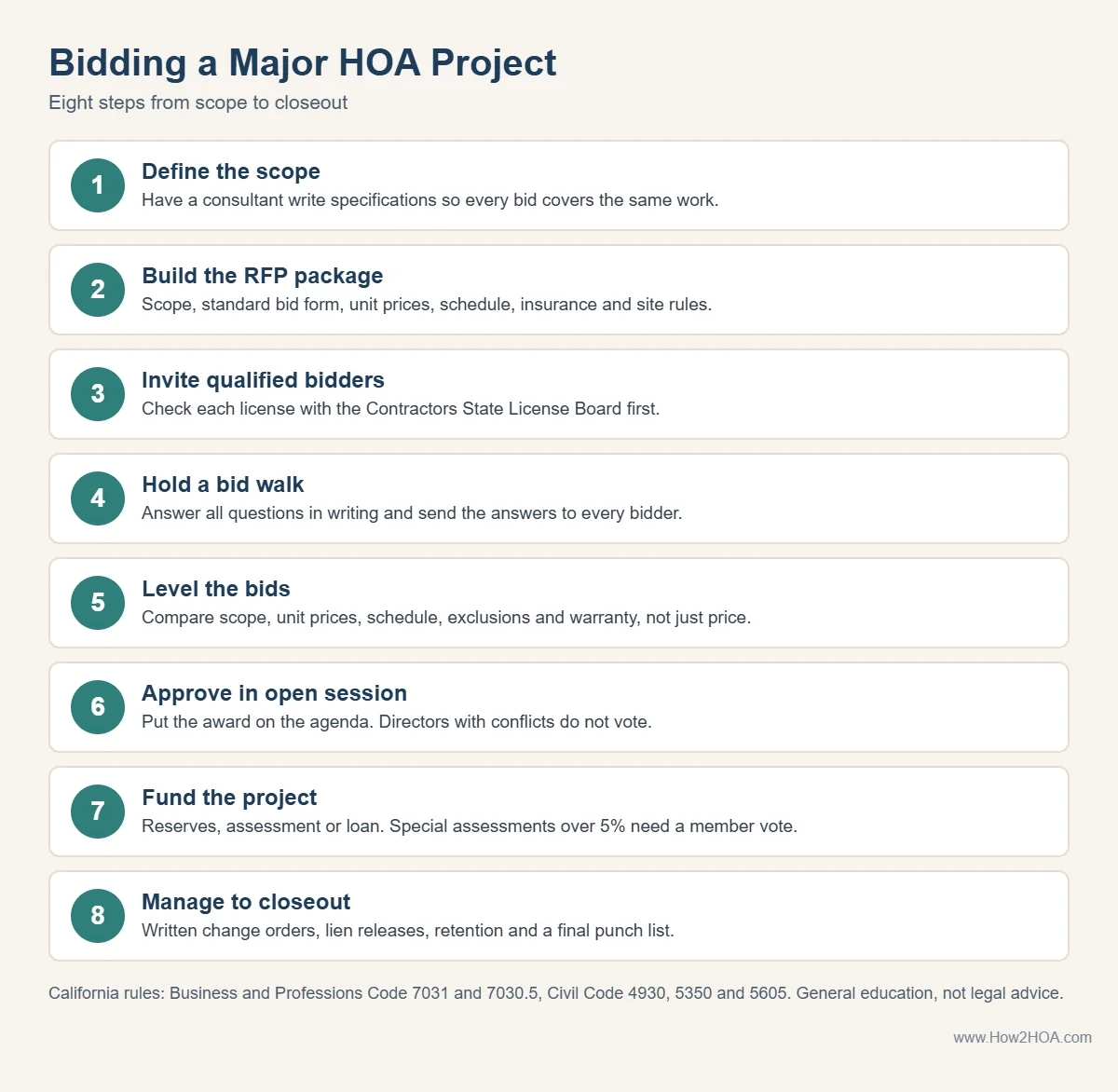
Quick checklist
- Scope written by a consultant for major work
- Standard bid form with unit prices
- Licenses checked before the bid walk
- Written answers sent to all bidders
- Bid leveling sheet reviewed by the board
- Conflicts disclosed before the vote
- Contract approved on the agenda in open session
- Funding decided before signing
- Change orders, lien releases and retention managed through closeout
Sources / The Law Behind This Page
- California Business and Professions Code section 7031 (unlicensed contractors)
- California Business and Professions Code section 7030.5 (license numbers on contracts and bids)
- California Civil Code section 4930 (agenda items)
- California Civil Code section 5350 (director conflicts)
- California Civil Code section 5605 (assessment limits)
- Contractors State License Board license check
This article is general educational information, not legal advice. Your governing documents and the details of your project matter, so check with your association’s attorney, insurance broker or another qualified professional before you sign a construction contract.
Last reviewed November 2026. By the How2HOA Editorial Team.