California HOA Guide

California HOA Reserves and Major Repairs

How California boards plan and pay for roofs, paving and other major components: the reserve study, the funding plan, the disclosures owners receive each year and the rules for spending or borrowing reserve money.

What the law requires

Reserve Studies, Funding Plans and Disclosures

Reserves are money set aside for the major components your association must repair or replace. California requires a study of what they will cost, a plan to pay for them and yearly disclosure to every owner.

California’s reserve planning rules are in Civil Code sections 5550 to 5580, with the yearly disclosures in section 5300.

If reserves fall short and the board turns to a special assessment, the free Dues and Special Assessment Calculator checks it against the 5 percent limit, and the Special Assessment Notice Letter template writes the notice to owners.

yle>.h2h-prose p{margin:0 0 1.25rem}.h2h-prose p:last-child{margin:0}.h2h-prose a{color:inherit;font-weight:600;text-decoration:underline;text-decoration-color:var(–h2h-accent);text-underline-offset:3px}.g-ccc86bc a,a.g-ccc86bc{color:inherit;text-decoration:none}.g-ccc86bc a:hover,a.g-ccc86bc:hover{text-decoration:underline}.h2h-prose ul{margin:0 0 1.25rem;padding-left:1.25rem}.h2h-prose ul:last-child{margin-bottom:0}.h2h-prose li{margin:0 0 .5rem}
  • The reserve study. At least once every three years, the board must have a reasonably competent and diligent visual inspection made of the accessible areas of the major components the association must repair, replace, restore or maintain, as part of a reserve study. This applies when the current replacement value of those components is at least half of the association’s gross budget, not counting the reserve account. The board must review the study, or have it reviewed, every year and make any needed adjustments to its reserve analysis.
  • What the study must contain. At a minimum, the study lists the major components with a remaining useful life of less than 30 years, the probable remaining life of each and what each will cost to repair or replace. It also estimates the total yearly contribution needed to cover those costs after subtracting the reserves already on hand, and it includes a reserve funding plan.
  • What counts as a major component. The law doesn’t list them, but it does say they include gas, water and electrical service lines to the extent the association is responsible for repairing or replacing them.
  • The reserve funding plan. The plan must show how the association will pay for repair and replacement of every major component with a remaining life of 30 years or less, except components the board has decided won’t be repaired or replaced. It must include a schedule of the date and amount of any change in regular or special assessments needed to fund it. The board adopts the plan at an open board meeting. If the plan calls for an assessment increase, the board approves that increase in a separate action that follows the assessment limits in section 5605.
  • Disclosure in the annual budget report. The budget report goes to members 30 to 90 days before the fiscal year ends. Among other things, it must include a summary of the reserves, a summary of the reserve funding plan with a notice that the full plan is available on request, a statement about any decision to defer or skip repair of a major component with 30 years or less of life left (and why), a statement about any special assessments the board expects to need, how the board will fund reserves and how reserve amounts were calculated. Any interest assumption on cash reserves can’t exceed 2 percent above the discount rate published by the Federal Reserve Bank of San Francisco.
  • The reserve summary. It must be in boldface, be based on the most recent study or review and count only cash or cash equivalents. It lists each major component’s replacement cost, remaining life and useful life; the cash reserves needed and the cash reserves actually set aside as of fiscal year end; the percentage funded; and the funding shortfall per unit.
  • The Assessment and Reserve Funding Disclosure Summary. This standard form goes out with every annual budget report. It answers whether projected reserves will be enough for the next 30 years, lists any additional assessments that would be needed and shows the percentage funded now and for each of the next five budget years, along with the interest and inflation rates assumed. The law sets the formula for the amount of reserves needed but says the board isn’t required to fund reserves to that amount.
  • Shared maintenance organizations. If a community service organization maintains components the association would otherwise be responsible for, it must give the association the information needed for these reserve disclosures.

What the law requires

Spending, Borrowing and Protecting Reserve Funds

Reserve money can be spent only on the major components it was set aside for, or on litigation about them. Borrowing it for anything else takes notice, a written finding and repayment within a year.

Sections 5500 to 5520 set the guardrails around reserve accounts, and sections 5605 and 5610 limit how fast assessments can rise to replenish them.

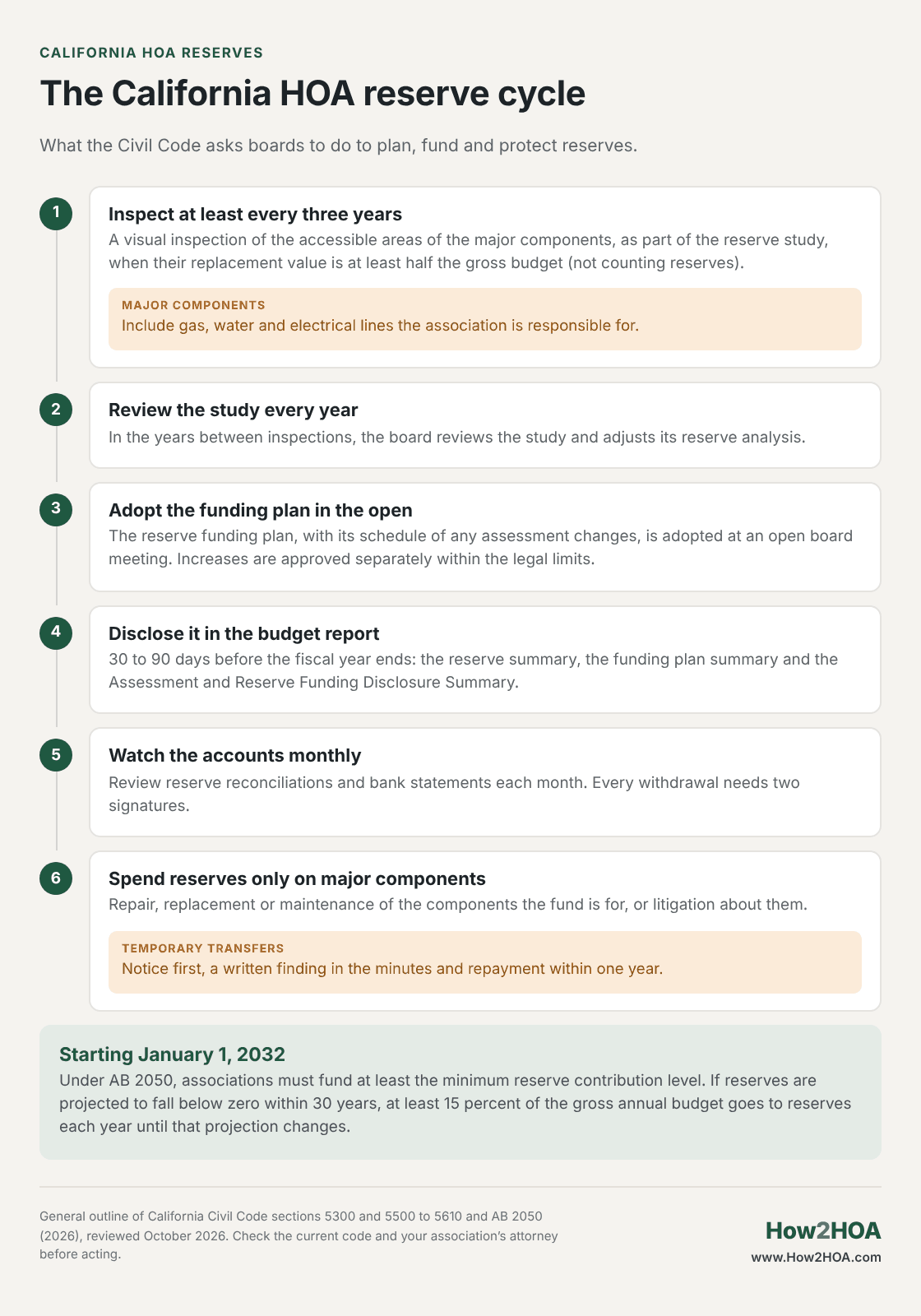
Monthly oversight. Unless your governing documents set a stricter standard, the board must review every month a current reconciliation of the reserve accounts, the latest statements from the banks holding them and an income and expense statement for the reserve and operating accounts.

Two signatures. Withdrawals from reserve accounts need the signatures of two directors, or of one director and one officer who isn’t a director.

Board approval for transfers. No transfer from the reserve or operating accounts may be made without the board’s prior written approval unless it is under a set limit. For associations with 50 or fewer separate interests, that limit is the lesser of $5,000 or 5 percent of estimated income in the operating budget. For 51 or more, it is the lesser of $10,000 or 5 percent.

What reserves can pay for. The board may spend reserve funds only on repair, restoration, replacement or maintenance of the major components the association is obligated to maintain and for which the reserve fund was set up, or on litigation involving them.

Temporary transfers to operating. The board may move reserve money to the operating account to meet short-term cash needs or other expenses, but only after giving notice in the board meeting notice that it intends to consider the transfer. The notice must explain why the transfer is needed, give some repayment options and say whether a special assessment may be considered. If the board approves, it must record a written finding in the minutes explaining the reasons and when and how the money will be repaid. The money must go back within one year. The board can delay repayment only after giving the same notice and making a documented finding that a delay is in the community’s best interests. If necessary, the board must levy a special assessment to restore the funds, subject to the limits in section 5605.

Reserves used for litigation. If the board decides to use reserve funds, or transfer them temporarily, to pay for litigation, the association must give general notice of that decision and of the availability of an accounting. Unless your documents require more, the association must prepare an accounting of litigation expenses at least quarterly and make it available for members to inspect at the association’s office.

Limits on raising assessments. Without approval from a majority of a quorum of members, the board can’t raise regular assessments more than 20 percent over the prior year or impose special assessments that total more than 5 percent of budgeted gross expenses for the year. Unless members approve, the board can raise regular assessments at all only if it distributed the required parts of the annual budget report. These limits don’t apply to increases for emergencies. An emergency is an extraordinary expense ordered by a court; one needed to address a threat to health or safety or another hazardous condition; or one the board could not reasonably have foreseen when it prepared the budget. For that last kind, the board must first pass a resolution with written findings and send it to members with the assessment notice.

Starting January 1, 2032. AB 2050 (Chapter 796, Statutes of 2026) adds minimum funding requirements. The reserve study must be reviewed and updated every year and must include the minimum reserve contribution level that keeps the projected reserve balance from falling below zero over the next 30 years. The association must fund reserves each year at no less than that level. If the study projects the balance will drop below zero at any point in the next 30 years, the association must transfer at least 15 percent of its gross annual budget to reserves each year until it no longer does. If the budget can’t cover the minimum, the association must levy a reserve funding special assessment under the same rules as other special assessments, with a member vote on any amount over the cap. That money goes into reserves, and this kind of assessment can be levied no more than once every nine years. Until 2032, the current reserve study rules stay in effect.

The reserve cycle

The California HOA Reserve Cycle at a Glance

Six steps of the California HOA reserve cycle: inspect the major components at least every three years, review the study every year, adopt the reserve funding plan at an open board meeting, disclose reserves in the annual budget report 30 to 90 days before the fiscal year ends, review the reserve accounts monthly with two signatures for withdrawals, and spend reserves only on major components, repaying any temporary transfer within one year. Starting January 1, 2032, associations must fund at least the minimum reserve contribution level.

Share this infographic: Pinterest · Facebook · LinkedIn · Email · Download

How to do it

Managing Your Reserves Step by Step

Tie the reserve study to your budget calendar. The study feeds the funding plan, and the funding plan feeds the budget report owners receive before the new fiscal year.

Use this yearly sequence to keep your reserve study, funding plan and disclosures on track.

  1. Check when the last site inspection happened. If it has been close to three years, schedule a full study with a visual inspection so it’s done before budget season.
  2. Confirm the component list. Make sure the study includes every major component the association must maintain, including any gas, water or electrical lines it is responsible for. If long-life components are left out of the calculation, the study must say so.
  3. Review the study every year. In years without a site inspection, have the study reviewed and adjusted for actual costs, completed projects and the current reserve balance.
  4. Adopt the reserve funding plan at an open meeting. Put it on the agenda, discuss it in front of members and adopt it. Approve any assessment increase it calls for as a separate vote within the section 5605 limits.
  5. Build the reserve disclosures into the budget report. Include the reserve summary, the funding plan summary, the Assessment and Reserve Funding Disclosure Summary and the statements on deferred repairs, expected special assessments and funding methods. Send it 30 to 90 days before the fiscal year ends.
  6. Review the reserve accounts every month. Look at the reconciliation, the bank statements and the income and expense statement at each board meeting or as a monthly review.
  7. Control withdrawals and transfers. Require two signatures on every reserve withdrawal and written board approval for any transfer over the statutory limit.
  8. Follow the borrowing rules if you need a temporary transfer. List it in the meeting notice with the reasons and repayment options, record a written finding and repay within one year.
  9. Plan for 2032 now. Ask your reserve study provider to show the minimum reserve contribution level and whether your balance is projected to fall below zero in the next 30 years.

Common mistakes

Where Reserve Planning Goes Wrong

Underfunded reserves usually show up later as a large special assessment, a loan or repairs that are put off until they cost more.

These are the problems that most often get California associations into trouble with reserves.

  • Letting the study go stale. Going more than three years without a site inspection, or skipping the annual review in between.
  • Covering operating shortfalls with reserves. Using reserve money for routine expenses without following the temporary transfer rules, or not paying it back within a year.
  • Withdrawing with one signature. Every reserve withdrawal needs two authorized signers.
  • Leaving components out. Forgetting utility lines the association is responsible for, or dropping long-life components without disclosing it in the study and the disclosure summary.
  • Deferring repairs quietly. The budget report must say when the board decides to defer or skip a repair to a major component and explain why.
  • Adopting the funding plan behind closed doors. The plan must be adopted at an open board meeting.
  • Raising assessments past the limits. Increasing regular assessments more than 20 percent, or special assessments past 5 percent of budgeted gross expenses, without a member vote, unless the increase qualifies as an emergency.
  • Assuming too much interest. The budget report’s reserve calculations can’t assume a return on cash above 2 percent over the San Francisco Federal Reserve discount rate.

Best practice, not a legal requirement

Habits That Keep Reserves Healthy

Everything in this section is a recommendation. None of it is required by California law.

The law sets the floor. These habits help boards avoid surprises and explain reserves to owners.

  • Use an experienced reserve study provider. Ask about their experience with communities like yours and credentials such as the Reserve Specialist designation.
  • Update the study early after big changes. A major project, a new amenity or a sharp jump in construction costs is a good reason for a fresh look before the three-year mark.
  • Prefer steady increases to big jumps. Small yearly increases are easier on owners than a large special assessment later.
  • Link maintenance to the study. Good preventive maintenance can stretch a component’s life, which changes the numbers in the study.
  • Explain reserves in plain language. Give owners a short summary of what the study found and what the board plans to do.
  • Adopt a written reserve investment policy. Decide in advance where reserve money is held and how safety and access are balanced.
  • Get bids early for big projects. Starting a year ahead gives the board time to compare contractors and schedule the work.

2 guides

Reserve Studies

Understanding HOA Reserve Studies

A reserve study tells your board what the major components will cost and how much to save. Here is how to read the key numbers and use them in the budget.

What Is a Reserve Specialist in an HOA?

A reserve specialist prepares the reserve study that tells an HOA what its major components will cost to replace and how much to save each year.

5 guides

Paying for Major Repairs

Paying for a Major HOA Repair: Reserves, Assessment or Loan?

A decision guide for boards comparing reserves, a special assessment and an HOA bank loan for a major repair, with the California rules.

California HOA Annual Disclosure Calendar

A deadline-by-deadline calendar of what a California HOA must send owners each year, from the Annual Budget Report to reviews and filings.

HOA Special Assessments in California: Limits and Votes

California boards can levy special assessments up to 5 percent of budgeted gross expenses without a member vote. The limits and alternatives.

How Much Can an HOA Raise Dues in California?

A California HOA board can raise dues up to 20 percent a year without a member vote if it sent the annual budget report. Here is how the limit works.

SB 326 Balcony Inspections: What Condo Boards Must Do

What SB 326 (Civil Code 5551) requires of California condo associations: covered balconies, who may inspect, the report, deadlines and paying for repairs.

Sources

The Law Behind This Page

Every legal point on this page comes from the official text. Each link below opens it on the California Legislature’s website in a new tab.

Civil Code sections: 5300 · 5500 · 5502 · 5510 · 5515 · 5520 · 5550 · 5560 · 5565 · 5570 · 5580 · 5605 · 5610

Bills: AB 2050 (Chapter 796, Statutes of 2026)

Keep going

Related Topics

California HOA Guide

Every California topic guide in one place.

Board Meetings

Notice, agendas, executive session and minutes.

Finances and Accounting

Budgets, reserves and collections in any state.

Management

Working with a management company.

Local Guides by City

City and neighborhood guides, county by county.

Get help

Want Help Managing Your Reserves?

A professional management company can schedule reserve study updates, review the reserve accounts every month and prepare the disclosures that go out with your budget.

Last reviewed October 21, 2026. By the How2HOA Editorial Team. This page is general educational information, not legal or financial advice. Laws change and your association’s governing documents control many of these questions, so check with your association’s attorney and reserve study provider about your situation.

Share this: