California HOA Maintenance and Repair Responsibilities

When a pipe bursts at 2 a.m., the first question is always the same: who fixes this? California has default answers, and your governing documents can change them. Here’s how to sort it out before the next leak. The legal fine print is at the bottom for when you need it.

The short version

Five Maintenance Rules Every Board Should Know

Your declaration comes first. State law fills the gaps.

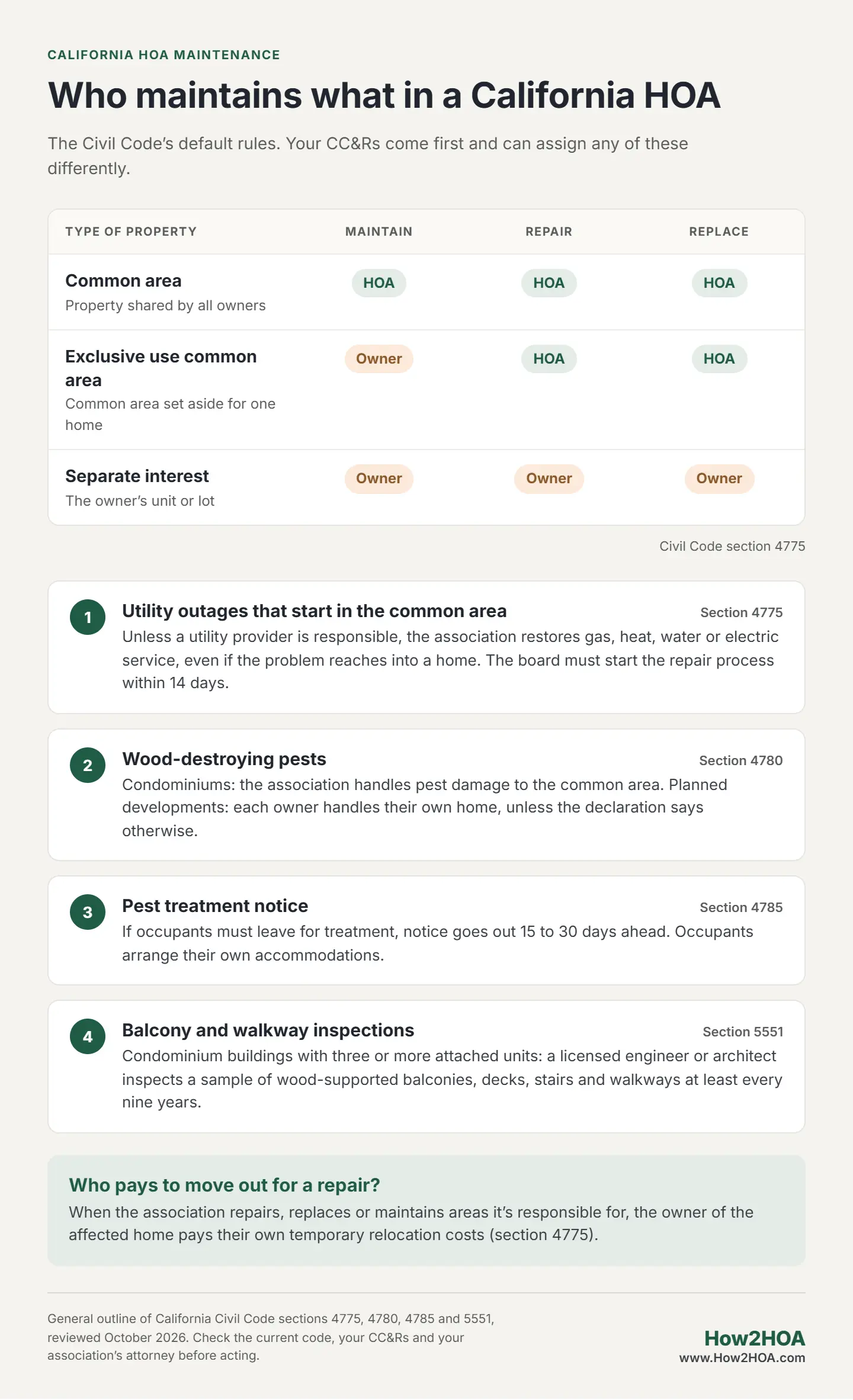
  1. The default split. The association handles the common area and owners handle their own homes. For exclusive use areas, meaning common area set aside for one home such as a balcony, the owner maintains and the association repairs and replaces, unless your declaration says otherwise.
  2. 14 days for utility outages. When gas, heat, water or electric service fails because of a problem starting in the common area, the board starts the repair process within 14 days.
  3. Balcony inspections. Condo buildings with three or more attached units need a licensed engineer or architect to inspect a sample of elevated decks and walkways at least every nine years.
  4. Danger means closed. If the inspector flags an immediate threat, keep people off until the local agency approves the repair.
  5. Pest treatment notice. Occupants get 15 to 30 days’ notice before a temporary move for treatment.

Who handles what

California HOA Maintenance at a Glance

Infographic: who maintains what in a California HOA

Share this infographic: Pinterest · Facebook · LinkedIn · Email · Download

Free tools

Free Tools for This Topic

Put who fixes what in writing before something breaks.

How to do it

Building a Maintenance Routine

Write down who handles each component before something breaks. Deciding in the middle of a leak is when disputes start.

A written plan turns the Civil Code defaults and your CC&Rs into a routine the whole board can follow.

  1. Read the declaration first. The declaration is your CC&Rs. Find its maintenance sections and the condominium plan or map, and note every place they change the state’s default split.
  2. Build a responsibility chart. List each component and who maintains, repairs and replaces it. Have the association’s attorney review it, then share it with owners. Our maintenance responsibility matrix is a starting point. This is good practice, not a legal requirement.
  3. Check the balcony rule. Confirm whether the balcony inspection law applies. It covers condo buildings with three or more attached units. If it does and no inspection is on file, hire a licensed engineer or architect now and calendar the next one.
  4. Plan for utility outages. Decide who calls the plumber or electrician, how the board will meet or vote by email, and how to start repairs within 14 days.
  5. Decide how pest control works. Use a licensed operator, or give the 48-hour written notice if the association applies pesticides itself. Send fumigation notices 15 to 30 days ahead.
  6. Use written contracts. Require licensed, insured vendors and a signed scope before work starts. See How to Hire a Contractor.
  7. Fund it. Make sure components the association repairs or replaces are in the reserve study.
  8. Tell owners what they maintain. Send a reminder each year with the chart. This is good practice.
  9. Keep the paperwork. File inspection reports, work orders, invoices and photos. Keep balcony reports for two inspection cycles. Track repairs with our free maintenance request form, work order and log.

Board checklist

  • ☐ We know where our declaration changes the state’s default split.
  • ☐ We have a written chart of who maintains, repairs and replaces each component.
  • ☐ We know whether the balcony inspection law applies, and our inspection is current.
  • ☐ Our next balcony inspection is on the calendar, and we keep reports for two cycles.
  • ☐ Elements flagged as an immediate threat are closed until the local agency approves repairs.
  • ☐ We can start utility repairs within 14 days, including by email vote if needed.
  • ☐ Pest relocation notices go out 15 to 30 days ahead with every required item.
  • ☐ Any pesticide we apply ourselves gets the 48-hour written notice, and a copy goes in the minutes.
  • ☐ Vendors are licensed and insured and work under written contracts.
  • ☐ Components the association repairs or replaces are in the reserve study.

In real life

What This Looks Like on a Real Board

Five everyday situations, and the right move in each one.

These are illustrations, not stories about a real community.

The balcony deck that rotted

An owner reports soft, rotted boards on her balcony and asks who pays. The balcony is exclusive use common area, meaning common area set aside for her home. Under the default rule she keeps it maintained, and the association repairs or replaces the rotted boards. Check your declaration first, because it can split the job differently.

The no-heat weekend

A gas line in the common area fails and twelve homes lose heat. The board has 14 days to start the repair process. If it can’t get a quorum together, the directors at the next properly noticed meeting count as a quorum for that vote, and directors can also vote on these repairs by email.

Tenting the building

Termites turn up in a condo building’s common area. The association handles the treatment and can move residents out temporarily. Notice goes out 15 to 30 days ahead, explaining why, when treatment starts and ends and that occupants arrange their own places to stay.

The handyman with a spray bottle

The association’s handyman wants to spray for ants around the buildings. Without a licensed pest control operator, the association gives written notice at least 48 hours ahead to affected owners and tenants, posts it for common areas where practicable and attaches a copy to the next board meeting’s minutes.

The inspector’s red flag

The balcony inspector finds a walkway that poses an immediate threat. The association has to act right away, including keeping people off it until the local enforcement agency inspects and approves the repair.

Common mistakes

Where Boards Slip Up

Most maintenance disputes start with the wrong answer to one question: who is responsible for this?

These are the maintenance mistakes that cost California associations the most time and money.

  • Quoting the statute when the CC&Rs say otherwise. The state’s split is a default. Your declaration controls where it’s different.
  • Mixing up maintain and repair. For exclusive use common area, the default makes the owner maintain it and the association repair and replace it.
  • Waiting on a utility outage. The board has 14 days to start the repair process, and it can use a reduced quorum or an email vote to get there.
  • Assuming the balcony deadline moved. The law still sets January 1, 2025 for the first condominium inspection.
  • Hiring the wrong inspector. The balcony inspection must be done by a licensed structural or civil engineer or architect.
  • Leaving a dangerous balcony open. After an immediate-threat finding, the association must keep occupants off it until repairs are approved.
  • Short-noticing a fumigation. Relocation notices must go out at least 15 days, and no more than 30 days, before the move.
  • Promising to pay for hotel stays. Under the defaults, owners and occupants cover their own relocation.

Best practice, not a legal requirement

Habits That Prevent Big Repairs

These habits catch small problems before they turn into special assessments.

  • Walk the property on a schedule. A seasonal walk-through with photos catches drainage, roofing and paving problems early.
  • Fix water problems fast. Small leaks become rot, mold and insurance claims. Treat them as urgent.
  • Track every request. Log each work order with its date, who handled it and when it closed, and answer owners in writing.
  • Keep a component record. Note install dates, warranties and vendors for roofs, paving, decks and building systems.
  • Bid big jobs. Get at least three written bids and check licenses and insurance. See Managing Outside Vendors.
  • Plan for wildfire where it applies. Foothill communities should build defensible space work into the yearly plan.

4 guides

Who Fixes and Who Pays

Who Pays for Repairs in an HOA?

Who pays for repairs in an HOA depends on who the governing documents make responsible. How to find the answer and the typical split.

Exclusive Use Common Area Explained

Exclusive use common area is common area reserved for one owner, like a balcony or parking space. Here is who maintains, repairs and replaces it.

Water Leaks in Condos: Who Pays for the Damage?

Who fixes the source of a condo water leak, who repairs the damage and whose insurance pays, plus the California default rules.

SB 326 Balcony Inspections: What Condo Boards Must Do

What SB 326 (Civil Code 5551) requires of California condo associations: covered balconies, who may inspect, the report, deadlines and paying for repairs.

4 guides

Vendors and Contractors

How to Hire a Contractor for Your Homeowners Association

How to hire a contractor for your HOA: write the scope, compare three written bids, verify license and insurance, and sign a reviewed contract.

Managing Outside Vendors for Your HOA

Managing HOA vendors comes down to one point of contact, clear expectations, a performance record, on-time payment and a plan for problems.

How to Manage Electricians for a Homeowners Association

An HOA electrical contractor should be licensed, insured and under a written contract that sets response times. How boards can compare companies.

How to Set Up a Towing Service in Your Homeowners Association

Setting up HOA towing: confirm your authority, adopt a written policy, post proper signs and contract with a licensed tow company.

5 guides

Grounds, Paving and Safety

Pavement and Asphalt Management for Homeowners Associations

HOA asphalt maintenance works best as a written plan: fill cracks early, seal on schedule, keep striping visible and fund resurfacing in reserves.

HOA Concrete Repair and Maintenance

HOA concrete maintenance means inspecting walkways, patios and pool decks, fixing small cracks early and knowing who is responsible for each surface.

Wildfire Defensible Space for Foothill HOAs

What California defensible space law requires of HOAs and owners, where the Zone 0 rule stands, and local rules in Placer County and Folsom.

Sacramento-Area Watering Rules and HOA Landscaping

California’s 2029 ban on watering decorative HOA turf, Civil Code 4735 limits on HOA rules, and Sacramento-area watering schedules and rebates.

Five Ways to Improve Your HOA Curb Appeal

HOA curb appeal improves when the board plans ahead, involves residents, picks low-maintenance landscaping and keeps common areas clean.

The legal details

Who Maintains, Repairs and Replaces What

Your declaration comes first. The Civil Code’s maintenance rules apply only where your CC&Rs don’t say otherwise.

California sets default rules for the three kinds of property in a common interest development, and adds a deadline for restoring essential utilities.

Unless the declaration provides otherwise, section 4775 splits the work this way:

  • Common area. The association repairs, replaces and maintains it.
  • Exclusive use common area. For the parts of the common area set aside for one home, the owner maintains them and the association repairs and replaces them. See Exclusive Use Common Area Explained.
  • Separate interest. Each owner repairs, replaces and maintains their own unit or lot.
  • Moving out for a repair. When the association repairs, replaces or maintains areas it’s responsible for, the owner of the affected home pays the cost of any temporary relocation.

Utility outages. Unless the declaration says otherwise, or a utility company is responsible for the part that failed, the association must make the repairs and replacements needed to restore gas, heat, water or electric service that begins in the common area, even if the problem extends into a home or its exclusive use common area. Starting January 1, 2027, AB 1892 rewords this so the duty applies when the interruption in service begins in the common area. The rules that come with that duty:

  • 14 days to start. The board must begin the repair process within 14 days of the interruption.
  • Financing. If reserves can’t cover it, the association may get competitive financing from a financial institution without a member vote and levy an emergency assessment to repay the loan. First the board must pass a resolution with written findings about the expense and why reserves don’t cover it, and send that resolution with the notice of the emergency assessment.
  • Quorum and email votes. If the board can’t reach a quorum within 14 days, at the next properly noticed meeting the directors present count as a quorum for the vote to start repairs, and the notice must say so. Directors may also vote on these repairs by email, and those votes become association records.
  • Disasters. These utility rules don’t apply when a declared federal, state or local emergency materially affects the association’s ability to carry them out.

Nothing in section 4775 makes an individual director personally liable.

The legal details

Balconies, Pests and Other Safety Duties

If an inspector flags an immediate threat, the association must act immediately, including keeping people off the balcony until the local agency approves the repair.

A few maintenance jobs come with their own deadlines, licenses and notices.

Balcony and elevated walkway inspections. In a condominium project, for buildings with three or more attached multifamily units, the board must have a licensed structural or civil engineer or architect visually inspect a random, statistically significant sample of the exterior elevated elements the association maintains or repairs at least once every nine years. These are wood-supported decks, balconies, stairways and walkways, and their railings, with a walking surface more than six feet above the ground (section 5551).

  • Deadlines. The first inspection was due by January 1, 2025, then every nine years with the reserve study inspection. For a building whose permit application was submitted on or after January 1, 2020, the inspection is due within six years of the certificate of occupancy.
  • The report. The inspector stamps or signs a written report, presents it to the board and it becomes part of the reserve study. Since January 1, 2026, it must also list the inspection date, unit and element counts, how many elements were inspected, how many pose an immediate threat and how many units that affects, and certify that a statistically significant sample was evaluated.
  • Records and resale. Reports are kept for two inspection cycles and owners can inspect them. A seller must give a buyer the most recent report (section 4525).
  • Immediate threats. The inspector sends the report to the association right away and to local code enforcement within 15 days. The association must take preventive measures immediately, including keeping occupants off the element until the local enforcement agency has inspected and approved the repairs.

Our SB 326 balcony inspection guide walks through the process.

Wood-destroying pests. In a condominium, community apartment project or stock cooperative, the association repairs and maintains common area damage from termites and other wood-destroying pests or organisms, unless the declaration says otherwise. In a planned development, each owner handles their own separate interest unless the declaration sets up a different scheme. A majority of all members can vote to hand that job to the association, which can then recover the cost as a special assessment (section 4780).

Moving people out for pest treatment. The association may temporarily remove occupants when needed for prompt, effective treatment. Notice must go to occupants and owners 15 to 30 days before the move, stating why, when treatment starts and is expected to end, and that occupants arrange their own accommodations (section 4785).

Applying pesticides without a licensed operator. If the association or its agent applies a pesticide itself rather than using a licensed pest control operator, it must give a written notice with the specific information and warning statement the law requires. The notice goes to affected owners and tenants at least 48 hours before treating a home, and is posted where practicable at least 48 hours before treating the common area. A copy is attached to the minutes of the next board meeting (section 4777).

Sources

The Law Behind This Page

Every legal point on this page comes from the official text. Each link below opens it on the California Legislature’s website in a new tab.

Civil Code sections: 4525 · 4775 · 4777 · 4780 · 4785 · 5551

Bills: AB 1892

Keep going

Related Topics

California HOA Guide

Every California topic guide in one place.

Insurance

What California associations must carry and disclose.

Reserves and Major Repairs

Reserve studies and paying for big projects.

Maintenance and Vendors

Upkeep and vendor management in any state.

Local Guides by City

City and neighborhood guides, county by county.

Get help

Want Help Keeping Up With Maintenance?

A professional management company can schedule inspections, manage vendors and track repair requests, so the board can focus on decisions.

Last reviewed October 21, 2026. Civil Code sections cited: 4525, 4775, 4777, 4780, 4785 and 5551, plus AB 1892 (2026). By the How2HOA Editorial Team. This page is general educational information, not legal advice. Laws change and your association’s governing documents control many of these questions, so check with your association’s attorney about your situation.

Share this: