Buying, Selling and Renting in a California HOA

When a home sells, the escrow company handling the sale wants the association’s paperwork fast, and California sets the clock, the pricing rules and what can’t be held back. Rentals have limits of their own. Here’s how to handle both. The legal fine print is at the bottom for when you need it.

The short version

Five Rules for Sales and Rentals

Treat every resale request like a deadline, because it is one.

  1. 10 days to deliver. Requested documents go out within 10 days of the request.
  2. Nothing held hostage. Delivery can’t be held back for anything except the document fee.
  3. Fees at actual cost. Itemized, billed separately, no bundling, and electronic copies cost no more than paper.
  4. No transfer fees. Beyond the document fees, the association can charge only its actual cost to update its records.
  5. Rentals can’t be banned. Caps can’t go below 25 percent of the homes, but rentals of 30 days or less can be prohibited.

Resale steps

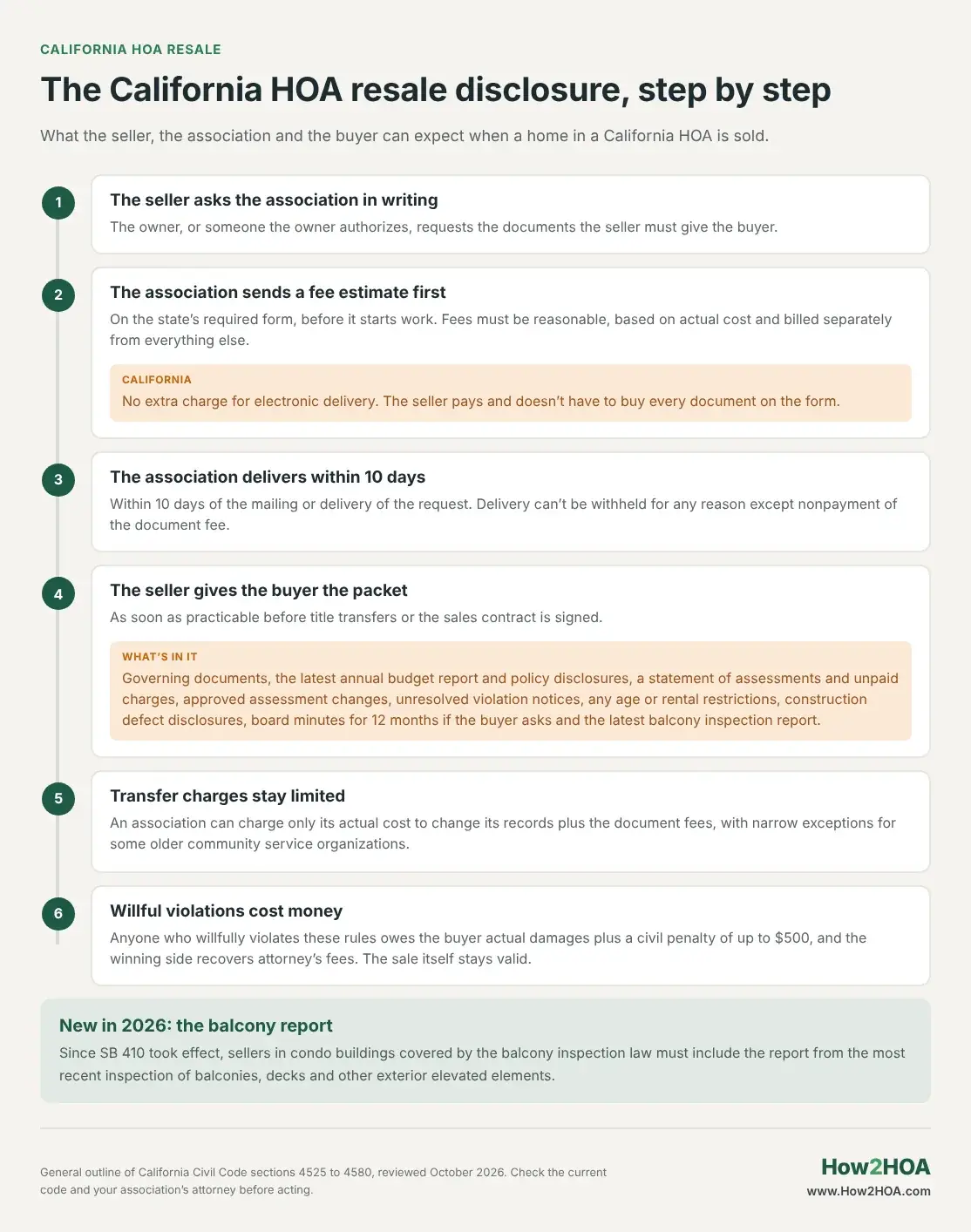
How a Resale Disclosure Works

Infographic: 6 steps of a California HOA resale disclosure

Share this infographic: Pinterest · Facebook · LinkedIn · Email · Download

Free tools

Free Tools for This Topic

Start new owners off with the right paperwork.

How to do it

Handling Resale Requests and Rentals

Name one person, keep the packet ready and bill it cleanly.

A short routine keeps the association inside the law and keeps escrow moving.

  1. Name who handles requests. Choose a board member, staff person or management company, and publish how owners and escrow officers can order documents. This is good practice, not a legal requirement.
  2. Keep the packet current and digital. The law lets the association keep the documents electronically and post them online, which makes the 10-day deadline easy to meet.
  3. Send the fee estimate first, on the form the law sets out, before any work starts.
  4. Calendar 10 days from the mailing or delivery of each request.
  5. Pull the account statement: current assessments and fees, anything unpaid on the home and any approved changes that aren’t due yet.
  6. Gather the rest: unresolved violation notices, any defect disclosures and, for condo buildings covered by the balcony inspection law (three or more attached units), the latest balcony inspection report.
  7. Bill it cleanly. Itemize each document’s fee, bill document fees separately, don’t bundle extra documents and don’t charge more for electronic delivery.
  8. Limit transfer charges to the actual cost of changing the association’s records.
  9. Update records after closing and welcome the new owner. The welcome is good practice, not a legal requirement.
  10. Check rental rules once a year against the state’s rental limits, and keep a list of owners with grandfathered rental rights (owners who bought before a rental ban was adopted).

Board checklist

  • ☐ We send a fee estimate on the required form before processing a request.
  • ☐ Requested documents go out within 10 days of the request.
  • ☐ We never hold documents back for anything but the document fee.
  • ☐ Document fees reflect actual cost, are itemized and billed separately and aren’t bundled with other charges.
  • ☐ Electronic delivery costs no more than paper.
  • ☐ For covered condo buildings, our packet includes the latest balcony inspection report.
  • ☐ Transfer charges are limited to our actual cost to change our records.
  • ☐ Canceled orders get the refunds the law requires.
  • ☐ Our documents don’t ban rentals or cap them below 25 percent.
  • ☐ We know which owners have grandfathered rental rights.

In real life

What This Looks Like on a Real Board

Five everyday situations, and the right move in each one.

These are illustrations, not stories about a real community.

The seller who’s behind on dues

A seller owes $900 in past-due assessments, and the board wants to hold the resale documents until it’s paid. It can’t. The documents go out on time, and the association’s statement in the packet shows what’s owed.

The $150 transfer fee

At closing, the escrow officer asks why the association’s bill includes a $150 “transfer fee” on top of the document fees. There’s no good answer. Beyond the document fees, the association can charge only its actual cost to change its records.

The 10-home rental cap

A 120-home community’s CC&Rs cap rentals at 10 homes. That’s under 10 percent, and California won’t enforce a cap below 25 percent, which here means at least 30 homes. A home doesn’t count as rented if the owner lives in it or in its accessory unit.

The owner who bought before the rule

An owner bought in 2018. In 2024 the association adopts a ban on rentals of 30 days or less. That ban doesn’t apply to this owner, because it came after they acquired title. Before renting under that protection, the owner gives the association proof of the purchase date and the tenant’s contact information.

The missing balcony report

A condo in a covered building goes on the market. Since January 1, 2026, the packet the seller hands the buyer has to include the latest balcony and elevated walkway inspection report.

Common mistakes

Where Boards Slip Up

Most of these mistakes delay a sale or expose the association to damages and penalties.

These are the resale and rental errors we see most often in California associations.

  • Holding the packet until a past-due account is paid. Delivery can’t be withheld for anything except the document fee.
  • Adding a transfer or processing fee. Beyond the document fees, the association can charge only its actual cost to change its records.
  • Charging extra for electronic delivery or bundling documents. Both are prohibited.
  • Missing the 10-day deadline. It runs from the mailing or delivery of the request, not from when the board gets around to it.
  • Leaving out the balcony report. Since January 1, 2026, sellers in covered condo buildings must include the latest inspection report.
  • Enforcing an old rental ban or a cap below 25 percent. Neither is enforceable, and willful violations carry a civil penalty of up to $1,000.
  • Counting an owner-occupied home as a rental. A home doesn’t count toward the cap if the owner lives in it or in its accessory unit.
  • Forgetting grandfathered owners. A rental prohibition adopted after an owner bought doesn’t apply to that owner.

Best practice, not a legal requirement

Habits That Make Sales Go Smoothly

These habits keep escrow on schedule and help new owners start off well.

  • Publish a resale page. One page explaining how to order documents, what they cost and how long they take saves calls and missed deadlines.
  • Post your fee schedule. Showing the fees up front heads off disputes at closing.
  • Review fees every year. Make sure they still match the association’s actual cost.
  • Encourage sellers to order early. Ordering documents when the home is listed leaves time to answer buyer questions.
  • Give new owners a welcome packet. A short summary of the rules, assessment due dates and who to contact helps buyers settle in. Boards can welcome new owners with our free HOA welcome letter template. Buyers can start with what to look for in HOA documents.
  • Keep rental rules simple. Clear lease and contact rules that apply to every owner are easier to enforce than complicated ones.

3 guides

Buying in an HOA

Buying a House in an HOA? Here’s What You Need to Know

Buying a house in an HOA makes you a member with dues to pay and rules to follow. Here is what to expect, what to ask and how to weigh the trade-offs.

What Everyone Should Know About Buying a Home With an HOA

Before buying a home with an HOA, read its documents. Which ones to request and what to look for in the budget, reserves, rules and minutes.

Your Mortgage and the HOA: What Lenders Look At

Lenders count HOA dues when you qualify and review the association when you buy a condo. How dues and assessments affect your mortgage.

2 guides

Selling in an HOA

How to Sell a House in an HOA

Selling in an HOA adds a few steps to a normal sale: resale documents, a settled account and association fees at closing. Here is how to handle each one.

Benefits of Selling a Home With an HOA

An HOA gives a seller a maintained neighborhood, shared amenities and documented finances to show buyers. How to use them and answer objections.

3 guides

Renting in an HOA

Renting Out Your Home in a Homeowners Association

Most HOAs let you rent out your home, but caps, owner-occupancy periods and lease rules may apply. What to check, including California’s limits.

How to Handle Short-Term Rentals in Your Community

Short-term rentals bring parking, noise and enforcement problems. A board’s options, from minimum rental terms to registration and fines.

Short-Term Rental Rules by City: Sacramento to San Jose

Permit, residency, day-cap and tax rules for short-term rentals from Sacramento to San Jose and how they stack with HOA rules.

The legal details

What Sellers Must Give Buyers

The seller has to give the buyer the association’s documents as soon as practicable before title transfers (section 4525).

California puts the disclosure duty on the seller, but most of the paperwork comes from the association.

An owner selling a home in a California HOA must give the prospective buyer these items as soon as practicable before title transfers or a real property sales contract is signed (section 4525):

  • a copy of all the governing documents, plus a written statement from the association if it isn’t incorporated
  • if the documents limit occupancy or use by age in a way that differs from Civil Code section 51.3, a statement that the restriction is enforceable only as far as that section allows (see 55+ community rules in California)
  • the most recent documents the association distributed under the annual disclosure rules, such as the annual budget report and annual policy statement
  • a written statement from an authorized association representative showing the current regular and special assessments and fees, any unpaid assessments, fines or penalties on the home. It must also list the late charges, interest and collection costs that are or may become a lien
  • a copy or summary of any notice of an alleged violation that is still unresolved, though the association doesn’t have to inspect the home to find one
  • a copy of any initial list of construction defects the association sent members under the old section 6000 process, which is no longer in the code, unless the association later settled with the builder and complied with section 6100 (see Developer Transition)
  • any change in regular or special assessments and fees the board has approved that isn’t yet due
  • a statement describing any provision in the governing documents that prohibits renting
  • if the buyer asks, the board meeting minutes approved over the previous 12 months, not counting executive sessions
  • a copy of the report from the most recent balcony and elevated element inspection under section 5551.

New for 2026. The balcony report requirement comes from SB 410 (2025), which took effect January 1, 2026. The same bill makes those inspection reports association records that members can inspect, kept for two inspection cycles (section 5551). The inspection law covers condominium buildings with three or more attached units.

The legal details

What the Association Must Do and Can Charge

The association has 10 days to deliver the documents, and it can’t hold them back for anything except the document fee (section 4530).

The seller is responsible for the packet, but the association supplies most of it, on a deadline and with strict rules on fees.

  • The 10-day deadline. When the owner, or someone the owner authorizes, asks in writing, the association must provide the requested documents within 10 days of the mailing or delivery of the request. It may keep them electronically or post them on its website, and the requester can choose electronic delivery when the documents are kept that way. Delivery can’t be withheld for any reason or put on any condition except payment of the document fee (section 4530).
  • A fee estimate first. On written request, the association must give a written or electronic estimate of its fees, on the form set out in section 4528, before it processes the request.
  • Fees based on actual cost. The association may charge the seller a reasonable fee based on its actual cost to get, prepare, copy and deliver the documents. Electronic delivery can’t cost more than paper. Document fees must be stated and billed separately from every other fee, fine or assessment in the sale. Each document’s fee must be itemized, and documents the law doesn’t require can’t be bundled into the packet. The seller pays (section 4530).
  • Canceled orders. No cancellation fee is allowed if the request is canceled in writing before any work is done, or if completed work has already been paid for. A written cancellation before work starts gets a full refund, and a later one gets a refund for the work not yet done (section 4530).
  • The seller’s own copies. A seller must give the buyer, at no cost, current copies of any of these documents the seller already has, and doesn’t have to buy every document on the form (sections 4528 and 4530).
  • Outside help. An association may contract with a person or company to handle these requests for it (section 4530).
  • No transfer fees beyond actual cost. An association can’t charge any assessment, penalty or fee in connection with a transfer except its actual cost to change its records and the document fees above (section 4575). Narrow exceptions apply to certain older community service organizations and similar entities that meet specific conditions (section 4580).
  • Penalties. Anyone who willfully violates these rules is liable to the buyer for actual damages plus a civil penalty of up to $500, and the winning side in a lawsuit recovers reasonable attorney’s fees (section 4540). A sale that breaks these rules still transfers valid title (section 4545).

The legal details

Renting Out a Home

A California HOA can’t ban rentals or cap them below 25 percent of the homes, but it can ban rentals of 30 days or less (section 4741).

California’s rental rules changed in 2021, and many older CC&Rs still contain restrictions that are no longer enforceable.

  • No bans or unreasonable limits. An owner isn’t bound by any provision in the governing documents that prohibits, has the effect of prohibiting or unreasonably restricts renting a home, an accessory dwelling unit or a junior accessory dwelling unit (section 4741).
  • A 25 percent floor. An association can’t adopt or enforce a cap that limits rentals to less than 25 percent of the homes, though it can allow more. A home doesn’t count as rented if the owner lives in it or in its accessory unit (section 4741).
  • Short-term rentals can be banned. An association may adopt and enforce a rule prohibiting short-term rentals of 30 days or less (section 4741). Cities often have their own rules, too.
  • Older documents. These limits have applied since January 1, 2021, whether or not the documents were updated. Boards had to remove or restate noncompliant provisions by July 1, 2022, without a member vote, after giving 28 days’ general notice with the text and its purpose and effect and deciding at a board meeting after hearing comments. An association that willfully violates the section owes actual damages and a civil penalty of up to $1,000 (section 4741).
  • Grandfathered owners. An owner isn’t subject to a rental prohibition adopted after they acquired title to their home (section 4740). Certain transfers, including some that are exempt from property tax reassessment, don’t end that right. Before renting under this protection, the owner must give the association proof of the date they acquired title and the name and contact information of the prospective tenant or the tenant’s representative (section 4740).
  • Telling buyers. If the governing documents still contain a rental prohibition, the resale packet must describe it (section 4525).

For the practical side of leasing, see Renting Out Your Home in a Homeowners Association.

Sources

The Law Behind This Page

Every legal point on this page comes from the official text. Each link below opens it on the California Legislature’s website in a new tab.

Civil Code sections: 51.3 · 4525 · 4528 · 4530 · 4540 · 4545 · 4575 · 4580 · 4740 · 4741 · 5551 · 6100

Bills: SB 410

Keep going

Related Topics

California HOA Guide

Every California topic guide in one place.

Governing Documents and Rules

CC&Rs, bylaws and how rules change.

Assessments and Collections

Dues, late payments and liens.

Living in an HOA

Life as an owner in any state.

Management

Working with a management company.

Local Guides by City

City and neighborhood guides, county by county.

Get help

Want Help With Resale Requests?

A professional management company can handle resale document requests, fee estimates and the 10-day deadline, so sales close on time and the board stays out of the paperwork.

Last reviewed October 21, 2026. Civil Code sections cited: 51.3, 4525, 4528, 4530, 4540, 4545, 4575, 4580, 4740, 4741, 5551, 6000 and 6100, plus SB 410 (2025). By the How2HOA Editorial Team. This page is general educational information, not legal advice. Laws change and your association’s governing documents control many of these questions, so check with your association’s attorney about your situation.

Share this: