California HOA Assessments and Collections
Nobody joins a board to chase a neighbor for late dues. But California spells out every step, and skipping one can mean starting over at the association’s expense. Here’s how to set dues and collect fairly. The legal fine print is at the bottom for when you need it.
The short version
Five Rules for Dues and Collections
Calendar every collection date. Most mistakes are missed dates.

Free tools
Free Tools for This Topic
Check the math before the notice goes out.
How to do it
Running Collections Step by Step
Calendar every deadline. Most collection mistakes are missed dates or missing paperwork.
A simple routine keeps the association inside the law and keeps most accounts from ever reaching a lien.
In real life
What This Looks Like on a Real Board
Five everyday situations, and the right move in each one.
These are illustrations, not stories about a real community.
Common mistakes
Where Boards Slip Up
Most of these mistakes cost the association money, because it has to start over or reverse the charges.
These are the errors we see most often in California collections.
Best practice, not a legal requirement
Habits That Make Collections Easier
These habits help boards collect fairly and keep neighbors on good terms.
5 guides
Setting and Raising Assessments
How Much Can an HOA Raise Dues in California?
A California HOA board can raise dues up to 20 percent a year without a member vote if it sent the annual budget report. Here is how the limit works.
HOA Special Assessments in California: Limits and Votes
California boards can levy special assessments up to 5 percent of budgeted gross expenses without a member vote. The limits and alternatives.
8 Tips to Handle Raising HOA Fees
Raising HOA fees goes best when the board shows the numbers, follows the legal limits and tells owners early. Eight tips for boards and owners.
What Assessments Your HOA Community Needs and Why
Regular assessments pay for yearly operations and reserves; special assessments cover one-time costs the budget cannot. What each should cover.
Paying for a Major HOA Repair: Reserves, Assessment or Loan?
A decision guide for boards comparing reserves, a special assessment and an HOA bank loan for a major repair, with the California rules.
3 guides
Late Payments, Liens and Foreclosure
How to Handle Late Fees and Notices in an HOA
Handle late HOA payments with a written policy: a prompt reminder, a formal late notice, only lawful late charges and a payment plan first.
How to Establish an HOA Lien
The steps to establish an HOA lien, from the pre-lien notice and board vote to recording and notifying the owner, with California's requirements.
How to Collect Late HOA Fees Through Foreclosure
How an association collects late HOA fees through foreclosure: when it applies, judicial versus nonjudicial sales, the steps and California's rules.
3 guides
Courts and Dispute Resolution
How to Pursue HOA Collections Through Small Claims Court
When small claims court is the right way to collect unpaid HOA assessments, how to file, what to bring and California's claim limits.
How to Obtain a Court Judgment for Collection of HOA Fees
How an association sues an owner for a money judgment on unpaid HOA fees, how a judgment compares with a lien, and the California rules.
IDR and ADR: Resolving HOA Disputes Before Court
How California HOAs and owners resolve disputes before court: the hearing before a fine, internal dispute resolution (IDR) and ADR.
The legal details
Setting and Raising Assessments
Without a member vote, regular assessments can rise no more than 20 percent a year, and special assessments can’t top 5 percent of budgeted gross expenses.
The association has to collect enough to do its job, but no more than it needs, and the Civil Code limits how fast the board can raise the bill.
The legal details
Collecting Past-Due Assessments
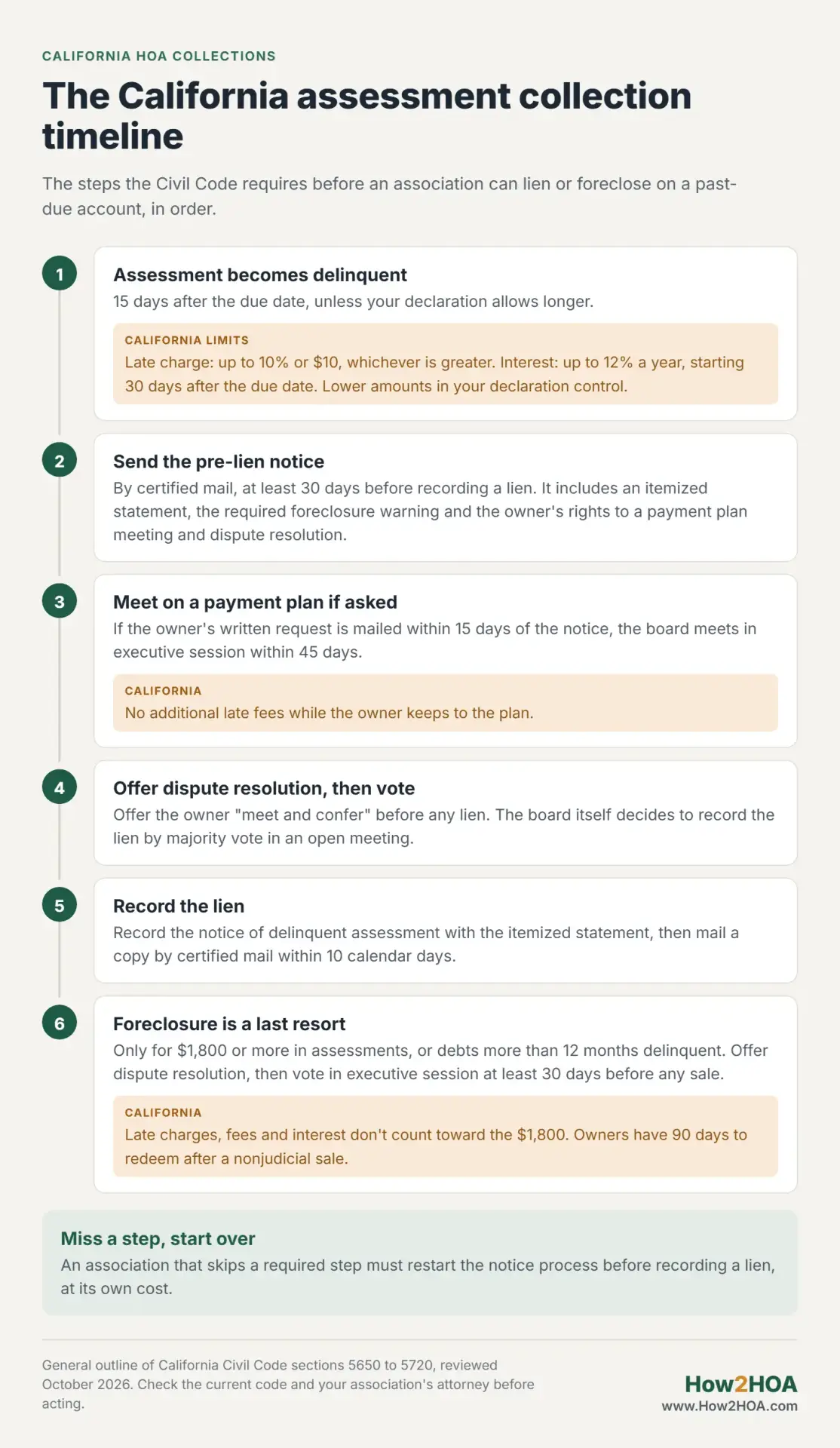
Skip a required step and the association must restart the notice process before it records a lien, at its own cost (section 5690).
California spells out every step between a missed payment and a lien, and the order matters.
Sources
The Law Behind This Page
Keep going
Related Topics
California HOA Guide
Every California topic guide in one place.
Budgets, Reporting and Records
Budget reports, financial reviews and owner records.
Finances
Budgets, reserves and collections in any state.
Management
Working with a management company.
Local Guides by City
City and neighborhood guides, county by county.
Get help
Want Help With Collections?
A professional management company can handle notices, payment plans and the paper trail California requires, so the board can focus on decisions.
Last reviewed October 21, 2026. Civil Code sections cited: 5205, 5300, 5600, 5605, 5610, 5615, 5650, 5655, 5658, 5660, 5665, 5670, 5673, 5675, 5685, 5690, 5705, 5715, 5720, 5725 and 5730, plus AB 2050 (2026). By the How2HOA Editorial Team. This page is general educational information, not legal advice. Laws change and your association’s governing documents control many of these questions, so check with your association’s attorney about your situation.