
HOA rules are the standards every owner takes on when buying into the community, and the board is responsible for enforcing them fairly. The rules come from the association’s governing documents. Enforcement works best in stages: prevent problems where you can, resolve them informally when they come up, give formal notice and a hearing if that fails, and only then impose a fine or another penalty.
The services, appearance, safety and amenities that make an HOA a good place to live exist because the community operates under shared rules. When some owners break the rules and the board does not act, the owners who follow them lose part of what they expected when they bought. This overview explains what the rules are, why they matter and how each stage of enforcement works, with links to more detailed articles on each stage.
What HOA Rules Are and Where They Come From
An HOA runs under its governing documents. These usually include the Declaration of Covenants, Conditions and Restrictions (CC&Rs), the bylaws and the rules and regulations the board adopts. Our article on HOA governing documents explains how they fit together.
All of these documents must comply with federal, state and local law. Laws change, so the board needs to keep up and adjust the documents when necessary. If your governing documents say something different from the law, the law controls, and the association cannot enforce a provision that violates it.
The most common things HOA rules cover are:
- Assessment obligations (dues)
- Pets
- Rental guidelines
- Maintenance and architectural standards, such as landscaping and fence height
- Limits on occupancy
- Parking regulations
- Use of common areas and facilities
- Noise restrictions
These are only the most common subjects. Your documents may cover many others, and each rule will have its own details.
Why the Rules Matter
Enforcing the rules is one of the board’s core responsibilities. When rules go unenforced, amenities deteriorate, the association’s finances suffer, homeowners become unhappy and the blame lands on the board. Most owners chose the community partly because of its standards, and they bought in expecting the recorded restrictions to be applied.
Enforcement is also a duty each director accepted on joining the board. In most states the board has a duty to enforce the governing documents, along with reasonable discretion over how. In many states homeowners can take legal action if they believe the board is not enforcing the governing documents, and no board wants to be in that position. Long-term non-enforcement can also make a rule harder to enforce later.
If the board believes a rule is unnecessary or outdated, the answer is to amend the governing documents or repeal the rule through the proper process. Ignoring it is not a solution. A rule that stays on the books but is never enforced confuses owners and weakens the board’s position when it tries to enforce other rules.
Enforce Consistently and Fairly
Everyone agrees in principle that the rules should be followed. Acting on a violation is harder, even for a committed board member, because it usually means dealing with a neighbor. Consistency makes it easier.
Apply the rules the same way to every owner, including board members and their friends. Letting some homeowners slide while cracking down on others breeds resentment and undermines the board’s authority. Consistency also means enforcing all of the rules. If some are ignored, homeowners cannot tell what is actually expected of them, because the governing documents are the only guide they have.
Consistency does not take away the board’s judgment. A board can reasonably decide that a minor matter does not justify a lawsuit. What it should not do is enforce a rule against one owner and overlook the same thing next door.
Uneven enforcement creates legal risk as well. An owner who is fined for something the board has let others do can argue selective enforcement as a defense, and may bring a claim against the association.
The Stages of Enforcement
Enforcement is a process, not a single event. The steps should be written into your governing documents or an enforcement policy, and they have to follow any procedure your state requires. A penalty imposed without following the required steps may not hold up. Here is how the stages usually run.

Share this infographic: Pinterest · Facebook · LinkedIn · Email · Download
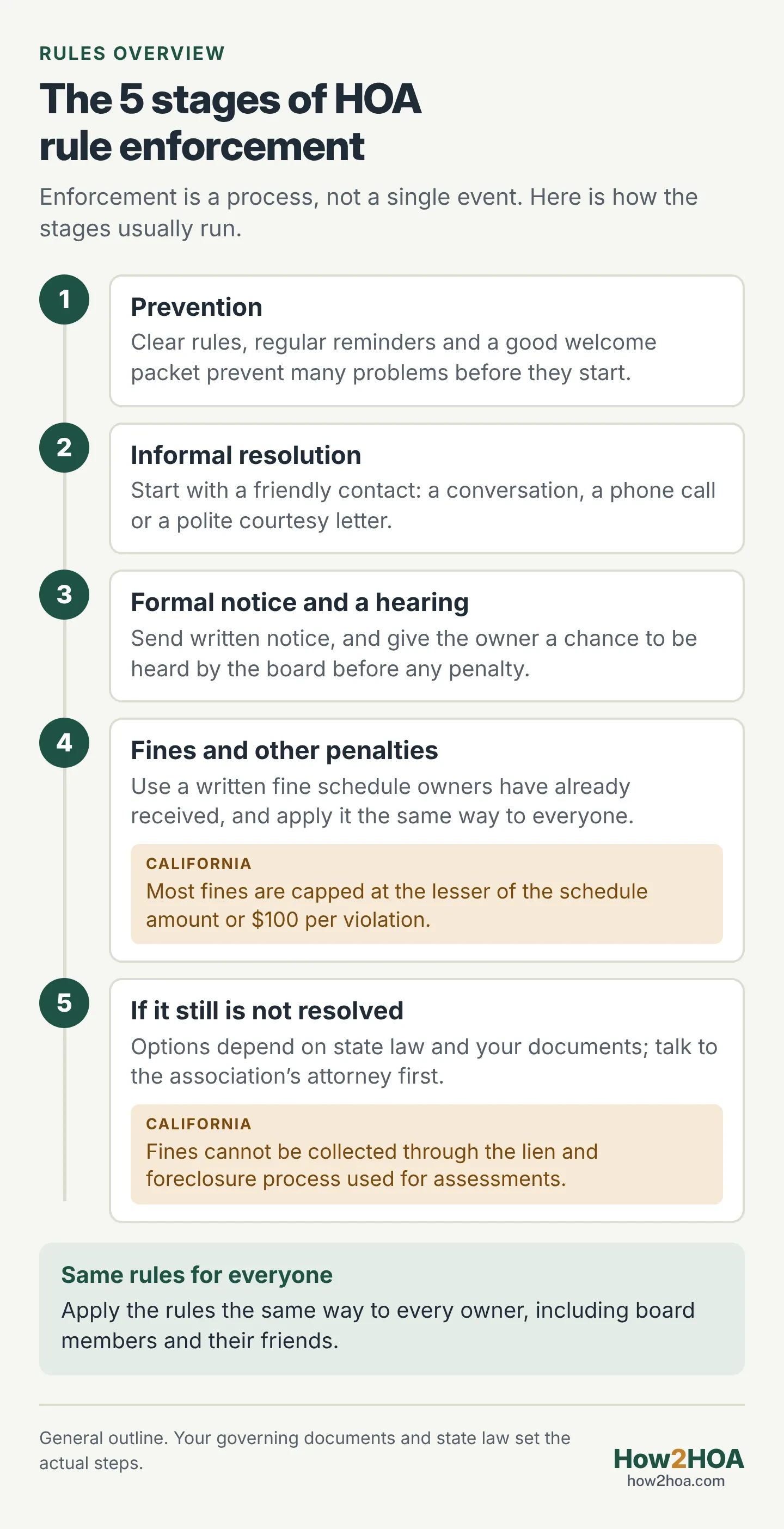
1. Prevention
Most violations happen because an owner did not know the rule or did not understand why it exists. Clear rules, regular reminders, a good welcome packet for new owners and a board that people know by name prevent many problems before they start. See our article on building voluntary compliance for practical ways to do this.
2. Informal Resolution
When a violation does occur, start with a friendly contact: a conversation, a phone call or a polite courtesy letter. Describe the problem, point to the rule and give the owner a reasonable deadline to fix it before any penalty is considered. Many issues end here. Our article on resolving a compliance problem informally covers this stage in detail.
3. Formal Notice and a Hearing
If the friendly approach has been tried and the problem continues, the formal process begins. The infographic below shows it from start to finish.

Share this infographic: Pinterest · Facebook · LinkedIn · Email · Download

Confirm your authority first. Before sending anything formal, find three things in writing:
- The rule itself, by document and section number.
- The enforcement procedure: who decides, what notice is required and what hearing the owner gets.
- The remedies the documents allow, such as fines, suspension of amenity privileges or recovery of repair costs.
An association can generally impose only the penalties its governing documents and state law authorize. If your documents do not provide for fines, do not issue any until the association’s attorney confirms you can.
Send a written warning. The first formal step is usually a warning letter that carries no penalty. A good one includes:
- the date and a plain description of what was observed
- the rule, quoted with its section number
- what the owner needs to do to fix it
- a specific deadline that is realistic for the work involved
- what happens next if it is not fixed, including the owner’s right to a hearing
- a name and phone number for questions.
Keep the tone factual. The letter may be read later by a judge, and it should show the association being reasonable.
Give notice of a hearing. If the deadline passes, the association sends a formal written notice. It should identify the violation and the rule involved, say what the owner needs to do and by when, and state what penalty could follow. It should also give the date, time and place the board will consider the matter and tell the owner of the right to attend and respond. Before any penalty is imposed, the owner should have a chance to be heard by the board. Many states require this notice and hearing by statute, and good practice calls for it everywhere because it is fair and it protects the association.
Hold the hearing. At the hearing:
- Present the facts briefly: what was observed, when and which rule applies.
- Let the owner speak without interruption and submit photos or documents.
- Ask questions, then deliberate and vote. Any director with a personal stake should abstain.
- Decide on the evidence, and treat this owner the way you treated the last one with the same violation.
If the owner does not attend, the board can usually decide on the record it has. Note in the minutes that notice was given.
Issue a written decision. Send the decision in writing soon after the hearing. State what the board found, the penalty if any, the date by which the violation must be corrected and what will happen if it is not. If the board decided not to impose a penalty, say that too.
4. Fines and Other Penalties
Fines give the rules some teeth. A fine is a tool for getting compliance. It is not a revenue source and should never be budgeted as one. Fines should come from a written fine schedule that owners have already received, and the same schedule should apply to everyone.
Many associations use a graduated schedule: a warning, then a small fine for a first violation, then larger ones for repeat violations, so that the first penalty is not out of proportion to the problem. Some documents also allow a new fine for each period that a continuing violation remains in place, such as a fence that does not meet the guidelines and stays up after the deadline. Whether that is permitted, and how often, depends on your documents and your state’s law, so get advice before fining repeatedly for one condition. State law may also limit the amount of a fine, so have your attorney review the schedule.
Fines are different from assessments. The rules on late charges, interest and liens that apply to unpaid dues often do not apply to fines. Our article on late fees and notices covers the assessment side.
Depending on your documents and your state, the board may also be able to suspend privileges such as use of the pool or clubhouse. Use the same notice and hearing before a suspension as before a fine.
5. If the Problem Still Is Not Resolved
When fines go unpaid or the violation continues, the board’s options depend on state law and the governing documents. Escalate only as far as the problem requires. The usual options, roughly in order of severity, are:
- Correcting the problem and charging the cost back. Do this only where the documents clearly grant that right, and with legal advice before anyone enters an owner’s property.
- Dispute resolution, such as a meeting under the association’s internal process, mediation with a neutral third party or arbitration.
- A small claims case to collect unpaid fines.
- A lawsuit asking a court to order compliance. This is expensive and slow, so a board should weigh the cost against what is at stake.
Whether unpaid fines can be collected through a lien or foreclosure varies sharply from state to state, so do not assume they can. In some states unpaid fines can become a lien on the home. In others, including California, fines cannot be collected through the lien and foreclosure process used for assessments. Talk to the association’s attorney before taking any of these steps.
The homeowner has options too. An owner who believes the board acted unfairly can present their side at the hearing, ask for dispute resolution and in the end go to court.
In California
California’s Davis-Stirling Act sets specific requirements. The state tightened its rules on fines and hearings when AB 130 took effect on June 30, 2025, so an older enforcement policy or fine schedule may no longer comply. Current law provides the following.
- Fine schedule. Under Civil Code section 5850, an association that fines members must adopt a schedule of monetary penalties and distribute it to the members with the annual policy statement. The penalties must be reasonable.
- Cap on fines. A fine may not exceed the lesser of the amount in the schedule in effect when the violation occurred or $100 per violation. The board may go above $100 only if the violation may result in an adverse health or safety impact on the common area or another member’s property, and only after the board makes a written finding describing that impact at a board meeting open to the members. The association may not add a late charge or interest to a fine.
- Notice of the hearing. Under Civil Code section 5855, the board must give the member written notice at least 10 days before the meeting at which it will consider discipline. The notice must state the date, time and place of the meeting, the nature of the alleged violation and that the member has the right to attend and address the board. The board must meet in executive session if the member asks.
- Opportunity to cure. The member must be allowed to cure the violation before the meeting. The board may not impose discipline if the member does so, or, when the cure would take longer than the time between the notice and the meeting, if the member provides a financial commitment to cure it.
- After the hearing. If the board and the member do not reach agreement, the member may request internal dispute resolution under Civil Code section 5910. If they do agree, the board puts the resolution in writing, and once the board and the member sign it, it binds the association and can be enforced in court. If the board imposes discipline, it must give the member written notice of the decision within 14 days. Discipline is not effective against the member unless the board followed these steps.
- Fines are not liens. Under Civil Code section 5725, a fine may not be treated as an assessment that becomes a lien enforceable by a nonjudicial foreclosure sale.
- Before going to court. Before filing a superior court action for an order enforcing the governing documents, the association or the member generally must first try alternative dispute resolution (Civil Code section 5930). Small claims cases and, generally, assessment disputes are exempt.
If your fine schedule still lists amounts above $100, have your attorney review it. Section 5850 sets the cap “per violation” and does not address a violation that continues over time, so also ask your association’s attorney before charging repeated fines for the same ongoing problem.
Our free HOA Fine Cap and Hearing Checker tests a proposed fine against the $100 cap and the health and safety exception and gives you the hearing notice and decision deadlines.
You can find more on rules and governing documents in our rules and legal section.
To set fines ahead of time, our free Fine Schedule Builder builds a graduated schedule within the $100 cap, with the 28-day rule change notice to adopt it. Our free Hearing Notice and Decision Letter Template writes the notice before a disciplinary hearing and the written decision after it.
The Law Behind This Article
Every legal point in this article comes from the official text. Each link below opens it on the California Legislature’s website in a new tab.
Civil Code sections: 5725 · 5850 · 5855 · 5910 · 5930
This article is general educational information, not legal advice. Laws vary by state and your association’s governing documents control many of these questions, so check with your association’s attorney or another qualified professional about your situation.