
The best way to handle HOA late fees is with a written collection policy that the board applies the same way to every owner: a reminder as soon as a payment is missed, a formal late notice that adds only the late charge your governing documents and state law allow, an offer of a payment plan, and a referral to the association’s attorney if the account is still unpaid. Collection law is state-specific. The deadlines, dollar limits and required wording change from one state to the next, so the association’s attorney should design the process and run the legal stages.
Late notices are the first stage of collections, and most accounts never get past it. The later stages are recording a lien and then enforcing the debt through small claims court, a court judgment or foreclosure. They are introduced near the end of this article, with a link to the article on each.
Why the board has to collect
An association runs almost entirely on the assessments its owners pay. Road repair, trash removal, landscaping, insurance and maintenance of shared facilities all come out of that money. When even a few owners fall behind, the budget feels it, and the gap has to be covered by cutting services, putting off maintenance or raising assessments on the owners who do pay.
Collection is the board’s job. No one else is responsible for it, and budget problems caused by unpaid accounts land on the board. It is also a matter of fairness. Every owner accepted the obligation to pay assessments when they bought into the community, and the neighbors who pay on time should not carry those who do not.
Start with a written collection policy
Your association should have a written course of action before it ever needs one. The policy has to follow state law and your declaration of covenants, conditions and restrictions (CC&Rs) and bylaws, and many states spell out what a board may and may not do when a payment is late. A useful policy answers these questions:
- When is a payment due, and when is it considered late?
- What late charge and interest apply, and where does the authority for them come from?
- Which notices are sent, in what order, how and by whom?
- When will the board consider waiving a late charge or agreeing to a payment plan?
- How are partial payments applied to the account?
- At what point does the account go to the association’s attorney?
Give the policy to every owner, follow it every time and keep the board out of the business of making one-off decisions about individual neighbors.
How to handle HOA late fees and notices, step by step

Share this infographic: Pinterest · Facebook · LinkedIn · Email · Download
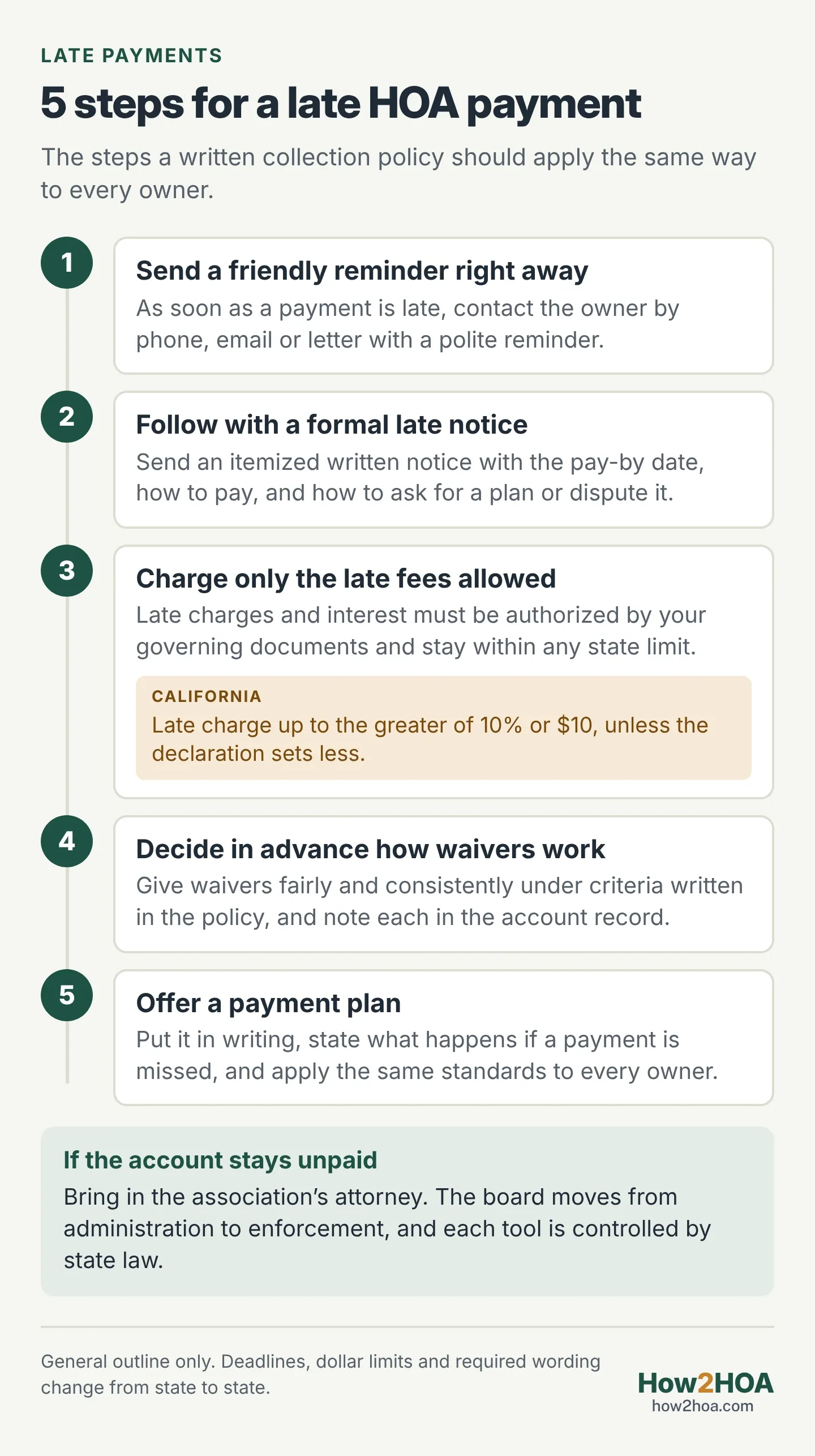
1. Send a friendly reminder right away
As soon as a payment is late, contact the owner by phone, email or letter with a polite reminder. It can feel awkward to tell a neighbor that they owe the association money, but acting early is kinder than letting two or three months build up. Many late payments are simple oversights: a changed bank account, a missed statement, a new owner who did not set up autopay. A short reminder is often all it takes.
2. Follow with a formal late notice
If the reminder does not work, send a formal written notice, sometimes called a demand letter. A good late notice includes:
- The owner’s name and the property address or account number.
- An itemized statement of what is owed: each unpaid assessment with its due date, then any late charge, interest and collection cost shown separately.
- The date by which the owner needs to pay, and how to pay.
- How to ask for a payment plan or dispute the amount.
- What the association may do next if the account stays unpaid.
Keep a copy of every notice and proof of how it was sent. If the account later goes to a lien or to court, that file is the association’s evidence. Once an account reaches the stage where a lien is possible, many states require a specific notice with specific wording, and that one should come from the attorney.
3. Charge only the late fees you are allowed to charge
A late charge and interest must be authorized by your governing documents and must stay within any limit your state sets. Do not invent new fees in the middle of a collection, and do not mix late charges with fines for rule violations. In many states the two are treated very differently when it comes to liens and foreclosure.
4. Decide in advance how waivers work
Some associations waive a late charge in certain circumstances, for example when an owner with a long record of paying on time misses once. Others never waive. Neither approach is required. What matters is that waivers are given fairly and consistently, under criteria written into the policy, and that each one is noted in the account record.
5. Offer a payment plan
One of the fastest and least expensive ways to resolve a delinquent account is a written payment plan. The owner agrees to pay the regular assessment plus a set amount toward the balance each month, and the association often agrees to stop adding late charges while the plan is being honored. The association gets paid without legal costs, and an owner going through a hard stretch gets room to catch up. Put the plan in writing, state what happens if a payment is missed, and apply the same standards to every owner.
If the owner still does not pay
When reminders, notices and a payment plan offer have not worked, the board moves from administration to enforcement. This is the point to bring in the association’s attorney, because each of the following tools is controlled by state law. They are listed in the order a board usually reaches them.
- Suspending privileges. Some governing documents let the board suspend a delinquent owner’s use of amenities such as the pool, fitness center or clubhouse. Whether that is allowed, and what notice and hearing must come first, depends on state law and your documents. Do not use a suspension to block access to the owner’s home, parking or utilities.
- A lien. The association can usually secure the debt with a lien on the owner’s property. See how to establish an HOA lien and what your options are once it is in place.
- Small claims court. For smaller balances, small claims court is quicker and cheaper than a regular lawsuit. Every state caps the amount that can be claimed there, and the caps differ widely.
- A lawsuit against the owner. The association can sue the owner personally and ask for a court money judgment, which can then be collected through tools such as wage garnishment.
- Foreclosure. In most states an association with a valid lien can eventually foreclose on it. Often the notice that foreclosure is coming is what prompts payment, and the property is never sold. See collecting through foreclosure.
Two cautions apply at every stage. First, fair debt collection laws may apply. The federal Fair Debt Collection Practices Act regulates “debt collectors.” Its definition covers those who regularly collect debts owed to someone else, and it excludes a creditor’s own officers and employees collecting in the creditor’s name. Whether that law or a state law applies to your association, its manager or its collection firm is a question for the attorney. Second, if an owner files for bankruptcy, an automatic stay stops most collection activity, including lawsuits and wage garnishments, as the federal courts explain. If that happens, stop contacting the owner about the debt and call the association’s attorney.
In California: late charges, notices and payment plans
California’s Davis-Stirling Act sets detailed rules for late charges and collection notices. These are the main ones, with links to the current statute text:
- When an assessment is delinquent. Regular and special assessments are delinquent 15 days after they become due, unless the declaration provides a longer period (Civil Code section 5650).
- Late charge limit. On a delinquent assessment the association may recover a late charge of no more than 10 percent of the delinquent assessment or $10, whichever is greater, unless the declaration sets a smaller amount (section 5650).
- Interest limit. Interest may be charged at an annual rate of no more than 12 percent, starting 30 days after the assessment becomes due, unless the declaration sets a lower rate (section 5650).
- Collection costs. The association may also recover reasonable costs of collecting the delinquent assessment, including reasonable attorney’s fees (section 5650).
- How payments are applied. A payment must be applied to the assessments owed first. Only after the assessments are paid in full may it be applied to collection costs, attorney’s fees, late charges or interest. An owner who asks must be given a receipt showing the date of payment and who received it, and the association must provide a mailing address for overnight payments (Civil Code section 5655).
- Payment under protest. An owner who disputes a charge may pay the disputed amount under protest, along with the other amounts levied, and then use dispute resolution or file in small claims court, as long as the disputed amount is within the small claims limit (Civil Code section 5658).
- Annual notice to owners. The annual policy statement must include the statutory “Notice Assessments and Foreclosure” and the association’s policies for enforcing lien rights and other remedies for unpaid assessments (Civil Code section 5310 and section 5730). That notice itself tells owners that the association’s collection practices may be governed by state and federal fair debt collection laws.
- The pre-lien notice. At least 30 days before recording a lien, the association must send the owner of record a written notice by certified mail with specific contents, including an itemized statement and the owner’s rights to a payment plan meeting and to dispute resolution (Civil Code section 5660). Our article on establishing a lien covers it in detail.
- Payment plans. After a pre-lien notice, an owner may ask in writing to meet with the board about a payment plan. If the request is mailed within 15 days of the postmark on the notice, the board must meet with the owner in executive session within 45 days of the postmark on the request. If the association has payment plan standards, it must give them to owners. Additional late fees do not accrue during the plan as long as the owner keeps to its terms, a plan does not stop the association from recording a lien, and if the owner defaults the association may resume collection from the point where it left off (Civil Code section 5665).
- Discipline requires notice and a hearing. Before the board meets to consider or impose discipline on a member, it must give the member at least 10 days’ written notice and a chance to attend and address the board (Civil Code section 5855). Ask the association’s attorney before suspending any privilege over an unpaid account.
- Fines are not late charges. A fine imposed as discipline for a rule violation may not be treated as an assessment that can become a lien enforceable by sale (Civil Code section 5725). Keep fines and assessments separate on the owner’s ledger.
These are summaries, not the full text, and a California board should have its attorney or a collection firm working under the attorney’s direction handle any account that has reached the pre-lien stage.
To run the numbers on a specific account, use our free HOA Collection Timeline Calculator. It works out the most a California association can charge in late fees and interest and lists every collection deadline, from the pre-lien notice to the lien.
How to prevent late payments
The cheapest collection is the one you never have to start. A few habits reduce late payments noticeably:
- Send automated reminders, for example 30 days, two weeks and one week before the due date, and again on the day payment is due.
- Offer automatic payments and make the sign-up easy for new owners.
- Send clear statements that show the amount, the due date and where to pay.
- Explain in plain language what assessments pay for when you announce the budget.
- Keep lines of communication open, and stay polite even when the account is months behind.
For more on budgets, assessments and financial reporting, see our HOA finances section.
The Law Behind This Article
Every legal point in this article comes from the official text. Each link below opens it in a new tab.
Civil Code sections: 5310 · 5650 · 5655 · 5658 · 5660 · 5665 · 5725 · 5730 · 5855
Other sources: FTC: Fair Debt Collection Practices Act (text) · U.S. Courts: Chapter 7 Bankruptcy Basics
This article is general educational information, not legal or financial advice. Laws vary by state and your association’s governing documents control many of these questions, so check with your association’s attorney or another qualified professional about your situation.