
An association can pursue HOA collections through small claims court when the unpaid amount fits under its state’s small claims limit. The association files a short claim form, pays a modest filing fee, has the owner served, and presents its ledger and documents to a judge. In some states, including California, no attorneys take part in the hearing. A win produces a money judgment that the association still has to collect. Claim limits, who may appear for the association and appeal rights all differ by state, so have the association’s attorney confirm the rules and review the claim before you file.
Small claims court is usually the first enforcement option a board looks at for a smaller balance. It comes after late notices and late charges have failed, and it sits alongside the other options compared in What Are HOA Lien Options?, which are a regular court judgment and foreclosure.
When small claims court makes sense
The board has a fiduciary responsibility to collect assessments, because the whole community depends on what they pay for. Most late accounts are resolved without any legal step: a friendly reminder, a formal notice that spells out the late charges, or a payment plan. When those have not worked, the board has to choose a legal route.
Small claims court is a lawsuit against the owner personally for a money judgment. It does not require a lien first, although an association can often record a lien as well. It fits certain situations:
- The balance is small enough to fit under the court’s limit.
- The debt is too small or too recent for foreclosure under your state’s rules.
- The owner has wages or a bank account that a judgment can reach.
- The debtor is a former owner, so there is no longer a property to lien.
- The association’s paperwork is clean and the amount is not seriously disputed.
Understanding the process makes the pros and cons easier to weigh, so we start there.
How HOA collections through small claims court work
- Confirm the rules. Check your state’s claim limit, whether there is a cap on how many claims you can file in a year, and who is allowed to appear for an association. Have the attorney review the ledger and the claim. Attorneys can usually advise and help with paperwork even where they cannot appear at the hearing.
- Authorize the claim. The board votes to file and names the person who will appear for the association, and the minutes record it.
- Fill out and file the claim form. Small claims forms are short and are usually available online. They ask for the owner’s name and address, why the owner owes the association money, when the payments were due and how the amount was calculated. The association files the form with the court and pays the filing fee, and the court sets a hearing date.
- Serve the owner. The owner must be formally served with the claim within the time your state sets before the hearing. Follow the court’s instructions exactly and file proof that service was made.
- Consider mediation. Many courts offer mediation before or on the hearing date. A signed payment agreement reached there is often the best result for both sides.
- Attend the hearing. The association’s representative explains the debt and hands the judge the documents. The owner responds. The judge may decide on the spot or mail the decision later.
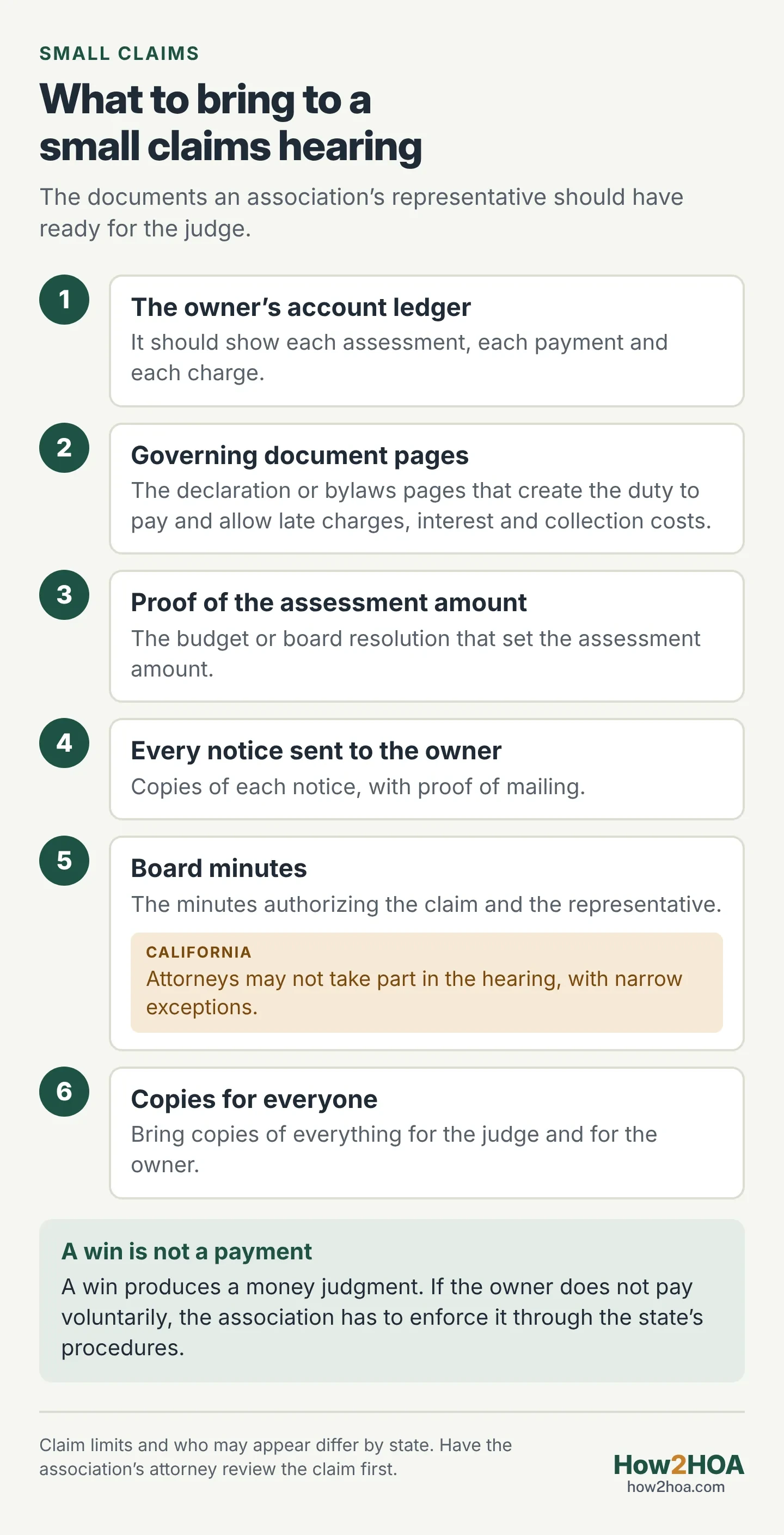
What to bring to the hearing
- The owner’s account ledger, showing each assessment, each payment and each charge.
- The pages of the declaration or bylaws that create the duty to pay assessments and allow late charges, interest and collection costs.
- The budget or board resolution that set the assessment amount.
- Copies of every notice sent to the owner, with proof of mailing.
- The board minutes authorizing the claim and the representative.
- Copies of everything for the judge and for the owner.

Share this infographic: Pinterest · Facebook · LinkedIn · Email · Download
After the decision
If the association wins, it has a money judgment, not a payment. If the owner does not pay voluntarily, the association has to enforce the judgment through the state’s procedures, such as garnishing wages, levying a bank account or recording a judgment lien against real estate. In many states the losing owner can appeal, and the appeal may move the case to a higher court where attorneys take part. If the association loses, its right to appeal may be limited or nonexistent, depending on the state. Talk to the attorney before deciding what to do next.
Pros of pursuing payment through small claims court
- Low cost. The main expense is the filing fee and the cost of service, and the winning side can usually have those court costs added to the judgment.
- Speed. A hearing is typically set much sooner than a trial in a regular civil case.
- Simplicity. The rules are informal and designed for people who are not lawyers. A treasurer or manager with a clean ledger can present the case.
- Proportion. For a balance of a few thousand dollars, it is a measured response that does not put anyone’s home at risk.
Cons of small claims court
- The claim limit. Every state caps what can be awarded in small claims court, and the caps differ widely. Some states set a lower cap for businesses and associations than for individuals, and some limit how many larger claims one party can file in a year. A long-delinquent account can outgrow the limit.
- No attorney in the room, in some states. The association’s representative has to present the case alone. An attorney can still help prepare the paperwork and the presentation.
- Uneven appeal rights. In some states the party who filed the claim cannot appeal a loss, while the party who was sued can. If the owner appeals, the association may need an attorney after all, and it may not be able to recover much of that expense even if it wins again.
- A judgment still has to be collected. The court does not collect the money. If the owner has no wages, bank account or equity to collect from, the judgment may go unpaid.
- Volunteer time. Someone has to prepare the file, attend the hearing and follow through on enforcement.
If the decision to use small claims court is mostly about saving attorney’s fees, keep the appeal risk in mind. A case that starts cheaply can become more expensive than a regular lawsuit would have been.
In California: small claims rules for associations
These points come from the current statute text and the California courts’ self-help site, with each one linked in the sources section below.
- Small claims is an approved route for assessments. When delinquent assessments are below the $1,800 foreclosure threshold, the Davis-Stirling Act lists a small claims action as one of the ways the association may collect. The court may award the amount owed on the filing date and, at its discretion, additional assessments, reasonable late charges, collection costs, attorney’s fees and interest that accrue until the judgment is satisfied, up to the small claims limit (Civil Code section 5720).
- Claim limit for an association: $6,250. The general small claims limit is $6,250 (Code of Civil Procedure section 116.220). The higher $12,500 limit applies only to an action brought by a natural person (Code of Civil Procedure section 116.221). The California courts’ small claims guide states the same limits: up to $12,500 for individuals and up to $6,250 for businesses. An owner suing the association can therefore ask for more than the association can ask for when it sues an owner.
- Two larger claims per year. No person may file more than two small claims actions in California in a calendar year in which the amount demanded exceeds $2,500, and the small claims law defines “person” to include corporations and associations (Code of Civil Procedure section 116.231 and section 116.130). An association with several delinquent accounts should ask its attorney how this limit applies to it.
- Filing fee. The fee is $30 for a claim of $1,500 or less, $50 for a claim over $1,500 and up to $5,000, and $75 for a claim over $5,000. It is $100 for a party that has filed more than 12 small claims in the previous 12 months (Code of Civil Procedure section 116.230).
- No attorneys at the hearing. An attorney may not take part in conducting or defending a small claims case, with narrow exceptions. An attorney may advise a party before or after the case is filed, represent a party in an appeal to the superior court and represent a party in enforcing the judgment (Code of Civil Procedure section 116.530).
- Who may appear for the association. An association created to manage a common interest development may appear and participate through an agent, a management company representative or a bookkeeper who appears on its behalf. A corporation may also appear through a regular employee or a duly appointed or elected officer or director. The representative must file a declaration stating that they are authorized to appear and are not employed solely to represent the association in small claims court (Code of Civil Procedure section 116.540).
- Service deadlines. Service on the owner must be completed at least 15 days before the hearing if the owner lives in the county where the case was filed, or at least 20 days before if the owner lives outside it. Proof of service must be filed at least 5 days before the hearing (Code of Civil Procedure section 116.340).
- Appeals. The plaintiff has no right to appeal the judgment on its own claim. The defendant may appeal to the superior court (Code of Civil Procedure section 116.710). The appeal is a new hearing before a different judicial officer, and attorneys may take part (section 116.770). The judgment after that hearing is final, and for good cause the court may order reimbursement of attorney’s fees for the appeal of no more than $150 (section 116.780).
- Collecting. The courts’ guide on collecting a small claims judgment explains that you can start collecting once the 30 days to appeal or vacate have passed. A wage garnishment or bank levy requires a writ of execution, and a lien on real estate requires an abstract of judgment. The judgment expires in 10 years unless it is renewed.
- Owners can use small claims too. An owner who disputes a charge may pay it under protest and file a small claims action against the association, as long as the amount is within the small claims limit (Civil Code section 5658).
Claim limits and fees are changed by the Legislature from time to time, so confirm the current figures with the court or the association’s attorney before filing. For related topics, visit the HOA finances section.
The Law Behind This Article
Every legal point in this article comes from the official text. Each link below opens it in a new tab.
Civil Code sections: 5658 · 5720
Code of Civil Procedure sections: 116.130 · 116.220 · 116.221 · 116.230 · 116.231 · 116.340 · 116.530 · 116.540 · 116.710 · 116.770 · 116.780
Other sources: California Courts Self-Help Guide: Small claims in California · California Courts Self-Help Guide: Collecting a small claims judgment
This article is general educational information, not legal or financial advice. Laws vary by state and your association’s governing documents control many of these questions, so check with your association’s attorney or another qualified professional about your situation.