
To establish an HOA lien, the association generally sends the owner a formal pre-lien notice, waits the period its state requires, has the board approve the lien, and then records a lien document against the property in the county land records. Each step is set by state law and your governing documents, and a missed step can invalidate the lien, so the association’s attorney should prepare and record it.
Recording a lien is the second stage of collections. It comes after reminders, late notices and a payment plan offer have failed, and before the board decides how to enforce the debt. This article walks through how a lien gets recorded, then what it does and the choices it gives the board once it is in place.
What is an HOA lien?
An HOA lien is a legal claim the association holds against an owner’s property for unpaid assessments. When an owner does not pay an assessment by the due date, or by the end of any grace period, the debt is delinquent. State law and the declaration of covenants, conditions and restrictions (CC&Rs) then give the association the right to a lien on the owner’s lot or unit. Depending on the state, the lien arises automatically or exists only once the association records a notice in the county land records. Either way, recording is what tells buyers, lenders and title companies that money is owed on the property.
The lien covers the unpaid assessments and, where state law and the governing documents allow, late charges, interest and collection costs. Fines for rule violations are a different matter. Many states limit or bar using an assessment lien to collect them.
Before the lien: reminders, notices and payment plans
When an owner has not paid assessments, the board generally has a duty to the association to pursue payment. The community runs on that money, and the board is the only body that can enforce it. Most accounts are settled long before a lien, through a reminder, a formal late notice or a payment plan, which we cover in how to handle late fees and notices. A lien is the next step when those have not worked.
The details below vary with your state’s law, your bylaws and your CC&Rs. Treat them as a general outline and let the attorney supply the specifics.
Steps to establish an HOA lien

Share this infographic: Pinterest · Facebook · LinkedIn · Email · Download

Step 1: Check the account
Before anything is mailed, confirm that the ledger is right. Verify the amounts, the due dates, that every payment received has been applied correctly, and that the person on the account is the current owner of record. A lien based on a wrong balance or the wrong owner can create liability for the association instead of leverage.
Step 2: Send the pre-lien notice
Many states, and many governing documents, require the association to warn the owner in writing before a lien is recorded. The notice typically states the amount owed with an itemized breakdown, explains what the association intends to do, and tells the owner how to pay or dispute the debt. Many associations send it by certified mail, and some send a second copy by regular mail so that a refused certified letter does not become an argument later.
Both the notice and the waiting period matter. If the association skips the notice, leaves out required content, or records the lien before the waiting period has run, the lien can be invalid. The association can usually start again, but it will have lost time and paid attorney’s fees twice. How long the waiting period is depends on the state. The 30-day certified-mail notice that many boards have heard of is the California rule, described below.
Step 3: Give the owner a chance to resolve it
The time between the notice and the recording is the owner’s chance to pay, ask for a payment plan or dispute the amount. Some states require the association to offer a meeting or a dispute resolution process during this window. Even where it is not required, it is good practice. A payment plan signed at this stage costs far less than a lien and a foreclosure.
Step 4: The board votes
The decision to record a lien belongs to the board. It should be made by a vote at a properly noticed meeting and recorded in the minutes. State law determines whether the vote happens in open session or in a closed session, and how the property is identified. Because delinquency is sensitive, many associations refer to the account or parcel number in open-meeting minutes instead of the owner’s name. Ask your attorney what your state requires.
Step 5: Prepare and record the lien
Once the procedural requirements have been met, the association’s attorney prepares the lien and records it with the county office that keeps land records, called the county recorder or register of deeds depending on the state. Liens are public records. What the document must contain differs by state, but it generally includes:
- The amount owed. This is usually the same itemized information that was in the pre-lien notice, updated to the recording date.
- A legal description of the property. This lets buyers, lenders and title companies know exactly which property the lien is against.
- The name of the owner of record. Even where the owner’s name is kept out of board minutes, it generally has to appear in the recorded lien.
- An authorized signature. The lien is signed by the person your documents or your state’s law designate, often an officer of the association.
If your state allows foreclosure without a lawsuit (nonjudicial foreclosure), the lien may need additional information, such as the name of the trustee who would conduct a sale.
Step 6: Send the owner a copy
Many states require the association to send a copy of the recorded lien to every owner of the property, often by certified mail and within a short, fixed time. Find out the deadline before you record, and put it on the calendar the day the lien is recorded.
Keep a complete file
Owners generally have the right to inspect association records, and an owner facing a lien will often ask for proof that the association followed the rules: the ledger, a copy of the pre-lien notice, proof of mailing and the minutes of the meeting where the board voted. Response deadlines for records requests can be short, so keep these documents together in one collection file from the start. The same file is what the attorney will need if the lien is ever challenged.
After the lien is recorded
A lien secures the debt against the property. It does not put money in the association’s account by itself.
- It clouds the title. A recorded lien shows up in a title search, and buyers and lenders generally will not close until it is paid and released. For many accounts this alone produces payment.
- It does not guarantee full payment. Liens are paid in order of priority, and a first mortgage is usually ahead of the association’s lien. If a sale does not cover the senior debts, the association may recover little or nothing from the property.
- Priority rules vary. Some states give association liens a limited “super-priority” over the first mortgage. There is a federal layer as well: the Federal Housing Finance Agency, as conservator of Fannie Mae and Freddie Mac, has stated that it will not consent to association foreclosures that would wipe out a Fannie Mae or Freddie Mac lien.
- It may not last forever. In some states an assessment lien expires unless the association acts to enforce it within a set time. Ask the attorney how long yours lasts.
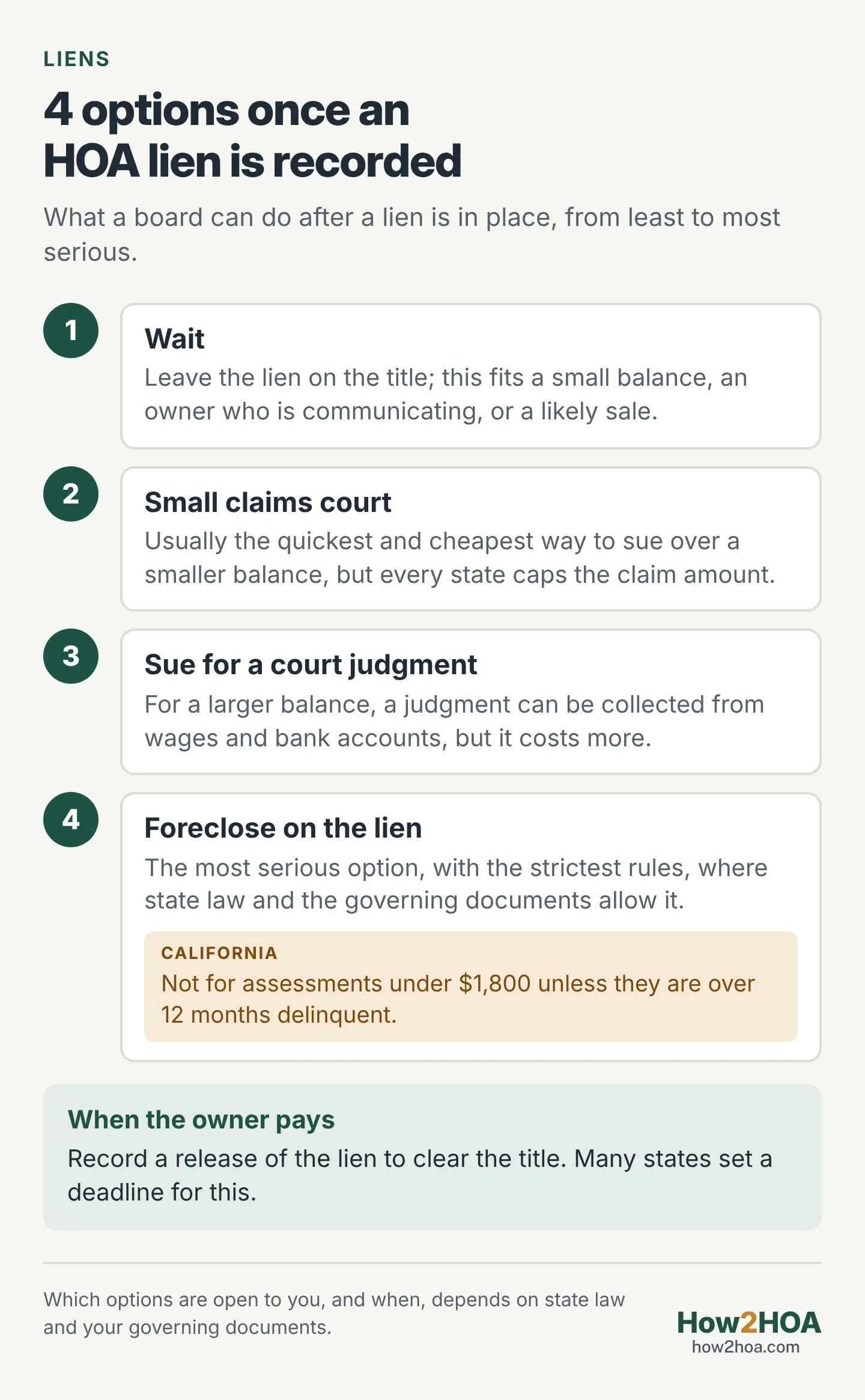
A recorded lien gives the association four choices. It can leave the lien in place and wait, or it can move on to enforcement through small claims court, a lawsuit for a court judgment or foreclosure. Not every route is available in every state, and each has its own rules, so make the choice with the association’s attorney.

Share this infographic: Pinterest · Facebook · LinkedIn · Email · Download
Option 1: Wait
Lawsuits and foreclosure cost time and money, so many boards record the lien and then wait. The lien stays on the title while assessments continue to come due, and the owner cannot easily sell or refinance without paying. Waiting makes sense when the balance is small, the owner is communicating, or a sale is likely. It is a weak choice when the balance keeps growing and there is no sign of a sale.
Option 2: Small claims court
The owner is usually personally liable for assessments, so the association can sue the owner instead of, or in many states in addition to, enforcing the lien. For a smaller balance, small claims court is usually the quickest and cheapest way to do that. Every state caps the amount that can be claimed there, and a win produces a judgment that the association still has to collect.
Option 3: Sue the owner for a court judgment
For a larger balance, the association’s attorney can file a regular civil lawsuit. A court money judgment can be collected from wages and bank accounts, which matters when the property has little equity or the debtor no longer owns it. It costs more than small claims court, and some states limit how a lawsuit and a lien can be combined.
Option 4: Foreclose on the lien
In most states, an association can foreclose on its lien if state law and the governing documents allow it, either through the courts or, in some states, through a trustee’s sale without a lawsuit. It is the most serious option and the one with the strictest rules. How soon it can start differs widely: some states let an association move quickly, and others require the debt to reach a minimum dollar amount or a minimum age first. We cover the process in collecting late HOA fees through foreclosure.
Releasing the lien
When the owner pays what is owed, the association needs to record a release of the lien promptly. Many states set a deadline for this, and a paid lien left on record keeps clouding the owner’s title. Make the release part of your closing checklist for every collection file.
How to choose among the options
The board should weigh the cost and time of each option against what it is likely to recover. Useful questions for the attorney include:
- How much is owed, and how fast is the balance growing?
- How much equity is in the property after the mortgage and taxes?
- Does the owner live there, and does the owner have income or a bank account a judgment could reach?
- Has a lender started its own foreclosure?
- Has the owner filed for bankruptcy?
The answers often point clearly to one route. The board’s duty is to collect fairly and consistently, and which tool it uses for a particular account is a business decision to make with the association’s attorney.
In California: recording and enforcing an assessment lien
California’s Davis-Stirling Act lays out the lien process step by step and controls closely what the association can do once the lien is recorded. This summary follows the current statute text, with a link to each section at the end of the article.
Recording the lien
- Pre-lien notice, at least 30 days ahead. At least 30 days before recording a lien, the association must notify the owner of record in writing by certified mail (Civil Code section 5660). The notice must include a general description of the association’s collection and lien enforcement procedures and how the amount was calculated; a statement that the owner may inspect the association’s records; a foreclosure warning in the wording and format the statute prescribes; an itemized statement of delinquent assessments, collection fees and costs, attorney’s fees, late charges and interest; a statement that the owner is not liable for charges, interest and collection costs if it is determined the assessment was paid on time; and notice of the owner’s rights to request a meeting with the board about a payment plan, to dispute the debt through the association’s internal “meet and confer” program, and to request alternative dispute resolution with a neutral third party before foreclosure begins.
- Secondary address. If an owner has given the association a secondary address for notices, an additional copy of these collection notices must be sent there (Civil Code section 4040).
- Payment plan meeting. If the owner mails a written request within 15 days of the postmark on the pre-lien notice, the board must meet with the owner in executive session within 45 days of the postmark on the request. If no regular board meeting falls in that period, the board may designate a committee of one or more directors to meet with the owner. A payment plan does not prevent the association from recording a lien (Civil Code section 5665).
- Dispute resolution offer. Before recording a lien, the association must offer the owner dispute resolution under its “meet and confer” program, and must take part if the owner asks (Civil Code section 5670).
- Board vote in an open meeting. Only the board may decide to record a lien, and it may not delegate the decision to a manager or other agent. The board must approve it by a majority vote of the directors in an open meeting and record the vote in the minutes of that meeting (Civil Code section 5673). This section does not say how the property must be identified. The statutory rule that minutes use the parcel number instead of the owner’s name applies to the later, separate vote to foreclose, which is taken in executive session under section 5705. Ask the association’s attorney how to word the lien vote in your open-meeting minutes.
- The notice of delinquent assessment. The lien is created by recording a notice of delinquent assessment with the county recorder. It must state the amount of the assessment and other sums owed, a legal description of the separate interest and the name of the record owner. The itemized statement from the pre-lien notice must be recorded with it. For the lien to be enforced by nonjudicial foreclosure, it must also give the name and address of the trustee authorized to enforce the lien by sale. It must be signed by the person designated in the declaration or by the association for that purpose, or by the association’s president if no one is designated (Civil Code section 5675).
- Copy to the owners within 10 days. A copy of the recorded notice must be mailed by certified mail to every person shown as an owner of the separate interest in the association’s records, no later than 10 calendar days after recording (section 5675).
- If a step is missed. An association that fails to follow these procedures must start the notice process over before recording a lien, and the association pays the cost of starting over (Civil Code section 5690). If a lien is determined to have been recorded in error, it must be released within 21 calendar days, the owner must be given a declaration that it was recorded in error, and the association must reverse the related late charges, fees, interest, attorney’s fees and collection costs and pay the costs of any related dispute resolution (Civil Code section 5685).
Enforcement, fines and release
- When the lien can be enforced. A lien may be enforced, including by a judicial sale or a trustee’s sale, only after 30 days have passed since it was recorded. The association may also sue the owner to recover the debt or accept a deed in lieu of foreclosure (Civil Code section 5700).
- Minimum for foreclosure. The association may not foreclose, judicially or nonjudicially, to collect delinquent assessments of less than $1,800, not counting accelerated assessments, late charges, collection costs, attorney’s fees or interest, unless the assessments are more than 12 months delinquent. Below that threshold it may file in small claims court, record a lien and wait, or use any other lawful method except foreclosure (Civil Code section 5720).
- Fines cannot be foreclosed. A monetary penalty imposed as discipline for violating the governing documents, other than a late-payment charge, may not be treated as an assessment that can become a lien enforceable by sale. A charge to reimburse the association for damage to the common area is treated differently (Civil Code section 5725).
- No selling the debt. An association may not voluntarily assign or pledge its right to collect assessments or to enforce or foreclose a lien to a third party, except to a state or federally chartered or licensed lender as security for a loan to the association. It may assign the unpaid obligations of a former member to a third party for collection (Civil Code section 5735).
- Release after payment. Within 21 days after the owner pays the sums in the notice of delinquent assessment, the association must record a lien release or notice of rescission and give the owner a copy (section 5685).
Because the notice wording, mailing method and timing are all set by statute, a California association should have its attorney, or a collection firm working under the attorney’s direction, prepare the pre-lien notice and the lien. The board’s part is to verify the account, hold the vote properly and keep the file. These are summaries. The articles on each enforcement option give the California detail, and the association’s attorney should confirm each step against the full statute and your declaration. For related topics, visit the HOA finances section.
The Law Behind This Article
Every legal point in this article comes from the official text. Each link below opens it in a new tab.
Civil Code sections: 4040 · 5660 · 5665 · 5670 · 5673 · 5675 · 5685 · 5690 · 5700 · 5720 · 5725 · 5735
Other sources: FHFA: Statement on HOA Super-Priority Lien Foreclosures
This article is general educational information, not legal or financial advice. Laws vary by state and your association’s governing documents control many of these questions, so check with your association’s attorney or another qualified professional about your situation.