
To obtain a court judgment for unpaid HOA fees, the association sues the owner personally, proves the debt, and asks the court for a money judgment. The judgment does not pay itself. The association then has to collect it with tools such as wage garnishment, a bank levy or a judgment lien. Court procedure and collection tools are set by state law, so the association’s attorney should file and manage the case.
A lawsuit for a money judgment is one of the enforcement options a board reaches after late notices and late charges have failed and, in most cases, after a lien has been recorded. For a smaller balance, the same kind of case can be filed in small claims court, which is quicker and cheaper. The remaining option is foreclosure of the lien.
What a money judgment is, and how it differs from a lien
An assessment lien is a claim against the property. A money judgment is a court’s decision that a person owes a stated sum. In most communities the owner is personally liable for assessments under the governing documents and state law, which is what allows the association to sue the owner as an individual and not only proceed against the lot or unit.

Share this infographic: Pinterest · Facebook · LinkedIn · Email · Download
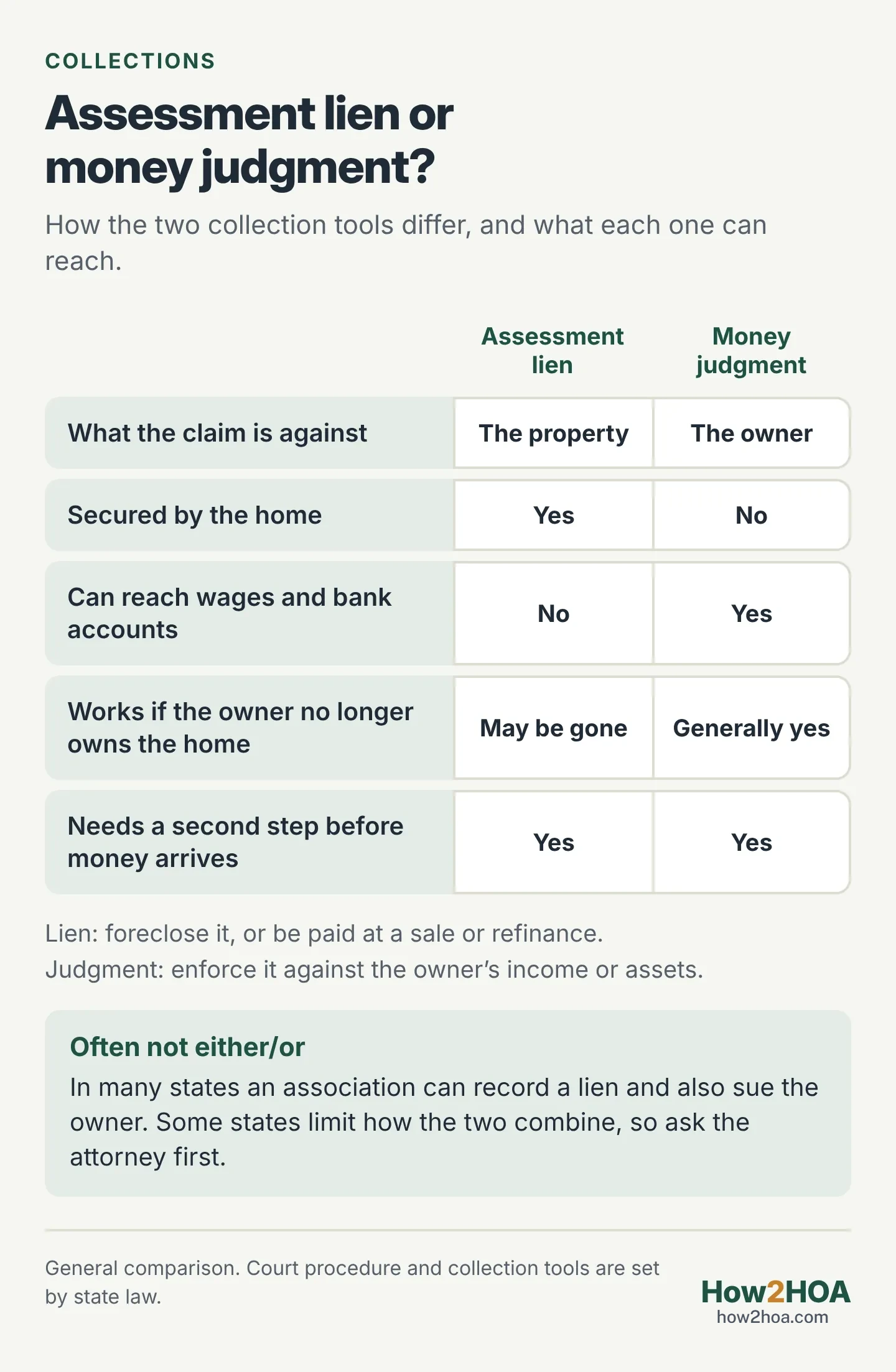
Some boards assume a judgment is the simpler route because there is no foreclosure to carry out. That is only half true. Both routes take a second step before any money arrives. A lien has to be foreclosed or paid off at a sale or refinance. A judgment has to be enforced against the owner’s income or assets, and winning in court is no guarantee of being paid.
Liens and judgments are not mutually exclusive in many states. An association can often record an assessment lien and also sue the owner, which protects it if one route fails, at the cost of more attorney time. Some states limit how the two can be combined, so this is a question for the attorney at the start.
Pros and cons of using a judgment
Advantages
- It reaches beyond the property. A judgment can be enforced against the owner’s wages, bank accounts and other assets. That matters when the home has no equity above its mortgage.
- It works against former owners. If the owner has sold the home or lost it to the lender, the association’s lien on that property may be gone, but the person generally still owes the assessments that came due while they owned it.
- It can become a lien on other real estate. In most states a recorded judgment creates a judgment lien on real property the debtor owns in that county.
- It does not require a sale of the home. For a board reluctant to foreclose on a neighbor, a lawsuit is a serious step that stops short of that.
Drawbacks
- It is not secured by anything. An assessment lien is attached to the property, so a sale or foreclosure can pay it. A judgment is attached to a person, and the association has to find income or assets to collect from.
- Collection can be slow and costly. The court does not collect for you. Each enforcement step has its own forms, fees and waiting periods, and state exemption laws protect part of a debtor’s wages and property.
- Help costs money. A collection agency or judgment enforcer charges a fee, often a share of whatever it recovers, and may recover nothing.
- Bankruptcy can interrupt it. If the owner files for bankruptcy, an automatic stay stops most collection activity, including lawsuits and wage garnishments, as the federal courts explain.
A judgment should not be pursued as a way to punish an owner or damage their credit. The purpose is to get the community paid, and a mark against a neighbor does nothing for the budget.
How to obtain a court judgment for unpaid HOA fees
The steps differ by state and by court, but a collection lawsuit generally follows this sequence:
- Board decision and attorney review. The board authorizes the lawsuit. The attorney checks the ledger, the governing documents, the notices already sent, any required pre-suit dispute resolution, and the deadline for suing under the statute of limitations.
- Filing the complaint. The attorney files a complaint in the court that handles claims of that size, stating what is owed and why, with the supporting documents the court requires.
- Serving the owner. The owner must be formally served with the lawsuit. A judgment obtained without proper service can be thrown out later.
- Response or default. The owner has a set time to respond and can dispute the claim. If the owner does not respond, the association can ask for a default judgment.
- Hearing, trial or settlement. If the owner contests the case, the association proves the debt with its ledger, governing documents and notices. Many cases settle at this stage with a written payment agreement.
- Judgment. If the association wins, the court enters a judgment for the unpaid assessments. Where the governing documents and state law allow, it also includes late charges, interest, court costs and attorney’s fees.
- Enforcement. The association uses the judgment to garnish wages, levy bank accounts, record a judgment lien or examine the debtor about assets, following the state’s enforcement procedures.
Settlements and confessions of judgment
Some associations have used a “confession of judgment” (sometimes called a confessional judgment). The owner signs a settlement with a payment schedule and agrees that, if a payment is missed, a judgment can be entered against them without a trial. Whether this is allowed depends entirely on the state. Some states restrict or prohibit confessions of judgment, and California has made them unenforceable, as noted below. Ask the attorney which settlement tools your state allows, such as a judgment the parties agree to in a case that has already been filed.
In California: suing an owner for unpaid assessments
These points come from the current statute text and the California courts’ self-help guides, each listed in the sources section below.
- Assessments are a personal debt. A regular or special assessment, with any late charges, reasonable collection costs, reasonable attorney’s fees and interest, is a debt of the owner of the separate interest from the time it is levied (Civil Code section 5650).
- The association may sue even if it has a lien. The Davis-Stirling Act states that neither its lien provisions nor Code of Civil Procedure section 726 prohibits an association from suing the owner to recover sums for which a lien has been created, or from accepting a deed in lieu of foreclosure (Civil Code section 5700).
- Small balances. When delinquent assessments are under the $1,800 foreclosure threshold and not more than 12 months delinquent, the association may not foreclose but may use small claims court or any other lawful method (Civil Code section 5720).
- Which court. An association can bring a claim of $6,250 or less in small claims court (Code of Civil Procedure section 116.220), but no more than two claims over $2,500 in a calendar year (Code of Civil Procedure section 116.231). Cases for $35,000 or less are limited civil cases, and larger ones are unlimited civil cases, according to the California courts’ self-help guide.
- Collecting the judgment. The California courts’ guide to collecting a judgment explains that the court does not collect the money for you. A wage garnishment or bank levy requires a writ of execution carried out by the sheriff. A lien on real estate requires an abstract of judgment recorded with the county recorder.
- How long it lasts. A judgment lien on real property is created by recording an abstract of judgment and generally continues for 10 years from the date the judgment was entered (Code of Civil Procedure section 697.310). The courts’ guide says most civil judgments last 10 years and must be renewed before they expire if collection will take longer.
- No confessions of judgment. A judgment by confession is unenforceable and may not be entered in any California superior court, except for those obtained or entered before January 1, 2023 (Code of Civil Procedure section 1132).
Whether the association can recover its attorney’s fees, how a lawsuit interacts with an existing lien, and which court to file in are all questions for the association’s attorney before the board votes to sue.
Choosing between a judgment and a lien
A lawsuit is often easier to start than a foreclosure, but an assessment lien is usually the stronger tool because it is attached to the property and not only to the person. A judgment makes the most sense when the property has little equity, when the owner has steady income or other assets, or when the debtor no longer owns the home. Ask the attorney to estimate, for the specific account, what each route would cost and what it is likely to bring in. For more on association finances, visit our HOA finances section.
The Law Behind This Article
Every legal point in this article comes from the official text. Each link below opens it in a new tab.
Civil Code sections: 5650 · 5700 · 5720
Code of Civil Procedure sections: 116.220 · 697.310 · 1132
Other sources: U.S. Courts: Chapter 7 Bankruptcy Basics · California Courts Self-Help Guide: Civil Lawsuits · California Courts Self-Help Guide: How to Collect a Judgment
This article is general educational information, not legal or financial advice. Laws vary by state and your association’s governing documents control many of these questions, so check with your association’s attorney or another qualified professional about your situation.