To change HOA management companies, the board reads the termination clause in its current contract, votes at a properly held meeting, gives written notice exactly the way the contract requires, and has the replacement firm signed before the old one leaves. The decision is usually the easy part. Most of the risk sits in the handover of money, records and vendor relationships, so that is where this guide spends its time.
Before you decide
Write down what is going wrong, with dates: late financial reports, unanswered owner calls, missed deadlines, billing surprises. Then raise the list with the firm’s owner or the manager’s supervisor. Sometimes the problem is one overloaded manager, and a reassignment inside the same firm fixes it at far less cost than a full transition. If the issues are with the firm itself (accounting errors, poor controls, fees that were never disclosed), a change is usually the right call.
The written list is worth keeping either way. If your contract only allows termination “for cause,” or requires a chance to cure, you will need it.
Switching management companies, step by step
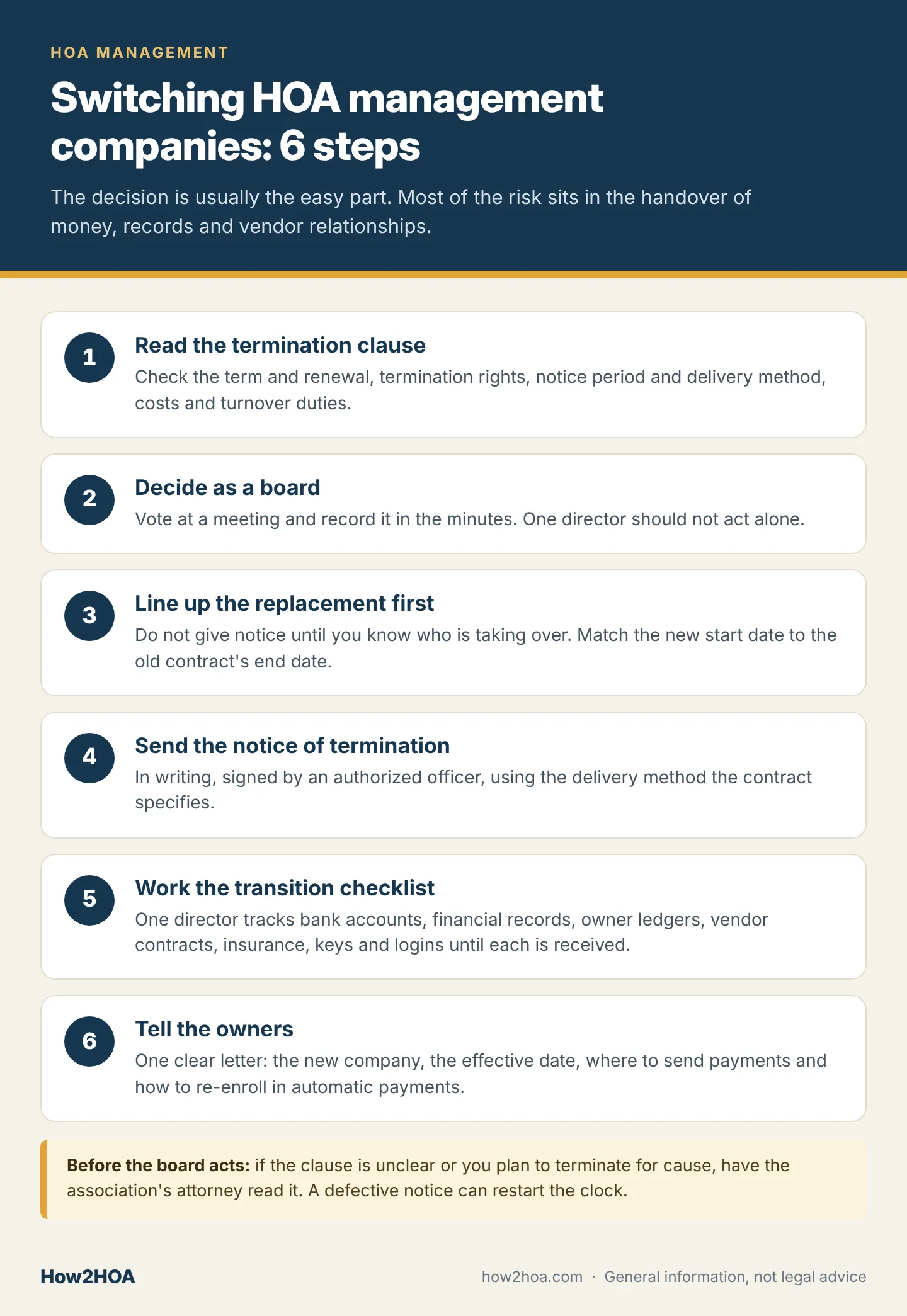
1. Read the termination clause
Pull the signed contract and every amendment. Our overview of HOA management contracts explains the common terms. For this purpose, look for:
- Term and renewal. When the current term ends, and whether it renews automatically unless you give notice by a certain date.
- Termination rights. Whether either side can end the contract without cause, or only for cause after written notice and a cure period.
- Notice period and method. How many days’ notice is required and how it must be delivered (for example, certified mail to a specific address).
- Costs. Any early termination charge, and any fee for copying, boxing or transferring records.
- Turnover duties. What the firm must hand over, and by when.
If anything is unclear, or you plan to terminate for cause, have the association’s attorney read the clause before the board acts. A defective notice can restart the clock.
2. Decide as a board
Ending one contract and signing another is a board decision, made by vote at a meeting and recorded in the minutes. One director should not act alone, however frustrated. Unless your governing documents say otherwise, owners do not vote on the choice of manager.
3. Line up the replacement first
Do not give notice until you know who is taking over. Send a written request for proposal to several firms, interview the manager who would be assigned to you (not only the salesperson), call references, and compare pricing on the same scope using the approach in how much HOA management costs. Ask each finalist for its onboarding plan and timeline. Set the new contract’s start date to match the old contract’s end date so there is no gap and no double billing.
4. Send the notice of termination
Send it in writing, signed by an authorized officer, using the delivery method the contract specifies. State the effective date, cite the contract section and attach a list of what you expect to receive and when. Keep the tone professional and keep paying the firm through the end date. You need its cooperation for the next several weeks.
5. Work the transition checklist
Assign one director as the point of contact and track every item until it is received.
- Bank accounts and signers. A list of every operating and reserve account, statements and reconciliations through the final day, updated signature cards and removal of the old firm’s online access. Accounts titled in the old firm’s name as trustee have to be closed or retitled.
- Financial records. General ledger, year-to-date financial statements, the current budget, unpaid invoices, check registers, tax returns, prior audits or reviews, and the reserve study.
- Owner ledgers. Each owner’s balance, prepayments, delinquencies, payment plans, recorded liens and any files with a collection attorney. Errors here turn into owner disputes fast.
- Owner roster. Names, mailing addresses, email addresses and delivery preferences.
- Governing documents and board records. CC&Rs (covenants, conditions and restrictions), bylaws, rules, minutes, resolutions, election records and architectural and violation files.
- Vendor contracts. Signed agreements, certificates of insurance, tax forms, warranties, open work orders and bids in progress.
- Insurance. Current policies, open claims and the agent’s contact details. Ask the agent to update the policies to reflect the new management company.
- Physical access. Keys, fobs, remotes, gate and alarm codes, and administrator rights to any access control system.
- Website, portal and email. Domain name ownership, website logins and association email accounts. Owner autopay set up through the old firm’s portal usually stops with the contract, so owners have to enroll again.
- Legal and mail. Pending legal matters, attorney contacts, mail forwarding and new billing addresses for utilities and government filings.
6. Tell the owners
Send one clear letter or email, ideally jointly with the new firm: who the new company is, the effective date, where to send payments, how to re-enroll in automatic payments, and whom to call. Confirm that assessment amounts are not changing because of the switch. Repeat the payment instructions at least once. Misdirected payments are the most common transition headache.

Share this infographic: Pinterest · Facebook · LinkedIn · Email · Download
The first 90 days
- First 30 days. The new firm ties its opening balances to the old firm’s final bank statements and reconciliations, and loads every owner ledger. The board reviews a list of anything still missing and follows up in writing.
- Days 30 to 60. The board receives its first full financial package and checks it against the last report from the prior firm. The manager walks the property and meets the main vendors.
- Days 60 to 90. Clear the open items: the prior firm’s final accounting, forwarded payments, any missing records. Then compare the new firm’s performance to the scope in the contract while expectations are still fresh.
A transition is also a natural time to tighten financial controls, since signers, logins and approval limits are all being reset anyway.
In California
The steps above are good practice anywhere. California adds specific legal requirements under the Davis-Stirling Common Interest Development Act and the Business and Professions Code.
- How the manager must hold your money. Under Civil Code section 5380, a managing agent that receives association funds must deposit them in a trust account at an insured financial institution in California, unless they go into an account controlled by the association or into escrow. The agent may not commingle association funds with its own money or with other clients’ money, must keep a separate record of receipts and disbursements, and may not benefit from interest earned on the funds. Transfers out of reserve or operating accounts above a set threshold need the board’s prior written approval: the lesser of $5,000 or 5 percent of estimated annual income for associations with 50 or fewer units, and the lesser of $10,000 or 5 percent for larger ones. Civil Code section 5502 applies the same approval rule to the association itself. At a transition, this is why the board should know how every account is titled.
- Disclosures from the new firm. A prospective managing agent must give the board the written disclosure required by Civil Code section 5375 no more than 90 days before entering into the agreement, covering its owners, licenses, certifications and financial interests. Civil Code section 5375.5 requires written disclosure of potential conflicts of interest, such as referral fees, with the bid.
- Fidelity coverage. Civil Code section 5806 requires the association to carry crime or fidelity coverage at least equal to its reserves plus three months of assessments, including computer fraud and funds transfer fraud. If the association uses a managing agent, the coverage must also cover dishonest acts by that company and its employees. Ask your insurance agent to confirm this still holds with the new firm. Separately, Business and Professions Code section 11504 requires a manager to disclose, before entering into or renewing a contract, whether its own fidelity insurance covers the association’s operating and reserve funds.
- Return of records. We did not find a Davis-Stirling section that sets a deadline for an outgoing manager to return records, so the contract controls. Section 11504 does require a manager to acknowledge in writing that the member disclosure documents it prepares are the association’s property. The association itself stays responsible for producing records to members under Civil Code section 5205 and for delivering sale documents within 10 days of a request under Civil Code section 4530, no matter who is holding the files. Put a specific turnover deadline and format in both the old firm’s exit terms and the new contract.
- Board meetings. Civil Code section 4935 allows the board to meet in executive session to consider the formation of contracts with third parties, and requires that the matters discussed be generally noted in the minutes of the next open meeting.
Our free HOA Management RFP Builder turns your needs into a request for proposal for management companies, with a scoring sheet and the disclosures California managers must provide.
Frequently asked questions
Can we terminate in the middle of the contract term?
It depends on the contract. Many allow either party to terminate without cause on written notice. Others require cause and a cure period. If yours is the second kind, get legal advice before sending anything.
Should the old and new firms overlap?
A brief, cooperative overlap in communication helps, but only one firm should be handling money at a time. Set a clean cutoff date for deposits and payments.
Boards that are still weighing their choices can start with the management options comparison or browse the HOA management hub.
The Law Behind This Article
Every legal point in this article comes from the official text. Each link below opens it in a new tab.
Civil Code sections: 4530 · 4935 · 5205 · 5375 · 5375.5 · 5380 · 5502 · 5806
Business and Professions Code sections: 11504
This article is general educational information, not legal or financial advice. Laws vary by state and your association’s governing documents control many of these questions, so check with your association’s attorney or another qualified professional about your situation.