An HOA executive session is a closed portion of a board meeting, or a separate closed meeting, where directors handle a short list of confidential matters without owners present. In most states, and in California by statute, that list is limited to topics such as legal matters, contract negotiations, member discipline, personnel and individual owners’ delinquencies. Everything else belongs in an open meeting.
What executive session is for
Open meetings are the default because owners are entitled to watch their board govern. Executive session is the exception, and it exists to protect three things:
- The association’s legal position. Advice from the association’s attorney is privileged, and discussing it in front of an audience can waive that protection.
- The association’s bargaining position. A board cannot negotiate a contract well if the other side hears its budget and its fallback plan.
- Individual privacy. Owners facing a violation hearing or a delinquency, and employees being evaluated, should not have their circumstances aired before the neighbors.
Executive session is not a place for subjects that are merely uncomfortable, controversial or likely to draw a crowd.
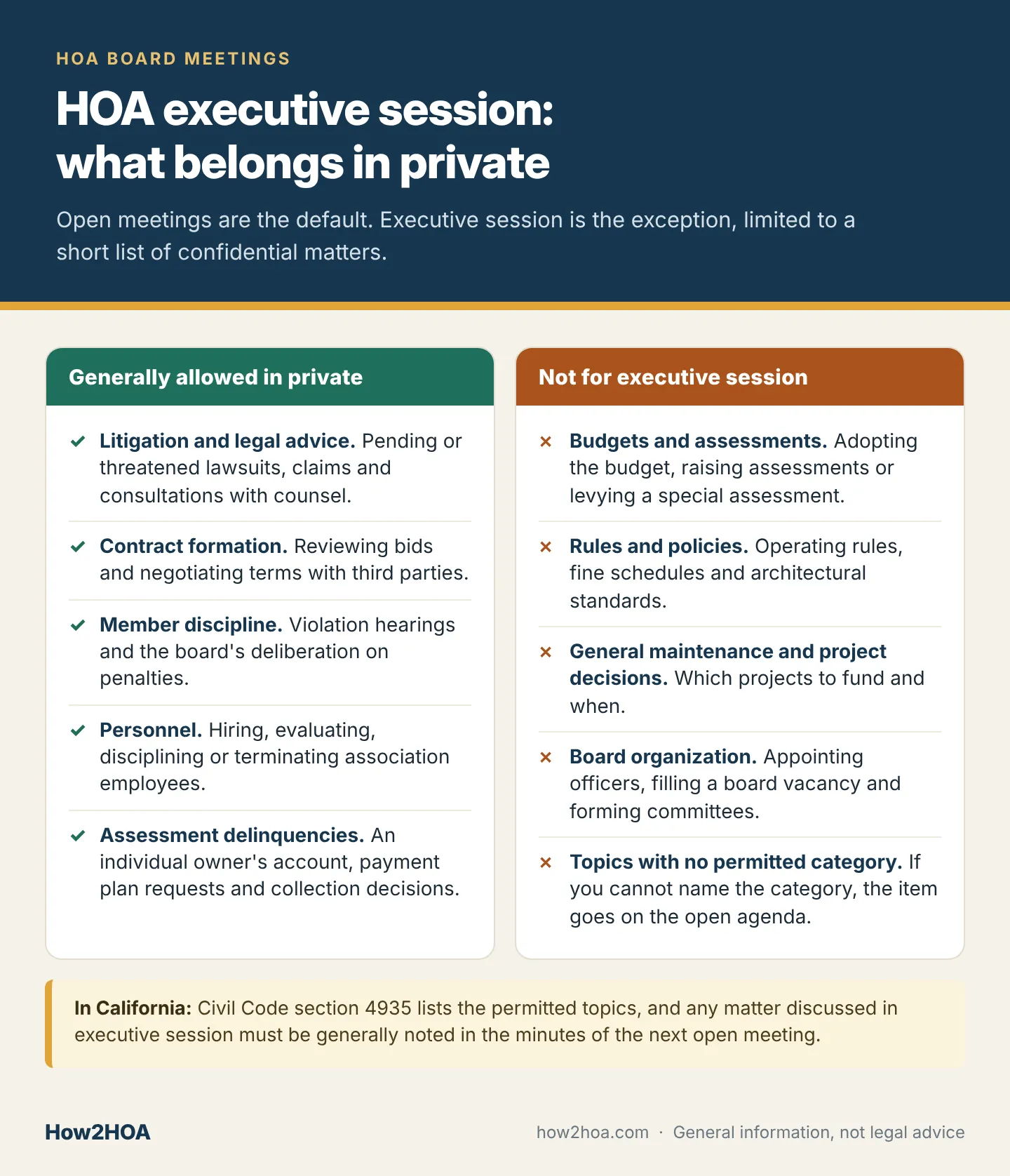
Topics generally allowed in private
State laws differ in wording, but the permitted categories are similar across the country:
- Litigation and legal advice. Pending or threatened lawsuits, claims and consultations with counsel.
- Contract formation. Reviewing bids and negotiating terms with vendors, managers and other third parties.
- Member discipline. Violation hearings and the board’s deliberation on penalties.
- Personnel. Hiring, evaluating, disciplining or terminating association employees.
- Assessment delinquencies. An individual owner’s account, payment plan requests and collection decisions.
What does not belong in executive session
- Budgets and assessments. Adopting the budget, raising assessments or levying a special assessment.
- Rules and policies. Adopting or changing operating rules, fine schedules and architectural standards.
- General maintenance and project decisions. Which projects to fund and when, apart from the confidential parts of a contract negotiation.
- Board organization. Appointing officers, filling a board vacancy and forming committees.
- Topics that do not fit a permitted category. If you cannot name the category, the item goes on the open agenda.
A common pattern is to label a broad subject “legal” because an attorney is in the room or a letter was received. The test is whether the board is actually receiving legal advice or discussing a dispute, not whether the topic feels sensitive.

Share this infographic: Pinterest · Facebook · LinkedIn · Email · Download
Who attends
Directors attend. The board may invite the manager, the association’s attorney and anyone else whose input is needed for a particular item, such as an insurance adjuster or a consultant. Invited guests should stay only for their item. An owner who is the subject of a disciplinary hearing or who asked to discuss a payment plan attends for that matter and then leaves before deliberation on other owners’ matters.
Confidentiality
What is said in executive session stays there. Directors owe duties of care and loyalty to the association, and repeating closed-session discussions to a spouse, a neighbor or a social media group can breach those duties, waive the attorney-client privilege and expose both the association and the director to claims. Our article on fiduciary duty and the business judgment rule explains those duties. Practical habits help: distribute executive session materials securely, collect or delete them afterward, and do not discuss the items by email.
Minutes of an executive session
Keep two records. Confidential executive session minutes should list who attended, the items considered and any decisions, in as few words as possible. The open meeting minutes then note that an executive session was held and the general subjects, without names or detail. For example: “The board met in executive session to consider two delinquent accounts, one disciplinary hearing and a legal matter.” See HOA meeting minutes for a template that includes this entry.
In California
The Common Interest Development Open Meeting Act, Civil Code section 4900 and the sections that follow, governs board meetings of California associations. Our overview of HOA board meetings and their breakdown covers open meetings generally. The executive session rules are below.
Permitted topics: Civil Code 4935
Civil Code section 4935 allows the board to adjourn to, or meet solely in, executive session to consider:
- Litigation.
- Matters relating to the formation of contracts with third parties.
- Member discipline.
- Personnel matters.
- A meeting with a member, at the member’s request, about the member’s payment of assessments.
The same section makes executive session mandatory in three situations:
| Situation | Rule |
|---|---|
| Member discipline | The board must meet in executive session if the member who is the subject requests it, and that member is entitled to attend. |
| Payment plan request | The board must meet in executive session to discuss a payment plan under Civil Code section 5665. |
| Foreclosure decision | The board must meet in executive session to decide whether to foreclose on an assessment lien. |
Two related sections fill in details. Under Civil Code section 5665, when an owner mails a written request to discuss a payment plan within 15 days of the postmark of the pre-lien notice, the board must meet with the owner in executive session within 45 days of the request’s postmark. If no regular board meeting falls in that period, the board may designate a committee of one or more directors to meet with the owner. Under Civil Code section 5705, the decision to foreclose must be made by a majority vote of the directors in executive session, cannot be delegated to a manager, and must be recorded in the minutes of the next open meeting by parcel number, not by the owner’s name. See collecting late HOA fees through foreclosure for the rest of that process.
Note the contrast with liens. The decision to record a lien must be made in an open meeting under Civil Code section 5673.
Disciplinary hearings
Under Civil Code section 5855, the board must give a member at least 10 days’ written notice before a meeting to consider discipline. The notice must say that the member may attend and address the board. The hearing is held in executive session if the member requests it. Our guide to HOA rules and enforcing violations covers the enforcement steps around the hearing.
Notice and agenda
- Four days for most meetings. Civil Code section 4920 requires notice of the time and place of a board meeting at least four days in advance.
- Two days for executive-only meetings. If a nonemergency meeting is held solely in executive session, the notice period is at least two days.
- Longer periods in the governing documents. A longer notice period in the governing documents applies, but it does not extend to executive-only meetings unless it specifically says so.
- The notice includes the agenda. Notice is given by general delivery and must contain the agenda. For a closed meeting, associations typically describe the items in general terms, such as “member discipline, delinquencies, legal.”
- Stick to the agenda. Under Civil Code section 4930, the board may not discuss or take action on an item at a nonemergency meeting unless it was on the agenda, with narrow exceptions.
To build a notice and agenda that follow these rules, including a separate executive session agenda for directors, use our free California HOA Board Meeting Notice and Agenda Template.
Members may attend board meetings except when the board adjourns to, or meets solely in, executive session (Civil Code section 4925).
No decisions outside a meeting
Civil Code section 4910 says the board may not take action on any item of business outside a board meeting. It also bars conducting a meeting through a series of electronic transmissions such as email, except for an emergency meeting where every director consents in writing and the consents are filed with the minutes. An email thread among directors deciding an executive session matter is not an executive session.
Minutes and member access
Section 4935(e) requires any matter discussed in executive session to be generally noted in the minutes of the immediately following meeting that is open to the entire membership. Executive session minutes themselves are excluded from the records members may inspect, and Civil Code section 5215 lets the association withhold them. That section carves out executed contracts that are not otherwise privileged, so a signed vendor or management contract is generally open to members even though it was negotiated in private. See HOA records requests.
Common mistakes
- Treating executive session as the working meeting. If the open meeting has become a brief formality after a long closed session, too much is happening in private.
- Vague or missing disclosure. Skipping the general note in the open minutes is a statutory violation in California.
- Email decisions. Polling directors by email and recording it later as an executive session action.
- Leaving guests in the room. A guest who hears privileged advice on an unrelated item can undermine the privilege.
- Refusing a member’s request. In California, a member facing discipline can require a closed hearing, and can attend it.
- Recording the lien vote in the wrong place. Lien approval is an open meeting vote. Foreclosure approval is an executive session vote.
Frequently asked questions
Can the board vote in executive session?
On permitted topics, boards generally do make decisions in closed session, and California expressly requires the foreclosure vote to happen there. Many boards still choose to approve the final contract in open session after negotiating privately. Ask your association’s attorney how your board should handle contract approvals.
Can owners attend an executive session?
No, except an owner who is the subject of a disciplinary hearing or who asked to meet about a payment plan, for that item only.
Does the board have to announce an executive session?
In California, yes. A meeting held solely in executive session requires at least two days’ notice with an agenda, and the topics must be generally noted in the next open meeting’s minutes.
Used correctly, executive session protects the association without shutting owners out. For more on running meetings, visit the board meetings hub.
The Law Behind This Article
Every legal point in this article comes from the official text. Each link below opens it in a new tab.
Civil Code sections: 4900 · 4910 · 4920 · 4925 · 4930 · 4935 · 5215 · 5665 · 5673 · 5705 · 5855
This article is general educational information, not legal or financial advice. Laws vary by state and your association’s governing documents control many of these questions, so check with your association’s attorney or another qualified professional about your situation.