California HOA Guide
California HOA Board Basics
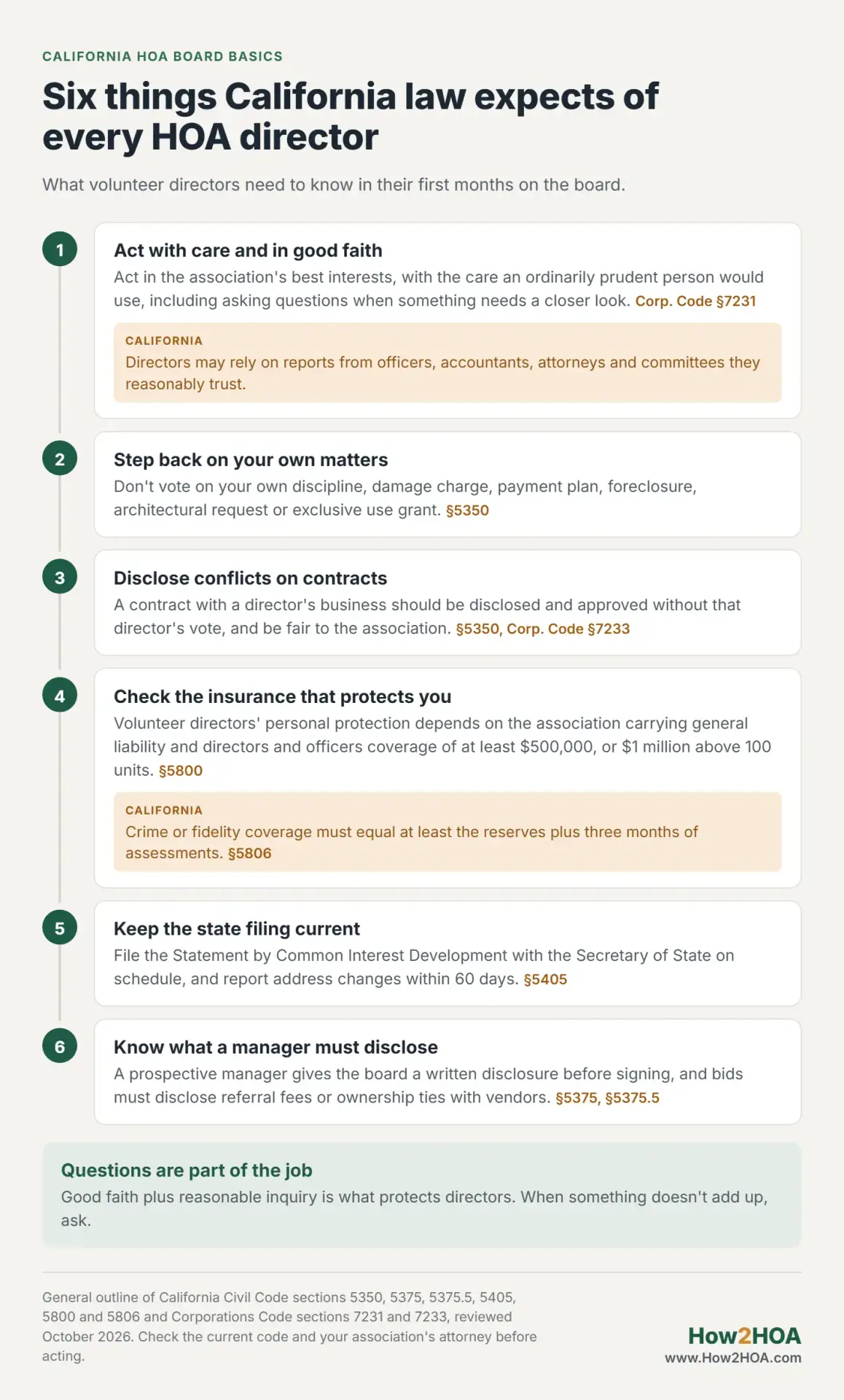
What California law expects of volunteer directors: the duty of care, conflicts of interest, the insurance that protects you and the filings every association has to keep current.
What the law requires
Your Duties as a Director
Good faith, the association’s best interests and reasonable care. That’s the standard.
Every California association is run by a board, and the law asks each director to act like a careful, honest steward of other people’s money and property.
What the law requires
Conflicts of Interest
If the vote is about you, your property or your business, step back.
California spells out the decisions a director can’t vote on and how to handle a contract that benefits a director.
What the law requires
Liability Protection and Insurance
Your personal protection as a volunteer depends on the association’s insurance limits.
California shields volunteer directors from personal liability in many lawsuits, but only when the association carries the right insurance.
What the law requires
Filings and Working With a Manager
An incorporated association that misses its Secretary of State filing can be suspended.
Two more duties catch new boards by surprise: a state filing and the disclosures a management company owes you.

How to do it
Your First 90 Days on the Board
Read first, ask questions second, vote third.
A new director doesn’t need to know everything on day one. These steps get you up to speed in a few months.
Common mistakes
Where Boards Slip Up
Several of these mistakes can strip directors of the protection the law offers volunteers.
These are the errors we see most often from new and experienced California boards alike.
Best practice, not a legal requirement
Habits of Effective Boards
Everything in this section is a recommendation. None of it is required by California law.
The law sets the minimum. These habits help a volunteer board work well together and earn owners’ trust.
5 guides
Your Role and Duties
What Are an HOA Board Member's Responsibilities?
What an HOA board member is responsible for: running the association's business, enforcing the documents and putting the membership first.
What Are the Rules for an HOA Board of Directors?
The rules for an HOA board come from state and federal law, the CC&Rs, the bylaws and operating rules. What each requires and where power stops.
HOA Board Officer Roles and What Each One Does
What the HOA president, vice president, treasurer and secretary each do, what no officer can do alone, and the California rules on officers.
HOA Fiduciary Duty and the Business Judgment Rule
What fiduciary duty requires of HOA directors, what the business judgment rule does and does not protect, and how to handle conflicts of interest.
How to Minimize Homeowners Association Liability
A board lowers HOA liability by acting with care and within its authority, keeping common areas safe and carrying the right insurance.
4 guides
Joining the Board
The Benefits of Joining Your HOA Board
Serving on your HOA board gives you a vote on how assessments are spent, a clear view of the finances and useful skills. What you gain.
How to Become an HOA Board Member
To become an HOA board member you generally need to own in the community, get nominated and win votes. How to qualify and what the job takes.
The Must-Have HOA Management Checklist for New Board Members
A practical checklist for new HOA board members covering records, finances, budget and reserves, maintenance, meetings and insurance.
Developer Transition: Taking Over the HOA From the Builder
What developer transition means, a checklist for the first owner-controlled HOA board, and California rules on developer control and defects.
3 guides
Working Together
3 Common Mistakes HOA Board Members Make
The most common HOA board mistakes: policing neighbors instead of managing property, communicating too little and going it alone. How to avoid them.
Battling Board Members: When HOA Board Members Fight
When HOA board members fight, the fix depends on the cause: a power play, a push for reform, a grudge or personal gain. How to get back to work.
How to Set Up and Run HOA Committees
HOA committees work when the board gives them a written assignment, a chair, a deadline, a budget and a way to report back. How to set them up.
Sources
The Law Behind This Page
Keep going
Related Topics
California HOA Guide
Every California topic guide in one place.
Budgets, Reporting and Records
Annual reports, the monthly review and owner records.
Board Members
Roles, duties and serving on the board in any state.
Management
Working with a management company.
Local Guides by City
City and neighborhood guides, county by county.
New Board Member Guide
Where to start in your first months on the board.
Get help
Want Support for Your Board?
A professional management company can keep the filings, insurance renewals and deadlines on track, so volunteer directors can focus on decisions for the community.
Last reviewed October 21, 2026. Sections cited: Civil Code 4800, 4805, 5350, 5375, 5375.5, 5385, 5405, 5800, 5805 and 5806, and Corporations Code 7231 and 7233. By the How2HOA Editorial Team. This page is general educational information, not legal advice. Laws change and your association’s governing documents control many of these questions, so check with your association’s attorney about your situation.