California HOA Guide

California HOA Enforcement, Fines and Disputes

How California HOAs enforce the rules fairly: the fine limits that took effect in 2025, the hearing steps before any fine and the dispute resolution owners and boards must try before going to court.

What the law requires

Fines and the Hearing Process

A fine can’t be more than the lesser of your posted schedule or $100 per violation, unless the violation could affect health or safety (section 5850).

AB 130 rewrote the fine rules in 2025. The changes took effect June 30, 2025, and apply to every California association that fines owners.

  • Publish a schedule. If the association fines owners for violating the governing documents, including fines tied to a guest’s or tenant’s conduct, the board must adopt a schedule of fines and send it to every owner in the annual policy statement. The schedule must follow the discipline the governing documents authorize, and fines must be reasonable. New or revised fines can go out in a supplement delivered to each owner, and any owner can ask for a copy of the current schedule (section 5850). A fine schedule is also an operating rule, so changing it follows the 28-day notice process.
  • The cap. A fine can’t exceed the lesser of the amount in the schedule in effect when the violation happened or $100 per violation (section 5850).
  • The health and safety exception. The board may impose a higher fine from the schedule if the violation may result in an adverse health or safety impact on the common area or another owner’s property. Before imposing it, the board must make a written finding describing that impact at a board meeting open to the members (section 5850).
  • No late charges on fines. The association can’t charge late charges or interest on a fine (section 5850).
  • Notice of the hearing. Before the board meets to consider discipline, or to charge an owner for repairing common area damage caused by the owner or the owner’s guest or tenant, it must notify the owner in writing, by personal or individual delivery, at least 10 days before the meeting. The notice must give the date, time and place, the nature of the alleged violation or damage and a statement that the owner may attend and address the board. If the owner asks, the board meets in executive session (section 5855).
  • The right to cure. The owner must have the chance to fix the violation before the meeting. The board can’t impose discipline if the owner cures it first, or, when the fix would take longer than the time before the meeting, if the owner provides a financial commitment to cure it (section 5855).
  • After the hearing. If the board and the owner agree, the board drafts a written resolution, which binds the association once both sign it. If they don’t agree, the owner can request internal dispute resolution. If the board imposes discipline or a repair charge, it must send the owner a written decision by personal or individual delivery within 14 days (section 5855).
  • Skipped steps undo the fine. Discipline or a repair charge isn’t effective against an owner unless the board follows every one of these steps (section 5855).
  • Fines aren’t liens. A fine can’t be treated as an assessment that becomes a lien the association can foreclose on (section 5725). See Assessments and Collections for how assessment liens work.
  • Declared emergencies. During a declared state or local emergency, the association can’t pursue enforcement, other than for unpaid assessments, if the emergency makes it unsafe or impossible for the owner to prevent or fix the violation (section 5875).

For the practical side of the process, see How to Enforce HOA Rules.

What the law requires

Internal Dispute Resolution

When an owner asks for internal dispute resolution, the association has to take part, and it can’t charge the owner a fee (section 5910).

Every California association must offer a free, fair and fast way to work out disputes with owners before anyone goes to court.

  • What it covers. Disputes between the association and an owner about their rights, duties or liabilities under the Davis-Stirling Act, the Nonprofit Mutual Benefit Corporation Law or the governing documents (section 5900).
  • The association must offer a procedure. It has to be fair, reasonable and expeditious, and it should make reasonable use of local dispute resolution programs with a neutral third party, such as low-cost mediation (section 5905).
  • The minimum requirements. Either side can start the process with a written request. The procedure must set prompt deadlines and the maximum time the association has to act. If an owner starts it, the association must take part. If the association starts it, the owner may decline, and an owner who takes part but doesn’t agree with the result can appeal to the board. Both sides get to explain their positions and may bring an attorney or someone else at their own cost, and the owner can’t be charged a fee (section 5910).
  • Written agreements count. A written resolution or agreement signed by both sides that doesn’t conflict with the law or the governing documents is binding and enforceable in court (section 5910).
  • The default process. If the association hasn’t adopted its own procedure, the law supplies one: either side can request in writing to meet and confer. The owner may refuse, but the association can’t. The board names a director to meet with the owner, and any agreement is put in writing and signed. The agreement binds the parties if it doesn’t conflict with the law or the governing documents and is within the director’s authority or ratified by the board (section 5915).
  • No lawsuit first. If an owner has requested dispute resolution, the association can’t file a lawsuit over that dispute until it has taken part in good faith (section 5910.1).
  • Tell owners about it. The annual policy statement must describe the association’s internal dispute resolution process (section 5920).
  • Start in writing. Owners and boards can use our free IDR Request Form to put a request in writing and track the association’s deadline.

What the law requires

Before Anyone Sues

Before most lawsuits over the governing documents, the parties have to try mediation or another form of alternative dispute resolution (section 5930).

If internal dispute resolution doesn’t settle things, California requires one more step before most enforcement lawsuits.

  • What alternative dispute resolution means. Mediation, arbitration, conciliation or another out-of-court process with a neutral party. It can be binding or nonbinding if both sides agree (section 5925).
  • When it’s required. Neither the association nor an owner may file an enforcement action in superior court without first trying alternative dispute resolution, when the lawsuit seeks only declaratory, injunctive or writ relief, or that relief plus damages within the small claims limits. It doesn’t apply to small claims cases or, except as the law otherwise provides, to assessment disputes (section 5930).
  • The Request for Resolution. Either side starts the process by serving a Request for Resolution with a brief description of the dispute, a request for alternative dispute resolution and notice that the other side must respond within 30 days or the request is deemed rejected. If it’s served on an owner, it must include a copy of the law’s ADR article (section 5935).
  • Timing and cost. If the request is accepted, the process must be finished within 90 days unless both sides agree in writing to extend it, and the parties share the cost (section 5940). The mediation confidentiality rules that begin at Evidence Code section 1115 apply to any process other than arbitration. Deadlines to file suit are paused while the request is pending and while the process runs (section 5945).
  • The certificate. Whoever files suit must attach a certificate saying alternative dispute resolution was completed, the other side didn’t accept it or urgent court relief is needed (section 5950). A court deciding attorney’s fees may consider whether a party’s refusal to try it was reasonable (section 5960).
  • The annual summary. The annual policy statement must include a summary of these rules, with the statutory warning that an owner who doesn’t follow them may lose the right to sue (section 5965).
  • Who can enforce what. CC&R restrictions are enforceable unless unreasonable, by any owner or the association unless the declaration says otherwise. Other governing documents can be enforced by the association against an owner or by an owner against the association. In a lawsuit to enforce the governing documents, the winning side recovers reasonable attorney’s fees and costs (section 5975).

For a side-by-side look at both processes, see IDR and ADR: Resolving HOA Disputes Before Court.

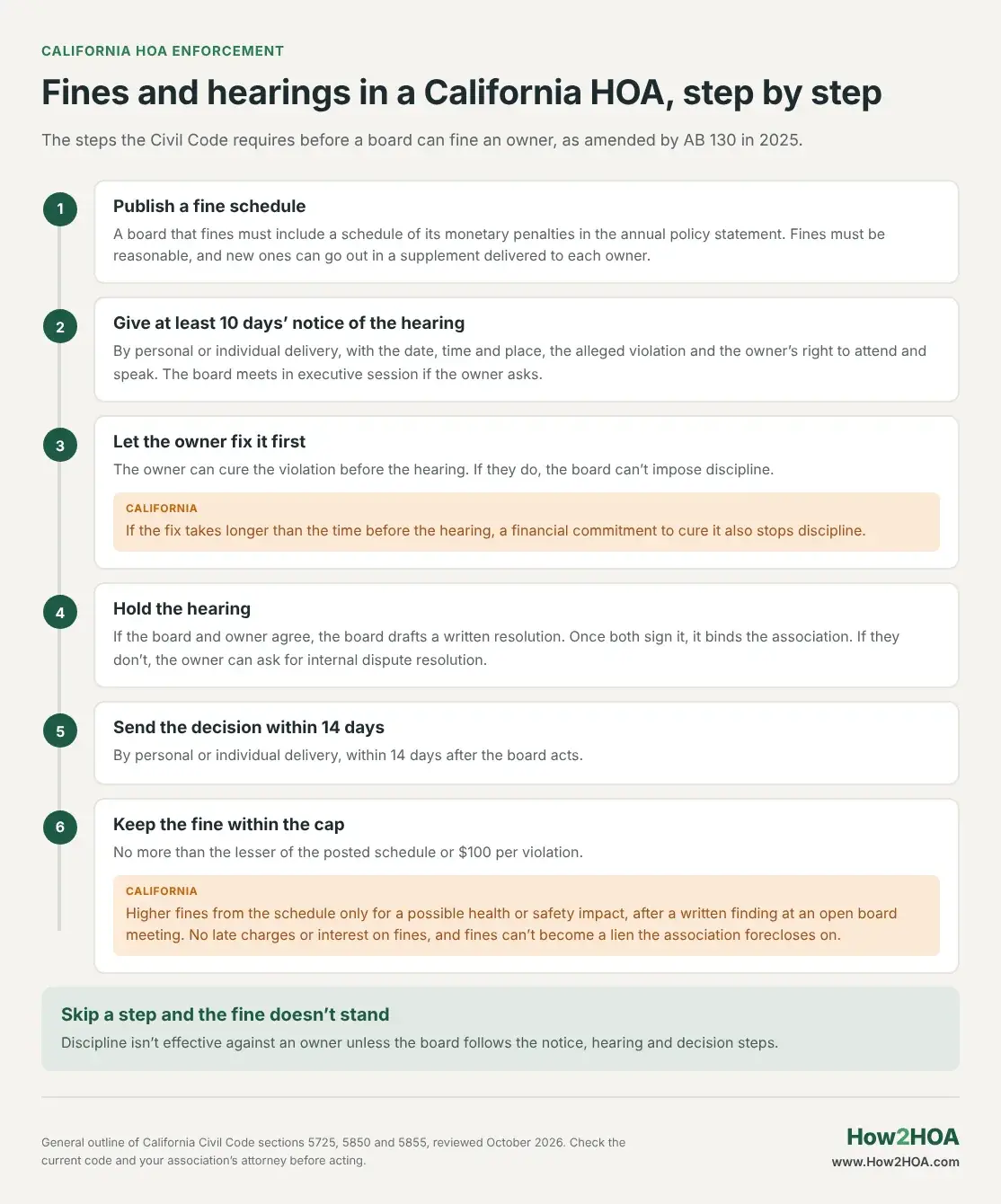
Fine and hearing steps

How a Fine Works, Step by Step

Six steps before a California HOA fines an owner: publish a fine schedule, give at least 10 days of hearing notice, let the owner cure the violation first, hold the hearing, send the decision within 14 days, and keep the fine to the lesser of the schedule or $100 per violation unless a health or safety finding is made.

Share this infographic: Pinterest · Facebook · LinkedIn · Email · Download

How to do it

Running Enforcement Step by Step

Every fine should be able to survive a second look from the owner, the board and a judge.

A consistent routine protects owners’ rights and keeps the association’s decisions from being overturned.

  1. Check your fine schedule. Make sure it’s in the annual policy statement, matches what the governing documents authorize and caps each fine at $100 unless the health and safety exception applies.
  2. Start with a courtesy notice. A friendly letter or call that explains the problem and asks for a fix settles most issues. This is good practice, not a legal requirement.
  3. Send the hearing notice at least 10 days ahead by personal or individual delivery, with the date, time, place, the alleged violation and the owner’s right to attend and speak.
  4. Watch for a cure. If the owner fixes the problem before the hearing, or commits financially to a fix that takes longer, close the matter without discipline.
  5. Hold the hearing, in executive session if the owner asks. Let the owner speak and keep a record of what the board considered.
  6. Put any agreement in writing and have the board and the owner sign it.
  7. Decide and check the cap. For a fine over $100, the board must first make a written finding of the health or safety impact at an open board meeting.
  8. Send the written decision within 14 days by personal or individual delivery.
  9. Never add late charges or interest to a fine, and never try to collect a fine through a lien.
  10. Offer internal dispute resolution if the owner disagrees, and talk with the association’s attorney before serving a Request for Resolution or filing suit.

Board checklist

  • ☐ Our fine schedule is in the annual policy statement and no fine exceeds $100 without a health or safety finding.
  • ☐ Hearing notices go out at least 10 days ahead, by personal or individual delivery.
  • ☐ Every notice includes the date, time, place, the alleged violation and the owner’s right to speak.
  • ☐ Owners get the chance to cure before the hearing.
  • ☐ Agreements reached at hearings are put in writing and signed.
  • ☐ Written decisions go out within 14 days.
  • ☐ We never charge late fees or interest on fines.
  • ☐ Our annual policy statement describes our internal dispute resolution process and includes the ADR summary.
  • ☐ Owners are never charged to use internal dispute resolution.
  • ☐ We pause enforcement when a declared emergency makes it unsafe or impossible for an owner to comply.

Before you set a fine, run it through our free Fine Cap and Hearing Checker. It tests the amount against the $100 cap and the health and safety exception and gives you the hearing notice and decision deadlines.

To set fines ahead of time, the free Fine Schedule Builder builds a graduated schedule within the $100 cap, with the 28-day rule change notice to adopt it. When a hearing is set, the Hearing Notice and Decision Letter Template writes the notice before the hearing and the written decision after it.

Common mistakes

Where Boards Slip Up

Most of these mistakes make a fine unenforceable or hand the owner grounds to challenge it.

These are the enforcement errors we see most often in California associations, many of them from rules that changed in 2025.

  • Using a fine schedule written before AB 130. Fines above $100 now need the health or safety exception and a written finding at an open meeting (section 5850).
  • Adding late fees or interest to fines. The law no longer allows either (section 5850).
  • Fining without a hearing. Discipline isn’t effective unless the board gives 10 days’ notice and an opportunity to be heard (section 5855).
  • Fining an owner who already fixed the problem. A cure before the hearing ends the matter (section 5855).
  • Sending the decision on the old 15-day timeline. It’s 14 days now (section 5855).
  • Trying to lien a fine. Fines can’t become a lien the association forecloses on (section 5725).
  • Charging for internal dispute resolution or refusing to take part. Both violate the law when an owner invokes the process (section 5910).
  • Filing suit without trying alternative dispute resolution. Missing the certificate can get the case thrown out, and an unreasonable refusal can affect attorney’s fees (sections 5950 and 5960).

Best practice, not a legal requirement

Habits That Keep Enforcement Fair

Everything in this section is a recommendation. None of it is required by California law.

The law sets the minimum. These habits keep enforcement consistent and keep neighbors on speaking terms.

  • Lead with a conversation. Most violations end with a friendly call or note. Save formal notices for when that doesn’t work.
  • Document everything. Dated photos, copies of notices and proof of delivery make a decision easy to defend.
  • Treat everyone the same. Apply the same rules and fines to every owner, including directors and their neighbors.
  • Write an enforcement policy. A short written process for notices, hearings and fines keeps each board consistent from year to year.
  • Use mediation early. Local, low-cost mediation programs often resolve disputes faster and more cheaply than lawyers do.
  • Know when to call the attorney. Bring in counsel before an enforcement lawsuit, a fine over $100 or any dispute that involves fair housing or disability accommodation questions. For the bigger picture, see The Building Blocks of HOA Compliance.

4 guides

Enforcing the Rules

HOA Rules and Enforcing Violations

HOA rules come from the governing documents, and the board must enforce them fairly. What the rules cover and the stages of enforcement.

How to Solve Compliance Issues in an HOA

Most HOA compliance issues can be solved without a fine: confirm the facts, find out why, talk before you write and agree on a fix with a date.

The Building Blocks of HOA Compliance

HOA compliance starts before a violation letter: rules owners support and understand, an easy path to comply and a board they trust.

How to Deal With Barking Dogs in Your Homeowners Association

What an HOA board can and cannot do about a barking dog, how nuisance rules and local noise ordinances fit together and a fair escalation path.

1 guide

Resolving Disputes

IDR and ADR: Resolving HOA Disputes Before Court

How California HOAs and owners resolve disputes before court: the hearing before a fine, internal dispute resolution (IDR) and ADR.

Sources

The Law Behind This Page

Every legal point on this page comes from the official text. Each link below opens it on the California Legislature’s website in a new tab.

Civil Code sections: 5725 · 5850 · 5855 · 5875 · 5900 · 5905 · 5910 · 5910.1 · 5915 · 5920 · 5925 · 5930 · 5935 · 5940 · 5945 · 5950 · 5960 · 5965 · 5975

Evidence Code sections: 1115

Bills: AB 130

Keep going

Related Topics

California HOA Guide

Every California topic guide in one place.

Governing Documents and Rules

CC&Rs, bylaws and how rules change.

Board Meetings

Open meetings, executive session and notice.

Rules and Governing Documents

Rules and enforcement in any state.

Management

Working with a management company.

Local Guides by City

City and neighborhood guides, county by county.

Get help

Want Help With Enforcement?

A professional management company can track violations, send the required notices on time and prepare hearings, so the board can focus on fair decisions.

Last reviewed October 21, 2026. Civil Code sections cited: 5725, 5850, 5855, 5875, 5900, 5905, 5910, 5910.1, 5915, 5920, 5925, 5930, 5935, 5940, 5945, 5950, 5960, 5965 and 5975, plus Evidence Code section 1115 and AB 130 (2025). By the How2HOA Editorial Team. This page is general educational information, not legal advice. Laws change and your association’s governing documents control many of these questions, so check with your association’s attorney about your situation.

Share this: