
To deal with barking dogs in your homeowners association, start with a neighbor-to-neighbor conversation, move to a written complaint backed by a log, and then let the board use its normal notice and hearing process under the nuisance or pet rules. The city or county animal noise ordinance is a separate track that any resident can use at the same time. The board can enforce the association’s own documents. It cannot enforce the city code, and it cannot fine or restrict an owner without following its procedures.
What the association can and cannot do
The board’s authority comes from the governing documents. Most CC&Rs include a nuisance clause that prohibits activity that unreasonably interferes with other residents’ use of their homes, and many associations also have pet rules. Those provisions are what the board enforces. In general, a board can:
- Investigate a complaint and decide whether the barking violates a rule
- Send a courtesy letter, then a formal violation notice
- Hold a hearing and, if the documents allow it, impose a fine or other discipline
- Adopt a clearer pet noise rule, using the rulemaking steps its documents and state law require
A board generally cannot:
- Cite anyone under the city or county code. That belongs to animal control or code enforcement.
- Treat one neighbor’s complaint as proof. The board needs evidence it can weigh.
- Skip notice and a hearing because the facts seem obvious
- Order a dog out of the community on its own say-so. Removal is a serious remedy that calls for the association’s attorney and, usually, a court.
One caution before the board acts: if the dog is a service animal or another assistance animal for a resident with a disability, fair housing law may limit how pet rules and pet restrictions apply to it. That does not mean a real nuisance has to be ignored, but federal guidance on assistance animals has changed in the last few years and state law can differ, so get legal advice before acting on a complaint that involves an assistance animal.
How HOA nuisance rules and local ordinances fit together
Think of them as two systems that sit side by side. The association’s rules are a private agreement among owners, enforced by the board. The local ordinance is public law, enforced by the city or county. A dog can violate one, both or neither, and a decision in one system does not bind the other.
Local ordinances vary a lot, so read yours. As one example, the City of Petaluma’s municipal code section 9.08.180 makes it unlawful to keep an animal that makes continuous and incessant noise that disturbs others, and defines that as noise totaling 10 minutes or more within any one-hour period. It carves out barking provoked by a trespasser or by teasing, and it has animal control officers collect signed statements and bark logs. Your city may use a different measure or no fixed measure at all.
That example also shows what a workable rule looks like. “No nuisance barking” leaves the board arguing about opinions. A rule with a measurable standard, such as a duration within a set period, gives owners fair warning and gives the board something it can apply the same way every time. Whether to adopt one, and what the number should be, is a policy choice for your board and its attorney. It is good practice, not a legal requirement. Our guides to HOA rules and governing documents cover how rules are written, adopted and enforced.
A fair escalation path for barking dogs in your homeowners association

Share this infographic: Pinterest · Facebook · LinkedIn · Email · Download
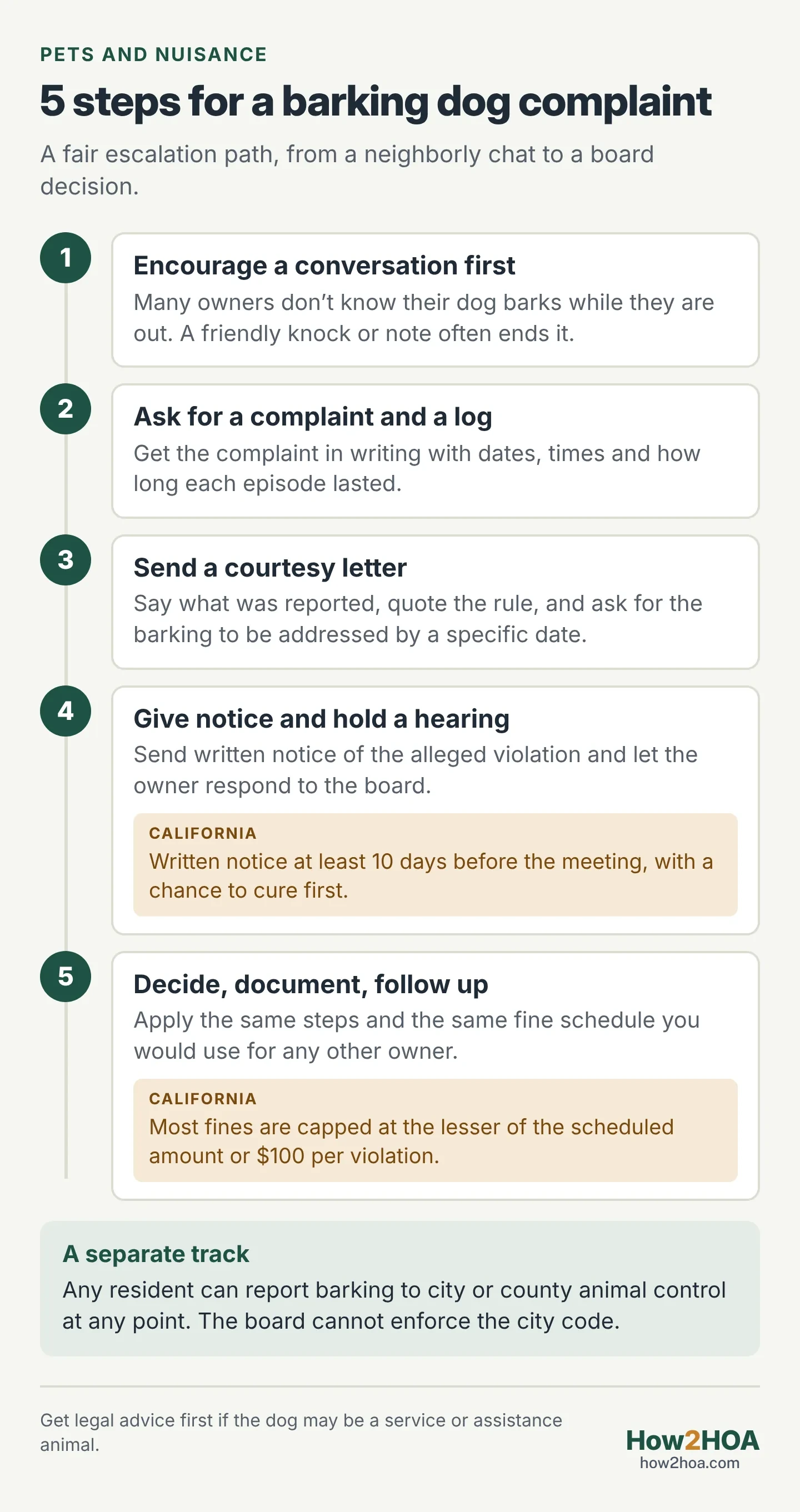
1. Encourage a conversation first
Many owners have no idea their dog barks while they are at work. A friendly knock or note from the neighbor often ends the problem without the board ever hearing about it.
2. Ask for a written complaint and a log
If talking fails, ask the neighbor to put the complaint in writing with dates, times and how long each episode lasted. Short audio or video clips recorded from the complaining owner’s own home help. A second household reporting the same thing makes the record much stronger.
3. Send a courtesy letter
Tell the dog owner what was reported, quote the rule and ask for the barking to be addressed by a specific date. Keep the tone neutral. If the home is rented, send the letter to the owner. Most governing documents make the owner responsible for a tenant’s violations, so check yours; see our guide to renting out your home in an HOA.
4. Give formal notice and hold a hearing
If the barking continues, follow the violation process in your documents and state law: written notice of the alleged violation, a chance for the owner to respond to the board, and a written decision. Let the owner explain what they have tried.
5. Decide, document and follow up
Apply the same steps and the same fine schedule you would use for any other owner. Consistency is the board’s best protection against a claim of unfair treatment, and it is the heart of enforcing rules well. If fines do not work, talk to the association’s attorney about dispute resolution or court before doing anything further.
If you are the neighbor
Keep a simple log from the first bad night: date, start time, end time. Speak to the dog’s owner before you write to the board, and when you do write, stick to facts. Expect the board to need time, because it has to give the other owner notice and a hearing. You do not have to wait for the association, though. You can report the barking to your city or county animal control under the local ordinance at any point, and that agency will tell you what evidence it needs.
If you are the dog owner
Take the first letter seriously and answer it. Ask what times the barking was reported, since that usually points to the cause: boredom while you are out, people passing a window or a dog left in the yard. Common fixes include more exercise before you leave, keeping the dog indoors during the problem hours, blocking the view of the street, a midday walker or daycare, and a session with a trainer or your veterinarian. Then tell the board in writing what you changed. A board that sees a real effort is far more likely to close the matter than to fine.
In California
Three parts of the Davis-Stirling Act shape how a California board handles a barking complaint.
- Pets are allowed, subject to reasonable rules. Civil Code section 4715 says governing documents entered into, amended or modified on or after January 1, 2001, cannot prohibit an owner from keeping at least one pet, subject to the association’s reasonable rules and regulations. A noise rule is the kind of regulation that section leaves room for; a blanket ban is not.
- Notice, a chance to cure and a hearing come first. Under Civil Code section 5855, the board must give the member written notice at least 10 days before the meeting where it will consider discipline, stating the date, time and place, the nature of the alleged violation, and the member’s right to attend and address the board. The member must be given an opportunity to cure the violation before the meeting, and if the board imposes discipline, it must send written notice of the decision within 14 days after acting. Discipline imposed without these steps is not effective against the member.
- Fines are capped. Civil Code section 5850, as amended effective June 30, 2025, requires a schedule of penalties distributed to members and limits a fine to the lesser of the scheduled amount or $100 per violation. A higher amount is allowed only where the violation may cause an adverse health or safety impact on the common area or another member’s property, and the board makes a written finding to that effect in an open meeting. The association may not add late charges or interest to a fine.
How the cure opportunity applies to a problem that stops and starts, as barking does, is a question to put to your association’s attorney before the hearing. More state-specific guidance is on our California HOA page.
The Law Behind This Article
Every legal point in this article comes from the official text. Each link below opens it in a new tab.
Civil Code sections: 4715 · 5850 · 5855
Other sources: Petaluma Municipal Code 9.08.180
This article is general educational information, not legal advice. Laws vary by state and your association’s governing documents control many of these questions, so check with your association’s attorney about your situation.