
Renting out your home in an HOA is usually allowed, but the association’s governing documents may limit how many homes can be rented at once, how long you must own before you lease, and how short a lease can be. Check your CC&Rs and your state’s law before you sign a lease. As the owner, you stay responsible to the association for everything your tenant does.
This article covers long-term rentals: why associations restrict them, the common kinds of restriction, what California law allows, and what to do before you hand over the keys. Vacation rentals and other short stays raise different issues, and they have their own section below.
Why HOAs Restrict Rentals
Owners and boards often see rentals differently. An owner sees flexibility. You may need to relocate for work, you may not want to sell in a slow market, or you may want the income. Some owners also believe the right to rent makes a home worth more. A board has to think about the community as a whole, and it usually has four concerns.
Mortgage Financing
In condominium communities, lenders look at who lives in the building. The standard condominium questionnaire that lenders send to associations asks how many units are owner-occupied, second homes and investor-owned, and FHA considers the owner-occupancy percentage when it approves a condominium project. If a project does not meet a loan program’s standards, buyers have fewer financing choices, and that makes every unit harder to sell. Our article on your mortgage and the HOA explains the lender’s review in more detail.
Turnover
Rented homes tend to change occupants more often. That means more moving days, more moving trucks on the streets, and more wear on elevators, hallways and gates.
Rule Compliance
Tenants do not receive the resale package a buyer gets, so they may never see the rules unless the owner hands them over. When a violation happens, the association has to work through an owner who may live in another city. Boards worry that this adds up to more violations and slower fixes.
Maintenance and Involvement
Boards also worry that a home with an absentee owner gets less attention, and that owners who live elsewhere are less likely to vote, attend meetings or serve on the board. None of this is true of every rental. Plenty of tenants are model neighbors and plenty of landlords are attentive. Still, these are the reasons you will hear when a rental restriction is proposed.
A board cannot simply announce a rental restriction. In most associations it has to be written into the CC&Rs, which takes a vote of the owners. Expect pushback from owners who want to keep the option to lease. A community where most homes are already owner-occupied will usually find the vote easier than one with many rentals.
Types of Lease Restrictions
Rental Caps
A cap limits how many homes can be rented at one time. For example, an association might allow no more than 25 rented units at once. When the cap is reached, the next owner who wants to rent goes on a waiting list.
A cap only works if the association knows which homes are rented. Most caps come with a requirement to notify the association before you lease, and some owners ignore it. If your community has a cap, ask in writing where you stand before you advertise the home.
Owner-Occupancy Periods
Another common restriction requires a new owner to live in the home for a set period, such as a year, before renting it out. The aim is to discourage investors from buying homes they never intend to live in.
Lease Terms and Paperwork
Many associations set a minimum lease term and require a written lease that binds the tenant to the governing documents, often through an addendum the tenant signs. Some also ask you to register the tenancy by sending a copy of the lease, the tenant’s contact details and vehicle information.
Outright Bans
Some associations want to prohibit rentals completely. Whether they can depends on the state. Some states and localities limit or forbid blanket bans, and a provision that conflicts with the law cannot be enforced. Where bans are allowed, courts generally expect the restriction to be reasonable and to be properly adopted.
Grandfathering
Owners who bought before a restriction was adopted are often exempt from it, and the rule applies to anyone who buys afterward. Whether that is automatic depends on the wording of the amendment and on state law. In California it is written into the statute.
Enforcement
A restriction that nobody enforces will not last. One unaddressed violation invites the next, so a board that adopts a rental rule should apply it promptly and evenly. For you as an owner, the practical point is that the association enforces against you, not your tenant. Notices, hearings and fines for a tenant’s conduct come to the owner. Our article on HOA rules and enforcing violations explains how that process works.
Short-Term Rentals Are a Separate Question
Platforms such as Airbnb and Vrbo have made it easy to rent a home for a few nights. Many associations treat stays of less than 30 days differently from ordinary leases, because the turnover, parking and noise problems are sharper. Your city or county may also restrict short-term rentals or require a permit, and an association’s rules cannot authorize what local law forbids. If this is what you have in mind, read our article on handling short-term rentals before you list the home.
In California
California limits what an association can do about rentals. Two sections of the Davis-Stirling Act matter most, and our California HOA law overview explains the Act as a whole.
- No prohibition on existing owners. An owner is not subject to a governing document provision that prohibits renting unless that provision was in effect before the owner acquired title. Before renting, the owner must give the association verification of the date the owner acquired title and the name and contact information of the prospective tenant (Civil Code 4740).
- No unreasonable restrictions. Governing documents may not prohibit or unreasonably restrict the rental of a separate interest, an accessory dwelling unit or a junior accessory dwelling unit (Civil Code 4741).
- A floor on rental caps. An association may not restrict rentals to fewer than 25 percent of the separate interests. It may allow a higher percentage.
- Short-term rentals. An association may still prohibit transient or short-term rentals of 30 days or less.
- Accessory dwelling units. ADUs and junior ADUs are not counted as separate interests for the cap, and a home is not counted as rented if the owner lives in the home or in its ADU or junior ADU.
- Penalty. An association that willfully violates section 4741 is liable for the owner’s actual damages and a civil penalty of up to $1,000.
Section 4741 also required boards to amend governing documents that did not comply. If your CC&Rs still contain a rental ban or a cap below 25 percent, ask the association how it applies the provision today.
Before Renting Out Your Home in an HOA
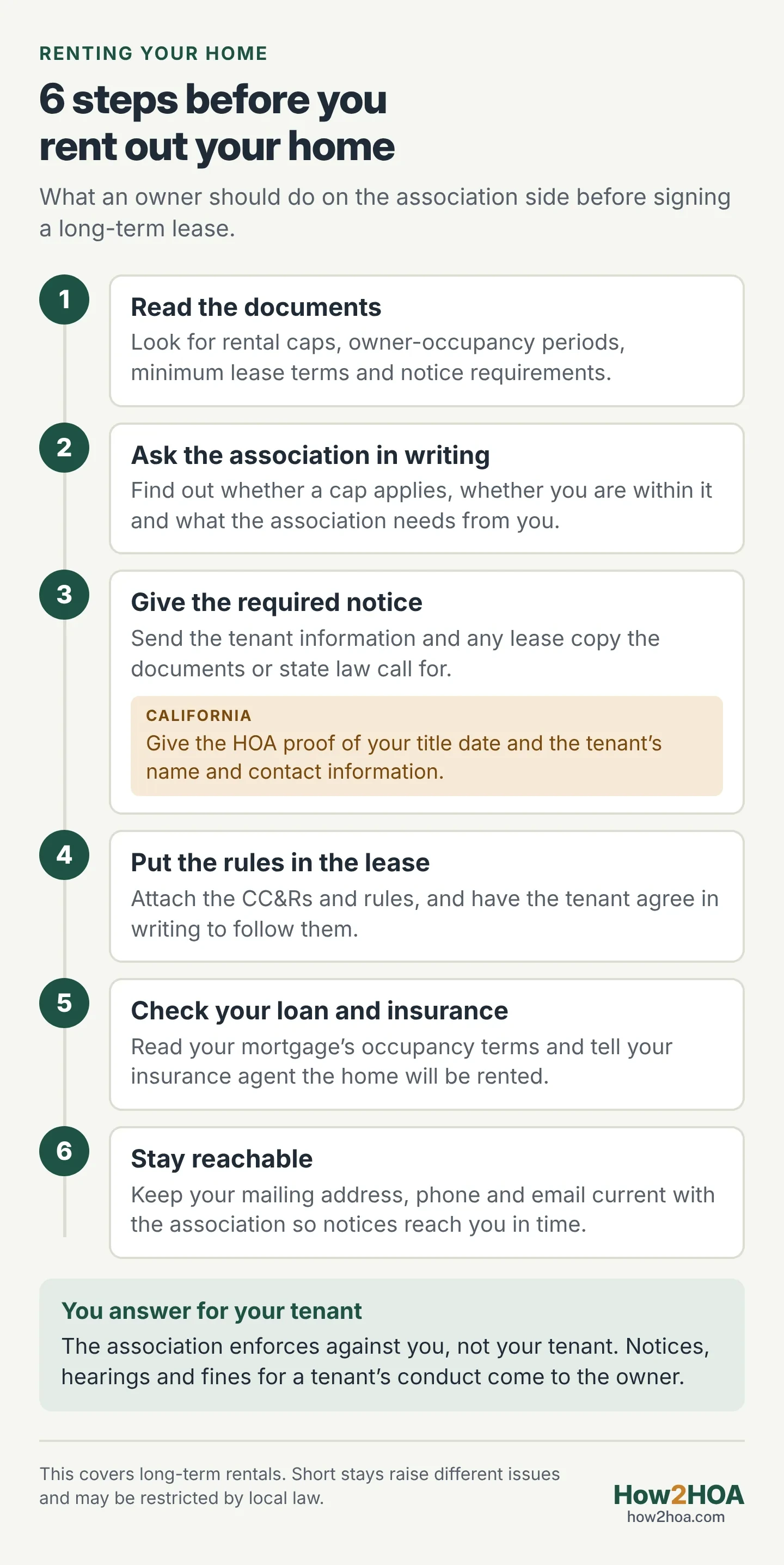
- Read the documents. Look in the CC&Rs and rules for caps, owner-occupancy periods, minimum lease terms and notice requirements.
- Ask the association in writing. Find out whether a cap applies, whether you are within it and what the association needs from you.
- Give the required notice. Send the tenant information and any lease copy the documents or state law call for.
- Put the rules in the lease. Attach the CC&Rs and rules, and have the tenant agree in writing to follow them. Cover parking, pets, trash and use of the amenities specifically.
- Check your loan and your insurance. If you have a mortgage, read its occupancy terms before you move out. Tell your insurance agent the home will be rented, because an owner-occupant policy may not fit a rental.
- Stay reachable. Keep your mailing address, phone and email current with the association so that notices reach you while there is still time to act.

Share this infographic: Pinterest · Facebook · LinkedIn · Email · Download
You can find more articles for owners in our section on living in an HOA.
The Law Behind This Article
Every legal point in this article comes from the official text. Each link below opens it in a new tab.
Civil Code sections: 4740 · 4741
Other sources: HUD: FHA Condominium Project Approval
This article is general educational information, not legal advice. Laws vary by state and your association’s governing documents control many of these questions, so check with your association’s attorney or another qualified professional about your situation.