Mello-Roos and HOA dues are two separate charges that often land on the same house. Mello-Roos is a special tax levied by a government agency (a city, county or school district) through a community facilities district, and it is collected on your property tax bill. HOA dues are assessments levied by a private homeowners association under its recorded governing documents, and you pay them directly to the association. In the newer neighborhoods of Roseville, Rocklin, Lincoln, Folsom and Elk Grove, many homes carry both.
This article is about California law and South Placer and Sacramento County practice. Other states use similar tools under different names (special districts, municipal utility districts, community development districts), so the comparison still helps if you are buying elsewhere.
What a Mello-Roos tax is
The Mello-Roos Community Facilities Act of 1982 starts at Government Code section 53311. It lets a local agency form a community facilities district (CFD) over a defined area and, with two-thirds voter approval, levy a special tax on the parcels inside it. When a district is formed over undeveloped land, the vote is typically by the landowners, which is why the tax is usually already in place when the first homes are sold.
CFD taxes generally come in two kinds, and the difference matters to a buyer:
- Facilities (infrastructure) taxes. These repay bonds sold to build roads, water and sewer lines, drainage, parks, schools and similar public improvements. They run until the bonds are repaid or a stated final tax year arrives.
- Services taxes. These pay for ongoing public services such as police, fire, or maintenance of parks, medians and streetlights. Many have no end date and rise each year by an inflation factor.
The tax is a lien on the property. Placer County’s Auditor-Controller notes that if a Mello-Roos direct charge becomes delinquent, the property may be subject to foreclosure by the levying agency.
Landscaping and lighting districts
A landscaping and lighting district is a different tool with a similar result on your tax bill. Formed under the Landscaping and Lighting Act of 1972, it charges an annual assessment (set each year from an engineer’s report) for streetlights, medians and roadside landscaping that the city maintains. It is an assessment based on benefit to the parcel, not a Mello-Roos special tax, but it also appears as a line item on the property tax bill.
What HOA dues are
HOA dues (the law calls them assessments) are set by the association’s board each year to fund the operating budget and reserves. They pay for what the association owns or must maintain under its CC&Rs (covenants, conditions and restrictions): private streets, gates, pools, clubhouses, common landscaping, and in condominiums the building exteriors and roofs. Civil Code section 5600 requires the association to levy assessments sufficient to perform its obligations, and section 5605 limits how much the board can raise them without a member vote. We cover those limits in how much an HOA can raise dues in California.
Unlike a facilities CFD, HOA dues do not end. They continue as long as the association exists, and they change with the budget, the reserve study and the cost of insurance and vendors.
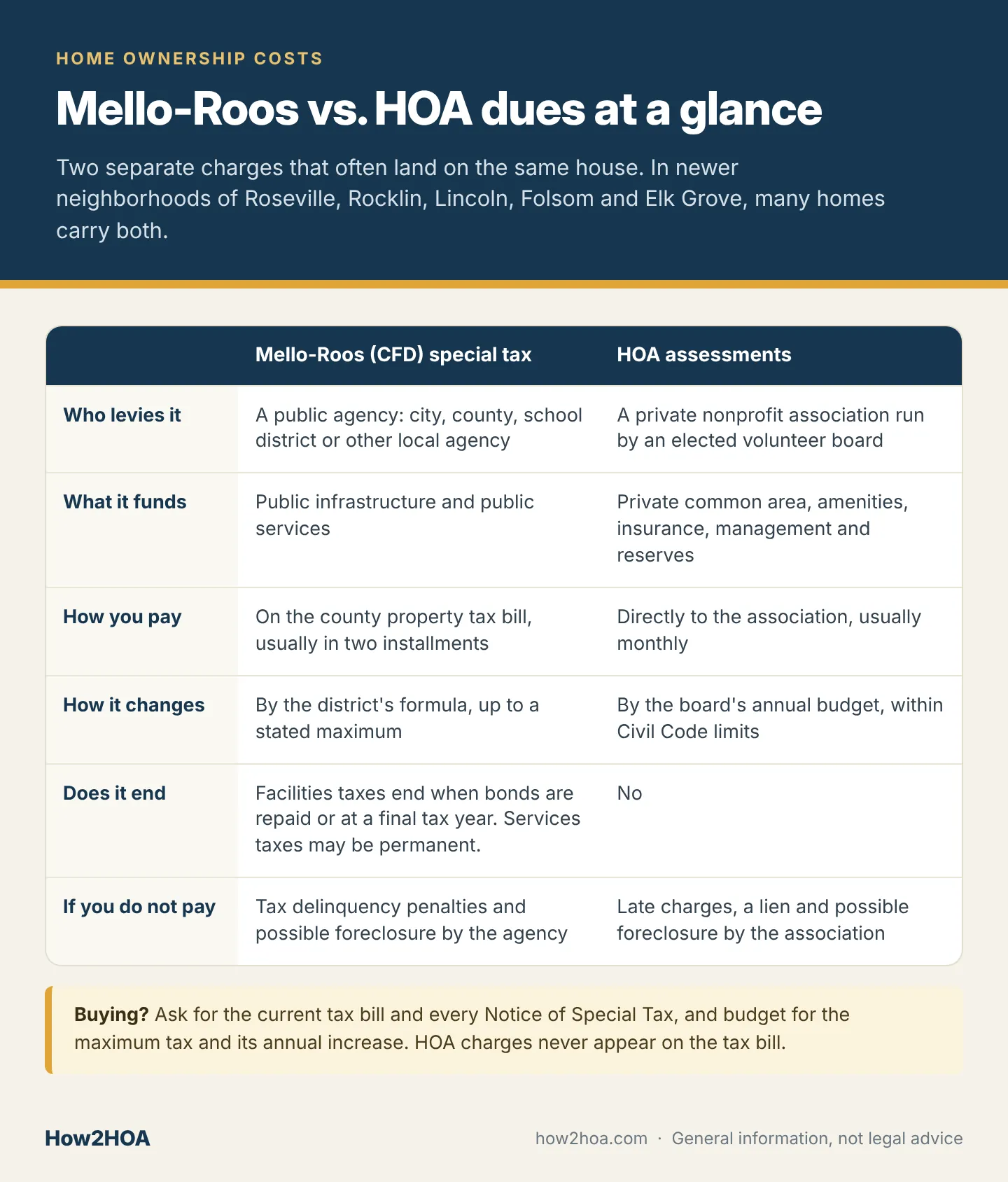
Mello-Roos vs. HOA dues at a glance
| Question | Mello-Roos (CFD) special tax | HOA assessments |
|---|---|---|
| Who levies it | A public agency: city, county, school district or other local agency | A private nonprofit association run by an elected volunteer board |
| What it funds | Public infrastructure and public services | Private common area, amenities, insurance, management and reserves |
| How you pay | On the county property tax bill, usually in two installments | Directly to the association, usually monthly |
| How it changes | By the district’s formula, up to a stated maximum; some rise a fixed percentage or by inflation each year | By the board’s annual budget, within Civil Code limits |
| Does it end | Facilities taxes end when bonds are repaid or at a final tax year; services taxes may be permanent | No |
| If you do not pay | Tax delinquency penalties and possible foreclosure by the agency | Late charges, a lien and possible foreclosure by the association |
| Who you call | The levying agency or its tax administrator (phone number is on the tax bill) | The board or the association’s manager |

Share this infographic: Pinterest · Facebook · LinkedIn · Email · Download
Why many homes here have both
The two charges pay for different things. A typical pattern in a master-planned area is that a facilities CFD repays the bonds for the arterial roads and sewer trunk lines, a city services CFD or lighting district maintains the public parkways and streetlights, and the HOA maintains what is private: the entry gate, the pool, the pocket park and the front-yard landscaping in some attached-home tracts. Paying a city maintenance tax does not mean the HOA is double-charging you. It usually means the public and private pieces of the neighborhood have different owners.
Local specifics, city by city
Rates differ by district, by lot and sometimes by home size, so we do not quote amounts for a neighborhood. Use the official sources below for the parcel you care about.
- Roseville (Placer County). The City’s Finance Department publishes its districts on the Special Taxes & Assessments page. City bond documents show CFDs formed for individual plan areas, including Westpark, Diamond Creek, Longmeadow and The Fountains.
- Rocklin (Placer County). The City’s Mello-Roos page describes its community facilities districts. Examples: CFD No. 1 (formed 1986) funds fire protection, ambulance and paramedic services; CFD No. 5 (1996) funds street and parkway lights and landscaping in public rights of way and parks; Whitney Ranch CFD No. 10 (2005) funded transportation, wastewater, drainage and landscaping facilities and is listed as expiring in fiscal year 2043. Rocklin also has two lighting and landscaping maintenance districts, formed in 1979 and 1996.
- Lincoln (Placer County). The City posts annual reports for each CFD on its Government Transparency page, including CFD 2003-1 (Lincoln Crossing), CFD 2005-1 (Sorrento), CFD 2006-1 (Lakeside), CFD 2010-1 (Police and Fire), CFD 2018-1 (City Maintenance), CFD 2018-2 (Public Services) and CFD 2019-1 (Independence at Lincoln). The same page carries the annual engineer’s report for the City’s landscaping and lighting assessment district.
- Folsom (Sacramento County). The City states that it contracts with NBS Government Finance Group to administer its Mello-Roos and special assessment districts and directs owner questions (current amounts, payoff figures, which district a property is in, the notice of special tax) to NBS at 800-676-7516. See the City’s Finance pages.
- Elk Grove (Sacramento County). The City’s Mello-Roos CFD page is unusually detailed. It lists city-run infrastructure CFDs (East Franklin 2002-1, Poppy Ridge 2003-1, Laguna Ridge 2005-1) with final tax years, and services CFDs for police and for maintenance that the City says are levied in perpetuity. For example, the City states the East Franklin infrastructure tax has a maximum of $840 per single-family unit that may not be increased and will not be levied after fiscal year 2037-2038, while the Laguna Ridge maximum rises 2% each July 1. Some Elk Grove CFDs are run by Sacramento County or by the Elk Grove Unified School District instead. The City’s Special Tax Hotline is (916) 627-3205.
How to find both charges on a specific property
Finding Mello-Roos and other district charges
- Read the property tax bill. District charges are itemized below the general 1% tax. In Placer County, the Auditor-Controller’s Mello-Roos FAQ explains that the last two characters of the tax code description will be “MR”, and that the phone number for each levying agency is printed on the bill. In Sacramento County, each charge has a four-digit code you can look up in the county’s Direct Levy Listing, which names the agency, the purpose and a contact number.
- Check the city’s district page. Use the city pages listed in the sources section below for maps, rate tables and end dates.
- Get the Notice of Special Tax. Under Civil Code section 1102.6b, a seller of residential property subject to a Mello-Roos lien must make a good faith effort to obtain a disclosure notice from the levying agency and deliver it to the buyer. Government Code section 53340.2 requires the agency to furnish it within five working days of a request and sets its contents: the maximum tax for the parcel, any annual percentage increase, the final tax year, and the facilities and services funded.
Finding HOA dues and obligations
HOA charges never appear on the tax bill. The seller must give the buyer the association’s resale documents under Civil Code section 4525. These include the governing documents, the most recent annual budget report, a statement of current regular and special assessments and any unpaid amounts, and any approved assessment changes that are not yet due. Some properties belong to two associations (a master and a sub-association), so ask whether there is more than one. Our guide on what to know before you buy in an HOA walks through how to read that package.
Questions buyers should ask
- Which districts is this parcel in? Ask for the current tax bill and every Notice of Special Tax, not a listing-sheet summary.
- What is the maximum tax and how does it escalate? The current levy can be below the maximum. Budget for the maximum and the annual increase.
- When does each tax end? Separate the facilities tax with a final year from any services tax with no end date.
- Can the facilities tax be prepaid? Some districts allow a payoff under their formula. The administrator can quote it.
- How many associations are there, and what does each maintain? Compare that with what the city maintains through its districts.
- Are HOA reserves funded, and is a special assessment planned? See our article on special assessments in California.
- How will my lender count these? Both charges are part of the monthly housing cost a lender reviews. See your mortgage and the HOA.
What this means for HOA boards
Boards hear “we already pay Mello-Roos for that” often. It helps to keep a one-page map or list showing which landscaped strips, lights, walls and parks belong to the city district and which belong to the association, and to share it with owners and new buyers. This is good practice, not a legal requirement. It also keeps the association from paying to maintain something a public district is already funded to maintain, which is worth checking when you are planning the budget. Boards in the region that want help sorting this out can read about HOA management in the Sacramento area.
For more on owning a home in a managed community, visit our Living in an HOA hub.
The Law Behind This Article
Every legal point in this article comes from the official text. Each link below opens it in a new tab.
Civil Code sections: 1102.6 · 4525 · 5600 · 5605
Government Code sections: 53311 · 53340.2
Other sources: City of Roseville: Special Taxes & Assessments · City of Rocklin: Mello-Roos · City of Rocklin: Landscape and lighting districts · City of Lincoln: Government Transparency · City of Folsom: Finance, fees and purchasing · City of Elk Grove: Mello-Roos community facilities districts · Placer County Auditor-Controller: Mello-Roos FAQ
This article is general educational information, not legal or financial advice. Laws vary by state and your association’s governing documents control many of these questions, so check with your association’s attorney or another qualified professional about your situation.