
HOA budget planning follows one sequence: work out what the community will need to spend next year, add the contribution to reserves, subtract any other income, and set assessments to cover the rest. The order matters. A household budget starts with income and decides what it can afford. An association starts with its obligations and then sets the income to match, because the roof and the insurance premium do not get cheaper when assessments are low. This article walks through the process step by step, then covers how to manage the budget once the year begins.
An HOA budget has two parts. The operating budget covers the day-to-day cost of running the community. The reserve budget funds the future repair and replacement of major components such as roofs, paving and pool equipment. Reserves are a planned savings program based on a reserve study, not a pot of money for surprises. For a closer look at the first part, see what an HOA operating budget is, and for other money topics visit our HOA finances section.

Share this infographic: Pinterest · Facebook · LinkedIn · Email · Download

The HOA Budget Cycle
A budget year moves through five stages. Boards tend to put most of their energy into the first three, but the last two decide whether the plan holds up.
- Information gathering. Before anyone drafts a number, the board or manager collects the facts: prior budgets and actual results, current contracts, utility and insurance history, and the reserve study (Steps 1 and 2 below).
- Creation. The numbers come together, with the board, the manager and often a finance committee working from the same information (Steps 3 to 7).
- Approval. In most associations the board adopts the budget. Expect a round or two of changes before the final version (Step 8).
- Execution. Once the fiscal year begins, assessments are billed at the new rate, and the manager or treasurer pays invoices against the lines the board approved.
- Monitoring. The board compares what happened to what it planned, every month, and uses what it learns to steer the current year and to build a better budget for the next one. See Managing the Budget During the Year below.
Step 1: Start Your HOA Budget Planning Early
There is no single date that suits every association, but earlier is better. Budget planning should start about four to five months before the new fiscal year. That leaves time to collect bids, get renewal estimates (including the insurance renewal), hold a board work session and fix problems before the deadlines arrive. It also keeps a calendar-year association from finishing its budget in the middle of the holiday season.
As a general target, aim to have the budget adopted and sent to owners 30 to 60 days before the fiscal year ends. Your state law or governing documents may set a specific window, so check them before you set the calendar.
Set that calendar at the start. Decide who gathers the numbers (the manager, the treasurer or a finance committee), when the draft goes to the board, when the board votes, and when the budget and any assessment notice go out. A budget built in a rush is where most avoidable mistakes get made. Our annual HOA budget checklist can help you keep track of the steps.
Step 2: Review the Last Three Years
Go through the budgets and the actual results for the previous three years. Look for trends in spending and for lines where the actual cost differed from the budget. A line that ran over three years in a row was not bad luck. The budget was too low. If your board already reviews a budget-versus-actual report during the year, as described in Managing the Budget During the Year below, much of this work is done: by mid-year you already know which lines were set too low.
Then adjust for price changes, because last year’s cost is not next year’s cost. For lines where you have no quote, the CPI Inflation Calculator from the U.S. Bureau of Labor Statistics shows how much consumer prices changed between any two months. Treat it as a rough check. The calculator uses the Consumer Price Index for all urban consumers, which tracks household prices in general, not landscaping contracts or insurance premiums. For your largest lines, get actual figures: the contract renewal rate, the utility’s announced rate change, the broker’s renewal estimate.
At this point you have a ballpark figure for next year’s spending. A few more pieces are needed before the budget is complete.
Step 3: Add New Upkeep and One-Time Work
Next, look for expenses that were not in last year’s budget. Some upkeep that was not needed last year will be needed this year.
Typical examples are visible repairs, painting, new landscaping and other upgrades. Walk the whole property, including the recreational areas, with the manager or a maintenance vendor and write down what you see. Regular annual maintenance should already be in your estimate from the three-year review.
Sort each item before you price it. Routine maintenance belongs in the operating budget. Replacing a major component that the reserve study already covers should be paid from reserves. A brand-new improvement, such as adding a feature the community never had, is a separate question: check your governing documents, because many require owner approval for capital improvements above a certain cost.
Step 4: Budget for Costs That Can Change
Some expenses are outside your control. The categories are familiar from prior budgets, but the amounts can move without warning. The two biggest are utilities and insurance. Your three-year review shows how they changed in the past, which helps, but it is no guarantee.
Utilities include water, electricity, garbage, sewer and natural gas. Rates change, and so does usage: a dry summer or a hidden leak can push the water bill well past the estimate. Check your utilities’ announced rate changes before you set these lines.
Insurance is the other line that has surprised many boards. Premiums can rise sharply at renewal for reasons that have nothing to do with your community, such as the insurer’s losses in your region, and a claim on your own policy can add to the increase. Ask your broker for a renewal estimate before you finalize the budget, and do not assume last year’s premium. Then add a reasonable cushion to both the utility and insurance lines.
Step 5: Set the Reserve Contribution and a Contingency
Do not leave reserves for last. The annual reserve contribution is a line in the budget like any other, and it should come from the funding plan in your reserve study, which estimates when each major component will need replacing and what it will cost. If you do not have a current study, see what a reserve specialist does.
Keep contributing every year, even when the fund looks healthy. Components keep aging and replacement costs keep rising, so the target moves each time the study is updated. A board that pauses contributions to hold assessments down is setting up a special assessment later.
Unforeseen expenses are a different matter. Budget a contingency line in the operating budget for the costs that cannot be predicted to the dollar: an inspection nobody scheduled, maintenance that comes up only every few years, a sudden repair. Size it from your own history of surprises. If each of the last three years produced several thousand dollars of unplanned repairs, plan for that again and be generous with the estimate.
For a hurricane, earthquake or other disaster, the first line of defense is the association’s insurance, and the board should know its deductibles and what the policy excludes, because the uncovered share falls on the owners.
Step 6: Calculate the Assessments
Once you know the costs, you can work out what each owner pays. Most associations use the same calculation:
- Add up the total operating expenses.
- Add the annual reserve contribution.
- Subtract income from other sources, such as interest or clubhouse rentals.
- Divide what is left among the owners in the way your governing documents require. Many planned communities charge every lot the same amount. Many condominiums use each unit’s percentage of ownership.
- Divide the annual figure by 12 for the monthly assessment.
Here is an example. An 80-home community with equal shares budgets $240,000 for operations and $60,000 for reserves and expects $4,000 in other income. That leaves $296,000 to be raised from assessments, or $3,700 per home per year, which is about $308 a month.
Compare the result with the current assessment. If the two are close, you are in good shape. If the new figure is much higher, go back through the expenses and make sure each one is justified, but do not trim real costs just to reach a number. It is tempting to announce a flat or reduced assessment. It is much worse to run out of money for things the neighborhood needs. If an increase is unavoidable, our tips for handling an increase in HOA fees can help you explain it. Check, too, whether your state law or governing documents cap how much the board can raise assessments without an owner vote.
Step 7: Look for Savings
There are legitimate ways to bring costs down for the coming year.
- Preventive maintenance. Servicing a pump or cleaning gutters on schedule usually costs less than repair, and it spares you the emergency call.
- Competitive bids. Shop around for recurring services such as lawn care, landscaping and snow removal. A less expensive contractor who is still qualified and insured can save real money. Ask each bidder to price the same scope so the numbers can be compared.
- Efficiency. Look at whether solar makes sense for common areas that use a lot of electricity, and whether irrigation can be cut back with better controllers or plants that need less water. Lower utility use helps the budget every year after the change is made.
Step 8: Adopt the Budget and Tell Owners
The board adopts the budget at a board meeting. Depending on your state and your governing documents, owners may also have a right to vote on or ratify the budget, or to approve an increase above a set percentage. Send owners the budget and the notice of the new assessment within the time your law and documents require, and include a short cover note in plain language that says what changed and why.
Managing the Budget During the Year
The work is not finished when the budget is adopted. Treat the approved budget as a working plan that the board checks every month, not a document that gets filed. Compare actual income and spending to the budget, find out why any line is off, and correct course while the fix is still small.
Many board members have no financial background, and that is fine. You do not need to be an accountant to ask why the water bill is running ahead of plan. You need a routine, readable reports and the habit of asking questions. When the routine is missing, small overruns pile up unnoticed, and the board discovers late in the year that it has to choose between a steep assessment increase and skipped maintenance.
Review the Numbers Month by Month
The main tool is a budget-versus-actual report, sometimes called a budget comparison or variance report. For each line it shows the budgeted amount, the actual amount and the difference (the variance), for the month and for the year to date. Your manager or bookkeeper should produce it with the monthly financial statements.
Here is how to read one. Say the landscaping line is $24,000 for the year, or $2,000 a month. At the end of June the year-to-date budget is $12,000 and actual spending is $13,500, so the line is $1,500 over. The number by itself tells you little. What matters is the reason, and there are usually three possibilities:
- Timing. The annual mulch delivery was paid in April, and spending will even out by year-end. No action is needed.
- A one-time event. A storm brought down two trees. The line will finish over budget unless something else gives.
- A lasting change. The contractor raised the monthly rate in March. The overrun will keep growing, and next year’s budget needs a higher number.
Only the second and third call for a decision, which is why a short written explanation for each significant variance is worth asking for. A board can set a simple trigger, for example any line that is more than 10 percent or $500 over its year-to-date budget, so the manager knows which lines to explain without being asked.
A sound monthly review covers a short list:
- The budget-versus-actual report, with explanations for the significant variances
- Bank reconciliations for the operating and reserve accounts, read alongside the bank statements
- The delinquency report, because unpaid assessments are a budget problem too
- The check register or list of payments
- Cash on hand compared with the bills expected over the next two or three months
Watch the income side as closely as the expense side. A budget assumes that nearly every owner pays on time. If delinquencies are rising, the association can be on budget for expenses and still run short of cash.
Then project the year-end result. Around the midpoint of the year, ask the manager or treasurer for a forecast: actual results so far plus a realistic estimate for the remaining months. A forecast turns “we are a little over on utilities” into “we will finish the year about $9,000 short unless we act,” and that is something a board can make a decision about.
Control Costs During the Year
Cost control during the year is mostly discipline in small decisions. The savings ideas in Step 7 still apply, along with a few habits:
- Check the line before you approve. When a proposal or an unusual invoice comes to the board, look first at how much is left in that budget line.
- Know your renewal dates. Many service contracts renew automatically, sometimes with a price increase. Review each one before the cancellation deadline, not after.
- Look at utilities. A sudden jump in the water bill often points to a leak or an irrigation controller that needs adjusting.
Be careful about false savings. Skipping maintenance or shorting the reserve contribution makes this year’s report look better and pushes a larger bill onto future owners.
Plan for the Unexpected
When a surprise cost arrives during the year, the contingency line you set in Step 5 is there to absorb it. Keep that line separate in your mind from the reserve fund. Reserves are set aside for the planned repair and replacement of major components such as roofs, paving and pool equipment. State law and governing documents often restrict what reserve money can be spent on, so do not count on reserves as a general cushion.
Make Mid-Year Corrections
When the forecast shows a shortfall, the board has several options. Start with the least disruptive.

Share this infographic: Pinterest · Facebook · LinkedIn · Email · Download
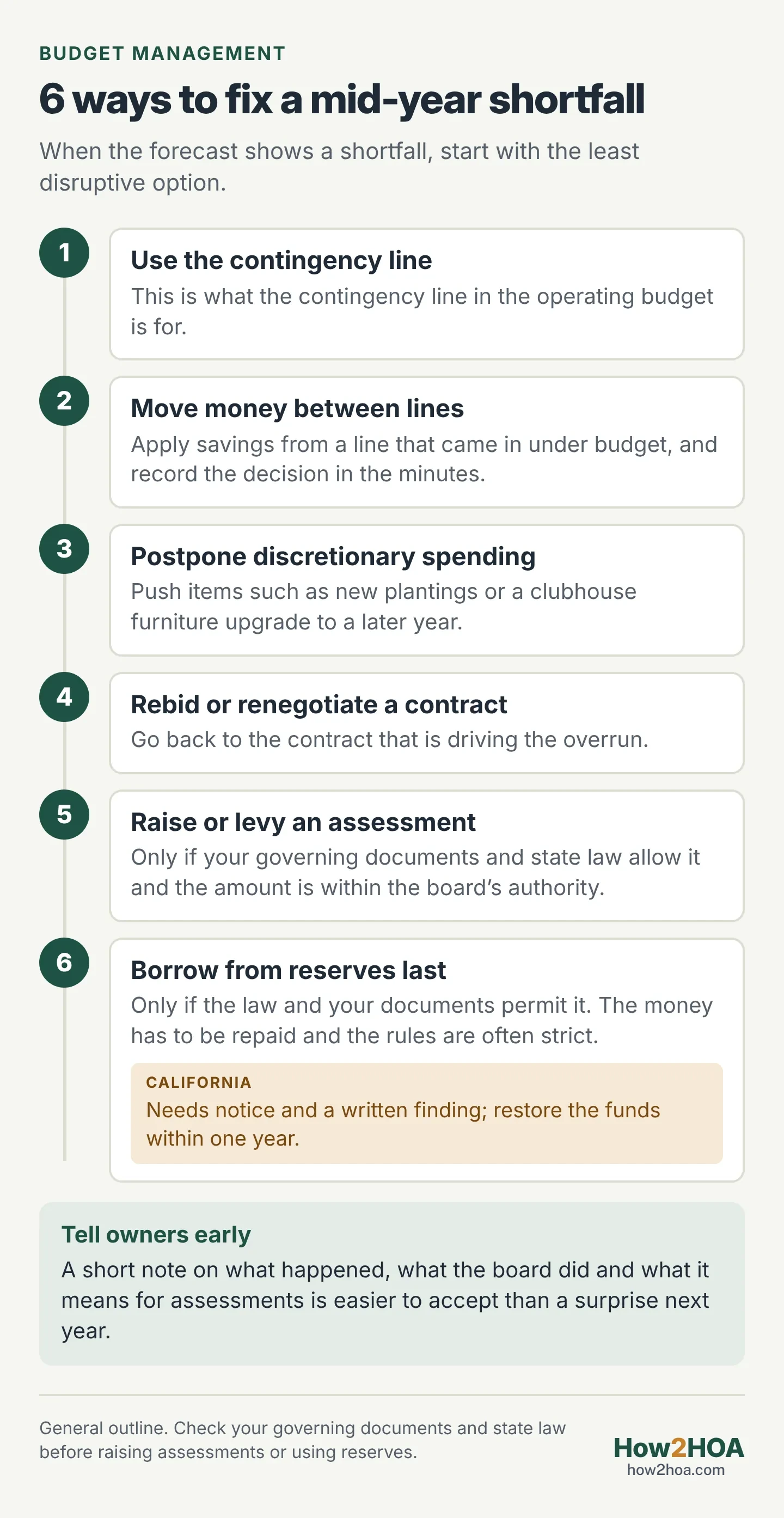
- Use the contingency line. This is what it is for.
- Move money between lines. If snow removal came in well under budget, the board can decide to apply the savings to an overrun elsewhere. Record the decision in the minutes.
- Postpone discretionary spending, such as new plantings or a clubhouse furniture upgrade, to a later year.
- Rebid or renegotiate a contract that is driving the overrun.
- Raise assessments or levy a special assessment, if your governing documents and state law allow it and the amount is within the board’s authority. Our article on regular and special assessments covers the limits.
- Borrow from reserves only as a last resort, and only if the law and your documents permit it. Money borrowed from reserves has to be repaid, and the rules for doing it are often strict.
Whatever the board decides, tell owners early and plainly. A short note that explains what happened, what the board did and what it means for assessments is much easier to accept than a surprise in next year’s budget.
Using an Accountant: Pros and Cons
Some boards hire an accountant to prepare the budget. The advantages are technical skill and an independent set of eyes. The drawbacks are cost and distance: an outside accountant does not walk the property, sit through the meetings or know which fence is about to fall over.
For most associations it works better to keep the budget in the hands of the board and manager and bring in a certified public accountant for specific jobs: the year-end review or audit, the tax return, setting up useful monthly reports, or a question the board cannot answer with confidence. Some states also require an outside review of the financial statements once an association reaches a certain size. See when to hire an accountant for your HOA for more on that decision.
In California
California associations have specific duties under the Davis-Stirling Common Interest Development Act, and it turns several of the practices above into legal requirements.
- Annual budget report. The association must distribute an annual budget report 30 to 90 days before the end of its fiscal year. Among other things, it must include a pro forma operating budget on an accrual basis, a summary of reserves, a summary of the reserve funding plan, a statement on whether the board is deferring or not undertaking repair or replacement of any major component with a remaining life of 30 years or less, a statement on whether special assessments are anticipated, any outstanding loans with an original term of more than one year, and a summary of the association’s insurance (Civil Code section 5300).
- Reserve study. At least once every three years the board must have a visual inspection of the accessible areas of the major components done as part of a reserve study, if the current replacement value of those components is at least half of the association’s gross budget, not counting the reserve account. The board must also review the study every year and adjust as needed (section 5550).
- Enough, and no more. The association must levy regular and special assessments sufficient to perform its obligations, and may not impose an assessment that exceeds the amount needed to cover the costs it is levied for (section 5600).
- Limits on increases. The board may not increase regular assessments for a fiscal year unless it has complied with the annual budget report requirements listed in the statute for that year, or has owner approval. Without approval by a majority of a quorum of the members, it may not raise the regular assessment more than 20 percent over the prior fiscal year. The limit does not apply to increases needed for an emergency as defined in section 5610, such as a court order, a threat to health or safety, or an unforeseen repair cost the board documents in a resolution. A quorum for this vote is more than 50 percent of the members (section 5605).
- Special assessments. Without owner approval, the board may levy special assessments in a fiscal year totaling up to 5 percent of that year’s budgeted gross expenses. Anything more needs approval by a majority of a quorum of owners. There is an exception for defined emergencies (section 5605, section 5610).
- Notice. Owners must receive individual notice of any increase in regular or special assessments at least 30 and not more than 60 days before the increased assessment is due (section 5615).
- Monthly review. Unless the governing documents set a stricter standard, the board must review each month the current reconciliations of the operating and reserve accounts, the current year’s actual operating revenues and expenses compared to the budget, the latest account statements, an income and expense statement, the check register, the monthly general ledger and the delinquent assessment receivable reports (Civil Code section 5500). Directors may do the review individually, or a subcommittee of the treasurer and at least one other director may do it, outside a board meeting, as long as the review is ratified at the next board meeting and reflected in the minutes (section 5501).
- Transfers. A transfer from the operating or reserve accounts needs prior written board approval unless it is below a set threshold. For associations with 51 or more separate interests, the threshold is the lesser of $10,000 or 5 percent of the estimated income in the annual operating budget. For associations with 50 or fewer separate interests, it is the lesser of $5,000 or 5 percent (section 5502).
- Borrowing from reserves. The board may authorize a temporary transfer from reserves to the operating fund for short-term cash flow needs, but only after giving notice in a board meeting notice that states the reasons, some of the repayment options and whether a special assessment may be considered. The board must record a written finding in the minutes explaining the reasons and describing when and how the money will be repaid. The funds must be restored within one year of the initial transfer, unless the board, after the same notice and a documented finding, temporarily delays repayment (section 5515).
- Outside review. Unless the governing documents are stricter, a licensee of the California Board of Accountancy must review the financial statement for any fiscal year in which the association’s gross income exceeds $75,000, and a copy goes to owners within 120 days after the fiscal year closes (section 5305).
Our free Reserve Funding Disclosure Calculator turns your reserve study figures into the disclosure summary that goes out with the annual budget report.
The Law Behind This Article
Every legal point in this article comes from the official text. Each link below opens it in a new tab.
Civil Code sections: 5300 · 5305 · 5500 · 5501 · 5502 · 5515 · 5550 · 5600 · 5605 · 5610 · 5615
This article is general educational information, not legal or financial advice. Laws vary by state and your association’s governing documents control many of these questions, so check with your association’s attorney or another qualified professional about your situation.