
A reserve specialist is the professional who prepares an HOA’s reserve study: the report that lists the major components the association must repair or replace, estimates how long each will last and what it will cost, and recommends how much to set aside each year. The term is also the name of a specific credential, the Reserve Specialist (RS) designation awarded by Community Associations Institute (CAI).
The common areas of a homeowners association include plenty of equipment and systems that need replacing every so often, and the money set aside for that work is the reserve fund. The reserve specialist assesses the current condition of those items, estimates when each will need replacing and what it will cost, and gives the board a roadmap for future funding and budgeting. For related reading, see our HOA finances section.
Why an HOA Needs Reserve Funds
State laws on reserves vary widely. CAI’s state-by-state summary of reserve requirements currently lists 12 states that require reserve studies or a reserve schedule for condominium associations and 12 that require reserve funding. Elsewhere the question is left to the governing documents and the board. Even where there is no legal requirement, it is wise for an association to keep funds in reserve.
As a board member, you do not want to face angry owners when replacement time arrives and no money has been set aside. Without a reserve fund, the association has to collect the money from owners through a special assessment or borrow it. Either one strains relationships in the community, and a buyer who reviews the association’s finances will see the shortfall.
The way to prevent this is to plan. Hiring a specialist at regular intervals to assess your situation helps make sure that enough money will be there when it is needed.
What a Reserve Study Covers
A reserve study analyzes the association’s major components. It inventories them, estimates the remaining useful life of each and puts a cost on repairing or replacing it. Even if your state does not require one, the study is one of the most useful tools you have for managing the association’s budget, because it lets the board plan how much to set aside instead of guessing. Our article on understanding HOA reserve studies explains the study itself in more detail.
The Two Parts of the Study
CAI’s Reserve Study Standards describe a reserve study as having two parts. The physical evaluation, often called the physical analysis, covers the component inventory, the condition assessment, and the life and cost estimates. The financial analysis covers the current status of the reserve fund and a recommended funding plan, and the standards call for it to consider at least 30 years of income and expenses.
Not every item the association owns belongs in the study. The standards use a three-part test: the association must have the obligation to maintain or replace the item, the need and timing must be reasonably predictable, and the cost must be material and reasonably estimable. Smaller and routine items stay in the operating budget.
Percent Funded
The “percent funded” figure compares the money actually in reserves with the fully funded balance, which is the share of each component’s replacement cost that matches the share of its life already used up. Take a roof with a 20-year useful life and a $100,000 replacement cost. When the roof is 10 years old, its fully funded balance is $50,000. If that roof were the association’s only component and the reserve account held $35,000, the association would be 70 percent funded.
With the study in hand, the board can decide how much to contribute to reserves in the coming year. That contribution becomes a line in the annual budget, as described in planning your HOA budget. The standards describe three funding goals: full funding, which aims to keep reserves at or near 100 percent funded; threshold funding, which keeps the balance above a chosen dollar amount or percent funded; and baseline funding, which only keeps the cash balance from falling below zero and carries the most risk.
Levels of Service
Reserve studies come in different levels, and the price varies accordingly. Under the CAI standards a Level I study is a full study with an on-site evaluation. Level II is an update with a site visit, and Level III is an update with no site visit. A Level IV study is a preliminary one prepared before construction. The standards say that best practice is a site-inspection-based update at least every third year.
Working With a Reserve Specialist
The reserve specialist is the person who performs your reserve study. You will also see the titles reserve analyst and reserve study provider. Nobody can predict future costs with total accuracy, so what you want is an experienced professional whose estimates of timing and cost are reasonable and well supported. Without a sound estimate you can still end up with an underfunded reserve, and then the association may need a loan or a special assessment to cover the shortfall.
Your state may or may not set qualifications for the person who prepares the study. Either way, a professional credential is a useful screen. Two are common, and neither is a government license.
The Reserve Specialist (RS) Designation
The Reserve Specialist (RS) designation is awarded by Community Associations Institute. According to CAI, an applicant must:
- Have at least three years of experience preparing reserve studies
- Have prepared at least 30 reserve studies based on on-site visual observations in the past 36 months, at least 20 of them Level I or Level II
- Hold a bachelor’s degree in construction management, architecture or engineering, or meet one of the alternative background requirements CAI lists
- Submit client references and a sample full reserve study
- Agree to follow the Professional Reserve Specialist Code of Ethics
RS designees pay an annual fee and must redesignate every three years.
The Professional Reserve Analyst (PRA) Credential
The Association of Professional Reserve Analysts (APRA), a nonprofit association of reserve study providers, awards the Professional Reserve Analyst (PRA) credential. According to APRA, the applicant’s company must be an APRA member, and the applicant must have at least five years of full-time experience doing reserve studies, provide a list of 50 reserve studies based on site inspections, and submit a sample report and three client references. A PRA must also complete eight credits of continuing education each year.
When you interview providers, ask which credential the person who will visit your property holds, how many studies they have done for communities like yours, and which standards the report will follow.
What a Reserve Specialist Does Not Do
Remember that your reserve specialist is not performing an engineering analysis. They do not open up walls or dig down to the pipes. The CAI standards limit the condition assessment to a visual, non-invasive evaluation, exclude destructive testing, and state that structural integrity evaluations are not part of a reserve study unless otherwise noted. The same standards recommend periodic structural inspections and a preventive maintenance manual for every association, with the results fed back into the study.
Because of that scope, there are costs the specialist may not be able to estimate, especially for problems that cannot be seen, such as waterproofing under patios and parking areas. If you can give them that information up front, you will get a much more accurate estimate.
How to Get a Better Study
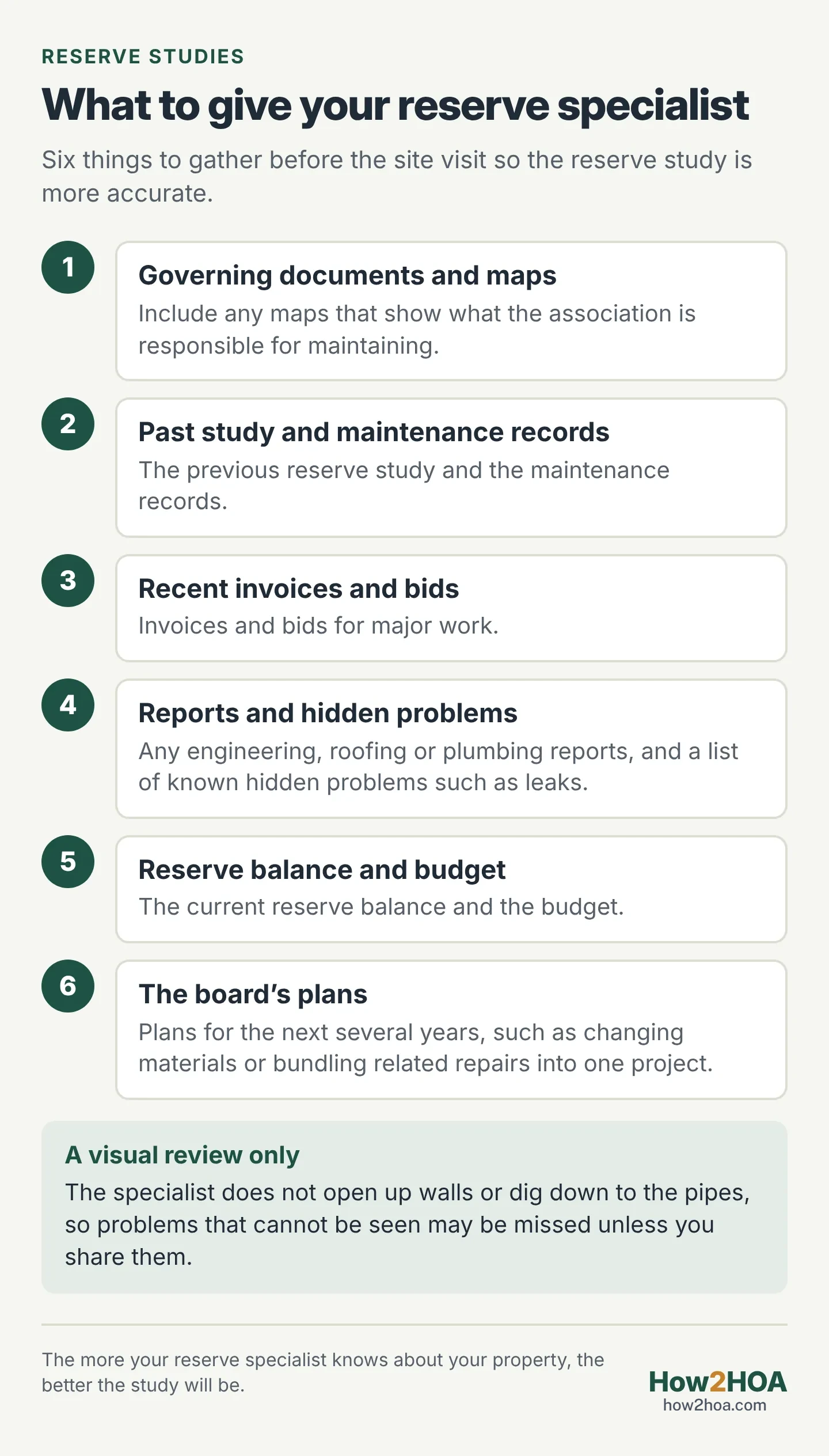
The more your reserve specialist knows about your property, the better the study will be. Before the site visit, gather:
- The governing documents and any maps that show what the association is responsible for maintaining
- The previous reserve study and the maintenance records
- Recent invoices and bids for major work
- Any engineering, roofing or plumbing reports, and a list of known hidden problems such as leaks
- The current reserve balance and the budget
- The board’s plans for the next several years

Share this infographic: Pinterest · Facebook · LinkedIn · Email · Download
Plans matter as much as history. Suppose you have wooden exterior elements that need painting every few years to keep up the community’s appearance, and the board intends to replace them with lower-maintenance materials. That costs more up front and may save money over time. If that is the plan, tell the specialist so it is reflected in the numbers.
Think strategically about timing as well. Bundling related repairs into one project can reduce costs, because the contractor only has to come out and set up once. Tell the specialist about that too, so the funding plan accounts for it.
After the Study
The specialist will help the board put together a funding plan, with charts and tables that illustrate the multi-year projections. Everyone on the board needs to understand why the money should be set aside, because it is the board that adopts the plan, builds the contribution into the budget and explains it to owners. If the study shows the fund is short, the choices are higher regular contributions, a special assessment or both. See regular versus special assessments for how those work.
The study is a planning tool, not a work order. When a project comes due, the association collects bids for the work, as covered in how to hire a contractor for your homeowners association. For a large project, a project manager or construction consultant may be the best way to keep the work on schedule. It also helps to know that the components in the study rarely appear on the balance sheet, a point explained in what HOA assets are.
In California
California does not require a new reserve study every year. The Davis-Stirling Common Interest Development Act sets a three-year cycle with an annual review.
- Inspection every three years. At least once every three years, the board must have a reasonably competent and diligent visual inspection made of the accessible areas of the major components the association is obligated to repair, replace, restore or maintain, as part of a study of its reserve account requirements. The requirement applies if the current replacement value of the major components is at least one-half of the association’s gross budget, not counting the reserve account (Civil Code section 5550).
- Annual review. The board must review the study, or have it reviewed, every year and make the necessary adjustments (section 5550).
- Contents. At a minimum the study must identify the major components with a remaining useful life of less than 30 years, their probable remaining useful life, the estimated cost of repairing or replacing them, the total annual contribution needed after subtracting the reserve funds on hand, and a reserve funding plan. Major components include the parts of gas, water and electrical service that the association is responsible for (section 5550).
- Who prepares it. Section 5550 does not name a required license or credential for the preparer. The standard is a reasonably competent and diligent inspection.
- Funding plan. The reserve funding plan must include a schedule of the date and amount of any change in regular or special assessments needed to fund it, and the board must adopt the plan at an open meeting. An assessment increase needed to fund the plan is approved in a separate board action that follows the limits in section 5605 (section 5560).
- Disclosure to owners. The annual budget report must include a summary of reserves based on the most recent study. The summary shows each major component’s estimated replacement cost, useful life and remaining life, the reserves needed compared with the cash actually set aside, the percent funded and the current deficiency per unit (section 5565). An Assessment and Reserve Funding Disclosure Summary on the statutory form must go out with the report. Among other things, it states whether projected reserve balances will be sufficient over the next 30 years (section 5570).
- No mandated funding level. Section 5570 gives a formula for the reserve amount to be disclosed for each component (current cost multiplied by years in service, divided by useful life) and says that this does not require the board to fund reserves in accordance with that calculation.
- Use of reserve money. Reserve funds may be spent only on the repair, restoration, replacement or maintenance of the major components the fund was established for, or on litigation involving those components (section 5510). The one exception is a temporary transfer to the operating fund under section 5515, which has its own notice and repayment rules.
The Law Behind This Article
Every legal point in this article comes from the official text. Each link below opens it in a new tab.
Civil Code sections: 5510 · 5550 · 5560 · 5565 · 5570
Other sources: CAI: Reserve requirements and funding by state · CAI Reserve Study Standards (July 2023) · CAI: Reserve Specialist (RS) designation
This article is general educational information, not legal or financial advice. Laws vary by state and your association’s governing documents control many of these questions, so check with your association’s attorney or another qualified professional about your situation.