
An HOA community needs two kinds of assessments. Regular HOA assessments, the monthly or quarterly dues, pay for the year’s operations and the annual contribution to reserves. Special assessments are one-time charges for a cost that the regular budget and the reserve fund cannot cover. A well-run association funds nearly everything through regular assessments and treats a special assessment as the exception.
Part of each regular assessment covers the association’s yearly operations, including landscaping and lawn care, snow removal, maintenance, insurance and water. Another part should go into a reserve account for large periodic expenses, such as replacing equipment, repairing community buildings and repaving roads. For more on association money matters, see our HOA finances section.
What Regular HOA Assessments Should Cover
Most homeowners think of the monthly HOA payment as a fee, but it is an assessment. The association has estimated what it will cost to maintain the common property and run the community for the year, added the amount that needs to go into reserves, and divided the total among the owners in the way the governing documents direct. The first part of that estimate is the operating budget, explained in what an HOA operating budget is. The goal is for regular assessments to cover all of it, so that owners are not asked for more during the year.
The items below are the ones most commonly covered.
Maintenance and Repair of Common Areas
This includes landscaping and outdoor maintenance: lawn care, snow and ice removal, trimming trees and shrubs, and clearing debris and fallen limbs. It also includes the cost of caring for shared amenities such as swimming pools, gyms, walking trails and community centers. Budget for everything from pool chemicals to the cleaning crew for the common areas.
Management, Staff and Professional Fees
The board is made up of volunteers, but much of the day-to-day work is often handled by a management company, and its fees belong in the assessment. So do wages and payroll costs if the association has its own employees. Budget for professional help as well. Every association needs access to an attorney for questions about its governing documents, collections and contracts, and to an accountant for the tax return and any year-end review. Legal and accounting fees should be a planned line in the budget, not a surprise.
Insurance
Insurance is one of the largest lines in many budgets, and the right coverage depends on your governing documents, your state’s law and the kind of community you have. An association typically carries these policies:
- Property insurance. Covers damage to the buildings and common property the association is responsible for insuring, from causes the policy covers, such as fire, storms, vandalism or theft.
- General liability insurance. Responds when someone falls in the parking lot or is hurt at the gym and holds the association responsible.
- Directors and officers (D&O) liability insurance. Often neglected, and worth having. It protects board members against claims that arise from decisions they make on behalf of the association.
- Fidelity (crime) coverage. Protects the association’s money against theft by the people who handle it, including directors, officers, employees and, if the policy is written to include it, the management company.
- Workers’ compensation insurance. Covers employees who are injured on the job. Whether it reaches volunteers, or the workers of a contractor who turns out to be uninsured, depends on state law and the policy, so ask your insurance agent how it applies to your association.
For more on the coverages an association carries, see the five core HOA insurance policies. For how the association’s master policy fits with an owner’s own policy, see what homeowners association insurance covers.
Utilities
Utilities for the common areas, such as lighting, irrigation water and clubhouse power, always belong in the budget. Beyond that, this is one of the more flexible items for a board to consider. Some associations also pay for services to the homes themselves, such as water, trash collection or bulk cable and internet, and pass the cost on to owners in the regular assessment.
Some owners see that arrangement as fair and others do not. One household puts out far more trash than another, and some owners watch cable television while others never turn it on. If the association pays for a utility on behalf of everyone, a negotiated bulk or flat rate for the whole community keeps the cost predictable and treats owners consistently. Where homes are separately metered, having owners pay their own usage avoids the argument.
Reserve Fund
The reserve fund pays for major repairs and replacements that the association knows are coming, such as roofs, paving, exterior painting, fences and pool equipment. It is not a general emergency account, and it is not meant for hiring staff or adding new amenities. A scheduled replacement that is not part of the year’s operating costs should be paid from reserves, which is why part of every regular assessment should go into the fund.
No single percentage of the assessment is right for every community. A new development with few shared components needs far less than an older condominium with elevators and flat roofs. To find out how much your association should be setting aside, hire a professional to prepare a reserve study. Our article on what a reserve specialist does explains what to expect. The study gives you a goal to work toward if the fund is short, and you can use the results to adjust regular assessments.
When a Special Assessment Is Needed
In a perfect world the reserve fund would always have enough for unusual expenses and major repairs. It is not a perfect world. Sometimes a large cost arrives and the association has to levy a special assessment. It will not make the board popular, but in some situations it has to be done for the safety of everyone.
The usual causes are these:
- A major component fails earlier, or costs more to replace, than the reserve study projected
- Damage that insurance does not cover, or a large deductible
- A court judgment or an unexpected legal cost
- An operating shortfall that cannot be closed any other way
- A new improvement that the owners have voted to add
Before levying one, check the limits. Governing documents and state law often cap the amount a board can impose without a vote of the owners, with exceptions for emergencies. They may also say how much notice owners must receive. Consider, too, whether the amount can be paid in installments, because a large lump sum is hard on owners with fixed incomes.
Being honest with owners about what the special assessment is for goes a long way. No one wants to pay more than they planned, but owners are more open to it when the board explains why the repair has to be done, how the amount was calculated and how it benefits them. Ask for their input on how to carry it out, and on how to build up the reserve fund so that another one can be avoided. Our tips for handling an increase in HOA fees apply here as well.
Regular or Special: Which One Fits
A few rules of thumb help a board decide.

Share this infographic: Pinterest · Facebook · LinkedIn · Email · Download
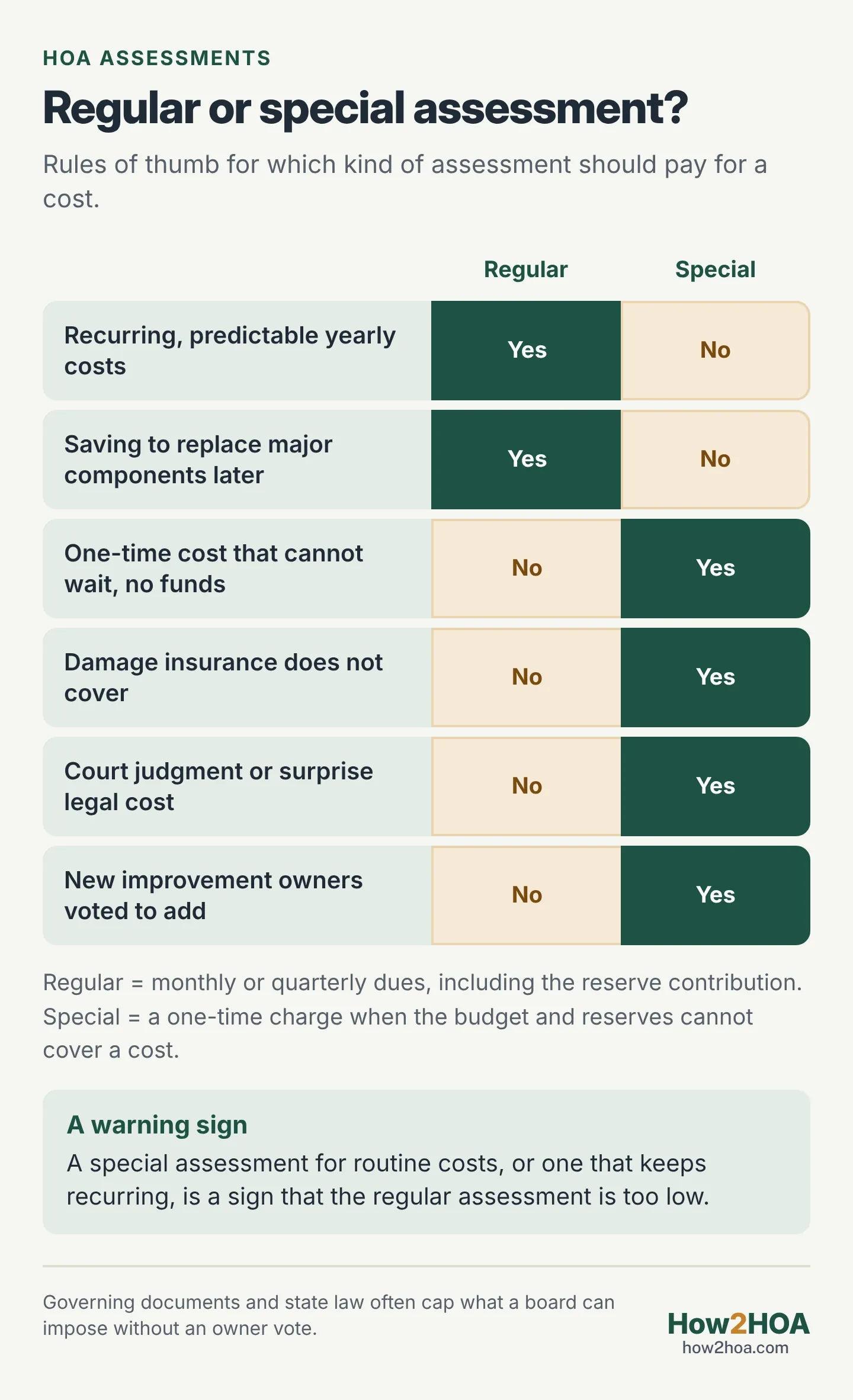
- A recurring, predictable cost belongs in the regular assessment.
- The future replacement of a major component also belongs in the regular assessment, through the reserve contribution.
- A one-time cost that cannot wait, when the money is not in the budget or in reserves, is what a special assessment is for.
- A special assessment for routine costs, or one that keeps recurring, is a sign that the regular assessment is too low.
In California
California’s Davis-Stirling Common Interest Development Act sets specific rules for both kinds of assessment.
- Duty to levy enough. The association must levy regular and special assessments sufficient to perform its obligations under the governing documents and the Act. It may not impose an assessment or fee that exceeds the amount needed to cover the costs it is levied for (Civil Code section 5600).
- Conditions for any increase. The board may not increase regular assessments for a fiscal year unless it has complied with the annual budget report requirements listed in the statute for that year, or has the approval of a majority of a quorum of the members at a member meeting or election (section 5605).
- Limits without an owner vote. Without that same member approval, the board may not impose a regular assessment more than 20 percent greater than the regular assessment for the preceding fiscal year, or impose special assessments that in total exceed 5 percent of the association’s budgeted gross expenses for that fiscal year. The statute says this rule applies notwithstanding more restrictive limitations placed on the board by the governing documents. For this purpose a quorum is more than 50 percent of the members (section 5605).
- Affordable housing units. For associations whose original declaration was recorded on or after January 1, 2025, section 5605 also sets a lower cap on annual increases in regular assessments for deed-restricted affordable housing units: 5 percent plus the percentage change in the cost of living, and no more than 10 percent over the preceding regular assessment. The statute lists exceptions.
- Emergency exception. The limits do not apply to increases necessary for an emergency, which the statute defines as an extraordinary expense required by a court order; an extraordinary expense needed to operate, repair or maintain the development where a threat to personal health or safety or another hazardous condition on the property is discovered; or an extraordinary repair or maintenance expense that the board could not reasonably have foreseen when it prepared the annual budget report. In the last case the board must first pass a resolution with written findings on why the expense is necessary and why it could not have been foreseen, and distribute the resolution to owners with the notice of assessment (section 5610).
- Notice. The association must give owners individual notice of any increase in regular or special assessments at least 30 and not more than 60 days before the increased assessment is due (section 5615).
- Fidelity coverage. Unless the governing documents require more, the association must maintain fidelity or crime coverage for its directors, officers and employees in an amount at least equal to its reserves plus three months of total assessments (section 5806).
As an example of the limits, take an association with budgeted gross expenses of $400,000 and a regular assessment of $300 a month. Without an owner vote and outside an emergency, the board could raise the regular assessment to no more than $360 a month for the next fiscal year, and could levy special assessments totaling no more than $20,000 in the fiscal year.
The Law Behind This Article
Every legal point in this article comes from the official text. Each link below opens it in a new tab.
Civil Code sections: 5600 · 5605 · 5610 · 5615 · 5806
This article is general educational information, not legal or financial advice. Laws vary by state and your association’s governing documents control many of these questions, so check with your association’s attorney or another qualified professional about your situation.