Sacramento, Roseville, Folsom and San Jose all allow short-term rentals in some form, but each city sets different conditions, and none of those city rules override an HOA’s own restrictions. An owner in an association has to satisfy both: the city’s permit, residency and tax rules, and the association’s CC&Rs (covenants, conditions and restrictions). Whichever is stricter controls. This is a California article, checked against each city’s official pages and municipal code in October 2026. City rules change, so confirm with the city before acting.
City rules at a glance
| City | Permit or registration | Residency and day limits | Transient occupancy tax |
|---|---|---|---|
| Sacramento | Short-term rental permit required (City Code 5.114) | Primary residence: permit required. Non-primary residence: 90 days total per calendar year | 12% |
| Roseville | Short-term rental permit and business license required (Municipal Code Chapter 4.25) | Primary residence only, single-family dwellings, no more than six people | 10% |
| Folsom | Business license certificate and TOT certificate. No stand-alone short-term rental permit confirmed | No more than three paying guests in a dwelling. Not allowed in accessory dwelling units | 8% |
| San Jose | No special permit found in the zoning rules. Taxes must be paid | Host not present: 180 days per calendar year. Host present: 365 days | 10% before October 1, 2026. Confirm the current rate (see below) |
City of Sacramento
The City of Sacramento’s short-term vacation rental page states that all operators of short-term rental property (a stay of 30 days or less) need a short-term rental permit. The City Council created the permit on January 19, 2016, in City Code Chapter 5.114.
- Primary residence. The operator must hold the permit, pay an annual business tax of $50 and collect and remit transient occupancy tax.
- Non-primary residence. The home may operate as a short-term rental for a total of 90 days in a calendar year. After that, the city says it may be rented only for stays of at least 31 days until the next year.
- Tax. The city’s transient occupancy tax is 12 percent under City Code Chapter 3.28.
- Reporting. Active permits are published on the city’s open data portal, and unpermitted rentals can be reported through 311.
For a board, the public permit list is useful. It lets the association see whether a home being advertised has a city permit.
City of Roseville
Roseville regulates short-term rentals in Municipal Code Chapter 4.25, and the city’s short-term rental permit page explains the process.
- Permit. It is unlawful to advertise or operate a short-term rental without a permit. The city lists a $185 fee for a new permit and $85 for yearly renewal, plus a business license.
- Primary residence. The rental must be the permit holder’s primary residence, defined in the code as a dwelling where the permittee lives at least 183 days during the calendar year. The chapter is written around single-family dwellings, one per parcel.
- Limits. No more than six people at any time, no accessory dwelling units, no events, parking on site or in front of the parcel, and a contact who can respond within 30 minutes of a complaint at any hour.
- Notice. Owners within 200 feet receive written notice before a permit is issued, and the permit number must appear in advertisements.
- Tax. Roseville’s transient occupancy tax is 10 percent (Municipal Code Chapter 4.24), remitted monthly.
Owners of condominiums or townhomes should ask the Roseville Finance Department how Chapter 4.25 applies to their property type before listing.
City of Folsom
Folsom does not have a stand-alone short-term rental permit that we could confirm. The city’s vacation rentals page applies existing code sections to furnished homes rented for less than 30 days.
- Business license. A city business license certificate is required under Folsom Municipal Code Chapter 5.04.
- Guest limit. No more than three paying guests are allowed in a dwelling. Large groups and events such as weddings fall under the bed and breakfast rules and need a conditional use permit first.
- Accessory dwelling units. They may not be used as vacation rentals.
- Tax. The city’s short-term rentals tax page states the transient occupancy tax is 8 percent of rent, including stays booked through home-sharing services. Operators must register for a TOT certificate and remit quarterly.
The vacation rentals page also notes that the city has been considering new vacation rental regulations as part of a Zoning Code update and that private HOA rules may also apply. Check with Folsom Planning Services for the current status before relying on the rules above.
City of San Jose
San Jose treats short stays as “incidental transient occupancy” under Municipal Code Chapter 20.80, Part 2.5 (sections 20.80.150 to 20.80.170). It is an allowed use in houses, duplexes, multifamily dwellings, mobilehomes, live/work units and guest houses that meet the listed criteria. It is not allowed in an accessory dwelling unit.
- Day limits. 180 days per calendar year when the host is not present, and 365 days when the host is present. “Host present” means the host is on the premises between 10 p.m. and 6 a.m. during the stay.
- Occupancy. With the host present, up to three transient users in a one-family dwelling or two per unit in two-family and multifamily dwellings. Without the host, two people in a studio, three in a one-bedroom and two more for each additional bedroom, up to ten.
- Local contact and records. For stays without the host, guests and adjacent neighbors must be given a local contact who can respond within 60 minutes. Hosts keep records for three years.
- Tax. Hosts are responsible for transient occupancy tax under Municipal Code Chapters 4.72 and 4.74, unless a hosting platform pays under an agreement with the city. Those chapters set rates of 6 percent and 4 percent, a combined 10 percent. Voters considered Measure A in June 2026 to raise the 4 percent portion to 6 percent effective October 1, 2026. Confirm the rate now in effect with the San Jose Finance Department.
We did not find a separate short-term rental permit in Part 2.5. Questions about zoning compliance go to San Jose’s Planning, Building and Code Enforcement department.
How city rules and HOA rules stack
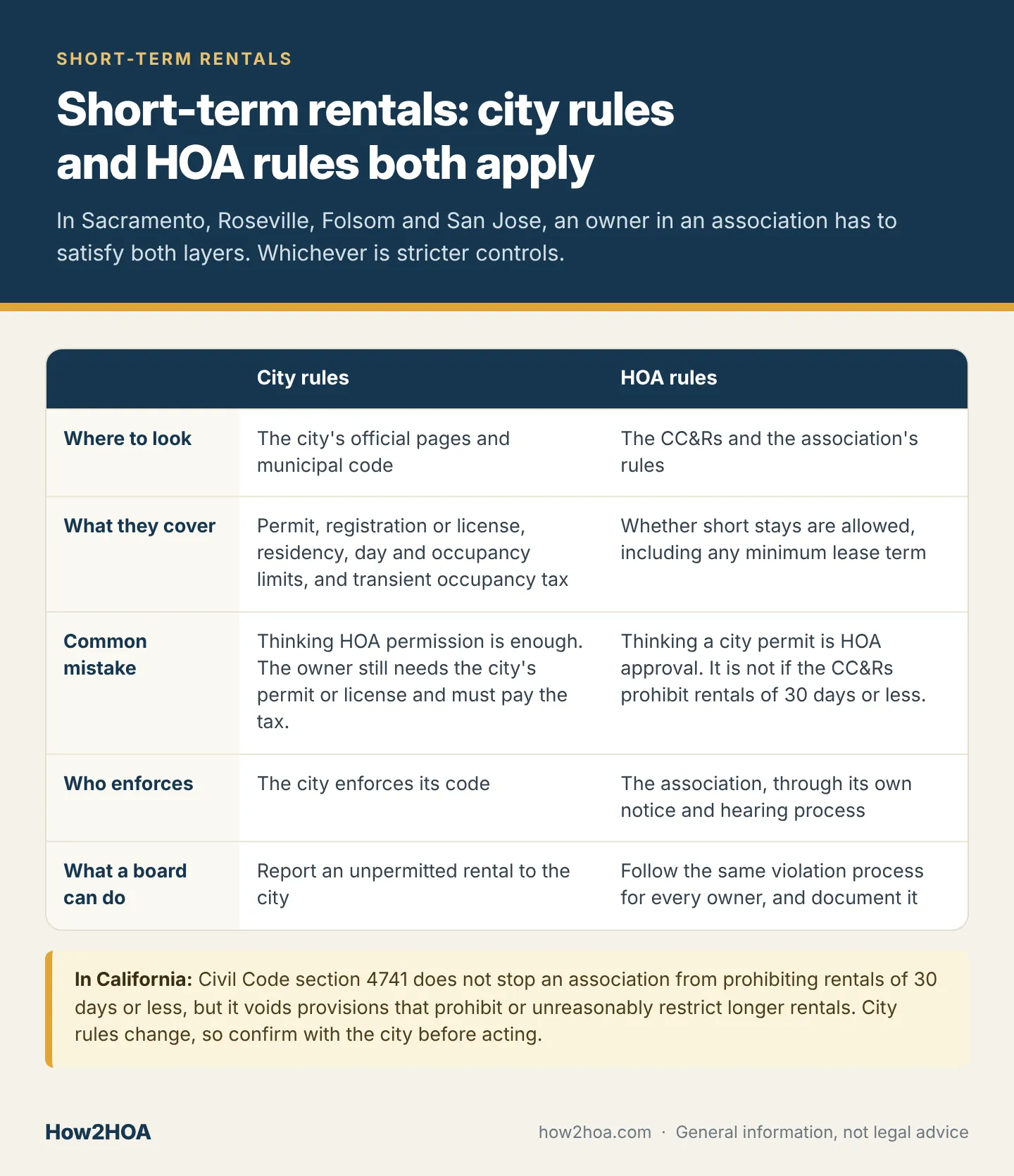
City law and the association’s governing documents are two separate layers, and an owner must comply with both.
- A city permit is not HOA approval. If the CC&Rs prohibit rentals of 30 days or less, a Sacramento or Roseville permit does not make the rental allowed inside the community.
- HOA silence is not city approval. If the association allows short stays, the owner still needs the city’s permit or license, must follow the day and occupancy limits and must pay the tax.
- Enforcement is separate. The city enforces its code. The association enforces its documents through its own notice and hearing process. A board can also report an unpermitted rental to the city.

Share this infographic: Pinterest · Facebook · LinkedIn · Email · Download
In California: what Civil Code sections 4740 and 4741 allow
State law limits how far an association can go in restricting rentals in general, but it treats short-term rentals differently.
- Short-term rentals may be prohibited. Civil Code section 4741 says it does not stop a common interest development from adopting and enforcing a governing document provision that prohibits transient or short-term rental of a separate interest for 30 days or less.
- Longer rentals are protected. The same section voids governing document provisions that prohibit or unreasonably restrict rentals, and it bars any rental cap that limits rentals to less than 25 percent of the separate interests. Accessory dwelling units are not counted as separate interests, and a home is not counted as rented if the owner lives in it or in its accessory unit.
- Penalty. An association that willfully violates section 4741 is liable for actual damages and a civil penalty of up to $1,000.
- Owners who bought before a restriction. Under Civil Code section 4740, an owner is not subject to a governing document provision prohibiting rental of the home unless that provision was in effect before the owner acquired title. Before renting, the owner must give the association verification of the date title was acquired and the tenant’s name and contact information.
How section 4740 applies to a new short-term rental ban for owners who bought earlier is a question for the association’s attorney, as is whether a change needs a CC&R amendment approved by the members or can be done by rule. Our article on HOA options for renters and short-term rentals walks through the choices a board has, and rental residences in HOAs covers long-term leasing.
What boards should do
- Read your documents. Find out what the CC&Rs and rules actually say about minimum lease terms. Our guide to governing documents explains which document controls.
- Know your city’s rules. Keep the city’s page handy so the manager can answer owner questions accurately.
- Tell owners both layers apply. A short notice in the newsletter prevents most problems.
- Enforce consistently. Follow the same violation process for every owner, and document it.
For more on owning, renting and living in an association, visit the How2HOA living in an HOA hub.
The Law Behind This Article
Every legal point in this article comes from the official text. Each link below opens it in a new tab.
Civil Code sections: 4740 · 4741
Other sources: City of Sacramento: Short-term vacation rentals · City of Sacramento: Transient occupancy tax · Roseville Municipal Code Chapter 4.25 · City of Folsom: Vacation rentals · City of Folsom: Short-term rentals tax · San Jose Municipal Code Chapter 20.80, Part 2.5 · City of San Jose: 2026 ballot measures
This article is general educational information, not legal or financial advice. Laws vary by state and your association’s governing documents control many of these questions, so check with your association’s attorney or another qualified professional about your situation.