HOA Management
HOA Management: Self-Management, Management Companies and Contracts
HOA management is the day-to-day work of running an association: collecting assessments, paying bills, keeping the books, arranging maintenance, answering owners, enforcing rules and getting notices and filings out on time. Every association has to get that work done.
In this section
Thirteen guides in four groups:
What a management company does
Managing the association yourselves
Hiring a management company
California rules for managers
The basics
How HOA Management Works: The Board Decides, Management Carries It Out
The choice is who does it: the volunteer board itself, a professional management company, or a mix of the two.
This section is for board members deciding between self-management and a management company, boards reviewing a contract they already have, and homeowners who want to know who is responsible for what.

Share this infographic: Pinterest · Facebook · LinkedIn · Email · Download
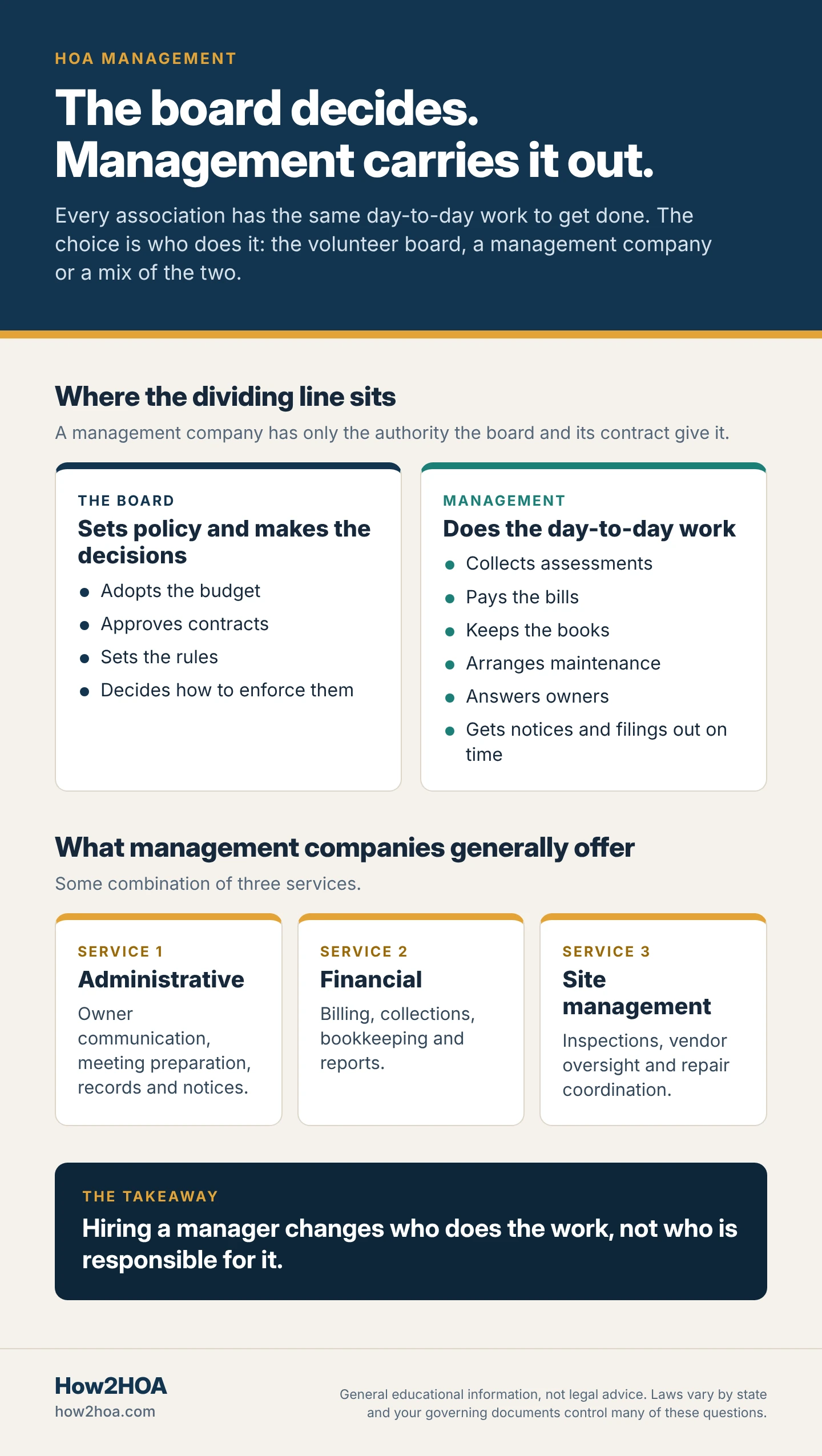
Neither approach suits every community. A small association with simple common areas and willing volunteers can run itself well. A larger one with amenities, employees and more legal paperwork may find the workload too heavy for volunteers. Many sit somewhere in between, and the answer can change as a community ages or its volunteers turn over.
If your board is weighing the two right now, start with our side-by-side comparison: Self-Managed vs. Professional HOA Management.
Start with the dividing line. The board sets policy and makes the decisions: it adopts the budget, approves contracts, sets rules and decides how to enforce them. Management is the work of carrying those decisions out. A management company works for the board under a written contract and has only the authority the board and that contract give it. California law, for example, lets the board of a nonprofit mutual benefit corporation (the form many associations there take) delegate management to a management company, but the corporation must still be run under the ultimate direction of the board (Corporations Code section 7210). In practice, hiring a manager changes who does the work, not who is responsible for it.
Management companies generally offer some combination of three services: administrative (owner communication, meeting preparation, records and notices), financial (billing, collections, bookkeeping and reports) and site management (inspections, vendor oversight and repair coordination). What Do HOA Management Companies Actually Do? describes each one.
A self-managed board does this work itself or hires help piece by piece, such as a bookkeeper, an accountant, an attorney and a landscaper. It avoids the management fee and keeps the board close to the details. The cost is volunteer time, and the risk is that a deadline, a required notice or a financial control gets missed when a key volunteer steps down. How to Self-Manage Your HOA: A Helpful Guide covers the systems that make it work.
Hiring a company buys time, continuity and experience, and it costs a fee that owners pay through their assessments. It also brings work of its own: the board has to choose carefully, read the contract and keep supervising. As a matter of good practice, compare proposals that cover the same scope, check references and get the terms in writing, including duties, fees and extra charges, the length of the agreement, how either side can end it, and insurance. Some states add legal requirements. In California, a prospective managing agent must give the board a written disclosure statement before a management agreement is signed (Civil Code section 5375). What Are HOA Management Contracts? lists what the agreement should cover.
2 guides
What a Management Company Does
What Do HOA Management Companies Actually Do?
Explains how the board's job differs from the manager's and describes the administrative, site management and accounting work a company typically handles.
What Is the Difference Between Property Management and HOA Management?
A property manager works for a landlord and handles tenants and units, while an HOA manager works for the board and handles common areas, finances and governance, and this article helps you tell which one you need.
2 guides
Managing the Association Yourselves
How to Self-Manage Your HOA: A Helpful Guide
How a volunteer board can manage the association itself with a compliance calendar, written roles, financial controls and the right outside professionals.
The Risks of Self-Managing Your Homeowners Association
The problems a board without professional help can run into, including missed legal requirements, lawsuits, weak budgeting, and no neutral party or single point of contact for owners.
6 guides and 1 free tool
Hiring a Management Company
7 Benefits of Professional HOA Management (and the Trade-Offs)
Seven practical benefits of hiring a manager, the trade-offs that come with them, and when a small association may not need one.
Can Hiring an HOA Management Company Save Your Community Money?
Where savings from a management company come from, where they do not, and how a board can run the numbers with the fee counted as a cost.
What Are HOA Management Contracts?
How to choose a company, why a written agreement matters, and the eight topics a management contract should cover, from duties and billing to termination and insurance.
How Much Does HOA Management Cost?
How management companies price their work, what the base fee covers, what is billed on top, and how to compare proposals fairly.
How to Write an HOA Management RFP
What to put in an HOA management RFP, with a copy-ready outline, scoring table, timeline, interview questions and the California disclosure rules.
Free Tool: HOA Management RFP Builder
Fill in a short form and get a ready-to-send RFP as a Word document, with California's required disclosures and a scoring sheet for comparing proposals.
How to Switch HOA Management Companies
A step-by-step guide to changing HOA management companies: the termination clause, the board vote, the notice, the transition checklist and the first 90 days.
3 guides
California Rules for Managers
Managing Agent Disclosures in California HOAs
What a California HOA management company must disclose to the board before a contract, when bidding and every year, and the new 2027 fee statement.
Certified HOA Managers in California: What the Title Means
California doesn’t license HOA managers, but it protects the word certified. What the title requires, how to check it and what managers must disclose.
How California Law Protects HOA Money a Manager Handles
How California protects HOA money a manager handles: trust accounts, no commingling, board approval for big transfers, monthly reviews and crime coverage.
A to Z
Every Article in This Section
Sources
The Law Behind This Page
Keep going
Related Sections
Board Members
The duties that stay with the board whoever handles the daily work.
Finances
The budget, reserves and assessments that management has to track.
Maintenance and Vendors
Looking after the common areas and the contractors who work on them.
Rules and Governing Documents
The documents that define what the association must do.
Start here
Start With What a Management Company Does
Every association has to get that work done. Start with what a management company does, then work through the rest of the section.
This page is general educational information, not legal or financial advice. Laws vary by state and your association's governing documents control many of these questions, so check with your association's attorney about your situation.