California HOA Board Meetings

Most board trouble in California starts at a meeting: an item that wasn’t on the agenda, a decision made by email, a notice that went out a day late. Here’s how to run meetings that hold up. The legal fine print is at the bottom for when you need it.

The short version

Five Rules for Every Board Meeting

If it isn’t on the agenda, the board can’t act on it.

  1. No decisions by email. The board acts only at meetings. Email votes are allowed only in a true emergency, with every director’s written consent.
  2. Four days’ notice, with the agenda. Two days for a meeting held only in executive session. Your documents may require more.
  3. Stick to the agenda. Outside three narrow exceptions, the board can’t discuss or act on anything that isn’t on it.
  4. Owners get to speak. Members can attend and comment, within a reasonable time limit, at every meeting except executive session.
  5. Minutes within 30 days. Draft minutes marked as drafts, or a summary, meet the deadline.

Meeting rules

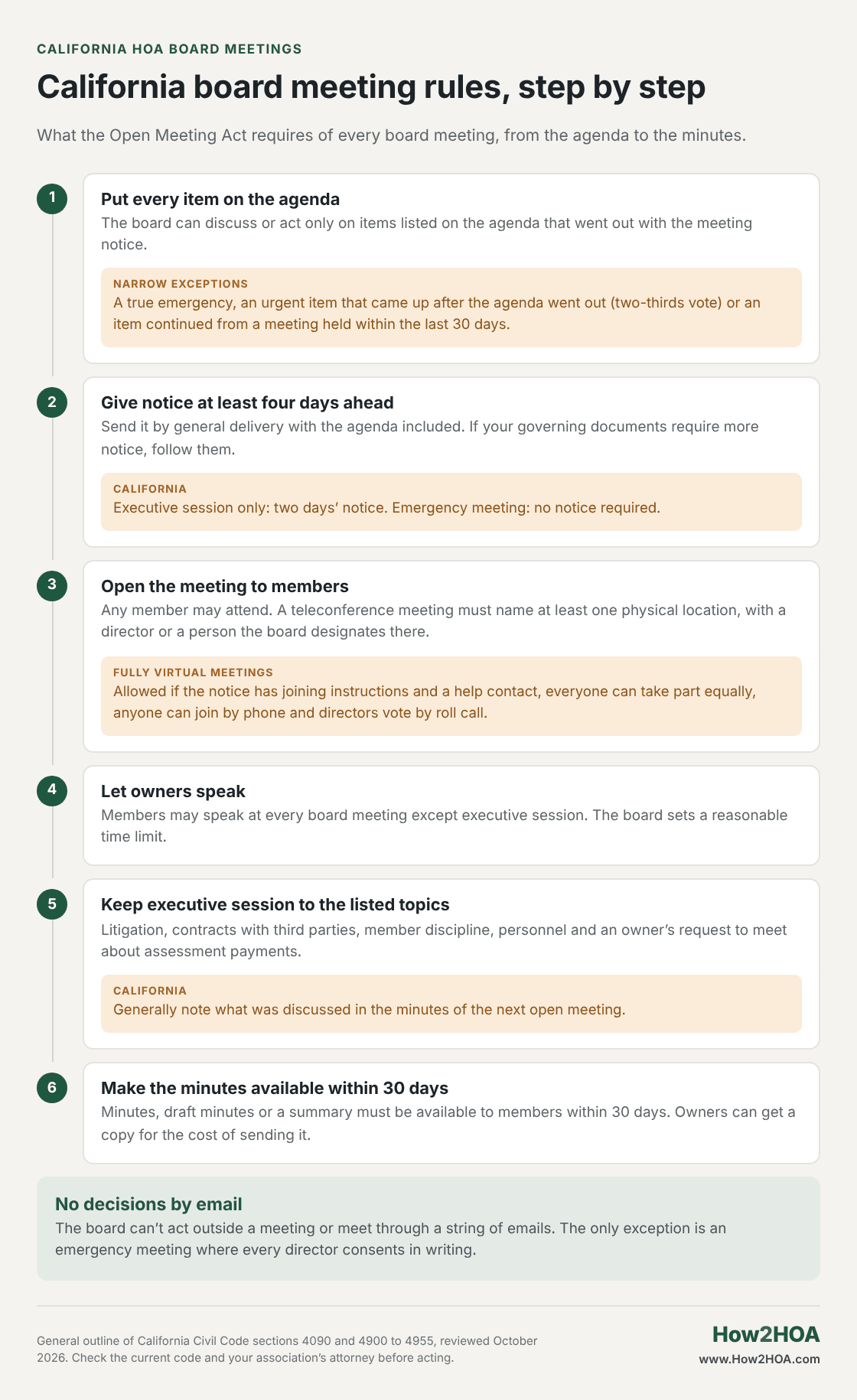
The California Board Meeting Rules at a Glance

Infographic: 6 steps for following California HOA board meeting rules

Share this infographic: Pinterest · Facebook · LinkedIn · Email · Download

Free tools

Free Tools for This Topic

The notice, the agenda and the checklist, ready to fill in.

How to do it

Running a Compliant Board Meeting Step by Step

Build the agenda first. Almost every Open Meeting Act problem starts with an item that wasn’t on it.

Use this routine for every regular board meeting. It follows the order the law expects.

  1. Set the year’s meeting calendar. Pick regular meeting dates in advance so owners know when to expect them and notices never run late.
  2. Draft the agenda. List every item the board may discuss or act on. If it isn’t on the agenda, the board can’t take it up except in three narrow cases, shown in the examples below.
  3. Send notice on time. At least four days ahead, or two days for a meeting held only in executive session. Use the delivery methods your annual policy statement names, and send it individually to owners who asked.
  4. Choose the format. In person, by teleconference with a physical location or fully virtual. For a fully virtual meeting, put the joining instructions, the help contact and the individual-delivery reminder in the notice, and offer a phone option.
  5. Open the floor to owners. Give members the chance to speak, using the time limit the board has set.
  6. Work through the agenda. Take each item in turn and record motions and votes. If something urgent comes up that isn’t on the agenda, make and record the required finding before discussing it. In a fully virtual meeting, vote by roll call.
  7. Go into executive session only for permitted topics. Afterward, note the topics generally in the minutes of the next open meeting.
  8. Get the minutes out within 30 days. Draft minutes marked as drafts or a summary meet the deadline. The board can approve the final version at its next meeting.
  9. Keep the paper trail. File the notice, the agenda, any emergency email consents and the minutes with the association’s records.

Board checklist

  • ☐ Notice and the agenda go out at least four days ahead, or two days for a meeting held only in executive session.
  • ☐ Notices go out the way our annual policy statement says, and individually to owners who asked.
  • ☐ The board acts only at meetings, never by email, outside a true emergency with every director’s written consent.
  • ☐ Nothing is discussed or decided that isn’t on the agenda, unless the board first makes one of the three findings the law allows.
  • ☐ Owners can attend and speak at every open meeting, within a reasonable time limit.
  • ☐ Executive session is used only for litigation, contracts with third parties, member discipline, personnel and an owner’s request to meet about paying assessments.
  • ☐ Executive session topics are noted generally in the minutes of the next open meeting.
  • ☐ Fully virtual meetings include joining instructions, a help contact, a phone option and roll call votes.
  • ☐ Minutes, draft minutes marked as drafts or a summary are available to owners within 30 days.

Want a printable version? Use the Board Meeting Checklist.

Need the notice and agenda itself? Our free Board Meeting Notice and Agenda Template builds both, plus a separate executive session agenda for directors.

In real life

What This Looks Like on a Real Board

Five everyday situations, and the right move in each one.

These are illustrations, not stories about a real community.

The reply-all vote

A director emails the board: “Can we approve the tree trimming bid?” Three directors reply “Yes.” It feels efficient, but it’s acting outside a meeting, which California doesn’t allow unless it’s a true emergency and every director consents in writing.

The right way: put the bid on the next agenda and vote on it there.

Dinner with a quorum

Three of five directors meet for dinner and spend an hour talking through next year’s budget. That’s a board meeting under the law, and nobody gave notice. Dinner is fine. Working through association business with a quorum at the table is not.

The surprise at the meeting

An owner stands up and says a big tree is leaning toward her roof. The board can listen, ask questions and put it on a future agenda. Acting tonight takes one of three findings: a majority agrees it’s an emergency, two-thirds find the need came up after the agenda went out, or it was on an agenda in the last 30 days and was continued. The board has to name the item openly before discussing it.

The executive session that wandered

The board goes into executive session to talk about a vendor contract, then drifts into debating the landscaping budget. Executive session is only for litigation, contracts with third parties, member discipline, personnel and an owner’s request to talk about paying assessments. The budget talk belongs in the open meeting.

The all-Zoom meeting

A board wants to meet entirely online. It can, if the notice has clear joining instructions, a contact for tech help and a reminder that owners can ask for individual notices, everyone can take part as fully as in person, anyone can join by phone and votes are by roll call. It can’t be used for a meeting where ballots are counted.

Common mistakes

Where Boards Slip Up

Each of these can get the association sued, with attorney’s fees and penalties on the line.

These are the Open Meeting Act problems that come up most often.

  • Deciding by email or text. The law bars it unless it’s an emergency and every director consents in writing. A string of “reply all” votes isn’t a meeting.
  • Adding items at the meeting. Discussing or voting on something that wasn’t on the agenda, without one of the three findings the law allows.
  • Short or misplaced notice. Giving fewer than four days’ notice, or posting it somewhere the annual policy statement doesn’t designate.
  • Stretching executive session. Using it for topics the law doesn’t allow there, or forgetting to note the topics in the next open meeting’s minutes.
  • Quorum get-togethers. A quorum of directors working through association business over dinner or at an unnoticed “workshop” is holding a board meeting, whatever they call it.
  • Virtual meetings without the safeguards. Skipping the phone option, the help contact or the roll call vote required for a meeting with no physical location.
  • Cutting owners off. Refusing to let members speak, or setting a time limit too short to be reasonable.
  • Late minutes. Missing the 30-day deadline.

Best practice, not a legal requirement

Habits That Make Meetings Work

These habits keep meetings short, open and focused on decisions.

  • Send a board packet early. Give directors the agenda and backup documents several days ahead, so the meeting is for deciding, not reading.
  • Post notices more than one way. Post at the designated location and also email owners who have agreed to electronic delivery.
  • Use a consent agenda for routine items. Group approvals like prior minutes and routine reports into one vote, and let any director pull an item for discussion.
  • Adopt meeting rules in writing. A short set of procedures, or a recognized system like Robert’s Rules, makes motions and votes predictable.
  • Hear owners early. Holding owner comments near the start lets owners speak before the board acts, without waiting through the whole meeting.
  • Test the technology. Run a short test before any teleconference and keep a backup dial-in number ready.
  • Write minutes as actions, not transcripts. Record motions, who made them and how directors voted. See HOA Meeting Minutes for a template.
  • Brief new directors on the agenda rule. A short walk through the no-email-votes rule and the agenda rule prevents most problems.

4 guides

Planning and Running the Meeting

HOA Board Meetings and Their Breakdown

The kinds of HOA meetings (board, executive session, annual, special and emergency), a typical board agenda and California’s open meeting rules.

The Strategy Behind an HOA Board Meeting

Good HOA board meetings are won in the preparation. Ten ways to plan the agenda, ready your directors and owners and follow the Open Meeting Act.

How to Run HOA Board Meetings Smoothly

A chair’s guide to running an HOA board meeting: set time limits, have documents ready, handle motions consistently and keep to the agenda.

How to Manage Conflict in HOA Board Meetings

Disagreement on an HOA board is normal. Ground rules, chairing tools and prevention steps that keep conflict in board meetings productive.

3 guides

Owners, Executive Session and Minutes

How to Get Community Members to HOA Meetings

Owners come to HOA meetings when they get early notice, a short agenda and a real chance to be heard. How to raise attendance.

HOA Executive Session: What a Board Can Discuss in Private

What an HOA board may discuss in executive session, what must stay in open meetings and California’s notice, agenda and minutes rules.

HOA Meeting Minutes: What to Record (With a Template)

What HOA meeting minutes should include and leave out, a copy-ready template and the California rules on timing and member access.

The legal details

Notice, Agendas and Acting Only in Meetings

Outside a true emergency, the board can act only at a noticed meeting, and only on items listed on the agenda it sent at least four days ahead.

California’s Common Interest Development Open Meeting Act, sections 4900 to 4955 of the Civil Code, sets the ground rules for how a board meets, gives notice and makes decisions.

What counts as a board meeting. A board meeting is any gathering of enough directors to make a quorum, at the same time and place, to hear, discuss or deliberate on business within the board’s authority. A teleconference counts too, when a quorum is connected by audio or video. If a quorum of directors gets together to talk through association business, that’s a board meeting, whatever it’s called.

  • No action outside a meeting. The board may not take action on any item of business outside a board meeting. It also may not meet through a series of emails or other electronic messages. The one exception is an emergency meeting: directors can meet by email if every director consents in writing and the consents are filed with the minutes.
  • Four days’ notice. The association must give notice of the time and place of a board meeting at least four days ahead, and the notice must include the agenda. A meeting held only in executive session needs two days’ notice, and an emergency meeting needs none. If your governing documents require longer notice, follow them. A longer period in your documents applies to emergency or executive-session-only meetings only if it says so specifically.
  • How notice is delivered. Board meeting notices go out by general delivery. That can be any individual-delivery method, a billing statement or newsletter, a posting at the location named in the annual policy statement or a posting on the association’s website if the annual policy statement designates it. Any owner can ask to receive general notices individually.
  • Emergency meetings. The president, or any two other directors, can call an emergency meeting when something that couldn’t reasonably have been foreseen needs immediate attention and possible action, and giving notice is impracticable.
  • The agenda rule. At a nonemergency meeting, the board may not discuss or act on anything that isn’t on the agenda sent with the notice. Directors and the manager may still briefly answer owners’ comments, ask clarifying questions, make short announcements and ask for an item to go on a future agenda.
  • Acting on an item that isn’t on the agenda. Only three situations allow it. A majority of the directors present decides an emergency exists. Two-thirds of the directors present (or every director present, if fewer than two-thirds of the board is there) find that the need to act came up after the agenda went out. Or the item was on the agenda of a meeting held within the last 30 days and was continued to this one. Either way, the board must openly identify the item before discussing it.

The legal details

Owners, Teleconferences, Executive Session and Minutes

A member who wins an Open Meeting Act lawsuit recovers attorney’s fees, and the court can add a penalty of up to $500 per violation.

Owners have the right to attend and be heard at board meetings, with a short list of exceptions the board has to respect.

Attending and speaking. Any member may attend board meetings except executive session. The board must let members speak at any meeting of the association or the board, except executive session, and must set a reasonable time limit for owner comments. Members may raise issues that aren’t on the agenda, even though the board can’t act on them that day.

Teleconference meetings. A board can meet by teleconference as long as every participating director can hear the others and the members speaking. Unless the meeting is executive session only or is held fully virtually under the rules below, the notice must name at least one physical location where members can attend, and at least one director or a person the board designates must be there.

Fully virtual meetings. A board or member meeting can be held entirely by teleconference, with no physical location, if all of these are true:

  • the notice includes clear instructions for joining, the phone number and email address of someone who can help with technical problems and a reminder that members can ask for individual delivery of notices
  • every director and member can take part as fully as they could in person
  • directors vote by roll call
  • anyone entitled to participate can join by phone.

This option isn’t available for a meeting where election ballots are counted. Separate rules apply when a declared disaster or emergency makes meeting in person unsafe.

Executive session. The board may meet privately only to consider litigation, the formation of contracts with third parties, member discipline, personnel matters or an owner’s request to meet about paying assessments. It must use executive session to discuss member discipline if the member asks (and that member may attend), to discuss a payment plan and to decide whether to foreclose on a lien. Anything discussed in executive session must be generally noted in the minutes of the next open meeting.

Minutes. The minutes, draft minutes marked as drafts or a summary of any open board meeting must be available to members within 30 days. Any member can get a copy on request by paying the association’s cost of sending it, and the annual policy statement must tell members how and where to ask.

Member meetings. Annual and special meetings of the members must follow a recognized system of parliamentary procedure or procedures the association adopts. Members may speak, subject to a reasonable time limit set by the board.

If the board gets it wrong. A member can sue within one year to enforce the Open Meeting Act. A member who wins recovers reasonable attorney’s fees and court costs, and the court may impose a civil penalty of up to $500 per violation. The association recovers its costs only if the court finds the suit frivolous, unreasonable or without foundation.

Sources

The Law Behind This Page

Every legal point on this page comes from the official text. Each link below opens it on the California Legislature’s website in a new tab.

Civil Code sections: 4045 · 4090 · 4900 · 4910 · 4920 · 4923 · 4925 · 4926 · 4930 · 4935 · 4950 · 4955 · 5000 · 5450

Keep going

Related Topics

California HOA Guide

Every California topic guide in one place.

Elections and Voting

Board elections, secret ballots and acclamation.

Board Meetings and Elections

Running meetings and elections well in any state.

Management

Working with a management company.

Local Guides by City

City and neighborhood guides, county by county.

Get help

Want Help Running Board Meetings?

A professional management company can prepare agendas, send notices on time and keep the minutes, so the board can focus on decisions.

Last reviewed October 21, 2026. By the How2HOA Editorial Team. This page is general educational information, not legal advice. Laws change and your association’s governing documents control many of these questions, so check with your association’s attorney about your situation.

Share this: