
To improve HOA meeting attendance, give owners a reason to come and make it easy for them to do so. Send the agenda early, keep the meeting short, ask for owners’ input and help, and make the evening feel like a community gathering instead of a formal proceeding. Board business is rarely exciting, so a little food, a door prize and a chance to talk with neighbors go a long way.
Attendance matters for practical reasons too. Owners who come to meetings understand why the board makes the decisions it does, and at the annual meeting you may need a minimum number of owners taking part before an election can go ahead. Our article on how to conduct HOA elections explains how quorum works there.

Share this infographic: Pinterest · Facebook · LinkedIn · Email · Download
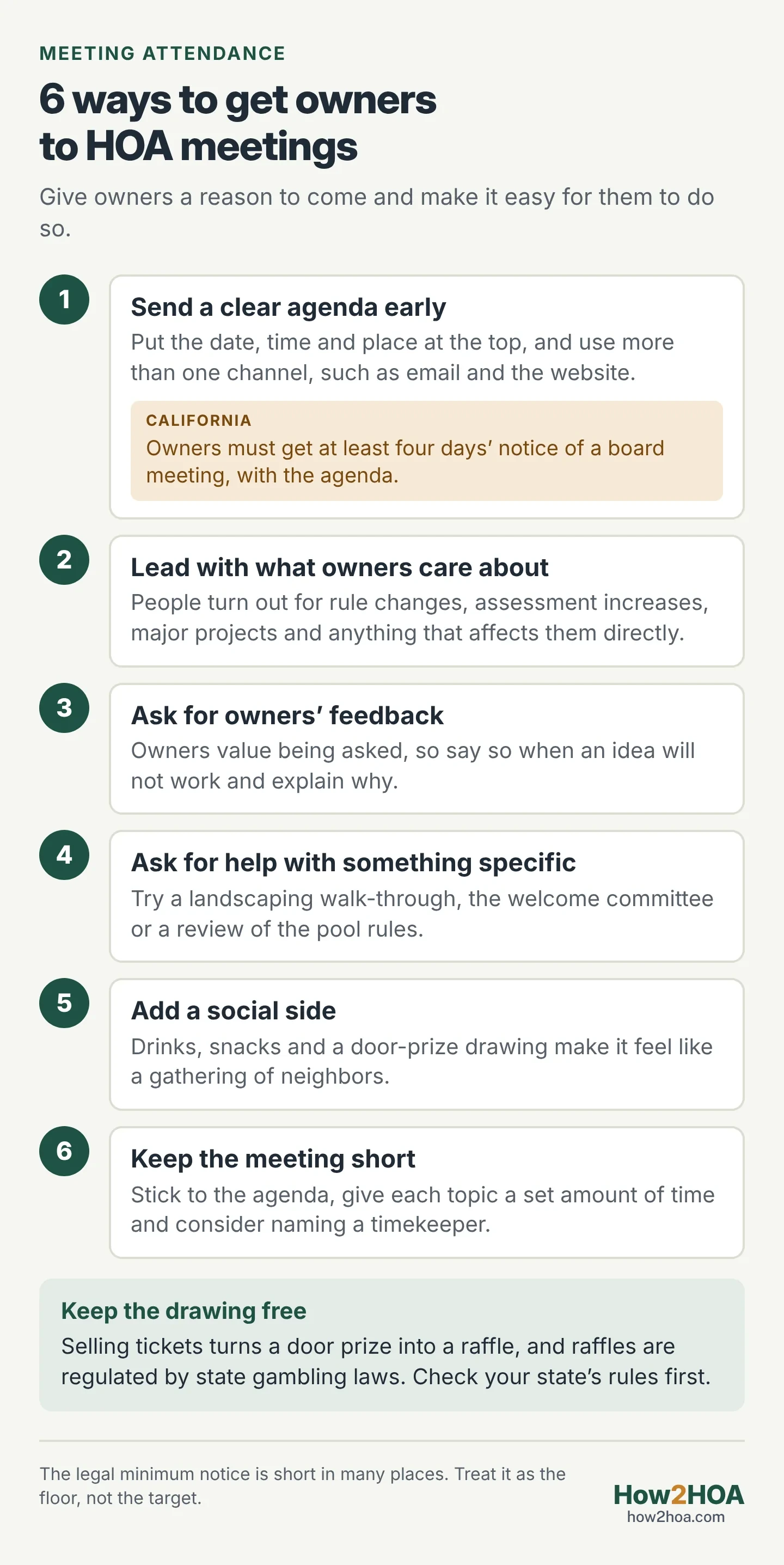
Give Plenty of Notice and a Clear Agenda
Get a clear, good-looking agenda to homeowners well ahead of the meeting. People’s calendars fill up quickly, and if you wait too long the date may already be taken. Put the date, time and place at the top, and use more than one channel: email, the association website, the newsletter, a sign at the entrance or the mailboxes. Publishing the meeting dates for the whole year in January is even better.
The legal minimum notice is short in many places. Treat it as the floor, not the target.
Ask for Homeowner Feedback
Homeowners will sometimes suggest ideas the association cannot carry out. They still value being asked. Owners tend to be more comfortable with their association when they feel their voices are heard, even when a particular concern cannot be acted on. Say so when an idea will not work, and explain why.
Other times, owners offer good ideas the board had not thought of. They may know service providers, such as landscapers, that your board has not tried. Contacts like these can help you improve the neighborhood on budget and on schedule. For more ways to listen between meetings, see giving a voice to your HOA community members.
Some homeowners will never volunteer, but others enjoy lending a hand. Give them a reason to come by asking for their help with something specific: a landscaping walk-through, the welcome committee, a review of the pool rules. Many owners assume their help is not wanted, usually because nobody on the board has asked. A committee is the simplest way to put willing owners to work, and our article on how to set up and run committees shows how.
No association will get full participation. But when a few owners feel appreciated, they come back, bring neighbors and take pride in the community, and that pride shows in how the community runs. Nobody wants to attend a meeting where they do not feel heard. The people who get a chance to speak are the ones who stay involved.
Make Your Meetings Social
An HOA meeting exists to work through maintenance items and the board’s planned actions. If nothing on the agenda affects an owner directly, that owner has little reason to come. Give them one by adding a social side. Drinks and snacks are an easy start. Refreshments make the meeting feel less like a formal proceeding and more like a gathering of neighbors, and people who arrive early to chat are in a better mood when business starts.
A door-prize drawing is another draw. The association may not need to spend anything on prizes. Owners who run local businesses are often glad to donate a gift card or a service, because it puts their name in front of their neighbors. The association gets a prize, and the business owner gets some goodwill.
Keep the drawing free. Give every owner who attends one ticket at no charge. Selling tickets turns a door prize into a raffle, and raffles are regulated by state gambling laws. Check your state’s rules before you sell a single ticket.
It may be a small bribe, but if it gets people in the room, it is worth it.
Be Efficient With Time
Keep your meetings as short and efficient as you can. A homeowner who sits through a meeting that runs too long will not want to come to another one. If your meetings are consistently quick and thorough, it becomes much easier to get people back. Stick to the agenda, give each topic a set amount of time, tell everyone what the limits are, and consider naming a timekeeper. It is the board’s job to rein in people who keep straying off topic. Our article on planning a board meeting agenda covers how to set this up.
If the agenda is crowded and the meeting is likely to run past two hours, be realistic. Take the top-priority items and save the rest for a second meeting. A gap of at least a few days lets everyone absorb what they heard and come back fresh. The second meeting needs its own notice.
Put some care into how the agenda looks and reads, since you will circulate it before the meeting and hand it out at the door. Lead with the items owners care about most. People turn out for rule changes, assessment increases, major projects and anything else that affects them directly. Routine items still have to be listed, but they do not need the headline.
HOA Meeting Attendance Rules in California
California law gives owners specific rights around meetings, and a board that uses them well will see better turnout.
- Notice. Owners must get at least four days’ notice of a board meeting, and the notice must include the agenda (Civil Code section 4920). The notice can be given by any of the general delivery methods in section 4045, which include a newsletter or billing statement, and posting at a location or on a website that the association has designated in its annual policy statement. An owner who asks for individual delivery must get notices that way.
- The right to attend and speak. Any member may attend a board meeting, except an executive session, and the board must let members speak within a reasonable time limit (section 4925).
- Every item goes on the agenda. The board generally may not discuss or act on an item that was not on the agenda (section 4930). You can choose what to feature, but you cannot leave business off.
- Remote attendance. A board or membership meeting may be held entirely by teleconference, with no physical location, if the notice includes clear instructions for joining, a phone number and email address for technical help and a reminder that members may request individual delivery of meeting notices, every director and member can take part as fully as they could in person, a telephone option is offered, and director votes are taken by roll call. A meeting at which election ballots are counted cannot be held this way (section 4926). For owners who travel or have young children, a way to join from home can be the difference between attending and not.
- Membership meetings. For an incorporated association, written notice of a meeting of the members goes out no fewer than 10 days (at least 20 days if sent by mail other than first-class, registered or certified) and no more than 90 days before the meeting (Corporations Code section 7511).
- Raffles. Under Penal Code section 320.5, a raffle may be conducted only by an eligible tax-exempt nonprofit organization, which generally must register with the Department of Justice first. At least 90 percent of the gross receipts must go to beneficial or charitable purposes, which do not include purposes that benefit the organization’s own members. The Attorney General’s raffle page explains that registration is not required when all tickets are free and no donation is tied to getting one. For an HOA meeting, a free door prize is the safe choice.
Above all, ask your homeowners to get involved. Being asked makes people feel like part of the community, and a community whose owners show up is easier to run. You can find more on agendas, procedure and elections in our board meetings section.
The Law Behind This Article
Every legal point in this article comes from the official text. Each link below opens it in a new tab.
Civil Code sections: 4045 · 4920 · 4925 · 4926 · 4930
Corporations Code sections: 7511
Penal Code sections: 320.5
Other sources: California Attorney General: Raffles
This article is general educational information, not legal advice. Laws vary by state and your association’s governing documents control many of these questions, so check with your association’s attorney or another qualified professional about your situation.