
HOA elections are run under three sets of rules: your state’s law, your association’s bylaws and CC&Rs, and any election rules the board has adopted. To conduct one properly, read those rules first, set a timeline that meets every notice deadline, keep an accurate list of who may vote, have the ballots counted by someone neutral, and announce the results openly. This article walks through each step and then sets out what California law requires.
Elections matter because an association is a democratic institution. The owners choose the directors who will set the budget, enforce the rules and sign the contracts. When the process is clear and consistent, owners trust the result, even when their candidate loses. When it is not, the association can end up with a disputed board and, in some states, a court setting the results aside.

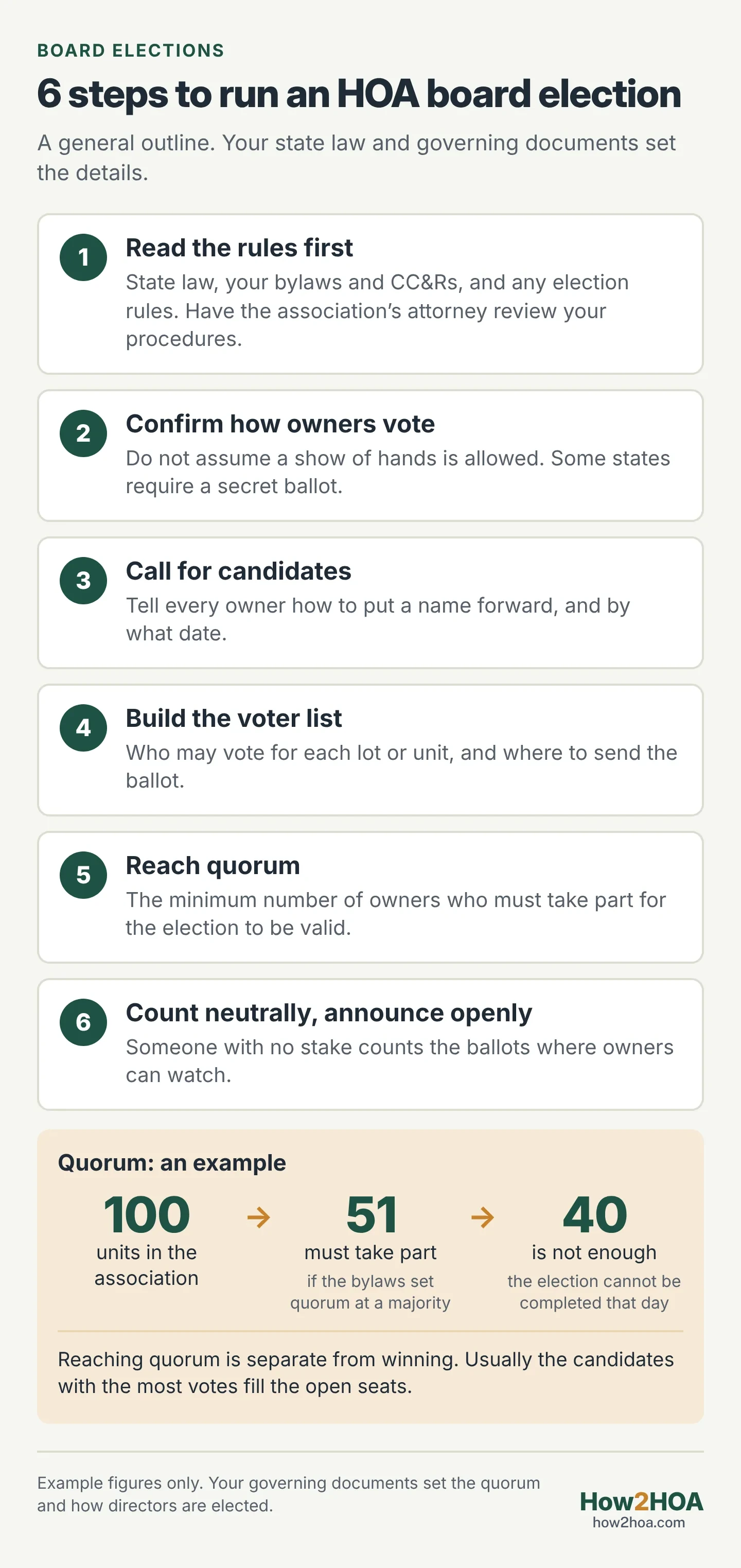
Share this infographic: Pinterest · Facebook · LinkedIn · Email · Download
Bylaws and the Ballot Box
The first step is to read your bylaws and CC&Rs. In most associations the playbook for elections is already there: how many directors there are, how long they serve, when the annual meeting is held, who may vote, what quorum is, and whether proxies or cumulative voting are allowed. If you are not sure where to look, our guide to HOA governing documents explains what each document covers.
Next, check your state’s statutes. Where state law and your documents conflict, state law usually wins, and election laws change often. Have the association’s attorney review your procedures, and any changes to them, before you start the election, not after someone challenges it.
How owners vote depends on your state and your documents. Depending on where you are, voting may happen in person at the annual meeting, by mailed ballot, by proxy or online. Do not assume that a show of hands is allowed. Some states, California among them, require a secret ballot for director elections and permit online voting only under specific conditions.
Once the method is settled, send a call for candidates to every owner, explaining how to put a name forward and by what date. Associations often set qualifications for candidates, such as being an owner and being current on assessments. State law may limit which qualifications you can impose, so confirm that yours are allowed before you turn anyone away.
Holding the Election
Before any ballots go out, get your voter list in order. This is the full list of who is entitled to vote: each owner’s name, the lot or unit they vote for, the number of votes that lot or unit carries, and a mailing address. Most associations allow one vote per lot or unit no matter how many people are on the deed, so co-owners need to know that they share a single ballot. An accurate list tells you how many ballots to expect, and it is the basis for your next task, which is checking for a quorum.
A quorum is the minimum number of owners who must take part for the election to be valid. Your governing documents set it. Suppose your association has 100 units and the bylaws set the quorum at a majority of the owners. You need 51 units represented, whether in person, by proxy or by ballot where your rules allow those to count. If only 40 take part, the election cannot be completed that day. Low turnout is a common reason elections stall, which is why it pays to work on getting owners to HOA meetings long before election season.
Reaching quorum is separate from winning. Directors are usually elected by plurality: if three seats are open, the three candidates with the most votes are elected, even if none of them was chosen by more than half of the voters. Check your bylaws, because some associations use cumulative voting or elect directors by district.
Someone neutral should collect and count the ballots. In some associations the management company helps with mailings and logistics, and others bring in an outside election inspector to supervise and certify the vote. Before you hire one, confirm that the person is experienced with the voting method you are using and is allowed to serve under your state’s law. California, for example, bars anyone who is already paid by the association for other services from acting as inspector.
Make the Votes Count
It is the board’s job to see that the election is run smoothly and fairly. Voters expect that of any election, and an HOA election hits close to home because it affects the neighborhood’s finances and the owners’ daily lives. Four points deserve the most attention:
- Know the quorum you need and how votes are counted toward it.
- Keep the voter list up to date, and know who may cast the vote for each lot or unit.
- Set a process for counting votes, and make sure the person or team counting them has no stake in the outcome.
- Check your state’s law, your bylaws and your CC&Rs for the required procedure before you begin.
Count the ballots where owners can watch, announce the results promptly, and keep the ballots and tally sheets in case of a recount. Results are often announced at the annual meeting. Our breakdown of HOA board meetings explains how the annual membership meeting differs from a regular board meeting.
These are general guidelines. What works for one association may not suit another, and there is room to adjust the details, such as how you invite candidates or how you introduce them to the owners. There is no room to improvise on the legal requirements. Talk with your board, listen to what owners want from the process, and plan well ahead.
HOA Elections in California: What the Law Requires
California regulates association elections in detail in Civil Code sections 5100 to 5145, part of the Davis-Stirling Act. These rules override contrary provisions in your governing documents. The summary below reflects the statutes as of October 2026. They have been amended several times in recent years, so confirm the current text with your association’s attorney before each election.
Secret Ballots and How Often Elections Are Held
Under Civil Code section 5100, the election and removal of directors must be by secret ballot. The same is true of votes on assessments that legally require a member vote, amendments to the governing documents, and grants of exclusive use of common area. A show of hands or a voice vote is not allowed for these. An association must hold an election for a seat on the board when that director’s term expires, and at least once every four years.
Election Operating Rules
Section 5105 requires every association to adopt election operating rules. The rules may not be amended less than 90 days before an election. Among other things, they must:
- Give all candidates and members advocating a point of view equal access to association newsletters, websites and other media during the campaign, if any candidate or member is given access. The association may not edit the content.
- Give all candidates and members advocating a point of view free access to common area meeting space during the campaign.
- Set the qualifications for candidates and the procedure for nominations. A procedure that prevents a member from nominating himself or herself is not allowed.
- State the voting power of each membership, the treatment of proxies, and the voting period.
- Provide for the selection of one or three independent inspectors of elections.
- Require the association to keep a candidate registration list and a voter list, and let members verify their own information on both at least 30 days before ballots are distributed.
The same section limits who can be kept off the ballot. A nominee who is not a member must be disqualified, apart from limited exceptions for developers and for owners that are legal entities, and so must a nominee who has already served the maximum number of terms the association allows. Beyond that, an association may disqualify a nominee only on grounds listed in the statute, and only if its bylaws or election rules say so. The listed grounds are not being current on regular and special assessments, co-owning a home with another candidate or sitting director, having been a member for less than one year, and certain past criminal convictions that would prevent the association from obtaining its required fidelity bond coverage. Unpaid fines, late charges and collection costs are not grounds. A person who paid under protest or is keeping up with a payment plan cannot be disqualified for nonpayment, and no one can be disqualified without first being offered internal dispute resolution. Any qualification applied to nominees must apply to sitting directors too.
The association also may not deny a ballot to a member for any reason other than not being a member when ballots are distributed. An owner who is behind on assessments still gets to vote.
Inspectors of Elections
Under section 5110, the association must select one or three independent third parties as inspectors of elections. An inspector may be a member of the association, but may not be a director, a candidate, or a relative of either. An inspector also may not be a person or business that is currently employed by or under contract with the association for any paid service other than serving as inspector. In practice, that rules out the association’s manager, management company and attorney. The inspectors determine who may vote, receive the ballots, rule on challenges, count the votes and report the results.
The Notice Timeline
Section 5115 sets minimum notice periods for director elections. They run one after another:
- At least 30 days before nominations close: general notice of the nomination procedure and the deadline.
- At least 30 days before ballots are distributed: general notice of the date, time and address for returning ballots, the date, time and location of the meeting at which ballots will be counted, and the names of all candidates on the ballot.
- At least 30 days before the voting deadline: ballots delivered to every member (or, if the association uses electronic voting, to every member voting by written ballot) with two preaddressed envelopes and voting instructions, together with a copy of the election rules or the web address where they are posted.
Because the candidate list has to be final before the second notice goes out, in practice that adds up to at least 90 days from the first notice to the close of voting, and most associations need longer. A member who asks for individual notice must be given it. The ballot itself does not identify the voter. It goes in an inner envelope, which is sealed inside a second envelope that the voter signs and marks with their name and address, and which is returned to the inspector.
Quorum
A quorum is required only if your governing documents or another law require one. Where one is required, each ballot received by the inspector counts as a member present. For director elections, if quorum is not reached, the association may adjourn the meeting to a date at least 20 days later, and at that reconvened meeting the quorum is 20 percent of the members voting in person, by proxy or by secret ballot, unless your documents set a lower figure. The association must give general notice of the reconvened meeting at least 15 days ahead, and the notice sent before the ballots must explain this possibility (section 5115).
Unless the articles or bylaws provide otherwise, the candidates who receive the most votes are elected (Corporations Code section 7615). If your governing documents provide for cumulative voting, the association must allow it.
Counting the Votes and Reporting Results
Under section 5120, the inspectors must count the votes in public, at a properly noticed open meeting of the board or the members, and any candidate or member may watch. No one, including a member or a management company employee, may open or review a ballot before that meeting. The results are reported to the board, recorded in the minutes of the next board meeting, and given to all members by general notice within 15 days of the election.
The sealed ballots, signed envelopes, voter list, proxies, candidate registration list and any tally sheet of electronic votes stay in the custody of the inspectors until the time for challenging the election has passed, and then go to the association (section 5125).
Election by Acclamation
When there are no more qualified candidates than open seats, section 5103 lets the board declare the candidates elected without sending ballots, but only if every condition is met:
- The association has held a regular election of directors within the last three years.
- The association gave individual notice of the election and the nomination procedure at least 90 days before the nomination deadline, and a reminder notice between 7 and 30 days before the deadline, each with the content the statute lists.
- The association acknowledged each nomination within seven business days and told each nominee whether he or she is qualified.
- All qualified nominees were allowed to be candidates.
- The board votes to seat the candidates by acclamation at an open, noticed board meeting, with each candidate’s name on the agenda.
These notice periods are changing. Assembly Bill 1892 (Chapter 169, Statutes of 2026) shortens the first notice to at least 30 days before the nomination deadline and sets the reminder at not less than 10 days before it. The same bill limits the 30-day notice of an electronic ballot, described below, to the members who are voting electronically. The changes take effect on January 1, 2027. Until then the 90-day rule applies, so ask your attorney which version governs your election.
Electronic Voting
Section 5105 allows an association to adopt an election rule that lets the inspectors conduct an election by electronic secret ballot. Online voting is an option the association must adopt by rule. It is not automatic, and it cannot be used for votes on regular or special assessments. The rule must, among other things:
- Let a member change between electronic and written voting up to 90 days before an election.
- Keep a voting list showing which members vote electronically and which vote by written ballot, with the procedure for opting in or out explained in the association’s annual policy statement.
- Require a valid email address from members who vote electronically. A member whose email address the association does not have gets a written ballot.
- Prohibit nominations from the floor.
At least 30 days before the election, the association must deliver individual notice of the electronic ballot with instructions for reaching the voting system and for voting. An electronic vote cannot be revoked once it is sent. Section 5110 requires the voting system to authenticate each voter, send a receipt, permanently separate the voter’s identity from the ballot, and store the ballots for recount and review. An election can be held entirely by mail, entirely by electronic secret ballot, or by a combination, but the ballots must still be counted at an open meeting (section 5115), and that meeting cannot be held entirely by teleconference (section 4926).
Proxies and Campaign Spending
A proxy is not a ballot and cannot be used in place of one. Proxies may be used only if the bylaws allow them, and a proxy holder still casts the member’s vote by secret ballot (section 5130). Association funds may not be used for campaign purposes in a board election. That includes expressly advocating the election or defeat of a candidate and, within 30 days of an election, featuring a candidate’s photograph or name prominently in an association communication, other than on the ballot, in legally required material, or where equal access is given (section 5135).
If the Rules Are Not Followed
A member may sue the association over an election violation within one year of the date the inspectors announce the results or the date the claim arises, whichever is later, in superior court or, for smaller claims, in small claims court. If the member proves that the election procedures were not followed, the court must void the results unless the association proves that the failure did not affect them. The court may also impose a civil penalty of up to $500 per violation, and a member who wins is entitled to reasonable attorney’s fees and court costs (section 5145).
For more on meetings, quorum and notices, visit our board meetings and elections section.
The Law Behind This Article
Every legal point in this article comes from the official text. Each link below opens it in a new tab.
Civil Code sections: 4926 · 5100 · 5103 · 5105 · 5110 · 5115 · 5120 · 5125 · 5130 · 5135 · 5145
Corporations Code sections: 7615
Other official sources: Assembly Bill 1892
This article is general educational information, not legal advice. Laws vary by state and your association’s governing documents control many of these questions, so check with your association’s attorney or another qualified professional about your situation.