
Most HOAs have no employees. Their work is done by a management company and vendors. But some associations hire a maintenance worker, a pool attendant, a gate staff member or a full-time on-site manager. The moment an association becomes an employer, the board takes on new legal duties. This guide covers the basics boards need to know.
Employee or independent contractor?
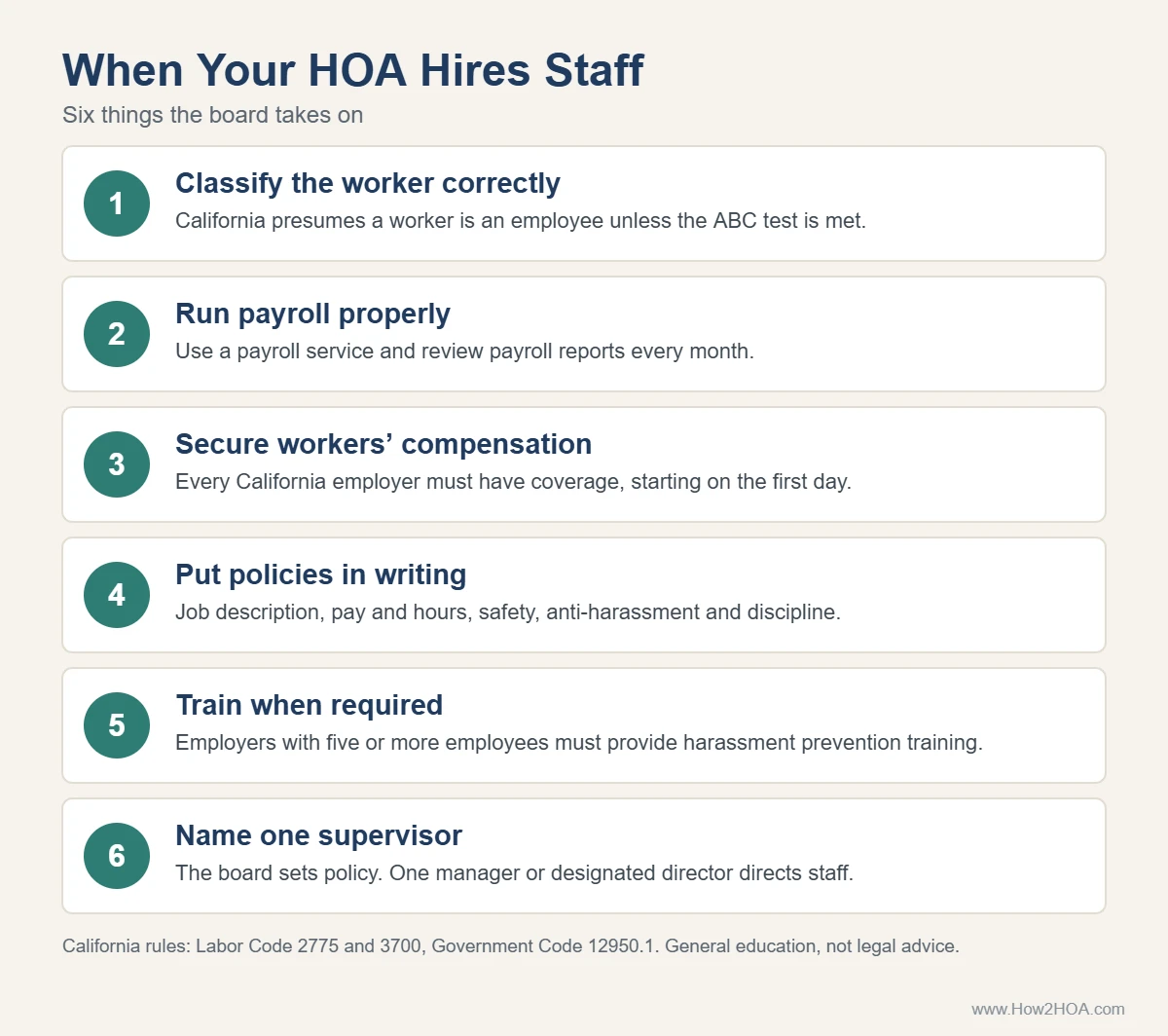
The label in a contract doesn’t decide whether a worker is an employee. The facts do. A worker who keeps set hours, takes direction from the association and does work that is part of the association’s regular operations often looks like an employee.
California generally uses the “ABC test.” A worker is presumed to be an employee unless the hiring entity shows that the worker is free from its control in doing the work, the work is outside the usual course of its business and the worker is customarily engaged in an independent trade or business (Labor Code section 2775). Misclassifying a worker can lead to back taxes, penalties and wage claims, so talk with an employment attorney before treating anyone who works regularly for the association as a contractor.
Payroll
Employers must withhold, pay and report payroll taxes and keep payroll records. As a good practice:
- Use a payroll service instead of running payroll by hand.
- Have the board review payroll reports every month along with the other financial statements.
- Keep payroll records with the association, not with a volunteer.
Workers’ compensation
In California, every employer must secure workers’ compensation, either through insurance or approved self-insurance (Labor Code section 3700). Coverage needs to be in place from the first day of employment. Even associations without employees should confirm that every vendor carries workers’ compensation for its own workers.
Written policies
Even an association with one employee needs:
- A written job description
- Pay, hours and timekeeping rules
- Safety rules
- Anti-harassment and complaint procedures
- Discipline procedures
California employers with five or more employees must provide sexual harassment prevention training to supervisors and other employees on a set schedule (Government Code section 12950.1). Have an employment attorney review the handbook before it’s adopted.
Who supervises?
Mixed messages are one of the biggest risks for association staff. As a good practice:
- Each employee has one supervisor, usually the manager or one designated director.
- The board sets policy; individual directors and owners don’t give staff instructions.
- Owners with concerns about staff go through the supervisor or the board’s official channel.
- Performance reviews and discipline are documented, and the board gets legal advice before any termination.
Should the association have employees at all?
Some boards decide the duties of an employer aren’t worth it and contract the work through the management company or a vendor instead. Others find direct staff more reliable. Compare the full cost, including payroll taxes, workers’ compensation, insurance, supervision time and legal risk, before deciding. Our guide to workers’ compensation for HOAs covers the insurance side in more detail.

Share this infographic: Pinterest · Facebook · LinkedIn · Email · Download
Quick checklist
- Confirm classification with an employment attorney
- Use a payroll service and review payroll monthly
- Secure workers’ compensation from day one
- Adopt a job description and written policies
- Name one supervisor for each employee
- Get legal advice before any termination
Sources / The Law Behind This Page
- California Labor Code section 2775 (ABC test)
- California Labor Code section 3700 (workers’ compensation)
- California Government Code section 12950.1 (harassment prevention training)
This article is general educational information, not legal or employment advice. Talk with an employment attorney about your association’s specific situation.
Last reviewed November 2026. By the How2HOA Editorial Team.