California HOA Elections and Voting

A California HOA election runs on deadlines, and if a court finds the rules weren’t followed, it can throw out the result. Here’s how to run one that holds up. The legal fine print is at the bottom for when you need it.

The short version

Five Things Every Election Needs

Work backward from the count, and keep the ballots in neutral hands.

  1. Secret ballots. Board elections, recalls, amendments to the governing documents and assessment votes the law requires all go by secret ballot.
  2. An independent inspector. Not a director, a candidate, a relative of either or anyone the association pays for other services, such as its manager.
  3. 30-day notices. The call for candidates, the pre-ballot notice and the ballots themselves each go out at least 30 days ahead.
  4. A public count. Nobody opens a ballot until the inspector counts them at an open meeting.
  5. Results within 15 days. Owners get general notice of the results.

Election timeline

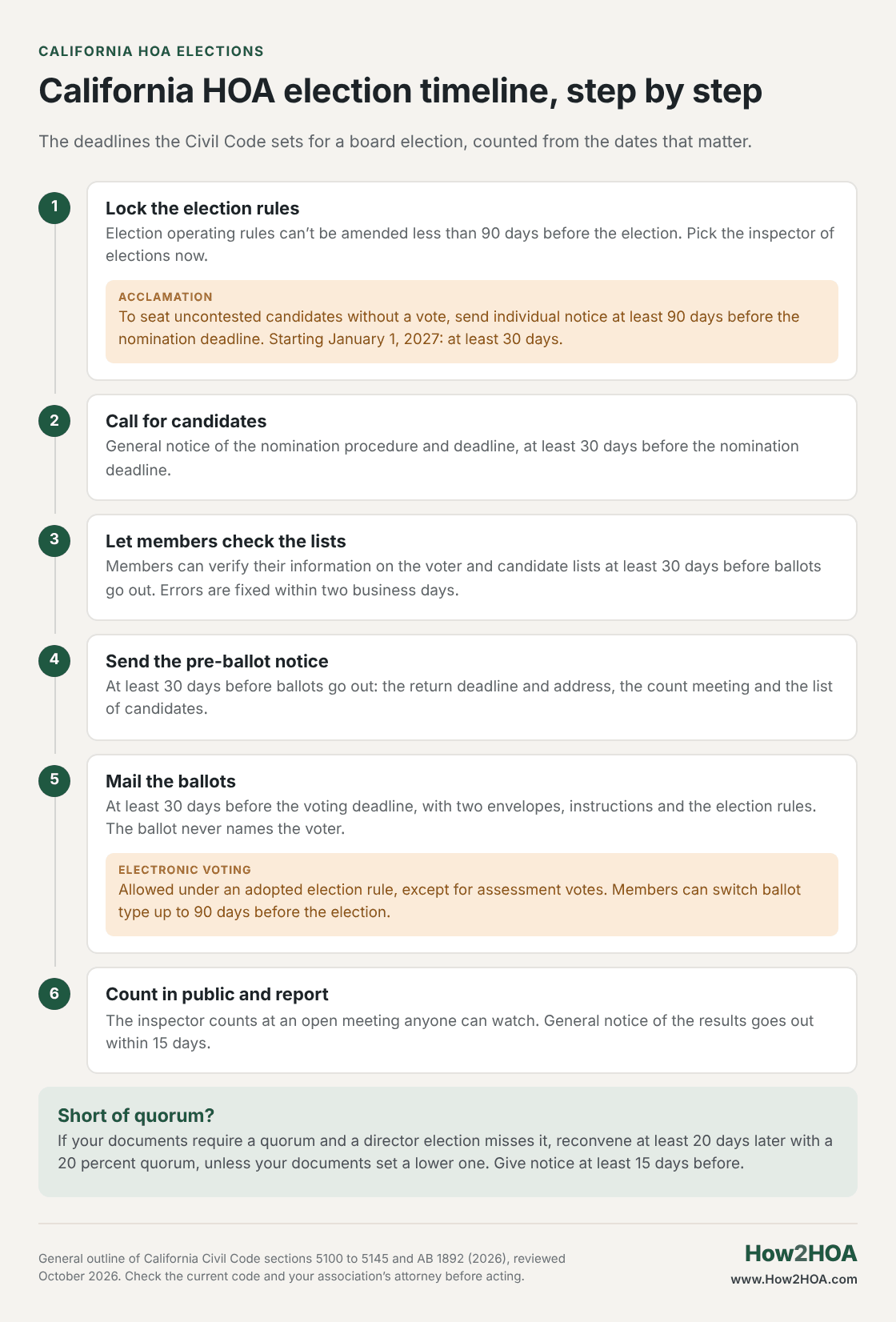
The California HOA Election Timeline at a Glance

Infographic: 6 steps of a California HOA board election

Share this infographic: Pinterest · Facebook · LinkedIn · Email · Download

Free tools

Free Tools for This Topic

Enter your election date and get every deadline.

How to do it

Running a California Board Election Step by Step

Work backward from the count. Most election deadlines are counted from the nomination deadline, the ballot mailing or the election itself.

Use this sequence for a regular board election. Recalls follow the same notice and ballot rules.

  1. Pick the count date and work backward. Set the meeting where ballots will be counted, then schedule every notice from it.
  2. Review your election rules early. Make any changes more than 90 days before the election. Check that they cover everything the law requires, including candidate qualifications and how the inspector is chosen.
  3. Choose the inspector of elections. Confirm the person or firm is independent: not a director, a candidate, a relative of either or a current paid vendor.
  4. Decide whether acclamation is possible. If you may seat uncontested candidates without a vote (the law calls it acclamation), send the initial individual notice at least 90 days before the nomination deadline (30 days starting January 1, 2027) and plan the reminder notice.
  5. Call for candidates. Give general notice of the nomination procedure and deadline at least 30 days before the deadline.
  6. Screen nominations fairly. Apply only the qualifications the law allows and your rules adopt. Offer internal dispute resolution (IDR) before disqualifying anyone.
  7. Let members check the lists. Make the voter and candidate lists available for members to verify their information at least 30 days before ballots go out.
  8. Send the pre-ballot notice. At least 30 days before ballots are distributed, announce the return deadline and address, the count meeting and the candidate list.
  9. Mail the ballots. At least 30 days before the voting deadline, send ballots with two envelopes, instructions and the election rules (or a link to them).
  10. Count in public and report. The inspector counts at an open meeting. Record the results in the minutes and give general notice within 15 days.

Board checklist

  • ☐ Our election rules cover candidate qualifications, nominations and how the inspector is chosen, and weren’t changed within 90 days of the election.
  • ☐ Our inspector isn’t a director, a candidate, a relative of either or anyone we pay for other services.
  • ☐ The call for candidates went out at least 30 days before the nomination deadline.
  • ☐ We disqualify candidates only for reasons the law allows and our rules adopt, and only after offering internal dispute resolution.
  • ☐ Members could check the voter and candidate lists at least 30 days before ballots went out.
  • ☐ The pre-ballot notice went out at least 30 days before the ballots.
  • ☐ Ballots went out at least 30 days before the voting deadline, with two envelopes, instructions and the election rules or a link to them.
  • ☐ Nobody opens a ballot before the inspector counts them at an open meeting.
  • ☐ Results go in the minutes and out to owners within 15 days.
  • ☐ Every board seat is up for election at least once every four years.

Planning your dates? Use the California HOA Election Timeline Planner.

In real life

What This Looks Like on a Real Board

Five everyday situations, and the right move in each one.

These are illustrations, not stories about a real community.

The manager as inspector

To save money, the board asks its manager to count the ballots. That’s not allowed: anyone the association currently pays for other services can’t serve as inspector. A volunteer poll worker with the county registrar, a California-licensed accountant, a notary or a member who isn’t a director, a candidate or a relative of either can.

The candidate with an unpaid fine

An owner with an unpaid fine wants to run. Unpaid fines, late charges and collection costs aren’t grounds to disqualify anyone. Being behind on assessments counts only if your bylaws or election rules say so, and never for an owner who paid under protest or is keeping to a payment plan. Before disqualifying anyone, the association has to offer internal dispute resolution.

Three seats, three candidates

Only three people run for three seats, and the board asks whether it still has to mail ballots. It can seat all three without a vote, but only if every one of these happened:

  • a regular election in the last three years
  • the early individual notice and the reminder notice
  • a reply to each nominee within seven business days
  • a board vote at an open meeting, with each candidate named on the agenda.

Starting January 1, 2027, the early notice moves from 90 to 30 days before the nomination deadline.

The newsletter spotlight

Two weeks before the election, the newsletter runs a feature on the board president’s garden, photo included. The president is up for reelection. Within 30 days of an election, association communications can’t feature a candidate’s photo or name prominently, outside ballot materials and a few other exceptions.

Not enough ballots back

The bylaws require a quorum of half the owners, and only a third send ballots back. The election isn’t over. The association can adjourn to a reconvened meeting at least 20 days later, with notice going out at least 15 days before it. There, 20 percent of the members voting counts as a quorum, unless your documents set a lower one.

Common mistakes

Where Elections Go Wrong

An election that skips a required step can be voided in court, which means paying for a second election and possibly the challenger’s attorney’s fees.

These are the problems that put California HOA elections at risk.

  • Using the manager or a director as inspector. Anyone under contract with the association for other paid services, and any director or candidate, is ineligible.
  • Disqualifying candidates for the wrong reasons. Unpaid fines or late charges, or a rule your bylaws or election rules never adopted, aren’t grounds. Neither is an owner who paid under protest or is on a payment plan.
  • Changing the election rules too late. Amendments within 90 days of the election aren’t allowed.
  • Opening ballots early. No one may open or review ballots before the public count, not even to “get a head start.”
  • Promoting incumbents with association resources. Featuring a candidate in the newsletter within 30 days of the election, or using association funds to campaign.
  • Missing a notice. Skipping the nomination notice, the pre-ballot notice or the 15-day results notice, or counting from the wrong date.
  • Seating candidates by acclamation without the notices. Acclamation is allowed only if every required notice and the open-meeting board vote happened.
  • Letting terms run past four years. Every seat needs an election at least once every four years.

Best practice, not a legal requirement

Habits That Make Elections Run Smoothly

These habits make elections easier to run and harder to challenge.

  • Keep a written election calendar. Put every deadline on one page as soon as the count date is set.
  • Hire a professional inspector for contested races. A firm that runs HOA elections regularly knows the steps and adds credibility.
  • Recruit candidates early. Talking with owners months ahead fills seats and avoids last-minute scrambles.
  • Publish candidate statements side by side. Give every candidate the same space and format.
  • Remind owners to vote. A short reminder as the deadline nears helps reach quorum, without favoring any candidate.
  • Consider electronic voting. It can raise turnout, but adopt the election rule well before the 90-day mark and keep paper ballots available.
  • Debrief after each election. Note what worked and what to fix while it’s fresh.

2 guides

Running an Election

How to Conduct Effective HOA Elections

How to run a fair HOA election: bylaws and state law, the voter list, quorum and a neutral count, plus California’s secret ballot rules.

How to Recall an HOA Board Member in California

How a California HOA recall works: the 5 percent petition, the board’s deadlines, the secret ballot, the vote needed and filling the seat.

2 guides

Running for the Board

How to Become an HOA Board Member

To become an HOA board member you generally need to own in the community, get nominated and win votes. How to qualify and what the job takes.

Joining Your HOA Board: Benefits, Duties and What to Consider

What to weigh before joining your HOA board: the time commitment, the legal duty, liability and insurance, eligibility and homework before you run.

The legal details

Election Rules, Nominations and Candidates

Board elections, recalls, amendments to the governing documents, assessments that legally need a vote and grants of exclusive use common area all go by secret ballot, whatever your documents say.

California’s election rules for HOAs live in Civil Code sections 5100 to 5145. They apply to incorporated and unincorporated associations alike and override contrary rules in the governing documents.

  • When an election is required. The association must hold an election for a board seat when that director’s term ends and at least once every four years. The secret ballot rules also cover any other vote your operating rules say they cover. They don’t apply to votes cast by delegates, or where the governing documents make one member from each separate interest a director.
  • Election rules are mandatory. Every association must adopt election operating rules. They must give all candidates and members advocating a point of view equal access to association media and free use of common area meeting space for the campaign. They must set candidate qualifications and nomination procedures, voting power, proxy rules, the voting period, how the inspector of elections is chosen and the candidate and voter lists the association keeps. Members must be able to nominate themselves. The rules can’t be amended less than 90 days before an election.
  • The call for candidates. At least 30 days before the nomination deadline, the association must give general notice of how to submit a nomination and the deadline. Members who ask get it by individual delivery. This applies to director elections and recalls.
  • Who must be disqualified. A nominee who isn’t a member when nominated, or who has already served the maximum number of terms your association allows. A director who stops being a member can’t keep serving.
  • Who may be disqualified. Only if your bylaws or election rules say so, an association may disqualify a nominee who isn’t current on regular and special assessments, who would serve alongside a co-owner of the same property, who has been a member for less than a year or whose past criminal conviction would keep the association from buying, or would end, insurance coverage the law requires it to carry. Unpaid fines, late charges and collection costs don’t count, and an owner who paid under protest or is keeping to a payment plan can’t be disqualified for being behind. Any rule applied to nominees must apply to sitting directors too.
  • Before disqualifying anyone. The association can’t disqualify a nominee who hasn’t been offered internal dispute resolution (IDR).
  • Campaigning with association money. Association funds can’t be used for campaign purposes in a board election. Within 30 days of an election, association communications can’t feature a candidate’s photo or name prominently, except for ballot materials, legally required communications and communications where equal access applies.

Election by acclamation. If, at the nomination deadline, there are no more qualified candidates than open seats, the board may seat them without a vote. Every one of these conditions must be met:

  • the association held a regular election within the last three years
  • it gave members an initial individual notice of the election and nomination procedure at least 90 days before the nomination deadline, plus a reminder notice 7 to 30 days before the deadline, each with the required content
  • it acknowledged each nomination and told each nominee whether they qualify, within seven business days
  • it let every nominee run except those properly disqualified
  • the board votes on it at an open meeting whose agenda names each candidate to be seated.

Starting January 1, 2027. AB 1892 (Chapter 169, Statutes of 2026) shortens the initial acclamation notice to at least 30 days before the nomination deadline and changes the reminder notice to no less than 10 days before the deadline. Until then, the 90-day initial notice applies.

The legal details

Ballots, the Count, Quorum and Challenges

If a court finds the election rules weren’t followed, it must void the results unless the association proves the mistakes didn’t change the outcome.

The procedures for ballots and counting are built to keep every vote secret and every step in neutral hands.

The inspector of elections. The association must choose one or three independent third parties as inspector of elections. Examples include a volunteer poll worker with the county registrar, a California-licensed accountant or a notary public. A member can serve, but not a director, a candidate or a relative of either, and not anyone currently paid by the association for other services, such as its management company. The inspector decides who may vote, rules on proxies and challenges, receives and counts the ballots and determines the results, acting impartially for all members.

The pre-ballot notice. For director elections and recalls, at least 30 days before ballots go out, the association must give general notice of the deadline and address for returning ballots, electronic voting instructions if it offers that option, the date, time and place of the meeting where ballots will be counted and the list of candidates. If the governing documents require a quorum, the notice must also say when quorum will be determined and explain the reconvened meeting described below.

Ballots and envelopes. Ballots go to every member by first-class mail or delivery at least 30 days before the voting deadline, with two preaddressed envelopes and instructions. The ballot can’t identify the voter. It goes into a sealed inner envelope, which goes into an outer envelope the voter signs and addresses to the inspector. At least 30 days before the election, members must also receive a copy of the election rules or a website address where they’re posted. The association can’t deny a ballot to anyone who is a member when ballots go out, and a member’s general power of attorney may vote.

Lists and proxies. Members must be able to check their own information on the voter and candidate lists at least 30 days before ballots are distributed, and the inspector must correct reported errors within two business days. Proxies, where the bylaws allow them, can’t replace a ballot: the proxyholder still votes by secret ballot, and any voting instructions go on a separate, detachable page.

Electronic voting. An association may adopt an election rule allowing voting by electronic secret ballot through the inspector, except in elections on regular or special assessments. Members must be able to switch between electronic and paper ballots up to 90 days before the election. A member without an email address on file gets a paper ballot. The voting system must keep each ballot secret, give voters a receipt and keep ballots available for a recount. The association sends notice of the electronic ballot, with instructions, 30 days before the election. Starting January 1, 2027, AB 1892 requires that notice no later than 30 days before the election, sent to each member who is voting electronically.

The count. The inspector counts the votes in public at a properly noticed open meeting of the board or members, and any candidate or member may watch. Nobody, including directors and management staff, may open or review a ballot before then. Once the inspector receives a ballot, it can’t be revoked. The results go to the board, into the minutes of its next meeting and out to members by general notice within 15 days. The inspector keeps the ballots and election materials until the time to challenge the election runs out, then hands them to the association.

When quorum isn’t reached. A quorum is needed only if your governing documents or another law require one, and every ballot received counts toward it. If a director election falls short, the association may adjourn to a reconvened meeting at least 20 days later, where 20 percent of the members voting in person, by proxy or by ballot is a quorum, unless your documents set a lower one. General notice of the reconvened meeting, with the date, time, place and candidate list, must go out at least 15 days before it.

Challenges. A member can sue within one year after the results are announced, in superior court or small claims court. A member who wins recovers reasonable attorney’s fees and court costs, and the court may add a civil penalty of up to $500 per violation.

Sources

The Law Behind This Page

Every legal point on this page comes from the official text. Each link below opens it on the California Legislature’s website in a new tab.

Civil Code sections: 5100 · 5103 · 5105 · 5110 · 5115 · 5120 · 5125 · 5130 · 5135 · 5145

Bills: AB 1892 (Chapter 169, Statutes of 2026)

Keep going

Related Topics

California HOA Guide

Every California topic guide in one place.

Board Meetings

Notice, agendas, executive session and minutes.

Board Meetings and Elections

Running meetings and elections well in any state.

Management

Working with a management company.

Local Guides by City

City and neighborhood guides, county by county.

Get help

Want Help Running Your Election?

A professional management company can line up an independent inspector, send every notice on time and keep the election materials in order.

Last reviewed October 21, 2026. By the How2HOA Editorial Team. This page is general educational information, not legal advice. Laws change and your association’s governing documents control many of these questions, so check with your association’s attorney about your situation.

Share this: