California HOA Guide

California HOA Architectural Review and Owner Rights

How architectural review must work in a California HOA, and the improvements and uses state law says an association can’t block.

What the law requires

How Architectural Review Must Work

Every disapproval must be in writing, say why, and explain how to ask the board to reconsider (section 4765).

If your governing documents require approval before an owner changes their home or the common area, the Civil Code sets the ground rules for that review.

When the governing documents require association approval for a physical change to a separate interest or the common area, section 4765 requires:

  • A written procedure. It must be fair, reasonable and expeditious, appear in the governing documents, set prompt deadlines and state the longest the association can take to answer an application or a request for reconsideration.
  • Good faith. A decision can’t be unreasonable, arbitrary or capricious.
  • Compliance with the law. Whatever the governing documents say, a decision can’t violate the law, including the Fair Employment and Housing Act, building codes and other land use or public safety laws.
  • Written decisions. A disapproval must explain why and describe how to ask the board to reconsider.
  • Reconsideration. An owner whose request is disapproved is entitled to reconsideration by the board at an open meeting, unless the board itself, or a body with the same members, made the decision at an open board meeting.
  • An annual notice. Each year the association must tell members which changes need approval and include a copy of the review procedure.

Changes inside the home. Subject to the governing documents and the law, an owner may make improvements within their separate interest that don’t impair the structure or mechanical systems or reduce support for other parts of the development. Owners may also modify their homes at their own expense to make them accessible for people who are blind, visually impaired, deaf or physically disabled. Those modifications must meet building codes and the intent of the governing documents’ safety and aesthetic rules, and exterior changes must leave reasonable passage for others and come out when no longer needed. The owner submits plans, and the association can’t deny approval without good cause. Changes to a home’s exterior appearance still follow the governing documents (section 4760). For disability requests, use our free reasonable accommodation request form.

Rebuilding after a disaster. Since January 1, 2026, the review of a substantially similar rebuild of a home damaged or destroyed in a declared disaster has its own timeline: 30 calendar days to say whether the application is complete, then 45 calendar days to approve it or send a full set of comments. Denials can be appealed, with a written decision within 60 days, and an owner who wins in court recovers attorney’s fees (section 4766 and section 4752).

Deadlines for specific projects. A solar application that isn’t denied in writing within 45 days is deemed approved (section 714), and an EV charger application within 60 days (section 4745), unless the delay comes from a reasonable request for more information.

What the law requires

What a California HOA Can’t Prohibit

Reasonable restrictions are usually allowed. An outright ban, or a rule that works like one, is usually void.

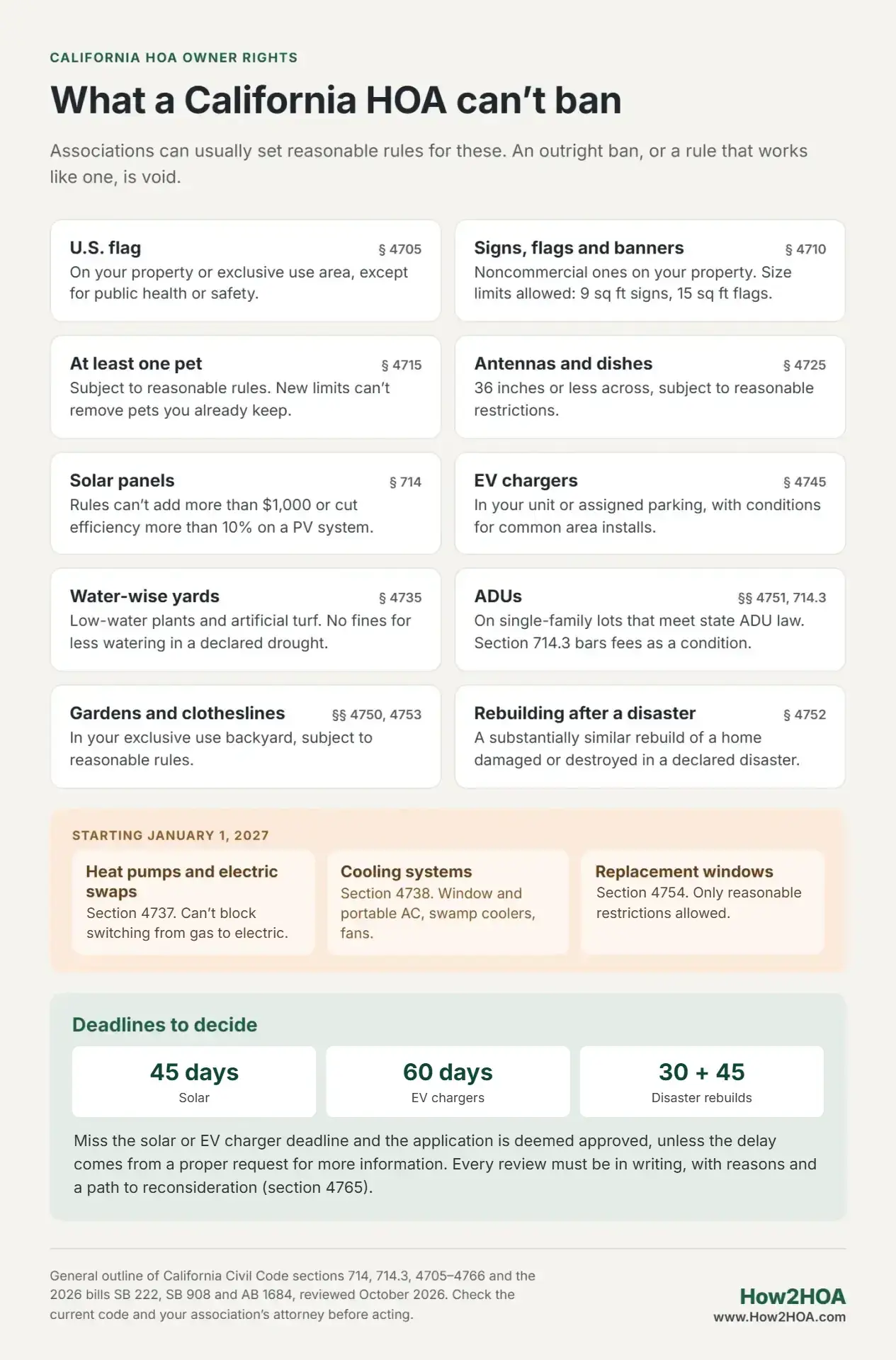
State law protects a list of improvements and uses, and the list grows on January 1, 2027.

  • The U.S. flag. Governing documents can’t limit displaying the U.S. flag on or in an owner’s separate interest or exclusive use common area, except to protect public health or safety (section 4705).
  • Noncommercial signs, flags and banners. These can’t be prohibited on or in a separate interest, except for public health or safety or if the display would break the law. The association may prohibit signs and posters over 9 square feet and flags or banners over 15 square feet (section 4710).
  • Pets. Owners may keep at least one pet, subject to reasonable rules. A new limit on the number of pets can’t force out a pet the owner already keeps under the old rules (section 4715).
  • Antennas and satellite dishes. Restrictions that effectively prohibit or restrict antennas 36 inches or less in diameter or diagonal are void, though reasonable restrictions are allowed (section 4725).
  • Fire-safe roofing. An association can’t require a roof that violates state fire-retardant roofing law, and in a very high fire hazard severity zone the governing documents must allow at least one compliant fire-retardant roof covering (section 4720).
  • Water-wise landscaping. Rules can’t prohibit low water-using plants or artificial turf, or block compliance with water-efficient landscape ordinances and water-use restrictions. During a declared drought emergency, the association can’t fine an owner for cutting back on watering, with an exception for homes served by recycled water (section 4735).
  • Backyard gardens and clotheslines. In a backyard set aside for the owner’s exclusive use, rules can’t effectively prohibit or unreasonably restrict personal agriculture or a clothesline or drying rack (section 4750 and section 4753).
  • Solar panels. Only reasonable restrictions are allowed. For a photovoltaic system, a restriction is unreasonable if it adds more than $1,000 to the cost or cuts efficiency by more than 10 percent (section 714).
  • EV chargers. Rules can’t effectively prohibit or unreasonably restrict a charger in an owner’s unit or designated parking space. For a charger in the common area or exclusive use common area, the owner agrees to conditions such as a licensed contractor, insurance and paying for installation and electricity. Starting January 1, 2027, SB 1267 amends these EV charger rules (section 4745).
  • ADUs. In a planned development, rules that effectively prohibit or unreasonably restrict an accessory dwelling unit or junior ADU on a lot zoned for single-family use that meets state ADU law are void. Reasonable restrictions are allowed (section 4751). Under section 714.3, as amended by AB 130 in 2025, reasonable restrictions can’t include fees or other financial requirements.
  • Rebuilding after a disaster. Rules that prohibit, or have the effect of prohibiting, a substantially similar rebuild of a home destroyed or damaged in a declared disaster are void (section 4752).

New on January 1, 2027. Three 2026 bills add to the list:

  • Heat pumps and electric appliances (SB 222, new section 4737). Associations can’t prohibit switching from gas to electric appliances, such as heat pump water heaters and heat pump HVAC systems.
  • Cooling systems (AB 1684, new section 4738). The same protections apply to air conditioners, window and portable units, swamp coolers, fans and heat pumps. A willful violation can cost the association actual damages plus a civil penalty of up to $2,000.
  • Replacement windows (SB 908, new section 4754). Associations may impose only reasonable restrictions on window replacements.

For solar and EV chargers in detail, see Solar and EV Chargers: What California HOAs Can Restrict.

Owner rights at a glance

What a California HOA Can’t Ban

What a California HOA can’t ban: the U.S. flag, noncommercial signs and banners within size limits, at least one pet, antennas 36 inches or less, solar panels, EV chargers, low-water plants and artificial turf, ADUs on single-family lots, backyard gardens and clotheslines, and rebuilding after a disaster. Starting January 1, 2027: heat pumps and electric swaps, cooling systems and replacement windows. Deadlines to decide: 45 days for solar, 60 days for EV chargers and 30 plus 45 days for disaster rebuilds.

Share this infographic: Pinterest · Facebook · LinkedIn · Email · Download

How to do it

Running a Fair Architectural Review

A complete-application checklist is the fastest way to meet every deadline and keep owners from waiting.

A clear process protects owners’ rights and makes the board’s decisions easier to defend.

  1. Put the procedure in writing. Include deadlines for decisions and reconsideration, as section 4765 requires.
  2. Check your rules against the protected list. Have the association’s attorney flag any rule that is void now or will be on January 1, 2027.
  3. Publish an application form and checklist. Our architectural application template is a starting point.
  4. Date-stamp every application. Calendar the 45-day solar and 60-day EV charger deadlines, plus the disaster rebuild timeline.
  5. Ask for missing information right away. A reasonable request for more information is what keeps a solar or EV application from being deemed approved.
  6. Decide on the written standards. Apply the same guidelines to every owner, in good faith.
  7. Put every decision in writing. For a disapproval, give the reasons and explain how to ask for reconsideration.
  8. Reconsider at an open board meeting when an owner asks, unless the board made the original decision at an open meeting.
  9. Send the annual notice describing which changes need approval, with a copy of the procedure.
  10. Keep the file. Store each application, the decision and any conditions with the property’s records. This is good practice.

Board checklist

  • ☐ Our review procedure is in the governing documents and states maximum response times.
  • ☐ Disapprovals are in writing, with reasons and reconsideration steps.
  • ☐ Owners can get reconsideration by the board at an open meeting.
  • ☐ We send the annual notice of approval requirements and the procedure.
  • ☐ We track solar (45-day) and EV charger (60-day) deadlines from the date of receipt.
  • ☐ Our rules allow the U.S. flag, permitted signs, at least one pet, small antennas, water-wise yards and backyard gardens and clotheslines.
  • ☐ Our ADU rules are reasonable and don’t include fees or financial requirements.
  • ☐ We have a disaster rebuild process with the 30-day and 45-day timelines.
  • ☐ We’ve updated our rules for heat pumps, cooling systems and windows before January 1, 2027.
  • ☐ Accessibility modifications are reviewed promptly and denied only for good cause.

Common mistakes

Where Boards Slip Up

An unanswered application can become an approval, and a void rule can cost the association attorney’s fees.

These are the architectural review mistakes that most often turn into disputes.

  • No deadlines in the procedure. Section 4765 requires prompt deadlines and a stated maximum response time.
  • Sitting on solar and EV applications. Silence past 45 or 60 days means the application is deemed approved.
  • Denying without reasons. A disapproval must explain why and how to ask for reconsideration.
  • Enforcing a rule the law voids. Bans on artificial turf, the U.S. flag or small satellite dishes don’t hold up.
  • Fining brown lawns in a declared drought. Section 4735 bars it, with a narrow recycled-water exception.
  • Applying a new pet limit to existing pets. Section 4715 protects pets owners already keep under the old rules.
  • Charging fees to approve an ADU. Section 714.3 says reasonable restrictions can’t include fees or other financial requirements.
  • Keeping 2027-void rules on the books. Bans on heat pumps, window air conditioners or replacement windows need updating before January 1, 2027.

Best practice, not a legal requirement

Habits That Make Review Easier

Everything in this section is a recommendation. None of it is required by California law.

The law sets the minimum. These habits cut down on applications, appeals and hard feelings.

  • Pre-approve common projects. Publish approved paint colors, fence styles and solar layouts so owners can skip full review.
  • Acknowledge receipt in writing. Send a dated confirmation the day an application arrives.
  • Visit before deciding on big projects. A short site visit answers questions faster than another round of letters.
  • Keep guidelines visual. Photos and diagrams of approved examples reduce guesswork.
  • Train the committee every year. Walk through the protected list and the deadlines whenever the law changes.
  • Record approval conditions. Spell out who maintains an owner-installed improvement and what happens at resale.

3 guides

Making Changes to Your Home

How to Propose Changes to Your Property in a Homeowners Association

Before you paint, build or plant, your HOA may need to approve it. How to apply, ask for an exception, and what California law requires.

Solar and EV Chargers: What California HOAs Can Restrict

California HOAs cannot ban solar panels or EV chargers but can set reasonable conditions. The cost limits, approval deadlines and board options.

How HOAs Can Regulate Holiday Décor

An HOA can set reasonable, even-handed rules on holiday decorations, but it cannot override legal protections for flags, signs and religious items.

3 guides

Owner Rights and Fair Housing

The Rights of Homeowners Association Members

HOA members generally have the right to vote, attend meetings, inspect records and get a hearing before discipline. The main rights and duties.

Service and Support Animals in an HOA: What Boards Can Ask

What an HOA board may and may not ask about a service or emotional support animal, what changed at HUD in 2026, and what California requires.

55+ Community HOA Rules in California: A Board’s Guide

How California 55+ communities stay legal: the federal 80 percent rule, age verification every two years, and who may live in the home under Civil Code 51.3.

2 guides

Yards, Water and Fire Safety

Sacramento-Area Watering Rules and HOA Landscaping

California’s 2029 ban on watering decorative HOA turf, Civil Code 4735 limits on HOA rules, and Sacramento-area watering schedules and rebates.

Wildfire Defensible Space for Foothill HOAs

What California defensible space law requires of HOAs and owners, where the Zone 0 rule stands, and local rules in Placer County and Folsom.

Sources

The Law Behind This Page

Every legal point on this page comes from the official text. Each link below opens it on the California Legislature’s website in a new tab.

Civil Code sections: 714 · 714.3 · 4705 · 4710 · 4715 · 4720 · 4725 · 4735 · 4737 · 4738 · 4745 · 4750 · 4751 · 4752 · 4753 · 4754 · 4760 · 4765 · 4766

Bills: AB 130 · AB 1684 · SB 222 · SB 908 · SB 1267

Keep going

Related Topics

California HOA Guide

Every California topic guide in one place.

Maintenance, Repairs and Safety

Who maintains what, inspections and repairs.

Enforcement and Disputes

Fines, hearings and resolving disputes.

Rules and Governing Documents

CC&Rs, bylaws and rules in any state.

Local Guides by City

City and neighborhood guides, county by county.

Get help

Want Help Running Architectural Review?

A professional management company can log applications, track statutory deadlines and send written decisions on time, so the board can focus on the decisions themselves.

Last reviewed October 21, 2026. Civil Code sections cited: 714, 714.3, 4705, 4710, 4715, 4720, 4725, 4735, 4737, 4738, 4745, 4750, 4751, 4752, 4753, 4754, 4760, 4765 and 4766, plus AB 130 (2025) and SB 222, SB 908, AB 1684 and SB 1267 (2026). By the How2HOA Editorial Team. This page is general educational information, not legal advice. Laws change and your association’s governing documents control many of these questions, so check with your association’s attorney about your situation.

Share this: