
An HOA can regulate holiday décor through reasonable written rules on when decorations may go up and come down, where they may be placed, and how bright or loud they may be. HOA holiday decoration rules have to be applied evenly to every holiday and every owner. They also cannot override state and federal laws that protect certain displays, such as the U.S. flag.
Residents love their decorations and often have strong feelings about what is and is not appropriate, so the holidays can bring some stress for the board along with the fun. It usually falls to the board to decide what is allowed. Here are the issues boards most often face, and how to handle them without spoiling the season.
What HOA Holiday Decoration Rules Usually Cover

Share this infographic: Pinterest · Facebook · LinkedIn · Email · Download
Date Ranges
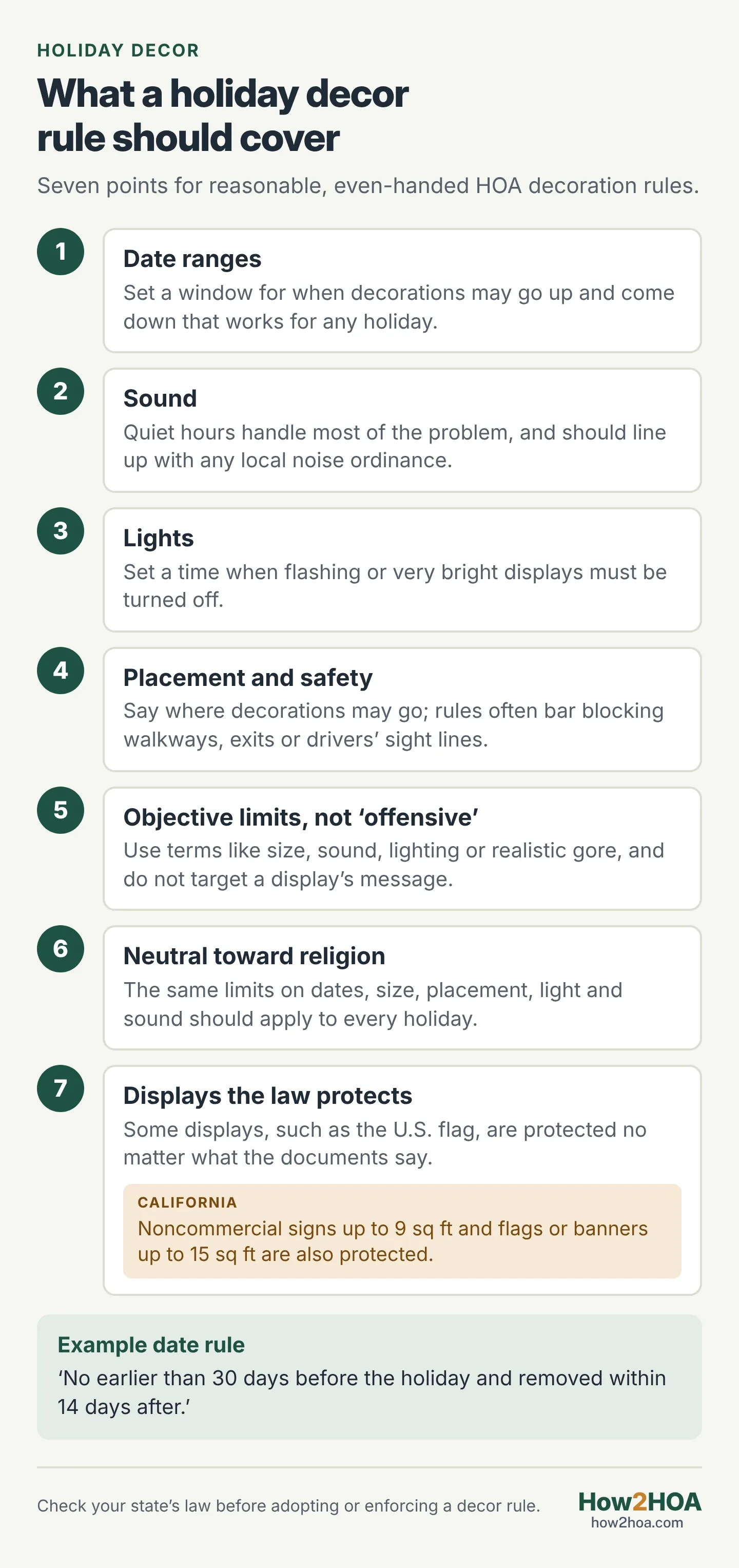
Everyone has had a neighbor who keeps the Christmas lights up well into March or puts out Halloween decorations in the middle of August. A rule that sets a window for decorations keeps this to a minimum. State it in a way that works for any holiday, for example “no earlier than 30 days before the holiday and removed within 14 days after.” A general rule like this treats every observance the same and saves the board from having to list holidays. Clear dates prevent confusion, and they let the board enforce the rule if someone strays from the schedule.
Noise and Lights
Some displays add sound to the lights and decorations, such as holiday carols or spooky sound effects. These can be fun, but when they are too loud or run too late they become a nuisance. Quiet hours handle most of the problem, and they should line up with any local noise ordinance. The same approach works for lights: set a time when flashing or very bright displays must be turned off, especially where homes are close together.
Placement and Safety
Say where decorations may go. Owners can usually decorate their own home, lot, patio or balcony. Common areas such as lawns, hallways, railings and shared roofs are different, because the association maintains and insures them. Rules often bar decorations that block walkways, exits, sprinklers or sight lines for drivers, and they may limit attachments that damage siding, roofs or railings the association has to repair.
Inappropriate, Violent or Offensive Decorations
Everyone should be able to feel comfortable walking around the neighborhood, and some communities restrict displays that are graphic or frightening. Be careful here. “Offensive” means different things to different people, and a vague standard invites disputes and uneven enforcement. Write the rule in objective terms where you can, such as limits on size, sound, lighting, realistic gore or obscene material, and apply it the same way to everyone. A rule should not target the message of a display, and it should never single out one religion or viewpoint. State law may also protect certain signs, flags and banners whatever they say, as described below.
Keep the Rules Neutral Toward Religion
The federal Fair Housing Act prohibits housing discrimination based on religion, among other protected characteristics. For décor rules, that means the same limits on dates, size, placement, light and sound should apply whether the display is for Christmas, Hanukkah, Diwali, Eid, Halloween or anything else. A rule that allows one faith’s decorations and restricts another’s, or enforcement that falls harder on one group, creates legal risk for the association. If the association decorates the common areas itself, think about how the display will look to residents of different faiths, and ask the association’s attorney if you are unsure.
Display Rights an HOA Cannot Override
Some displays are protected by law no matter what the governing documents say. At the federal level, the Freedom to Display the American Flag Act of 2005 says a condominium, cooperative or residential real estate management association may not adopt or enforce a policy that restricts or prevents a member from displaying the U.S. flag on residential property the member owns or has the exclusive right to use. The Act still allows reasonable restrictions on the time, place or manner of display that are necessary to protect a substantial interest of the association, and the display must be consistent with federal flag rules and customs.
Many states add their own protections for flags, political or noncommercial signs, and religious items. Check your state’s law before adopting or enforcing a décor rule that touches any of these. The California rules are summarized below.
Enforcing Décor Rules
Inspections
If regular inspections or community walk-throughs are part of your HOA’s routine, make sure residents know when they happen and how often. Much of the tension between residents and boards comes from poor communication. A reminder of the décor rules a few weeks before the season starts means nobody is surprised or caught off guard.
Reports From Neighbors
Residents are often the first to notice a problem. Encourage them to report concerns to the board or the manager in writing, so the association can look into the matter and respond the same way each time. Verify a complaint before acting on it, and treat it as a question of whether a rule was broken, not as a way to take sides between neighbors.
Follow Your Normal Process
A décor violation is handled like any other: a friendly reminder first, then formal notice and a chance to be heard before any fine. Because decorations are temporary, a polite note is usually all it takes. Our overview of HOA rules and enforcing violations explains each stage.
How to Avoid Issues and Conflicts With Holiday Décor
The holidays should be a relaxed time in your community. A few habits help prevent disputes over decorations and resolve them quickly and peacefully when they do come up. They work all year, whatever holiday your residents are celebrating.
Make the Rules Clear to Residents
You can avoid a lot of frustration by taking the time to explain the community’s rules for holiday decorations. Detailed rules may make you feel like a stickler, but they remove the gray areas for residents. Ambiguous rules seem more relaxed, yet they lead to more disputes: one resident is unhappy with a neighbor’s decorations, and another is upset at being told to take theirs down. Put the rules in writing, adopt them through the process your governing documents and state law require, and send a reminder before the season starts.
Encourage Residents to Talk to Each Other
Encourage residents to mention big décor plans to the neighbors who will see and hear them. A quick conversation about a light show or an inflatable display heads off many complaints. It also builds the friendships that make a neighborhood feel like a community. Our article on building voluntary compliance has more ideas along these lines.
Encourage Residents to Ask the HOA When in Doubt
When in doubt, ask. That is the attitude to encourage. If residents feel comfortable checking with the board before they spend hours on a ladder putting up decorations, tension stays low. Make this part of your year-round approach. A board that answers questions promptly and without judgment builds the kind of trust that makes residents willing to raise their questions and concerns early.
Use Your Judgment
Use good judgment when you write your holiday decoration rules. Not all communities are the same. A condominium with shared hallways needs different rules from a neighborhood of detached homes, and a community with many young children may want tighter limits on frightening displays. Once the rules are set, though, enforce them as written and the same way for everyone.
This article is about regulating decorations. For holiday parties, community events and guest parking, see our article on HOAs and festivities.
In California
California’s Davis-Stirling Act protects several kinds of display, and a décor rule cannot take those rights away.
- The U.S. flag. Under Civil Code section 4705, governing documents may not limit or prohibit a member from displaying the U.S. flag on or in the member’s separate interest or exclusive use common area, except as required to protect public health or safety. The protection covers a flag made of fabric, cloth or paper displayed from a staff or pole or in a window. It does not cover a depiction of the flag made of lights, paint, roofing, siding, paving materials, flora or balloons.
- Noncommercial signs, posters, flags and banners. Under Civil Code section 4710, governing documents may not prohibit posting or displaying noncommercial signs, posters, flags or banners on or in a member’s separate interest, except as required for public health or safety or if the display would violate a law. The item may be made of paper, cardboard, cloth, plastic or fabric and may be displayed from the yard, window, door, balcony or outside wall. The association may prohibit noncommercial signs and posters larger than 9 square feet and flags or banners larger than 15 square feet. The section does not protect displays made of lights, roofing, siding, paving materials, flora or balloons, or the painting of architectural surfaces, so string lights and inflatables remain subject to the association’s rules.
- Religious items on entry doors. Under Civil Code section 4706, governing documents may not limit or prohibit the display of one or more religious items on the entry door or entry door frame of a member’s separate interest. Civil Code section 1940.45 allows restrictions on an item that threatens public health or safety, hinders the opening or closing of the door, violates a law, contains obscene or otherwise illegal graphics or language, or, alone or together with other religious items on the door, has a total size greater than 36 by 12 square inches, provided it does not exceed the size of the door. If the association is maintaining, repairing or replacing the door, it may require the member to remove the item during the work, after giving the member individual notice.
Two more points apply to any California décor rule. A rule about the use of a separate interest or the common area is an operating rule, so the board generally must give members at least 28 days’ notice of the proposed rule and consider their comments before adopting it (Civil Code section 4360). And a fine for a décor violation is subject to the notice and hearing requirements in Civil Code section 5855 and the cap in section 5850: no more than $100 per violation, unless the board makes a written finding at an open meeting that the violation may harm health or safety. An owner who takes the decoration down before the hearing cannot be fined.
For more on rules and governing documents, visit our rules and legal section.
The Law Behind This Article
Every legal point in this article comes from the official text. Each link below opens it in a new tab.
Civil Code sections: 1940.45 · 4360 · 4705 · 4706 · 4710 · 5850 · 5855
Other sources: U.S. Department of Justice: The Fair Housing Act · Freedom to Display the American Flag Act of 2005 (Public Law 109-243)
This article is general educational information, not legal advice. Laws vary by state and your association’s governing documents control many of these questions, so check with your association’s attorney or another qualified professional about your situation.