
HOA compliance is built long before anyone gets a violation letter. It rests on four things: rules the community actually supports, rules written so people can understand them, a simple way to comply, and a board that residents know and trust. When those are in place, most owners follow the rules without being asked, and the board spends far less time on enforcement.
This article covers that groundwork. If you already have a specific violation in front of you, see how to solve compliance issues in an HOA. If informal efforts have failed and you need the formal steps, see how to enforce HOA rules.
What HOA Compliance Depends On
People tend to follow rules they know about, understand, can reasonably meet, and believe are fair. When an owner breaks a rule, the cause is usually a gap in one of those four areas. The owner never saw the rule. The rule was vague. Complying was harder than it needed to be. Or the owner decided the rule, or the board behind it, did not deserve respect.

Share this infographic: Pinterest · Facebook · LinkedIn · Email · Download
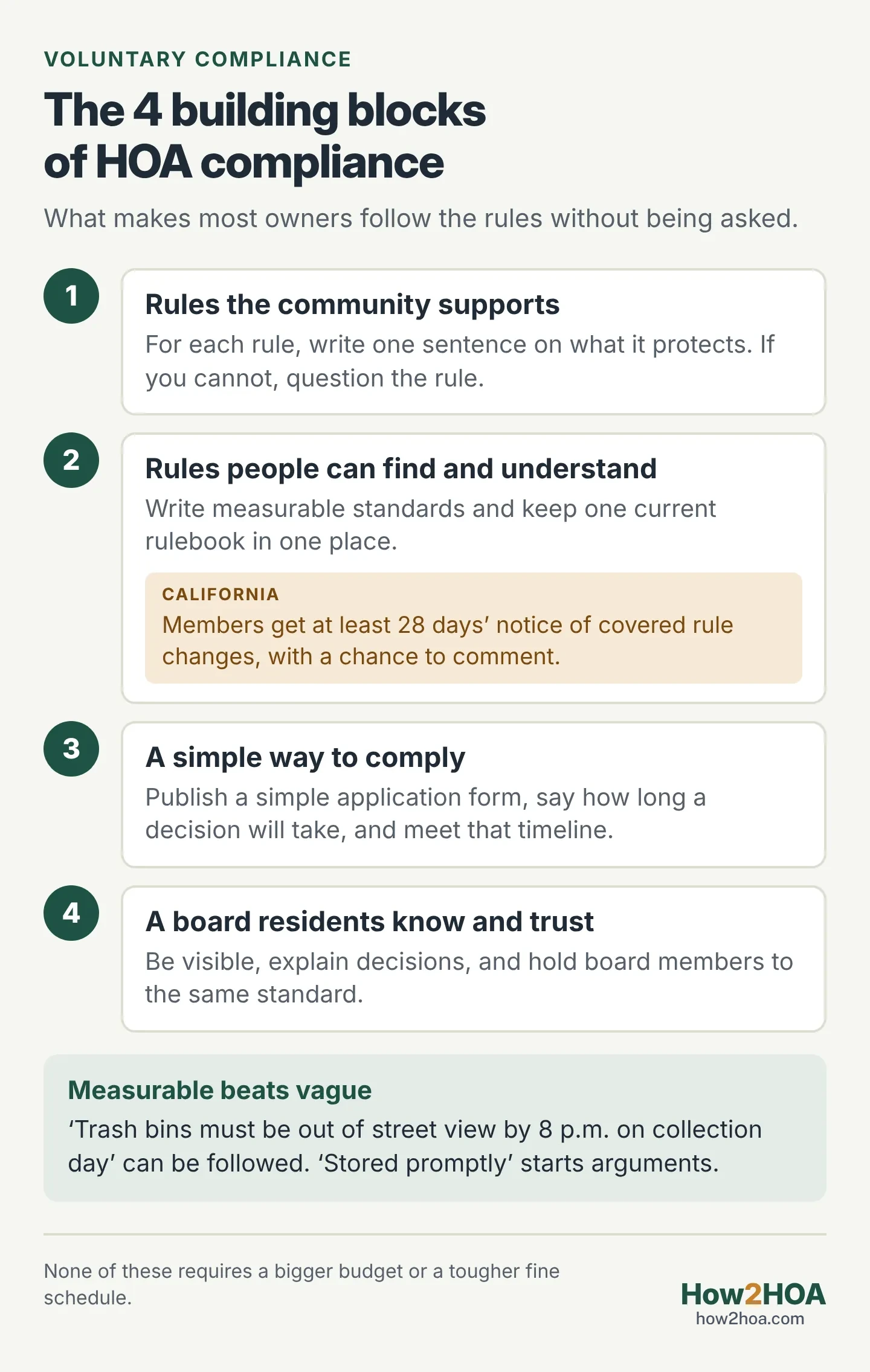
Each building block below closes one of those gaps. None of them requires a bigger budget or a tougher fine schedule. They require attention from the board.
Block 1: Rules the Community Agrees to Live By
A rule that most owners think is pointless will be ignored, and a board that tries to enforce it will burn goodwill doing so. Start by reading your current rules with fresh eyes.
- For each rule, write one sentence explaining what it protects: safety, property condition, shared costs, or quiet enjoyment. If you cannot write the sentence, question the rule.
- Look for rules the board has quietly stopped enforcing. A rule on the books that nobody enforces teaches owners that the rules are optional.
- Look for rules that conflict with current law. Statutes change, and where a statute and your documents conflict, the statute generally controls.
Know which document each rule lives in, because that decides who can change it. Restrictions in the recorded declaration (the CC&Rs) usually need a vote of the owners to amend. Operating rules can usually be changed by the board. Our guide to governing documents explains the difference. If a restriction no longer fits the community, the right move is to amend it through the proper process, and not to ignore it.
Before adopting or changing a rule, ask owners what they think. A short survey, a discussion item at an open meeting, or a draft circulated for comment will surface problems you did not see. It also changes how the final rule is received. Owners who were asked for their opinion are more willing to accept a rule, even one they argued against.
Block 2: Rules People Can Find and Understand
Many violations are honest mistakes. An owner who bought three years ago may never have read past the first page of the CC&Rs. Make the rules hard to miss and easy to read.
- Write measurable standards. “Trash bins must be out of street view by 8 p.m. on collection day” can be followed. “Bins must be stored promptly” starts arguments.
- Keep one current rulebook in one place, such as the owner portal or website, with the date of the last update on the cover.
- Give new owners and new tenants a one-page summary of the rules that cause the most trouble: parking, pets, trash, noise and exterior changes.
- Send reminders before the season when a rule matters. A note about holiday lighting in November works better than violation letters in January.
Tenants deserve a specific mention. They often never receive the governing documents at all. Ask owners who rent their homes to pass the rules along, and make the summary easy to forward.
Block 3: Make Compliance Easy
Some violations happen because following the rule is a chore. The classic example is the owner who repaints or replaces a fence without approval because the approval process looked slow or confusing.
- Publish a simple application form and a clear description of what to submit. See our guide on proposing changes to your property for the owner’s side of that process.
- Tell owners how long a decision will take, and meet that timeline.
- Pre-approve common choices where your documents allow it, such as a list of paint colors or fence styles.
- Give owners one named contact for rule questions, and answer those questions quickly.
Every question answered before the work starts is a violation that never happens.
Block 4: Relationships and Trust
Owners judge the rules by the people enforcing them. A board that is only heard from when something is wrong will be seen as a police force. A board that owners know by name gets the benefit of the doubt.
- Be visible. Attend community events, walk the property, and introduce yourself to new residents.
- Explain decisions. When the board adopts a rule or denies a request, give the reason in plain words.
- Hold board members to the same standard. Nothing damages compliance faster than a director with an unapproved shed.
- Apply rules the same way to everyone. Consistency is good practice, and uneven enforcement can also weaken the association’s position if a dispute ever reaches court.
- Give owners a real chance to speak at meetings, and report back on what you did with their comments.
In California
California’s Davis-Stirling Act turns several of these good practices into legal requirements for operating rules.
- A rule must meet a set of tests to be valid and enforceable. Under Civil Code section 4350, an operating rule must be in writing, within the board’s authority, consistent with the law and the association’s declaration, articles and bylaws, adopted in good faith following the required procedure, and reasonable.
- Owners get advance notice and a chance to comment. For the kinds of rule changes the statute covers, Civil Code section 4360 requires the board to give general notice at least 28 days before making the change, including the text of the proposed rule and a description of its purpose and effect. The board must decide at a board meeting after considering member comments, and must give notice of the adopted change within 15 days. There is a narrow exception for emergency rules.
- Owners may attend and speak. Civil Code section 4925 lets members attend board meetings, other than executive sessions, and requires the board to let members speak, subject to a reasonable time limit.
These are minimums. A board can always ask for input earlier and more often than the statute requires. Our California HOA law overview covers the wider framework.
A Self-Check for Your Board
Once a year, put these questions on the agenda:
- Can we state the purpose of every rule we enforce?
- Is there any rule we no longer enforce, and should we amend or repeal it?
- Could a new owner find the current rules in under five minutes?
- Which rule generated the most violations this year, and is the cause the owners or the rule?
- When did we last ask owners what they think of the rules?
Honest answers will show you which building block needs work. Fix that one first. Our guides to HOA rules and governing documents can help with whichever one it is.
The Law Behind This Article
Every legal point in this article comes from the official text. Each link below opens it in a new tab.
Civil Code sections: 4350 · 4360 · 4925
This article is general educational information, not legal advice. Laws vary by state and your association’s governing documents control many of these questions, so check with your association’s attorney about your situation.