
To propose changes to your property in a homeowners association, send a written application to the board or its architectural review committee before any work starts, and wait for written approval. Your governing documents say which changes need approval, what the application must include and how long the association has to answer. Following that process gives you the best chance of a yes, and it protects you from being told later to undo the work.
Every association is different. Some approve a list of changes in advance, and those are simple. Others review everything on the outside of the home, down to the paint color. You can also ask for something the current rules do not allow, but that takes longer and approval is not guaranteed. Either way, working through the approved channels gives you a much better chance than building first and asking later.
How to Propose Changes to Your Property Within HOA Rules

Share this infographic: Pinterest · Facebook · LinkedIn · Email · Download
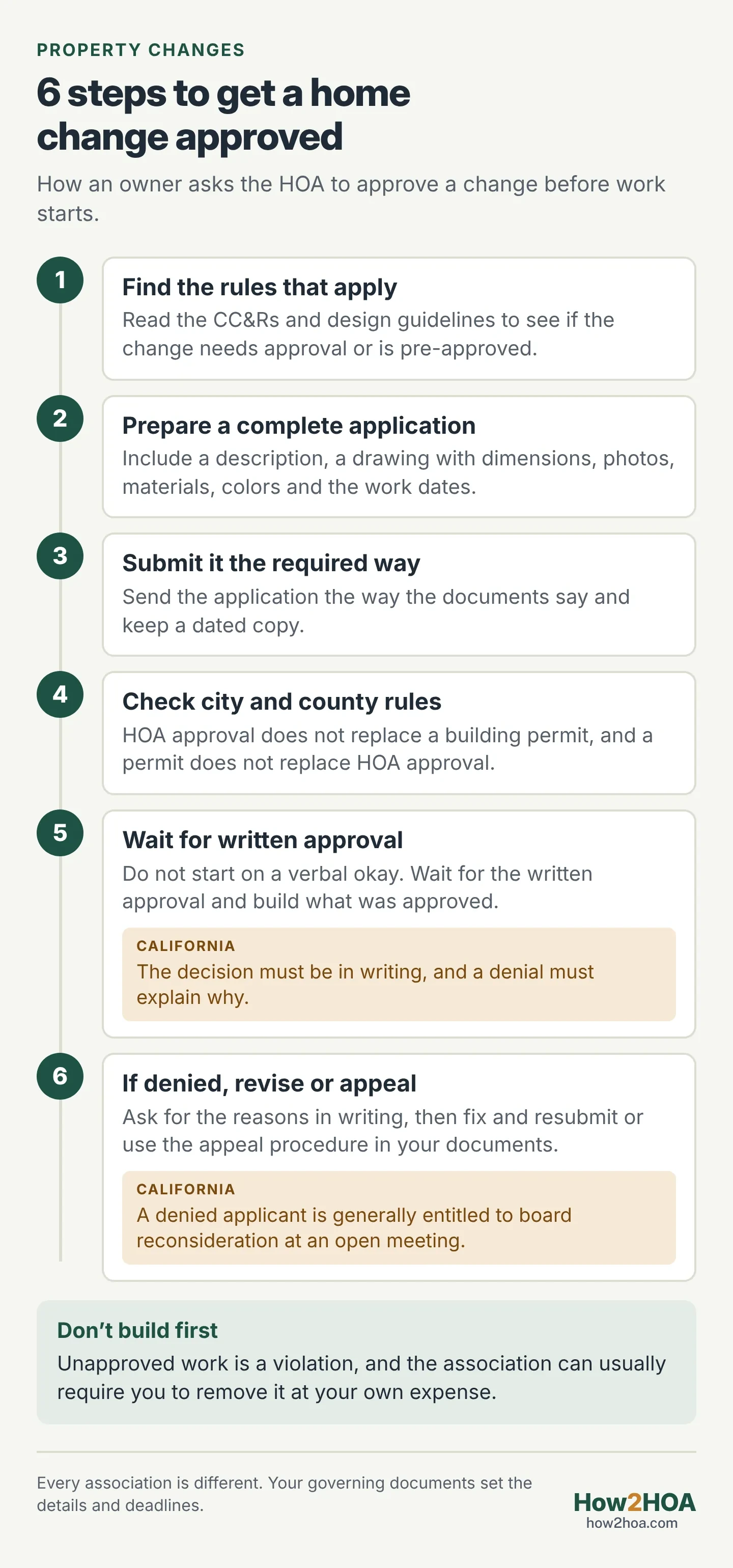
Find the Rules That Apply
Start by reading what your association has already decided. The requirement to get approval is usually in the CC&Rs. The details, such as approved colors, fence styles, roofing materials and plant lists, are usually in separate architectural or design guidelines. Our article on governing documents explains how these documents rank when they disagree.
You will usually find three kinds of change:
- No approval needed. Replacing a dead tree with the same kind of tree, or doing work inside the home that does not affect the structure or shared systems, often falls here.
- Pre-approved choices. Repainting in one of the association’s listed colors may need only a short notice, or nothing at all.
- Approval required. Anything outside the pre-approved list, such as a new color, a patio cover, a fence or an addition, needs an application.
If you cannot tell which kind your project is, ask the manager or the committee in writing before you buy materials.
Prepare a Complete Application
Even when a change is allowed, you may still have to submit it. A complete application is the fastest route to approval, because a committee that has to ask for missing information cannot decide until it arrives. Use the association’s form if it has one, and include:
- A plain description of the work and where on the property it will go
- A drawing or site plan with dimensions, plus photos of the current condition
- Materials, colors and product sheets or samples
- The contractor’s name and license information, if the association asks for it
- The start date and how long the work will take
- The section of the guidelines your project fits under
Follow the Process and Wait for a Written Answer
Submit the application the way the documents say, and keep a dated copy. Respecting the process builds goodwill and tends to speed things up. If your project is already allowed by the rules, approval should be straightforward. You mainly need to show that you understand the rules and that the project fits within them.
Do not start work on a verbal okay from a board member or a neighbor on the committee. Wait for the written approval, build what was approved and keep the approval letter with your house records. A future buyer will ask for it.
Propose Changes Outside HOA Rules
If you want something the rules do not allow, the process is harder. You have two options: ask for an exception, or ask to change the rule.
Ask for an Exception
Many governing documents let the board or the committee grant a variance, which is an exception for one property. Read the variance section closely, because it usually says what you have to show, such as an unusual lot shape or a hardship the rule did not anticipate. A variance request generally takes longer than a routine application, and the board may be cautious, since an exception granted to you may be requested by others.
Ask to Change the Rule
You can also ask the association to change the rule. How hard that is depends on where the rule lives. The board can usually amend design guidelines and operating rules. A restriction written into the CC&Rs normally needs a vote of the owners, often by more than a simple majority, and the association has to pay for drafting, balloting and recording. Our article on rewriting governing documents explains the amendment process.
Make a Persuasive Case
Whichever route you choose, you will need to persuade people. An association exists to maintain the community and protect the owners’ shared investment, so the board will ask how your change affects the look of the neighborhood, the neighbors next to you and the cost of enforcing the rules in future. Answer those questions before they are asked:
- Explain how the change benefits the community, not only you.
- Talk to your neighbors and bring their written support, especially from those who can see the change from their homes.
- Show examples of the same change done well in similar communities.
- Offer conditions that reduce the impact, such as screening, a matching color or a height limit.
An association is not a dictatorship. The board answers to the members and to state and local law, so support from other owners carries real weight.
Check City and County Requirements
The HOA’s decision may not be the only one you need. Building permits, zoning rules and setback requirements apply regardless of what the association says. HOA approval does not replace a permit, and a permit does not replace HOA approval.
Know Which Changes the Law Protects
For a few kinds of change, federal or state law limits what an association can refuse. One federal example is the FCC’s rule on antennas and satellite dishes, which protects dishes one meter or less in diameter installed on property you own or in an area set aside for your exclusive use, such as a balcony or patio. Many states have similar laws for solar panels, electric vehicle chargers and other improvements. For solar panels and EV chargers an association can usually still set reasonable conditions, so apply first. Antennas and dishes are different: the FCC rule generally bars an association from requiring approval before installation, though narrow safety rules can apply.
If Your Request Is Denied
Ask for the reasons in writing if the denial does not give them. A denial often points to something you can fix, such as a different material, a lower height or a different location. Revise and resubmit if you can. If you think the decision is wrong, use the appeal or reconsideration procedure in your documents, and ask to be heard at a board meeting.
Do not go ahead without approval. Unapproved work is a violation, and the association can usually require you to remove it at your own expense. Our article on HOA rules and enforcing violations explains what that process looks like.
In California
When the governing documents require approval before an owner makes a physical change to a separate interest or to the common area, Civil Code 4765 sets the ground rules for the association’s review. Our California HOA law overview covers the Davis-Stirling Act more broadly.
- A written procedure with deadlines. The association must provide a fair, reasonable and expeditious procedure in its governing documents. The procedure must set prompt deadlines and state the maximum time for a response. Section 4765 does not set a number of days, so look for the deadline in your own documents. A few kinds of projects have their own deadlines in other sections, described below.
- Good faith. The decision must be made in good faith and may not be unreasonable, arbitrary or capricious. It also may not violate governing law.
- A written decision. The decision must be in writing. If the request is disapproved, the decision must explain why and describe the procedure for reconsideration.
- Reconsideration. If the request is disapproved, the applicant is entitled to reconsideration by the board at an open meeting. The exception is a decision that the board itself, or a body with the same members as the board, made at an open meeting.
- Annual notice. Each year the association must tell the members which kinds of physical change need approval and give them a copy of the review procedure.
California also protects specific improvements. An association may not effectively prohibit a solar energy system, though it may impose reasonable restrictions, and a solar application is deemed approved if it is not denied in writing within 45 days of receipt, unless the delay comes from a reasonable request for more information (Civil Code 714). A similar rule applies to electric vehicle charging stations, with a 60-day period (Civil Code 4745).
Rebuilding after a disaster has its own rules. A rule can’t block a substantially similar rebuild of a home damaged or destroyed in a declared disaster, and the association must tell the owner in writing within 30 calendar days whether the application is complete, then approve it or return a full set of comments within 45 calendar days (Civil Code 4752 and 4766). Starting January 1, 2027, new sections also protect Energy Code-compliant replacement windows, with a 45-day deemed-approval rule (Civil Code 4754); heat pump water heaters, heat pump heating and cooling systems and swaps from gas to electric appliances (Civil Code 4737); and cooling systems such as air conditioners and evaporative coolers (Civil Code 4738).
Changing your property in an HOA takes patience, but the path is predictable: read the rules, apply in writing and wait for the written answer. You can find more articles for owners in our section on living in an HOA.
Our free Architectural Application Template gives owners a form for improvement requests, with the review deadlines for solar, EV charger and disaster rebuild requests.
The Law Behind This Article
Every legal point in this article comes from the official text. Each link below opens it in a new tab.
Civil Code sections: 714 · 4737 · 4738 · 4745 · 4752 · 4754 · 4765 · 4766
Bills: SB 625 (adds sections 4752 and 4766, effective January 1, 2026) · AB 1684 (adds section 4738) · SB 222 (adds section 4737) · SB 908 (adds section 4754); the last three take effect January 1, 2027
Other sources: FCC: Installing Consumer-Owned Antennas and Satellite Dishes
This article is general educational information, not legal advice. Laws vary by state and your association’s governing documents control many of these questions, so check with your association’s attorney or another qualified professional about your situation.