
The rights of homeowners association members generally include voting for the board, attending meetings and speaking at them, inspecting the association’s records, receiving notice and a hearing before being disciplined, and using the common areas. In return, members are responsible for paying assessments, following the governing documents and keeping up their property. The exact rights and duties come from state law and from your association’s own documents.
We spend a lot of time at How2HOA on information for board members. The board has many responsibilities, but homeowners have rights and obligations as well. Owners need to understand that the board has the authority to enforce the rules. The board, which has agreed to maintain the community under those same rules, needs to understand that homeowners still want individual freedom. When each side respects the other’s role, the community runs more smoothly. Knowing the rights and responsibilities is the first step.
Where Member Rights Come From
Most HOAs are nonprofit corporations set up to manage the community. Like other corporations, they have an elected board of directors, meetings, minutes and budgets. They are created and regulated under state law, and they also have their own governing documents.
One of those documents is the Declaration of Covenants, Conditions and Restrictions (CC&Rs), which sets most of the rules for homeowners. A buyer does not sign the CC&Rs. They are recorded against the property, so they bind every owner automatically, and buyers usually receive a copy before closing. Reading them before you buy is the best way to know what is expected. Our article on HOA governing documents explains what each document does.
Rights of Homeowners Association Members
Most member rights follow from the way the association is built: an organization run by directors whom the owners elect.

Share this infographic: Pinterest · Facebook · LinkedIn · Email · Download
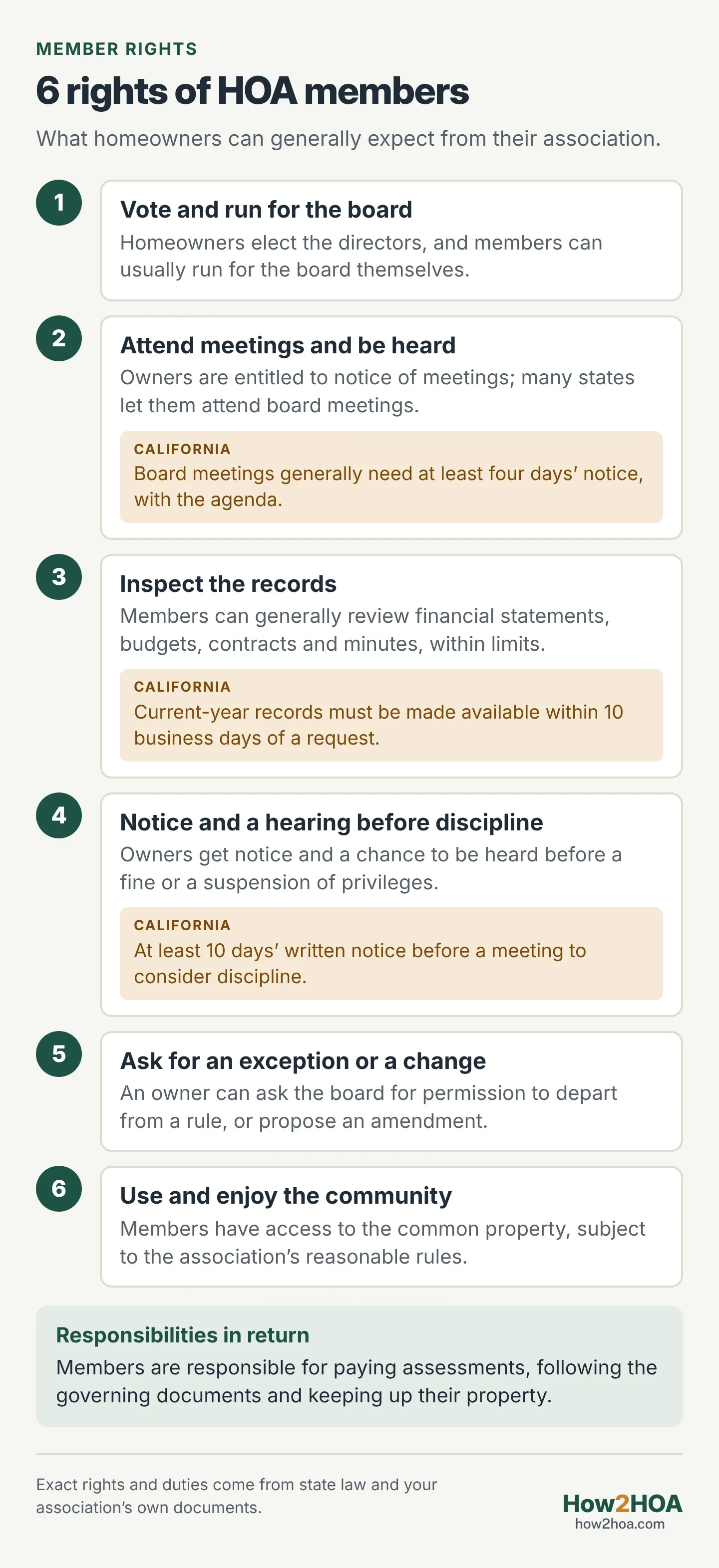
Vote and Run for the Board
Homeowners elect the board of directors. In most associations each lot or unit carries one vote, so an owner of two homes has two votes, but check your documents because some use a different formula. The bylaws set the length of a director’s term. Members can usually run for the board themselves, vote on amendments to the CC&Rs and bylaws, and vote on certain assessments. See how to conduct effective HOA elections for how the process should work.
Attend Meetings and Be Heard
Homeowners are entitled to notice of the date, time and place of association meetings, and in many states to the agenda as well. Many states let members attend board meetings, apart from closed sessions on matters such as litigation, personnel and member discipline, and some give members a right to speak. Involved members make the board’s job easier, and attending meetings is the best way for an owner to understand why decisions are made.
Inspect the Association’s Records
Members generally have the right to review the association’s records, such as financial statements, budgets, vendor contracts, meeting minutes, the governing documents, insurance information and collection policies. In many states that includes the membership list. The right has limits. Associations can usually withhold privileged legal communications, personnel files, records of closed sessions and other owners’ disciplinary and payment histories. State law typically sets how to make a request, how quickly the association must respond, and what it may charge for copies.
Notice and a Fair Hearing Before Discipline
Homeowners are entitled to notice and an opportunity to be heard before the board imposes discipline, such as a fine or a suspension of privileges. They can use any dispute resolution process the association offers, and they can challenge a penalty or a rule they believe was adopted improperly. Members also have the right to go to court against the association or a neighbor to enforce the governing documents, which is a last resort. Our guide on how to enforce the rules in your homeowners association describes the notice and hearing process from the board’s side.
Ask for an Exception or a Change
A property owner can ask the board for permission to depart from a rule. Depending on the documents, this may be a request for a “variance” or an application to the architectural committee. If you plan to alter your home, read our article on how to propose changes to your property. If the board says no, the owner can propose an amendment to the governing documents. The amendment procedure is set out in the documents. It takes longer, because the owner needs the support of enough other homeowners to pass it.
Use and Enjoy the Community
As members of the HOA, homeowners have the right to enjoy the community. That includes access to the common property, such as the clubhouse and other recreational facilities, subject to the association’s reasonable rules.
Homeowner Responsibilities
- Know and follow the governing documents. This usually covers things like exterior paint colors and keeping the property up to community standards, which owners handle on their own. Owners are also responsible for making sure their guests and tenants follow the rules on parking, noise, use of facilities and everything else.
- Pay assessments on time. This is one of the most important responsibilities. The whole community depends on assessments to function. The board is responsible for collecting the money, but each owner took on the obligation to pay in exchange for the benefits of the HOA. When some owners do not pay, the others carry the cost.
- Take part. An HOA is run by a board following governing documents, and it works best when owners participate. Attending meetings, reading the minutes, following community issues and voting in board elections are all part of membership.
- Communicate with the board. If you have trouble making a payment or cannot comply with a rule, contact the board or the manager first. Problems are easier to solve before they become violations or collection matters.
- Keep your contact information current. Give the association any new mailing address, email address or phone number, so that notices and essential community information reach you.
In California
California’s Davis-Stirling Act writes many of these rights into statute. The main ones are below.
- Record inspection. Civil Code sections 5200 to 5240 give members the right to inspect and copy “association records.” These include financial statements, executed contracts that are not privileged, tax returns, reserve account balances, check registers, agendas and minutes, the governing documents and the membership list (other than members who have opted out of sharing their information). Under section 5210, records are open for the current fiscal year and the two previous fiscal years, and minutes are open permanently. The association must make current-year records available within 10 business days of a request and prior-year records within 30 calendar days.
- Costs, limits and enforcement. The association may bill the member for the direct and actual cost of copying and mailing, after telling the member the cost and getting the member’s agreement to pay (section 5205), and it may withhold or redact items such as privileged information, executive session minutes, personnel records and other members’ disciplinary, collection and payment plan records (section 5215). A member can sue, including in small claims court, to enforce the right to inspect. If the court finds the association unreasonably withheld access, the member recovers reasonable costs and attorney’s fees, and the court may impose a civil penalty of up to $500 for each written request that was denied (section 5235).
- Open meetings and the right to speak. Under Civil Code section 4925, any member may attend board meetings, except when the board meets in executive session, and the board must permit any member to speak at any meeting of the association or the board, except when the board meets in executive session, subject to a reasonable time limit. Section 4920 generally requires at least four days’ notice of a board meeting, with the agenda. Under section 4950, minutes, draft minutes or a summary must be available to members within 30 days of the meeting.
- Discipline protections. Under Civil Code section 5855, the board must give a member at least 10 days’ written notice before a meeting to consider discipline. The member may attend and address the board, in executive session if the member asks, and may cure the violation before the meeting. The board must give written notice of its decision within 14 days, and discipline is not effective unless the board followed these steps. Section 5850 caps most fines at the lesser of the association’s fine schedule or $100 per violation, and bars late charges and interest on fines.
- Elections. Director elections, votes on amendments to the governing documents and certain other votes must be held by secret ballot under Civil Code section 5100.
- Assembly and speech. Civil Code section 4515 protects the right of members and residents to meet peacefully, canvass and petition, and distribute information at reasonable hours and in a reasonable manner, and to discuss community issues online. An association may not retaliate against someone for doing so.
- Dispute resolution. The association must provide a fair, reasonable and expeditious internal dispute resolution procedure (Civil Code section 5905). If a member invokes it, the association must participate, and the member may not be charged a fee (section 5910).
- A member duty. Civil Code section 4041 requires each owner to give the association written notice every year of the owner’s preferred delivery method for notices (a mailing address, an email address or both), an alternate or secondary one, any legal representative and whether the property is owner-occupied, rented, vacant or undeveloped.
You can find more articles on rules and governing documents in our rules and legal section.
Our free Records Request Form and Tracker writes a request for association records and shows every response deadline.
The Law Behind This Article
Every legal point in this article comes from the official text. Each link below opens it in a new tab.
Civil Code sections: 4041 · 4515 · 4920 · 4925 · 4950 · 5100 · 5200 · 5205 · 5210 · 5215 · 5235 · 5850 · 5855 · 5905 · 5910
This article is general educational information, not legal advice. Laws vary by state and your association’s governing documents control many of these questions, so check with your association’s attorney or another qualified professional about your situation.