When a resident with a disability asks to keep a service animal or an emotional support animal, an HOA board is handling a fair housing request, not a pet application. The board may confirm that the person has a disability and a disability-related need for the animal when those are not obvious, but it may not ask for a diagnosis or medical records, charge pet fees, or apply breed and weight limits. In California, state law protects emotional support animals in housing even though the federal housing agency changed its own enforcement position in 2026.
Two laws, two kinds of animals
- Service animals under the ADA. The Americans with Disabilities Act covers places open to the public. A service animal under the ADA is a dog individually trained to do work or perform tasks for a person with a disability. Animals that only provide comfort are not service animals under the ADA. The ADA reaches an HOA mainly where a facility is open to the public, for example a clubhouse rented to outside groups.
- Assistance animals under housing law. Fair housing law covers the home itself and the common areas. It uses a broader idea, often called an assistance animal, which includes trained service animals and support animals that ease the effects of a disability without special training. Most HOA requests fall here.
The federal framework, and what changed in 2025 and 2026
The federal Fair Housing Act makes it unlawful to refuse reasonable accommodations in rules, policies, practices or services when they are necessary to give a person with a disability equal opportunity to use and enjoy a dwelling. The implementing regulation, 24 CFR 100.204, uses a guide dog in a no-pets building as its example. The Act applies to community associations.
For years, boards relied on two guidance notices from the U.S. Department of Housing and Urban Development (HUD) that explained how to evaluate animal requests, including emotional support animals. That guidance is gone:
- Withdrawal. HUD withdrew its 2020 notice (FHEO-2020-01) and its 2013 notice on service and assistance animals effective September 17, 2025, and published the withdrawal in the Federal Register on April 6, 2026.
- New enforcement position. On May 22, 2026, HUD’s fair housing office issued an enforcement memorandum stating that it will pursue animal-related accommodation complaints only where the animal is individually trained to do work or perform tasks related to the person’s disability. HUD also said it intends to begin formal rulemaking.
What remains: the statute, the regulation and decades of court decisions. The HUD memorandum describes how HUD will handle complaints. It does not amend the Fair Housing Act, and HUD’s own notice says a person may still file a lawsuit in federal or state court within two years of an alleged violation. Courts are not bound by HUD’s enforcement choices, and state fair housing laws apply independently. A board outside California should not treat the federal change as permission to deny support animal requests without first checking state law and talking to counsel.
In California: state law still protects support animals
California’s Fair Employment and Housing Act (FEHA) has its own reasonable accommodation regulations, in title 2 of the California Code of Regulations, sections 12176 through 12185. They apply to homeowners associations. On July 20, 2026, the California Civil Rights Department (CRD), which enforces FEHA, issued a legal alert stating that California’s protections for emotional support animals in housing are unaffected by HUD’s change.
What the board may ask
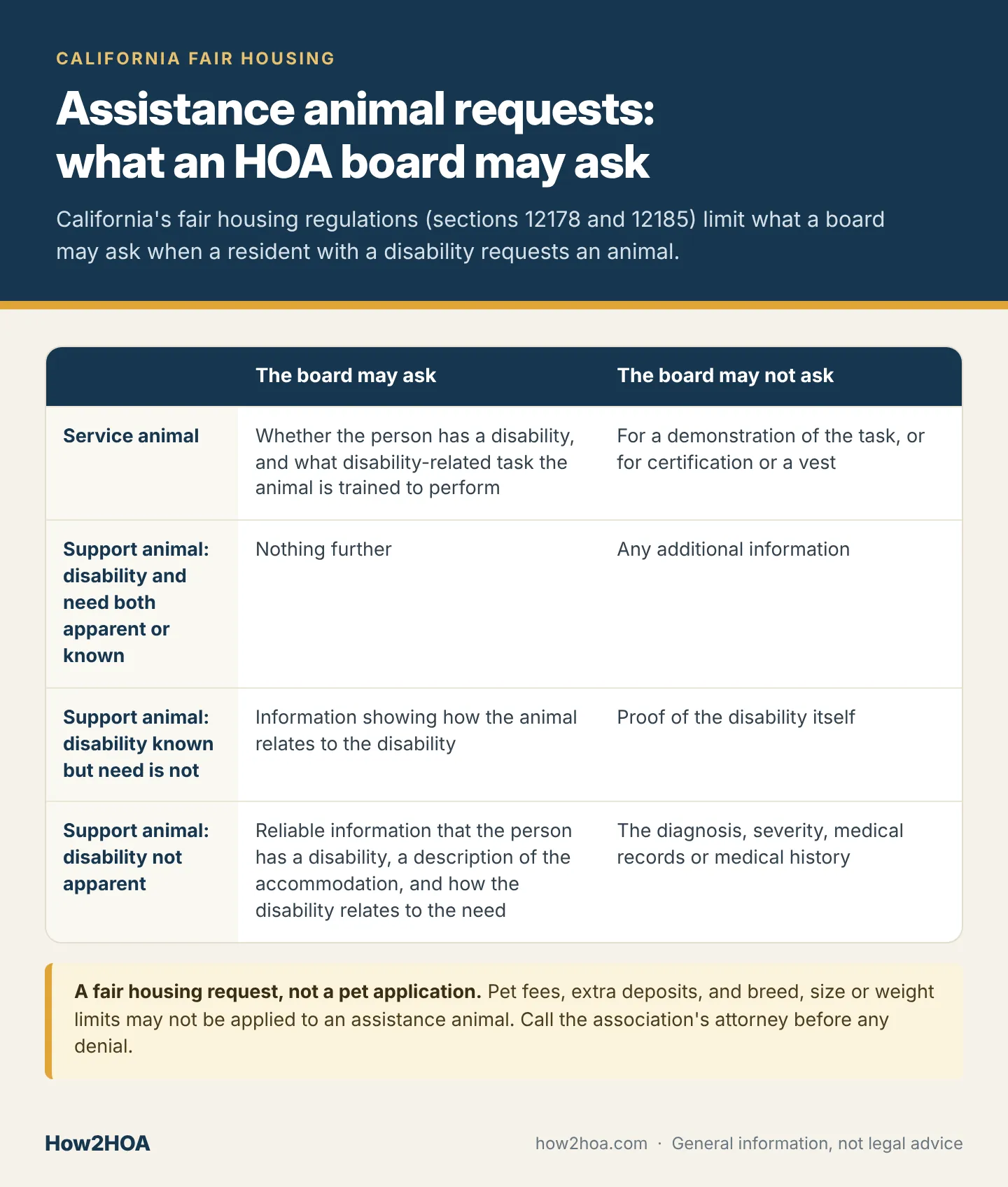
The assistance animal regulation (section 12185) and the information regulation (section 12178) set the limits.
| Situation | The board may ask | The board may not ask |
|---|---|---|
| Service animal | Whether the person has a disability, and what disability-related task the animal is trained to perform | For a demonstration of the task, or for certification or a vest |
| Support animal, disability and need both apparent or known | Nothing further | Any additional information |
| Support animal, disability known but need is not | Information showing how the animal relates to the disability | Proof of the disability itself |
| Support animal, disability not apparent | Reliable information that the person has a disability, a description of the accommodation, and how the disability relates to the need | The diagnosis, severity, medical records or medical history |
Reliable information can come from the person (for example, proof of disability benefits or a credible statement) or from a third party who knows about the disability, such as a medical professional, a service agency or a caregiver. A certificate bought from an online service with no individualized assessment by a medical professional is presumed not to be reliable. Even then, the board must give the person a chance to provide better information before denying the request. Vests, ID cards and registry certificates prove nothing by themselves.

Share this infographic: Pinterest · Facebook · LinkedIn · Email · Download
ESA letters from licensed practitioners
Since 2022, Health and Safety Code section 122318 (added by AB 468) has regulated the health care practitioners who write letters for emotional support dogs. The practitioner must hold a valid, active license and list its details in the letter, must have had a client-provider relationship with the person for at least 30 days, and must complete a clinical evaluation of the need for the dog. The rule is enforced against the practitioner by the licensing board. It gives a board a reasonable checklist for judging whether a letter is reliable, but a letter that falls short is a reason to ask for more information, not an automatic denial.
Rules that do not apply to assistance animals
- No pet fees or deposits. The association may not charge a pet fee or an additional deposit, or require extra liability insurance for the animal. It may charge for actual damage the animal causes, beyond ordinary wear and tear.
- No breed, size or weight limits. These restrictions may not be applied to an assistance animal.
- No-pet and pet-limit rules. A person may have more than one assistance animal. Each request is evaluated individually.
Separately, Civil Code section 4715 gives every owner in a California common interest development the right to keep at least one pet, subject to reasonable rules. That is a pet right, unrelated to disability, and it does not limit the accommodation rules above.
When a request can be denied
Under section 12179, a request may be denied if the person does not have a disability, if there is no disability-related need for the animal, or if granting it would be an undue financial and administrative burden or a fundamental alteration of the association’s operations. A specific animal may also be excluded if it poses a direct threat to the health or safety of others, or would cause substantial physical damage to others’ property, and no other reasonable accommodation would reduce the risk enough.
A direct threat finding must rest on objective, recent evidence about that animal’s actual conduct. Breed reputation, fear, speculation and harm caused by other animals do not count. Neighbors’ objections, or the worry that other residents will ask for the same thing, are not valid reasons either.
Before denying, the board must use what the regulations call the interactive process: a timely, good faith exchange with the resident to get missing information and look for an alternative that would work. An unreasonable delay can itself count as a denial.
Nuisance behavior is still enforceable
An approved assistance animal is not exempt from conduct rules. The association may enforce reasonable rules on waste pickup, control of the animal and nuisance behavior, as long as the conditions are no stricter than those for other animals and do not interfere with the animal’s work. The regulation gives the example that barking to alert a handler is permitted, while incessant barking may violate nuisance rules. Handle these complaints through your normal process for enforcing rules, with notice and a hearing, and see our guide to dealing with barking dogs.
A process boards can follow
The law requires a prompt, individualized, good faith decision. The steps below are good practice for getting there.
- Adopt a short written procedure. Say who receives requests and how quickly the board responds. A request does not have to be in writing or use particular words, so train whoever answers the phone to recognize one.
- Keep it confidential. Limit disability information to the people who need it to decide. Do not discuss it in open session or in the newsletter, and ask counsel how to record the decision. See our article on executive session.
- Ask only what is allowed. Use the table above, and ask once.
- Decide promptly and in writing. State any conditions, such as following leash and cleanup rules.
- Call the association’s attorney before any denial. Fair housing claims are expensive, and the association’s exposure is one reason to review your directors and officers coverage.
- Update the pet rules. Add a sentence stating that the rules are subject to reasonable accommodation under fair housing law.
Our free reasonable accommodation request form and response letter build in these limits.
Residents who believe a request was wrongly denied can file a complaint with the Civil Rights Department. Boards that want to limit their liability should treat that as a reason to get the process right the first time. For more on rules and governing documents, visit our legal hub.
The Law Behind This Article
Every legal point in this article comes from the official text. Each link below opens it in a new tab.
Civil Code sections: 4715
Health and Safety Code sections: 122318
Other sources: ADA.gov: ADA requirements for service animals · 24 CFR 100.204: Reasonable accommodations · Federal Register: Notification of withdrawal of Fair Housing and Equal Opportunity guidance documents (April 6, 2026) · California Civil Rights Department: Legal alert on emotional support animals in housing (July 20, 2026) · 2 CCR 12185: Assistance animals · 2 CCR 12178: Information requests · 2 CCR 12179: Denial of a reasonable accommodation request
This article is general educational information, not legal or financial advice. Laws vary by state and your association’s governing documents control many of these questions, so check with your association’s attorney or another qualified professional about your situation.