Directors and officers (D&O) insurance pays to defend and resolve claims that an HOA’s board members made a wrongful decision or failed to act, such as a lawsuit over how the board enforced a rule, handled an election or approved a contract. It does not cover injuries or property damage (that is general liability) or stolen funds (that is fidelity or crime coverage). In California, carrying a minimum amount of D&O coverage is also one of the conditions for the statutory protection that limits volunteer directors’ personal liability.
What D&O insurance covers
D&O policies respond to claims alleging a “wrongful act,” which policies generally define as an actual or alleged error, omission, misstatement, neglect or breach of duty by an insured acting in an association role. Typical HOA claims include:
- Governance disputes. Challenges to elections, recalls, assessments, rule changes or how meetings were run.
- Enforcement disputes. An owner claims the board enforced the CC&Rs (covenants, conditions and restrictions) unfairly, or failed to enforce them against a neighbor.
- Architectural decisions. Denial or approval of an owner’s application.
- Breach of fiduciary duty. Allegations that directors mismanaged money, ignored maintenance or acted with a conflict of interest.
- Discrimination and employment claims, if the policy includes them. Coverage here varies widely.
Two features matter more than the limit on the declarations page.
- Defense costs. Attorney fees are often the largest cost of an HOA dispute. Ask whether the insurer has a duty to defend (it hires and pays counsel) and whether defense costs are paid in addition to the limit or reduce it.
- Non-monetary claims. Many suits against associations do not ask for money. They ask a court to order the board to do something or stop doing something (injunctive or declaratory relief). Some policies, particularly D&O coverage added by endorsement to a package policy, respond only to claims for money damages. A policy that defends non-monetary claims is far more useful to an HOA.
Who is insured
The definition of “insured” differs by policy, so read it. A well-built community association policy usually includes:
- The association itself (often called entity coverage). Most lawsuits name the association, so this is essential.
- Past, present and future directors and officers.
- Committee members and other volunteers acting at the board’s direction. This matters if you rely on an architectural or election committee (see how to set up and run committees).
- Employees, if the association has any.
- The management company, usually as an additional insured and only for acts on the association’s behalf. Management contracts often require this, so confirm the policy matches the contract.
Common exclusions
Exclusions are where policies differ most. The ones boards run into most often:
- Bodily injury and property damage. These belong under general liability.
- Fraud, dishonesty and illegal personal profit. Often the insurer defends until a final ruling establishes the conduct.
- Breach of contract. Many policies exclude or limit claims that the association broke a contract, such as a vendor dispute.
- Prior and pending matters. Claims or circumstances the board knew about before the policy began.
- Insured versus insured. Claims by one insured against another, for example director against director. Good policies carve back coverage for claims brought by an owner who happens to be a former board member.
- Construction defects and developer claims. Often excluded, including claims against developer-appointed directors.
- Failure to obtain or maintain insurance. A real concern while property coverage is hard to place.
- Fines, penalties and the cost of complying with an injunction. The policy may pay to defend the claim but not the cost of doing what the court orders.
Claims-made basics
General liability policies are usually “occurrence” policies: the policy in force when the injury happened responds, even if the claim arrives years later. D&O policies are almost always “claims-made.” The policy in force when the claim is first made against the association, and reported to the insurer, is the one that responds. That creates three things to manage.
- Retroactive or prior acts date. Some policies cover only wrongful acts that took place after a stated date. When changing insurers, ask for full prior acts coverage or a retroactive date that matches the old policy, so past decisions stay covered.
- Reporting. A claim usually must be reported during the policy period or a short window after it ends. A “claim” is often defined broadly and can include a written demand letter, not just a lawsuit. Late reporting is one of the most common reasons D&O claims are denied. Good practice is to send any demand letter, agency complaint or lawsuit to the broker right away, and to report known disputes before each renewal.
- Tail coverage. An extended reporting period (a “tail”) lets the association report claims after a policy ends for acts that happened before it ended. Consider it when a policy is canceled or non-renewed, or when the replacement policy does not pick up prior acts.
D&O versus general liability versus fidelity
| Coverage | What it responds to | Example |
|---|---|---|
| Directors and officers (D&O) | Claims that a board decision or failure to act was wrongful | An owner sues to overturn an election or a denied architectural request |
| General liability | Bodily injury and property damage to others | A guest slips on a wet pool deck |
| Fidelity bond or crime policy | Theft of association funds, including computer and funds transfer fraud | A treasurer or manager’s employee diverts reserve money |
An association needs all three, plus property coverage. For the full picture, see the five core HOA insurance policies.
In California: section 5800 and the minimum limits
Civil Code section 5800 protects a volunteer officer or director of an association managing a residential or mixed-use development from personal liability, beyond the association’s insurance coverage, to anyone who suffers bodily injury, emotional distress, wrongful death, or property damage or loss as a result of the volunteer’s tortious act or omission. The protection applies only if all of these conditions are met:
- The act or omission was performed within the scope of the person’s association duties.
- It was performed in good faith.
- It was not willful, wanton or grossly negligent.
- The association maintained, both when the act or omission occurred and when the claim is made, one or more insurance policies that include (A) general liability coverage for the association and (B) coverage for the individual liability of officers and directors for negligent acts or omissions in that capacity, with both types of coverage at or above the statutory minimum.
The minimum applies to each of the two coverages:
| Size of development | General liability minimum | D&O minimum |
|---|---|---|
| 100 or fewer separate interests | $500,000 | $500,000 |
| More than 100 separate interests | $1,000,000 | $1,000,000 |
Several limits on this protection are worth knowing:
- Who qualifies. The section applies only to a volunteer officer or director who is a tenant of a residential separate interest in the development or who owns no more than two separate interests, all residential. Reimbursement of actual expenses does not end volunteer status.
- Developer-side directors are excluded. A director who is the declarant, or who is paid as an employee of the declarant (or of a financial institution that acquired a unit through foreclosure), is not a volunteer under this section.
- The association can still be liable. The section does not limit the association’s own liability for its negligence or that of its officers and directors.
- Both points in time count. Coverage must be in force when the act happened and when the claim is made. A lapse in D&O coverage can remove the protection.
The section also states that a director’s duties include deciding whether to investigate latent construction defects before the statute of limitations runs and whether to sue the builder.
Section 5805: higher general liability limits for owners
Civil Code section 5805 is a separate protection for owners. A tort claim against an owner that arises solely from the owner’s tenancy-in-common interest in the common area must be brought against the association, not individual owners, if the association carries general liability coverage of at least $2,000,000 (100 or fewer separate interests) or $3,000,000 (more than 100). Section 5805 does not set a D&O amount. Because of it, most California associations need general liability limits well above the section 5800 minimums.
These figures are conditions for statutory protections, not a measure of adequate coverage. Check your CC&Rs too, since many require specific coverages or higher limits. Section 5800 works alongside the business judgment rule, which we cover in fiduciary duty and the business judgment rule.
Questions to ask your broker
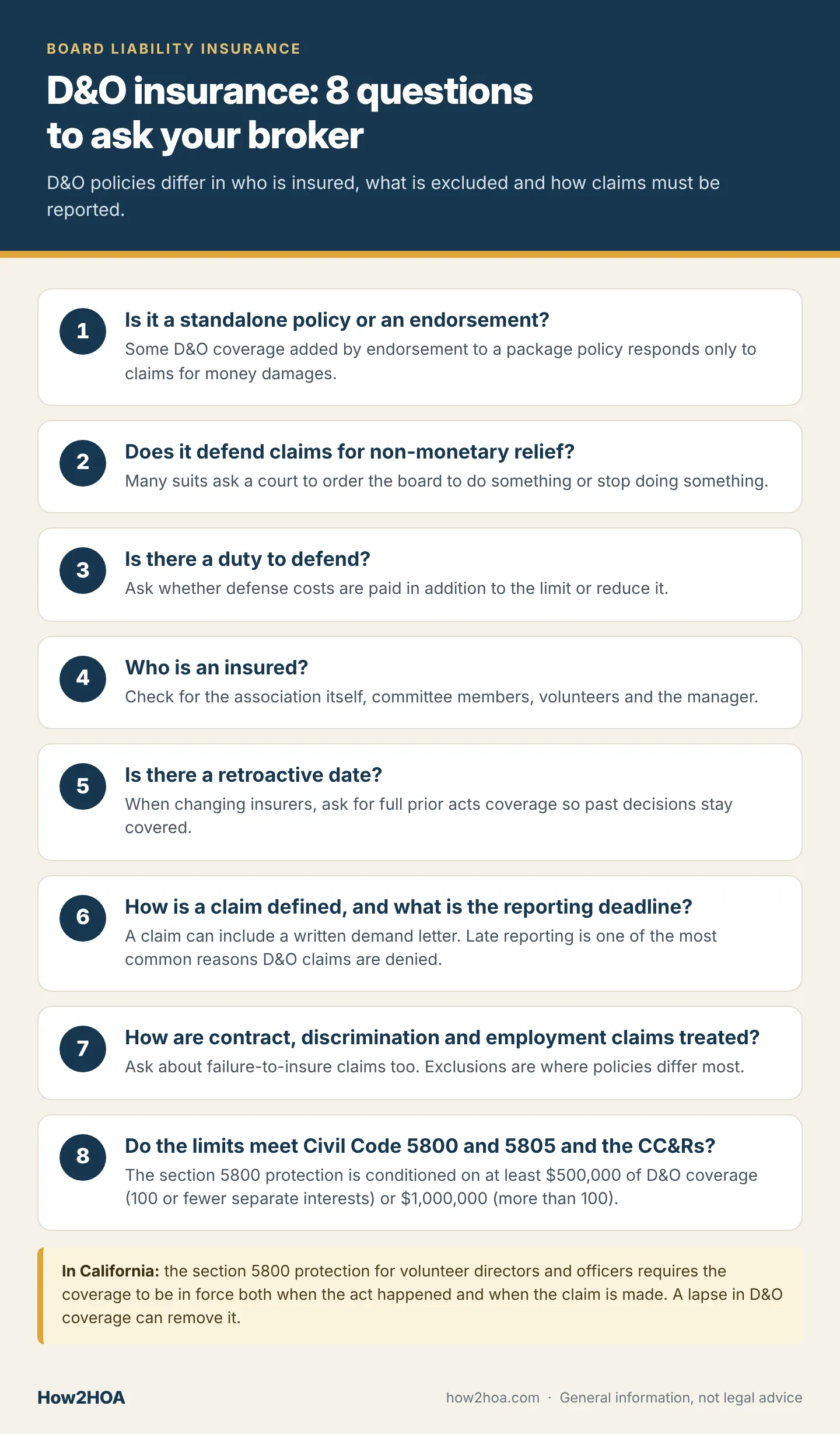
- Is this a standalone D&O policy or an endorsement to the package policy, and what are the differences in coverage?
- Does it defend claims for non-monetary relief?
- Is there a duty to defend, and are defense costs inside or outside the limit?
- Who is an insured? Are the association, committee members, volunteers and the manager included?
- Is there a retroactive date, and do we have full prior acts coverage?
- How does the policy define a claim, and what is the reporting deadline?
- How are breach of contract, discrimination, employment and failure-to-insure claims treated?
- What is the retention (deductible) per claim?
- Do our limits meet Civil Code sections 5800 and 5805 and our CC&Rs?
- If we change carriers, what happens to prior acts, and what would a tail cost?

Share this infographic: Pinterest · Facebook · LinkedIn · Email · Download
Insurance is a backstop. Following the governing documents, keeping good minutes and getting professional advice on hard decisions do more to keep directors out of trouble, as our guide to minimizing association liability explains. If you are thinking about joining the board, what to consider before becoming a board member is a good next read, and the insurance hub has the rest of our coverage guides.
The Law Behind This Article
Every legal point in this article comes from the official text. Each link below opens it in a new tab.
Civil Code sections: 5800 · 5805
This article is general educational information, not legal or financial advice. Laws vary by state and your association’s governing documents control many of these questions, so check with your association’s attorney or another qualified professional about your situation.