HOA board members owe a fiduciary duty to the association, which means they must put the community’s interests ahead of their own, make informed decisions and stay within the authority the law and governing documents give them. The business judgment rule is the other half of the bargain: when directors do those things, courts generally will not second-guess the decision or hold them personally liable just because it turned out badly. The rule does not protect self-dealing, decisions made with no investigation, or actions the board had no power to take.
The three parts of fiduciary duty
A fiduciary is someone trusted to manage money or property for others. Directors manage the association’s money and common property for all the owners. State laws word the standard differently, but it usually breaks into three duties.
Duty of care
Be informed before you vote. Read the board packet, ask questions, get bids and bring in professionals when the subject is outside the board’s knowledge. The standard is an ordinarily careful person in a similar position, not an expert and not a perfect record.
Most states let directors rely on reports from the manager, attorney, CPA, engineer or reserve specialist, as long as the reliance is reasonable. A director who knows a report is wrong cannot hide behind it.
Duty of loyalty
Act for the association, not for yourself, a relative, a friend or a faction. Loyalty problems include steering a contract to your own company, voting on your own violation, using confidential information for personal advantage, or giving neighbors you like a break on enforcement.
Duty to act within authority
A board has only the powers the statutes, the CC&Rs (covenants, conditions and restrictions) and the bylaws give it. Spending reserve money on something the documents do not allow, skipping a required member vote or ignoring the election rules is outside that authority, however good the intention. Our overview of HOA governing documents explains which document controls what.
What the business judgment rule protects
Volunteer boards make judgment calls with incomplete information: repair or replace, this bid or that one, raise assessments now or later. The business judgment rule exists so that reasonable people will agree to serve.
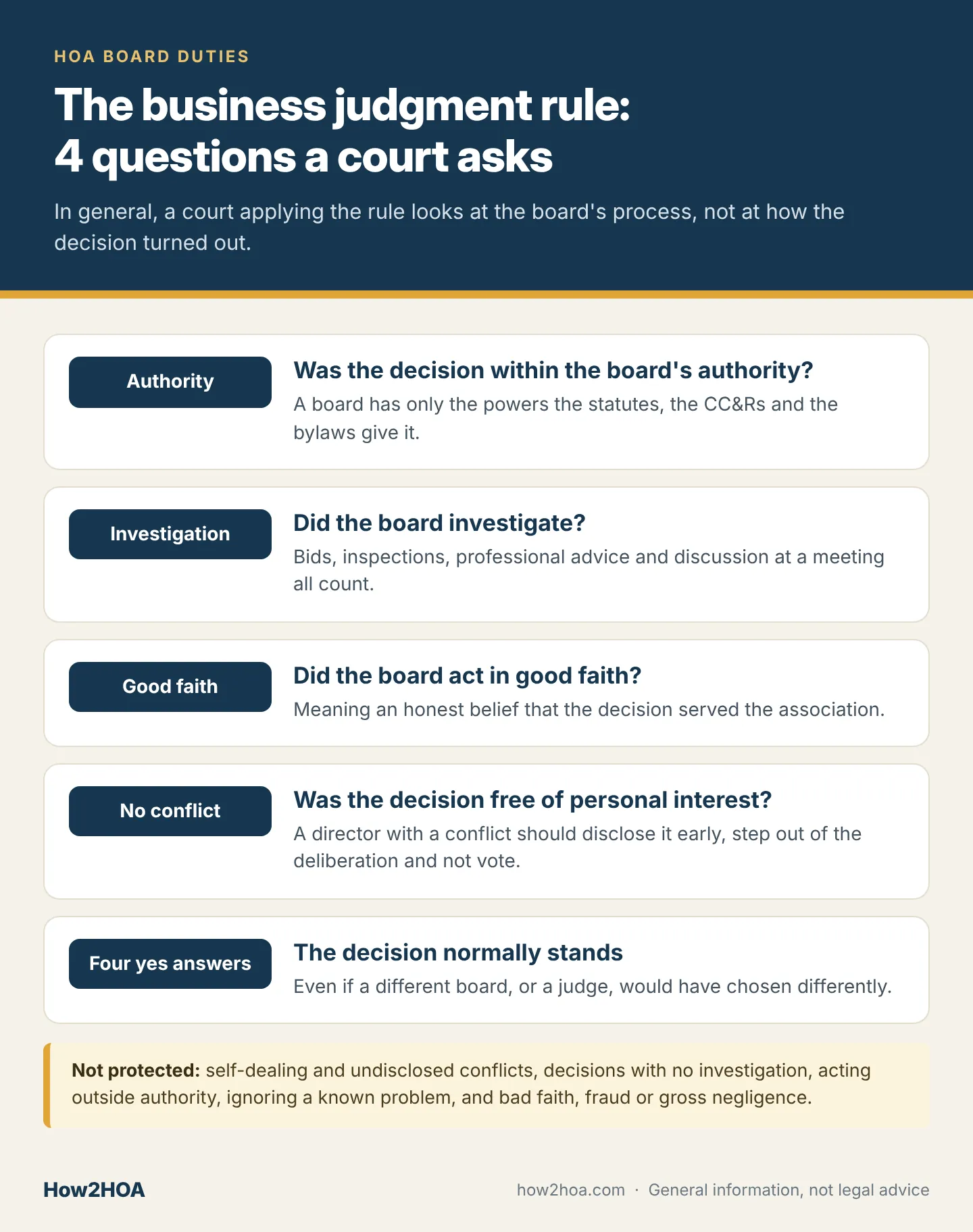
In general, a court applying the rule asks about the process, not the outcome:
- Was the decision within the board’s authority?
- Did the board investigate? Bids, inspections, professional advice and discussion at a meeting all count.
- Did the board act in good faith? Meaning an honest belief that the decision served the association.
- Was the decision free of personal interest?
If the answers are yes, the decision normally stands even if a different board, or a judge, would have chosen differently.
A plain example
A board learns the roofs are near the end of their life. It gets a consultant’s report and three bids, discusses the options at two open meetings, and chooses a mid-priced contractor with a longer warranty. Two years later the contractor goes out of business and the warranty is worthless. Owners are understandably angry. But the board investigated, acted in good faith and stayed within its authority, so the decision is the kind the rule protects.
Change the facts: the president signs with a roofer after one phone call, no bids, no board vote, and the roofer is the president’s brother-in-law. No investigation, a conflict of interest and no board action. The rule offers little or no protection.
What the rule does not protect
- Self-dealing and undisclosed conflicts. A decision that benefits a director personally gets a much harder look.
- Decisions with no investigation. “We did not know” is not a defense when the board never asked.
- Acting outside authority. Courts do not defer to a board that ignores its own CC&Rs or a statute.
- Doing nothing. Ignoring a known problem, such as a reported leak or a safety hazard, is not a judgment call.
- Bad faith, fraud or gross negligence.
- The association’s own liability. The rule mainly shields directors and their decisions. The association can still owe money for a broken contract or an injury.

Share this infographic: Pinterest · Facebook · LinkedIn · Email · Download
Conflicts of interest and recusal
A conflict is not misconduct in itself. In a small community, a director may well own the best local landscaping company or live next to the owner being fined. The problem is hiding it or voting on it. Good practice everywhere:
- Disclose early. Tell the full board about any financial or personal interest before the discussion starts.
- Step out. Leave the room for the deliberation, not just the vote.
- Do not vote. And do not lobby the other directors privately.
- Make sure the deal is fair. Get competing bids so the board can show the price and terms were reasonable.
- Record it. The minutes should show the disclosure, the recusal and the vote.
Many boards also adopt a written conflict of interest policy and have each director sign it yearly. That is good practice, not a legal requirement in most states.
In California
California has a statutory standard for directors, a separate court-made rule of deference for board decisions, and specific Davis-Stirling rules on conflicts and volunteer liability.
- Standard of care. Corporations Code section 7231 requires a director of a nonprofit mutual benefit corporation (the form most California associations take) to act in good faith, in a manner the director believes to be in the best interests of the corporation, and with the care, including reasonable inquiry, that an ordinarily prudent person in a like position would use.
- Reliance on experts. The same section lets a director rely on information and reports from officers or employees the director believes are reliable and competent, from counsel, independent accountants and other experts within their field, and from a board committee the director does not serve on. The director must act in good faith, make reasonable inquiry when the circumstances call for it, and have no knowledge that makes the reliance unwarranted. A director who meets these standards has no liability for an alleged failure to discharge a director’s duties.
- Judicial deference to boards. In Lamden v. La Jolla Shores Clubdominium Homeowners Assn. (1999) 21 Cal.4th 249, the California Supreme Court held that when a duly constituted board, upon reasonable investigation, in good faith and with regard for the best interests of the association and its members, exercises discretion within its authority to choose among ways of maintaining and repairing the common areas, “courts should defer to the board’s authority and presumed expertise.” The board in that case chose to spot-treat termites instead of fumigating the building. Notice the limits built into the rule: reasonable investigation, good faith, authority under the statutes and governing documents, and an ordinary maintenance decision. It is not a blanket shield for everything a board does.
- Self-dealing contracts. Corporations Code section 7233 covers contracts between the corporation and a director, or a business in which a director has a material financial interest. Such a contract is not void or voidable for that reason if the material facts are fully disclosed and it is approved in good faith by the members, or by the board without counting the interested director’s vote and the contract is just and reasonable to the corporation. Otherwise, the person defending the contract has to prove it was just and reasonable.
- Davis-Stirling conflict rules. Civil Code section 5350 applies sections 7233 and 7234 to every association, incorporated or not. It also bars a director or committee member from voting on six matters: their own discipline, an assessment against them for damage to the common area, their own request for a payment plan on overdue assessments, a decision whether to foreclose on a lien on their unit or lot, review of a proposed physical change to their own property, and a grant of exclusive use common area to them.
- Volunteer liability limits. Civil Code section 5800 protects a volunteer officer or director of a residential or mixed-use association from personal liability in tort (bodily injury, emotional distress, wrongful death, property damage) beyond the association’s insurance coverage. The act must have been within the scope of association duties, in good faith, and not willful, wanton or grossly negligent. The association must also have carried, both when the act occurred and when the claim is made, general liability insurance and insurance for the individual liability of officers and directors of at least $500,000 (100 or fewer separate interests) or $1,000,000 (more than 100).
- Who qualifies. Section 5800 applies only to a volunteer who is a tenant of a residential unit or an owner of no more than two separate interests, all residential. Reimbursement of actual expenses does not end volunteer status. The section does not limit the association’s own liability.
The practical takeaway from section 5800: if the association lets its coverage lapse or drop below those minimums, the directors lose a statutory protection. Check the declarations pages each year.
Habits that keep directors protected
- Decide at meetings. Vote at a properly noticed meeting and record it.
- Build a paper trail. Keep the bids, reports and advice the board relied on.
- Ask the professionals. Use the attorney, CPA, reserve specialist or engineer for questions in their fields, and follow up when something in a report looks off.
- Disclose and recuse. Every time, even when it feels like a formality.
- Keep the insurance current. Review limits and D&O coverage at each renewal.
Frequently asked questions
Can an HOA board member be sued personally?
Yes, anyone can be named in a lawsuit. Whether the director ends up personally liable is a different question. Directors who act in good faith, with reasonable care and within their authority are generally protected by the standards above and by the association’s insurance.
Does the business judgment rule apply to enforcing the rules?
Courts look at enforcement decisions too, but the test can differ by state and by the type of decision. Consistent, documented enforcement under a written policy puts a board in the strongest position. See how to minimize association liability.
What should a director do if they disagree with a board decision?
Vote no and ask that the vote be recorded in the minutes. If the decision appears unlawful or outside the board’s authority, say so and ask that the association’s attorney be consulted.
For more on serving well, visit the board member hub. Boards that want professional support with records, bids and compliance can also compare management options.
The Law Behind This Article
Every legal point in this article comes from the official text. Each link below opens it in a new tab.
Civil Code sections: 5350 · 5800
Corporations Code sections: 7231 · 7233
Other sources: Lamden v. La Jolla Shores Clubdominium Homeowners Assn. (1999) 21 Cal.4th 249
This article is general educational information, not legal or financial advice. Laws vary by state and your association’s governing documents control many of these questions, so check with your association’s attorney or another qualified professional about your situation.