
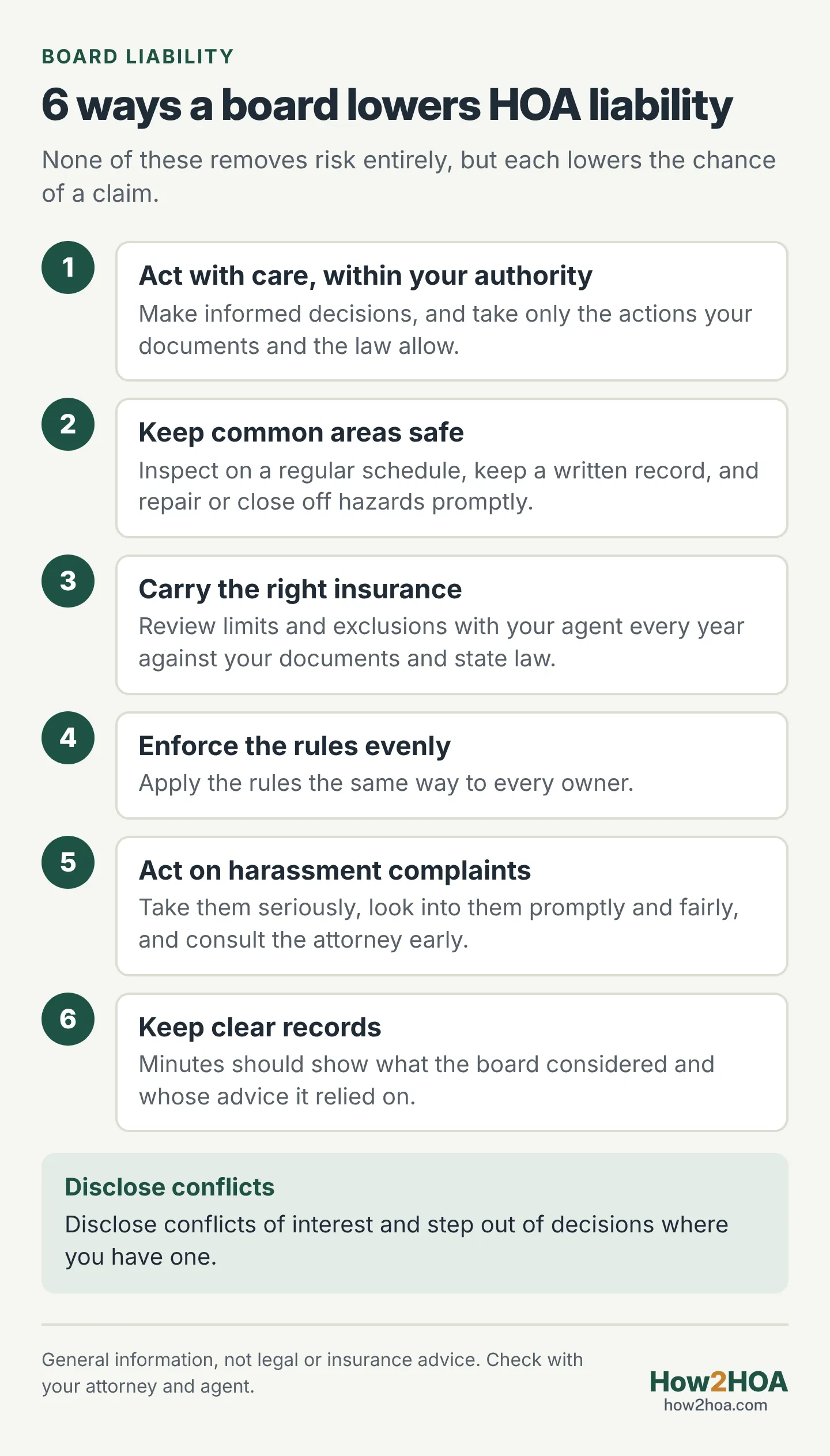
A board can minimize homeowners association liability by doing a handful of things well: acting within its authority and with reasonable care, keeping the common areas safe, carrying the right insurance, enforcing the rules evenly and responding promptly to complaints of discrimination or harassment. None of this removes risk entirely, but it lowers the chance of a claim and puts the association in a better position if one is made.
Serving on your HOA board is admirable, and it is a lot of work. The role also carries responsibilities that can expose the association to liability. If you are worried about personal liability, volunteer directors usually have protection from state law, the governing documents and the association’s insurance, which we cover near the end. Most of this article is about the liability of the association and its board.

Share this infographic: Pinterest · Facebook · LinkedIn · Email · Download
What the Board Is Responsible For
The board’s duties are set out in each association’s governing documents and in state law. They usually include at least the following, all carried out on behalf of the community:
- Maintaining the common areas
- Obtaining the insurance the association needs
- Preparing budgets and managing the rest of the finances
- Hiring and overseeing outside contractors
- Enforcing the governing documents
Our article on HOA board members’ responsibilities goes through these in more detail. Below are ways to limit the most common risks they bring.
Fiduciary Duties and Homeowners Association Liability
Most HOAs are nonprofit corporations. Even though the directors are volunteers, they owe the association the same kind of fiduciary duties that directors of other corporations owe under state law. These duties are usually described in three parts:
- Duty of care. Make informed decisions. Read the CC&Rs and bylaws when an issue comes up, look at the facts, ask questions and get advice from qualified professionals when a matter is outside the board’s knowledge.
- Duty of loyalty. Act ethically and for the good of the community as a whole, not for yourself, your friends or one group of owners. Disclose conflicts of interest and step out of decisions where you have one.
- Duty to act within the scope of authority. Take only the actions the governing documents and the law allow the board to take.
The community is trusting you with a lot, but most board members do these things naturally. Courts in many states give boards some deference when they make a reasonable, informed, good-faith decision within their authority, even if it turns out badly. That protection depends on being able to show how the decision was made, so keep minutes that record what the board considered and whose advice it relied on. Following these three duties is the foundation for reducing the HOA’s overall liability.
Common Areas and Amenities
Your HOA may offer a pool, a fitness center, a clubhouse, a playground or other amenities. Being able to use them is part of what attracts homeowners to the community. They are an asset, and the board wants to make sure they do not end up costing the association through an injury claim.
First, make sure everything meets the regulations that apply to it and works properly. Check the governing documents and the local, state and federal requirements for each amenity. Pools are a good example. Under the federal Virginia Graeme Baker Pool and Spa Safety Act, public pools and spas must have compliant drain covers, and a pool with a single blockable main drain needs an additional anti-entrapment system. The law’s definition of a public pool includes one that is open only to the residents of a multi-family residential area, so ask your pool contractor or attorney whether your pool is covered. State and local health codes usually add their own requirements for fencing, signs and water quality.
Next, check that everything is in good physical shape. Damaged or deteriorating equipment poses a risk of injury. Inspect on a regular schedule, keep a written record of each inspection, and repair or close off a hazard promptly once you know about it. A hazard the association knew about and left unrepaired is much harder to defend than one it had no reason to know about.
Then think through what could go wrong at each amenity. A clubhouse with a grill, stove or oven carries a fire risk. Pools carry the risk of slips and falls, diving injuries and drowning. Fitness centers, playgrounds, walking paths and parking areas each have their own hazards.
Once you know the risks, adopt rules that make accidents less likely. Examples include limits on smoking and alcohol, gates that lock at a set time, age limits for unsupervised use, and rules on which amenities guests may use. Communicate the rules clearly, post them where they apply, and send them to all residents so everyone knows what is not allowed. When work is contracted out, hire licensed and insured vendors and get certificates of insurance. Our article on managing outside vendors covers that process.
Neighbor-to-Neighbor Harassment
The federal Fair Housing Act prohibits housing discrimination, including harassment, because of race, color, religion, sex, familial status, national origin or disability. Regulations from the U.S. Department of Housing and Urban Development (HUD) address when a housing provider, including a community association, is responsible for harassment of one resident by another.
Under 24 CFR 100.7, an association can be directly liable for failing to take prompt action to correct and end a discriminatory housing practice by a third party, such as a neighbor, when:
- The conduct was because of a protected characteristic: race, color, religion, sex, familial status, national origin or disability.
- The conduct amounted to harassment. Under 24 CFR 100.600, hostile environment harassment is unwelcome conduct that is severe or pervasive enough to interfere with a person’s use or enjoyment of their home. A single incident can be enough if it is severe.
- The association knew or should have known about the conduct.
- The association had the power to correct it. That depends on how much control or other legal responsibility the association has over the person causing the problem.
The rule does not make the board the referee of every dispute. In its explanation of the rule, HUD said that not every quarrel among neighbors violates the Fair Housing Act, and that an association is expected to take the actions it legally can to end harassment. HUD pointed to the tools associations generally have under their CC&Rs, such as notices of violation, threats of fines and fines. Whatever the board does, the corrective action may not penalize the person who was harassed.
Separately, the association is responsible for discriminatory conduct by its own employees and agents, such as a manager or maintenance staff, whether or not the board knew about it.
These tests are specific, but applying them takes judgment. When a harassment complaint comes in:
- Take it seriously and write down what was reported and when.
- Look into it promptly and fairly.
- Use the enforcement tools in your governing documents if the conduct violates them.
- Consult the association’s attorney early to determine whether the Fair Housing Act or a state fair housing law applies. State laws often protect additional groups.
Investigating and responding quickly and thoroughly is the best way to protect the resident and to limit the HOA’s liability. Federal regulations can change, so confirm the current rule with your attorney.
Insurance and Protection for Volunteer Directors
Insurance is the backstop when prevention fails. Most associations carry general liability coverage for injuries and property damage in the common areas, and directors and officers (D&O) coverage for claims over board decisions. Review the limits and exclusions with your agent every year, and check them against what your governing documents and state law require. Our article on the five core HOA insurance policies explains the association’s coverages.
For individual directors, protection usually comes from three places: state laws that limit the personal liability of volunteers who act in good faith, indemnification provisions in the bylaws, and the association’s D&O policy. These protections generally do not extend to intentional wrongdoing, self-dealing or gross negligence, which is one more reason to follow the fiduciary duties described above.
In California
Most California associations are nonprofit mutual benefit corporations. Corporations Code section 7231 requires a director to act in good faith, in a manner the director believes to be in the best interests of the corporation, and with the care, including reasonable inquiry, that an ordinarily prudent person in a like position would use under similar circumstances. A director may rely on information and reports from officers, employees, attorneys, accountants and other experts, as long as the director acts in good faith, makes reasonable inquiry when the circumstances call for it, and has no knowledge that would make the reliance unwarranted. A director who meets this standard is not liable for an alleged failure to discharge the director’s duties.
Civil Code section 5800 adds protection for volunteer officers and directors of residential and mixed-use associations. A volunteer is not personally liable beyond the association’s insurance coverage for injury caused by the volunteer’s act or omission if the act was within the scope of association duties, was in good faith and was not willful, wanton or grossly negligent. The protection applies only if the association carried both general liability and directors and officers coverage when the act occurred and when the claim is made, in at least these amounts: $500,000 for a development of 100 or fewer separate interests, or $1 million for a development of more than 100. It covers only a volunteer who is a tenant of a residential separate interest or who owns no more than two separate interests, all of them residential, and it does not limit the liability of the association itself.
Habits That Lower Risk
- Follow your governing documents and your own written policies every time.
- Keep clear minutes and records of inspections, repairs, complaints and decisions.
- Apply the rules the same way to every owner. Our overview of HOA rules and enforcing violations explains how.
- Ask the association’s attorney, insurance agent or accountant before acting on a matter outside the board’s knowledge.
- Report claims and potential claims to the insurance carrier promptly.
More articles on these topics are in our rules and legal section.
The Law Behind This Article
Every legal point in this article comes from the official text. Each link below opens it in a new tab.
Civil Code sections: 5800
Corporations Code sections: 7231
Other sources: Virginia Graeme Baker Pool and Spa Safety Act (15 U.S.C. 8003) · 24 CFR 100.7: Liability for Discriminatory Housing Practices · 24 CFR 100.600: Quid Pro Quo and Hostile Environment Harassment · Federal Register: HUD Harassment Final Rule (2016)
This article is general educational information, not legal or insurance advice. Laws vary by state and your association’s governing documents control many of these questions, so check with your association’s attorney or another qualified professional about your situation.