California law requires up to 100 feet of defensible space around buildings in state responsibility areas and in locally designated very high fire hazard severity zones, and that duty falls on whoever owns or maintains the building. In an HOA, that usually means owners handle their own lots and the association handles the common area, including the greenbelts and open space behind the homes. The newer “Zone 0” rule for the first five feet is written into the statutes but, as of early October 2026, the regulation that would put it into effect is not yet in force.
This article is written for foothill communities in Placer, Sacramento and El Dorado counties. The statutes are California’s, but the board process at the end works anywhere wildfire is a risk.
What state law requires
Two parallel statutes set the rule. Public Resources Code section 4291 applies in the state responsibility area (SRA), where CAL FIRE is responsible for wildland fire protection. Government Code section 51182 applies to very high fire hazard severity zones designated by a city or county. Both say that a person who owns, leases, controls, operates or maintains a building must at all times:
- Maintain 100 feet of defensible space. The distance is measured from each side of the structure, but not beyond the property line unless another law or local ordinance says so. Fuel reduction is more intense from 5 to 30 feet. It does not mean bare ground; well-spaced, well-maintained trees and plants can stay.
- Clear chimneys. Remove any part of a tree within 10 feet of a chimney or stovepipe outlet.
- Remove dead wood. Keep plants next to or overhanging a building free of dead or dying wood.
- Keep roofs clean. Roofs must be free of leaves, needles and other vegetative debris.
Both statutes also say that no one is required to manage fuels on land they have no legal right to manage. That gap between one owner’s 100 feet and the neighbor’s land is where local ordinances, and HOAs, come in.
Zone 0: where the five-foot rule stands in October 2026
Both statutes call for an ember-resistant zone within five feet of the structure (an attached deck counts as part of the structure), with the details left to regulations of the Board of Forestry and Fire Protection. The statutes say new and existing structures must meet the same standard, that existing structures may be given a phase-in period, and that the zone does not apply until the Board’s regulations and guidance are in place.
That rulemaking is still open. The Office of Administrative Law’s public record of emergency regulation actions shows the Board’s “Zone 0 Defensible Space” filing as withdrawn on September 8, 2026, and when we checked in early October 2026 no replacement filing was listed as under review. So there is no statewide Zone 0 effective date or compliance deadline yet. Expect that to change, and check the Board’s defensible space page before you tell owners what is required. Some cities and counties have adopted their own five-foot rules, so also check locally.
Good practice in the meantime: treat the first five feet as the priority. CAL FIRE’s defensible space guidance recommends gravel, pavers or concrete instead of bark mulch next to the building, no stored firewood there, and replacing combustible fencing where it attaches to the home.
Find your fire hazard severity zone
The State Fire Marshal rates land as moderate, high or very high fire hazard. Updated SRA maps took effect April 1, 2024. Updated maps for local responsibility areas (land inside cities and other locally protected areas) were released in four phases between February 10 and March 24, 2025, and are adopted locally by ordinance. Look up an address on the State Fire Marshal’s Fire Hazard Severity Zones page, which links to separate viewers for SRA and local areas. A board should look up every parcel the association owns, not one address, because zone lines often cut through a community.
Who is responsible inside an HOA
- Owners’ lots. In a planned development of detached homes, each owner is responsible for defensible space on their own lot.
- Common area with buildings. The association is the “person” that owns or maintains the clubhouse, pool building and, in most condominium projects, the residential buildings and grounds. The duty is the association’s.
- Greenbelts and open space. State law measures from a structure outward and stops at the property line, so an association’s unbuilt open space is not always covered by the state statutes alone. Local ordinances often close that gap by requiring the owner of vacant land to clear vegetation within 100 feet of a neighbor’s structure (see the Placer, Auburn and El Dorado rules below). For most foothill associations, the open space behind the homes is the largest wildfire obligation they have.
Your CC&Rs (covenants, conditions and restrictions) decide who maintains what between the association and owners. See who pays for repairs in an HOA for how to read those provisions.
What HOA rules cannot block
We did not find a Davis-Stirling section written specifically about defensible space. The protections come from these rules:
- The law outranks the governing documents. Civil Code section 4205 says that when the governing documents conflict with the law, the law controls. A landscaping guideline that requires shrubs against the siding cannot override a state or local fire requirement.
- Fire-safe roofing. Civil Code section 4720 bars an association from requiring a roof that violates the state’s fire-retardant roofing standard, and in very high fire hazard severity zones the governing documents must allow at least one compliant fire-retardant roofing material.
- Low-water plants. Civil Code section 4735 voids rules that prohibit low water-using plants or artificial turf. Low-water does not always mean fire-safe, so plant choice near buildings still deserves attention.
Rebuilding after a wildfire. Since January 1, 2026, Civil Code section 4752 voids any rule that prohibits, or effectively prohibits, a substantially similar rebuild of a home damaged or destroyed in a disaster declared by the federal government, the Governor or a local government. A rebuild qualifies if it meets the local building code; stays within 110 percent of the original interior living space; stays within 110 percent of the original height (or the height the governing documents allow, if that is greater); is built on the original footprint or at least four feet from the side and rear lot lines; and meets the objective design standards in effect when the home was damaged, as long as those standards don’t unreasonably raise the cost or effectively block the rebuild. Under section 4766, the association must tell the owner in writing within 30 calendar days whether the application is complete (if it misses that deadline, the application is deemed complete), then approve it or return a full set of comments within 45 calendar days. An appeal must be decided within 60 calendar days, and an owner who wins a lawsuit to enforce either section is awarded reasonable attorney’s fees.
Good practice: update the architectural and landscaping guidelines now so that noncombustible ground cover, ember-resistant vents and noncombustible fence sections near the house are pre-approved. Owners should still use the normal process for proposing changes to their property.
Home sales: the AB 38 disclosure
Under Civil Code section 1102.19, a seller of property in a high or very high fire hazard severity zone must give the buyer documentation of defensible space compliance, or the buyer and seller must agree in writing that the buyer will obtain it (within one year after close of escrow where no local ordinance sets a different rule). This is an owner obligation, not the association’s, but owners will ask the board about the condition of adjacent common area when an inspector flags it.
Local rules and programs
- Placer County (unincorporated areas, including Granite Bay). The County’s Hazardous Vegetation and Combustible Material Ordinance (County Code Article 9.32, Part 4, effective May 21, 2020) goes beyond state law for vacant land: owners of unimproved parcels must clear vegetation within 100 feet of a neighboring structure and along roads the fire warden considers essential for getting in and out. Inspections are requested through the fire district serving the property. The Placer County Resource Conservation District runs a residential chipper program for cut material.
- Granite Bay and Loomis. The South Placer Fire District inspects properties during the dry season, May through November, issues a Notice to Abate for noncompliant properties, and takes complaints through an online form. The District also posts its 2025 local fire hazard severity zone map.
- City of Auburn. Auburn’s defensible space requirements include a fuel modification code section that, in high and very high zones on parcels of one acre or more, requires the landowner to maintain defensible space within 100 feet of a structure even when the structure is on a neighboring parcel. The same section lets the Fire Chief require up to 200 feet where conditions warrant, and requires new developments to place greenbelts as buffers between wildland fuels and structures.
- City of Folsom. Folsom requires private property owners to complete weed abatement by June 1 each year. The Fire Department inspects vacant lots and Code Enforcement inspects residential properties.
- El Dorado Hills and unincorporated El Dorado County. The County’s Hazardous Vegetation and Defensible Space Ordinance (Chapter 8.09, effective August 16, 2024) requires 100 feet around structures, clearance along driveways and roads, and a “good neighbor” rule that makes the owner of the adjacent parcel responsible for hazards within 100 feet of your structure. The County states it does not currently enforce Zone 0 and will incorporate the state rules once approved.
Insurance and budgeting
The Department of Insurance’s Safer from Wildfires framework lists the mitigation steps insurers must recognize with discounts: a Class A roof, ember-resistant vents, a five-foot ember-resistant zone, cleared decks, defensible space compliance, and community-level steps such as becoming a Firewise USA site. Firewise recognition is available to communities of 8 to 2,500 dwelling units, which fits most associations. A discount does not guarantee that a carrier will write or renew a policy. See our article on California HOA insurance costs and the FAIR Plan.
Vegetation management recurs every year, so it belongs in the operating budget as its own line item instead of being absorbed into general landscaping. One-time work such as removing dead trees or building a shaded fuel break may need separate funding. Ask your reserve specialist whether any of it belongs in the reserve study, and build the annual cost into your budget planning.
A board action plan
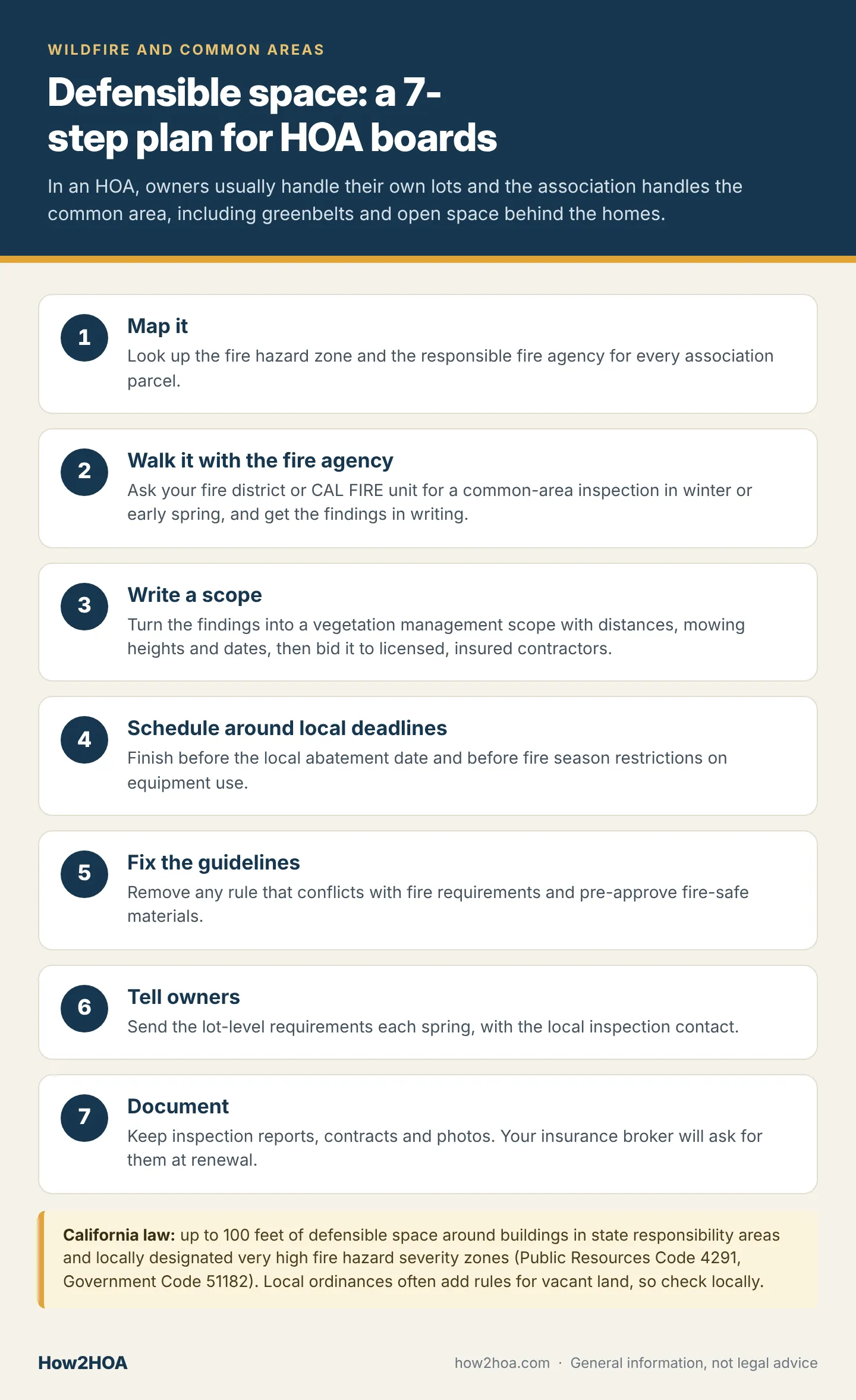
- Map it. Look up the fire hazard zone and the responsible fire agency for every association parcel.
- Walk it with the fire agency. Ask your fire district or CAL FIRE unit for a common-area inspection in winter or early spring, and get the findings in writing.
- Write a scope. Turn the findings into a vegetation management scope with distances, mowing heights and dates, then bid it to licensed, insured contractors.
- Schedule around local deadlines. Finish before the local abatement date and before fire season restrictions on equipment use.
- Fix the guidelines. Remove any rule that conflicts with fire requirements and pre-approve fire-safe materials.
- Tell owners. Send the lot-level requirements each spring, with the local inspection contact.
- Document. Keep inspection reports, contracts and photos. Your insurance broker will ask for them at renewal.

Share this infographic: Pinterest · Facebook · LinkedIn · Email · Download
Volunteer boards that find the annual cycle hard to keep up with can compare management options. For more on caring for common area, visit our maintenance hub.
The Law Behind This Article
Every legal point in this article comes from the official text. Each link below opens it in a new tab.
Civil Code sections: 1102.19 · 4205 · 4720 · 4735 · 4752 · 4766
Government Code sections: 51182
Public Resources Code sections: 4291
Other sources: Office of Administrative Law: Recent actions taken on emergency regulations · Board of Forestry and Fire Protection: Defensible space Zones 0, 1 and 2 · CAL FIRE: Defensible space · Placer County: Hazardous Vegetation and Combustible Material Ordinance · South Placer Fire District: Weed abatement · City of Auburn: Defensible space requirements · City of Folsom: Weed abatement · El Dorado County: Hazardous Vegetation and Defensible Space Ordinance · California Department of Insurance: Safer from Wildfires
This article is general educational information, not legal or financial advice. Laws vary by state and your association’s governing documents control many of these questions, so check with your association’s attorney or another qualified professional about your situation.