
You manage conflict in HOA board meetings by controlling how people disagree, not by trying to stop the disagreement. Set a time limit for each speaker, require everyone to be recognized by the chair before speaking, keep comments on the issue instead of the person, and move unresolved items to a set time and place. Disagreement is normal in any organization, and more so on a volunteer board whose members all live with the outcome. What matters is how you handle it.
Keep Conflict in HOA Board Meetings Controlled and Focused
You cannot prevent every conflict, but you can control how it plays out. When disagreements are left unmanaged, battle lines form and the bickering carries on after the meeting. That leads to personal attacks, standing feuds and directors resigning in anger. It also gives owners a poor impression of the board and its work.

Share this infographic: Pinterest · Facebook · LinkedIn · Email · Download
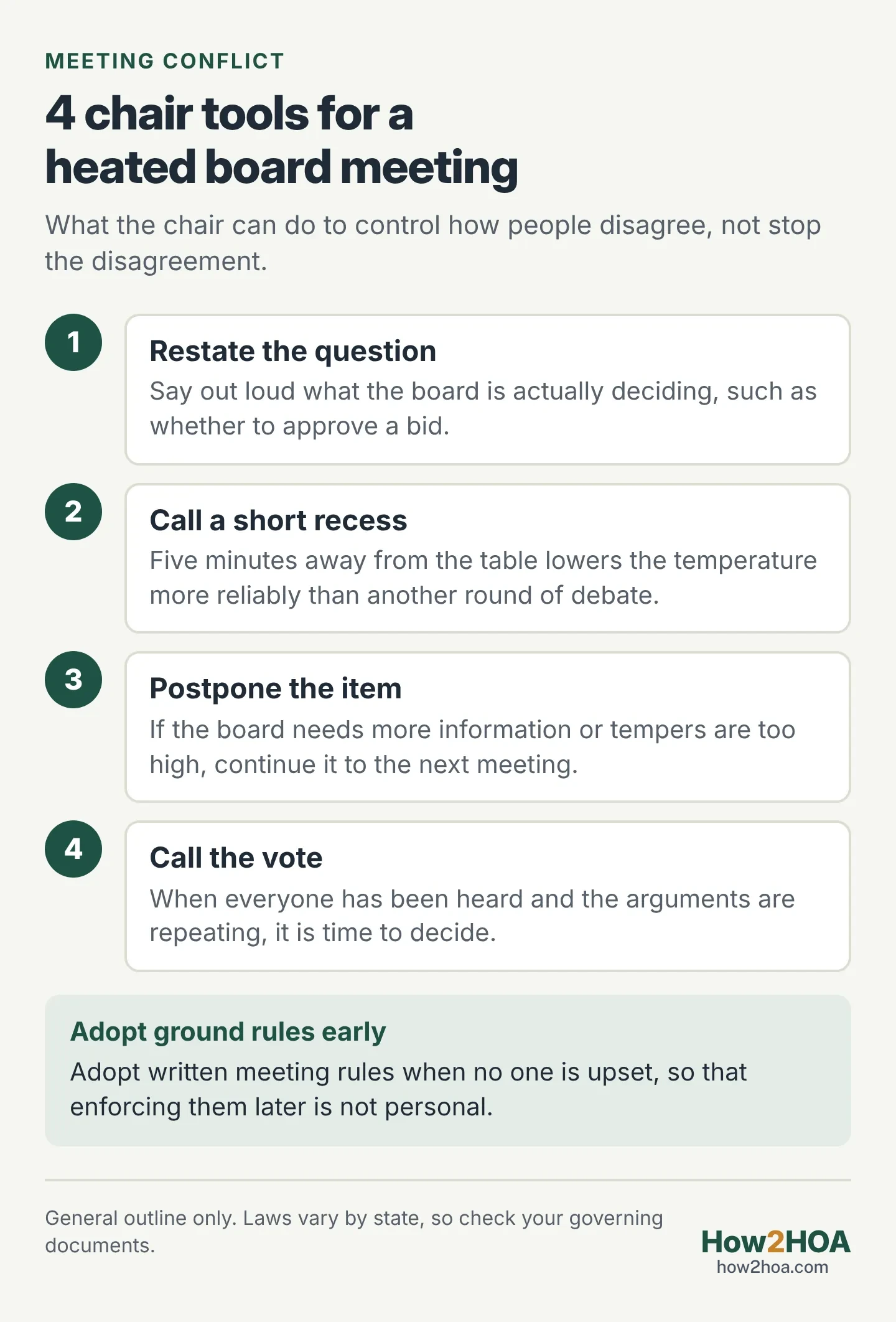
The chair has a few simple tools for keeping a heated discussion on course:
- Restate the question. Say out loud what the board is actually deciding (“The motion is whether to approve this bid”). Many arguments are about something other than the item on the table.
- Call a short recess. Five minutes away from the table lowers the temperature more reliably than another round of debate.
- Postpone the item. If the board needs more information, or tempers are too high, continue the item to the next meeting and say what will be brought back.
- Call the vote. When everyone has been heard and the arguments are repeating, it is time to decide.
These work best inside an orderly meeting. If your meetings lack structure in general, start with our article on how to run HOA board meetings smoothly.
Let Others Speak in a Controlled Environment
Every director has the right to speak up when they disagree with a proposal or have information to add. How they do it decides whether the conversation stays productive.
When the floor is open for discussion, whether among the directors or in an open forum where any owner can ask questions, make it clear that there is a time limit for each person. A few minutes is usually all anyone needs to make their case. Make it equally clear that no one speaks until the chair recognizes them, and then see that everyone who wants to speak gets a turn before anyone speaks a second time. Apply the limit the same way to people you agree with and people you do not.
Set Some Ground Rules
Whenever someone speaks, there should be firm rules about how they present their view and how they treat those who disagree. Adopt them as written meeting rules when no one is upset, so that enforcing them later is not personal.
- No personal accusations.
- No one interrupts another speaker.
- If a conflict cannot be resolved at the meeting, the board sets a time and place to continue the discussion, so everyone gets a say.
- Directors do not form alliances outside the boardroom to push their own agenda. A grievance is brought to the full board and handled there.
- Directors do not air board disputes in the media, on social media or around the community. Discussion is encouraged, but it should include all the directors, not only one faction.
Preventing Conflicts Before They Happen
Conflict often grows where there is too little structure or oversight for directors and officers, or where the board has no shared understanding of its role. A good share of what surfaces in the meeting room can be prevented by dealing with a few common issues ahead of time. A clear, well-prepared agenda is one of them, and we cover it in the strategy behind a board meeting. The others are below.
Have a Clear Mission Statement
A short statement of what the board is there to do, and how it goes about it, tells everyone why the board exists and what it can and cannot do. When a debate drifts, it gives the chair something neutral to point back to: “Is this within what the association is here to do?”
Define and Review the President’s Role
Many conflicts start when the president, or whoever chairs the board, tries to use more power than the position carries. In most associations the president runs the meetings and signs documents on the board’s instructions, but has one vote like every other director and answers to the board, not the other way around. Write down what the board expects of the position, and review it together once a year, so there is no misunderstanding about its limits. Our overview of HOA board members’ responsibilities covers what directors and officers are there to do.
Allow the HOA Board to Evolve
Another common source of conflict is a newer group of directors disagreeing with the “old guard.” Both sides should accept that an association has to change over time to meet the needs of a changing community. Keeping an open mind, and putting older rules on the agenda for review from time to time, is part of the board’s job. So is listening to the directors who remember why a rule was adopted in the first place.
Keep in Mind the Greater Good
There will be times when emotions run high: a lawsuit, misconduct by someone connected to the association, a disagreement over a new rule. Those are the times to remember the overall goal. A director who disagrees with a decision can vote no and ask that the vote be recorded in the minutes. Once the decision is made, though, the board should carry it out together. If directors keep fighting a decision after the vote, owners stop trusting that the board can represent them and look after their interests.
Leave It at the Door
Finally, a conflict that comes up at a board meeting should stay there. Do not carry it outside the meeting, and do not let it become personal. If you see that happening, raise it early. A quiet one-on-one conversation between the two people involved, or between the president and one director, is often enough to defuse things and remind everyone why they joined the board. If it has gone beyond that, see our article on what to do when HOA board members fight.
In California
California’s Common Interest Development Open Meeting Act affects how a board can handle conflict in three ways.
- Owners have a right to speak, within limits you set. The board must allow any member to speak at a board meeting (other than an executive session) and at membership meetings, and it sets a reasonable time limit for all members (Civil Code section 4925). A time limit is lawful. Refusing to hear owners at all is not.
- A closed session is not available for board infighting. The board may go into executive session only to consider litigation, the formation of contracts with third parties, member discipline, personnel matters, an owner’s assessment payments or payment plan, or a decision whether to foreclose on a lien (section 4935). A disagreement among directors is not on that list by itself, so the full board cannot simply close the doors to argue it out. Talk to your association’s attorney before using executive session for anything outside the listed topics.
- The board cannot settle things by email. The board may not take action outside a meeting or conduct a meeting through a series of electronic messages, except for an emergency meeting when every director consents in writing (section 4910). A quorum of directors gathering to discuss association business is a board meeting, with the notice that requires (section 4090). One-on-one conversations are fine. A majority of the board working out a position in private risks violating the Act.
You will find more on agendas, procedure and elections in our board meetings section.
The Law Behind This Article
Every legal point in this article comes from the official text. Each link below opens it in a new tab.
Civil Code sections: 4090 · 4910 · 4925 · 4935
This article is general educational information, not legal advice. Laws vary by state and your association’s governing documents control many of these questions, so check with your association’s attorney or another qualified professional about your situation.