
The main benefits of professional HOA management are consistent bookkeeping and collections, help keeping track of deadlines, less work for volunteers, coordinated maintenance, even-handed rule enforcement, organized communication and records, and continuity when board members change. Those benefits come with a fee and with limits: the board still makes the decisions and stays responsible for them. Here is what each benefit looks like in practice, and when it may not be worth paying for.
The 7 benefits of professional HOA management

Share this infographic: Pinterest · Facebook · LinkedIn · Email · Download
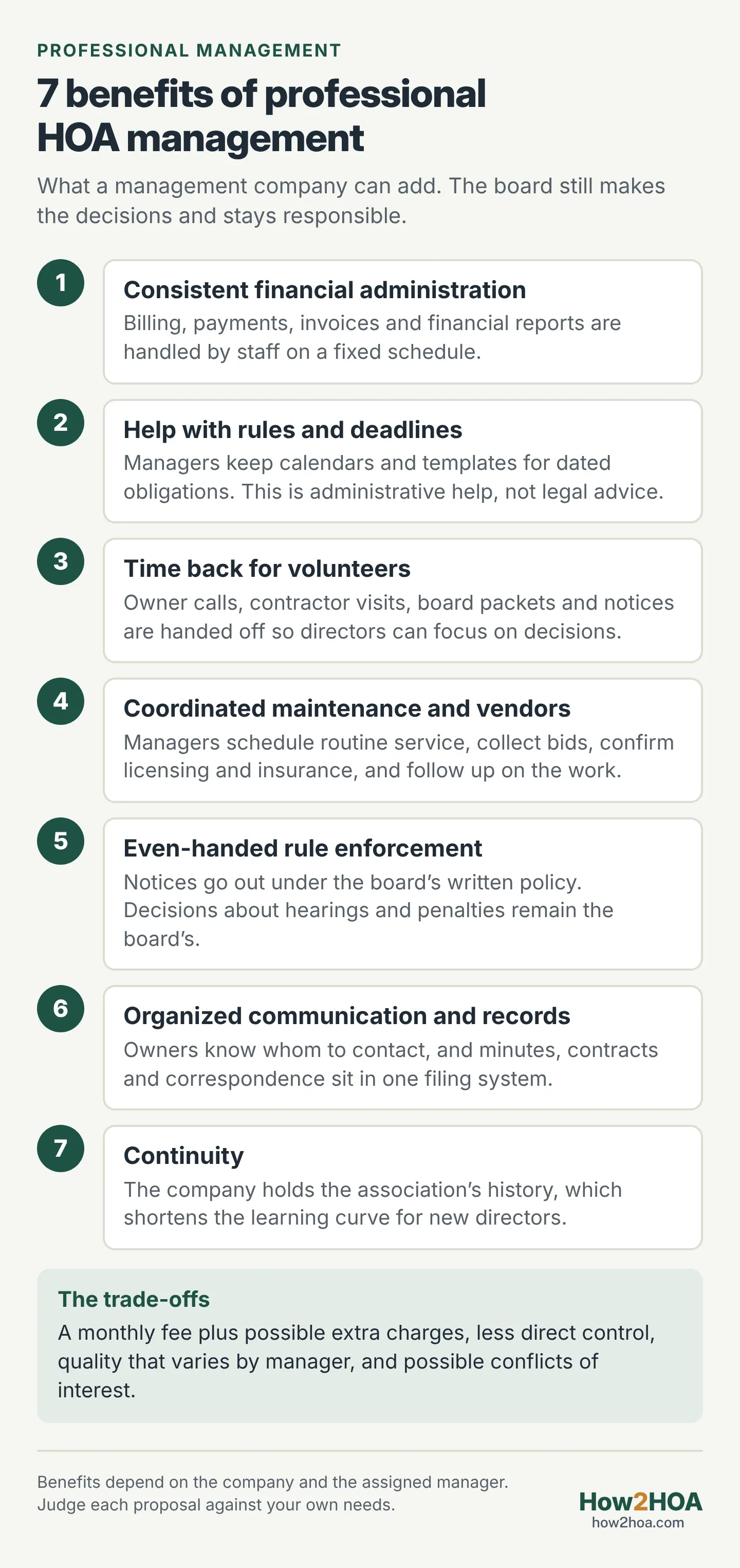
1. Consistent financial administration
A management company bills assessments, records payments, pays invoices and produces financial reports on a fixed schedule. Because the work is done by staff and not by one volunteer treasurer, it doesn’t stop when someone travels or steps down, and more than one person sees the money. The board still reviews the reports and approves the budget.
2. Help keeping track of rules and deadlines
Associations face a steady run of dated obligations: budgets, annual meetings, elections, disclosures, insurance renewals and tax filings. Managers who do this for many communities keep calendars and templates for it, and they tend to hear about changes in the law early. This is administrative help, not legal advice. Questions of interpretation belong with the association’s attorney.
3. Time back for volunteers
Answering owner calls, meeting contractors, preparing board packets and sending notices can take many hours a month. Handing that off lets directors spend their time on decisions. It can also make board service easier to recruit for, which matters where the same few people have served for years.
4. Coordinated maintenance and vendors
Managers schedule routine service, collect bids, confirm licensing and insurance, and follow up on the work. They also give owners one place to report a leak or a broken gate, including after hours if the contract covers it.
5. Even-handed rule enforcement
Enforcing rules against a neighbor is uncomfortable, and uneven enforcement creates disputes. A manager can inspect the property and send notices under the board’s written policy, which keeps the process consistent and less personal. Decisions about hearings and penalties remain the board’s.
6. Organized communication and records
A management company typically handles notices and newsletters, runs an owner portal, and keeps minutes, contracts and correspondence in one filing system. Owners know whom to contact, and the records are in place when a sale, a dispute or a financial review calls for them.
7. Continuity
Volunteer boards turn over. A management company holds the history: why a contract was signed, when the roof was last inspected, what an owner was told. That shortens the learning curve for new directors.
One claim we leave off the list is that professional management raises property values. Consistent upkeep and sound finances plausibly help a community’s appeal to buyers, but we have not found reliable data that isolates the effect of hiring a manager. Treat that claim with caution wherever you see it.
Can Professional Management Save Money?
It can, but not automatically. The management fee is a new line in the budget, and any savings arrive indirectly. For some associations those gains exceed the fee. For a small community with simple common areas and capable volunteers, they may not. These are the places where the money usually comes from.
Vendor bids and contract oversight
A company that manages many communities sees a lot of landscaping, roofing and plumbing invoices. That gives it a sense of what a fair price looks like, a list of contractors who have performed before and sometimes enough volume to get better terms. The saving is real when the manager writes a clear scope of work, collects comparable bids and checks the work before the invoice is paid. It is not guaranteed, so read the point on conflicts of interest under the trade-offs below. Our guide to managing outside vendors describes how the process should work with or without a manager.
Fewer expensive mistakes
Lapsed insurance, a missed tax filing, an election run incorrectly or a collection notice sent the wrong way can each be expensive to fix. A manager who tracks deadlines for a living lowers the odds.
Steadier assessment collection
Unpaid assessments are a cost that every paying owner ends up covering. A management company applies the board’s collection policy the same way to every owner and escalates on time. Volunteers often find that hard to do with neighbors.
Maintenance that isn’t deferred
Small repairs that get skipped tend to become large ones. A manager who walks the property, keeps a maintenance schedule and helps the board keep its reserve study current can help the association avoid emergency repairs and surprise special assessments. The manager coordinates this work. The reserve study itself should come from a qualified reserve professional, and the funding decisions stay with the board.
Shared technology
Online payments and work-order tracking, along with the owner portal, are usually part of the management service. A self-managed board buys software separately and runs it. Get a quote for standalone HOA software before you count this as a saving.
The trade-offs
- Cost. The fee recurs every month. It depends mainly on the number of homes, the complexity of the property (pools, elevators, gates, private streets or on-site staff), the scope of service, how many board meetings the manager attends and the condition of the association’s records and finances. Many contracts add charges outside the base fee, such as mailings and copies, extra meetings, violation letters, oversight of large construction projects, collection work and setup. A low base fee with a long list of extras can cost more than a higher all-inclusive fee. Our article on how much HOA management costs covers fees in more detail.
- You are replacing free labor. Volunteer hours cost the budget nothing. Management turns them into a cash expense. That can be well worth it for the board’s sake, but it is a cost, not a saving.
- The board is still responsible. A manager carries out the board’s decisions. It does not take over the board’s responsibilities. Directors still need to read the financials, approve spending and direct and supervise the work. A board that stops paying attention can lose more than it saves.
- Less direct control. Requests go through the manager’s process, which can be slower than a director picking up the phone.
- Quality varies. Service depends on the individual manager and on how many communities that person handles. An overloaded manager, or a company unfamiliar with your type of community, may deliver little of what is described above. Manager turnover can undo the continuity benefit, and changing companies takes time and usually money.
- Possible conflicts of interest. Some firms have affiliated vendors or receive referral income. Ask whether the company or its owners have a financial interest in any vendor they recommend, and whether they add a markup to vendor invoices.
When professional management may not be worth it
A small association with limited common area, healthy finances and a few willing, organized directors can run well without a manager. With only a handful of homes and few transactions, there may not be enough contracts to bid or errors to prevent for the savings to cover the fee. In that situation, the financial and record-keeping benefits can often be covered by a bookkeeper or financial-only service, HOA software and an attorney on call. Our guide on how to self-manage your HOA explains how to set that up.
Management is more likely to earn its fee as a community gets larger, its amenities get more complex, or volunteers get harder to find. If your board is weighing the two approaches, our self-managed vs. professional management decision guide walks through the choice step by step.
How to run the numbers for your association
To see whether a manager would save your association money, work through these steps:
- Add up what you spend now on bookkeeping, software, postage and tax preparation, plus any late fees, penalties or rework from the past two or three years.
- Estimate the hours directors put in each month and ask whether that pace can last.
- Write down the scope you want, then get proposals from more than one company against that same scope, each with a full fee schedule.
- Ask each company what it expects to change in your budget and why. Treat the answer as an estimate, not a promise.
- Price the middle options: financial-only management, or a bookkeeper plus software. Our page on comparing HOA management options describes the service models.

Share this infographic: Pinterest · Facebook · LinkedIn · Email · Download

Then put the fee into a draft budget and see what it does to assessments. Planning your HOA budget walks through that step.
What to check before you hire
For a fuller description of the services involved, see how management companies can help. Before you sign, ask:
- Who would be your assigned manager, and how many other communities does that person handle?
- Can you speak with boards of associations similar to yours in size and type?
- What is the complete fee schedule, including charges outside the base fee? Get it in writing and read it next to the contract.
- How are association funds held, and who can move them?
- What insurance does the company carry?
- How can either side end the agreement, and how are records returned? Our article on HOA management contracts covers these terms.
In California
California gives boards some specific tools for evaluating a manager, and a few rules that bear directly on cost:
- “Certified” has a legal meaning. State law sets what a person must complete to use the title “certified common interest development manager.” Under the current route, that means at least 30 hours of coursework and passing examinations covering topics such as the Davis-Stirling Act, finance and budgeting, and ethics (Business and Professions Code 11502).
- Annual manager disclosure. A person providing common interest development manager services must tell the board each year whether he or she is certified and by which organization, where the primary office is, and whether he or she holds an active real estate license. Before a contract is signed or renewed, the manager must also disclose whether the fidelity insurance of the manager or the employer covers the association’s operating and reserve funds (Business and Professions Code 11504).
- Disclosure before the agreement. No more than 90 days before the association enters into a management agreement, a prospective managing agent must give the board a written statement naming its owners and listing relevant licenses and professional certifications. The statement must also include any business in which the manager or firm has an ownership interest, profit-sharing arrangement or other monetary incentive, and whether it receives referral fees from a third party that distributes association documents (Civil Code 5375). Read it with vendor relationships in mind.
- Handling of funds. A managing agent that accepts association funds generally must keep them in a trust account at a California bank, savings association or credit union, or in another insured account the board requests in writing. It must keep separate records of receipts and disbursements and must not commingle association funds with its own money (Civil Code 5380).
- The board keeps control of large transfers. Even with a manager, transfers from operating or reserve accounts at or above set thresholds require the board’s prior written approval (Civil Code 5502).
- Fidelity coverage must reach the manager. An association that uses a managing agent or management company must have its crime or fidelity coverage extend to dishonest acts by that company and its employees (Civil Code 5806). Ask your insurance agent how that affects the premium.
- Reserve studies run on a three-year cycle. You may read that reserve studies are required every year. In California, the visual inspection that underlies the study is required at least once every three years for associations that meet the statute’s threshold, and the board must review the study annually (Civil Code 5550). A manager can keep that cycle on schedule but does not replace the study.
Professional management is a service, and like any service it is worth what it delivers for your particular community. It pays for itself when it prevents losses larger than its fee, or when the board would otherwise be unable to keep up. List the problems your board needs solved, then judge each proposal against that list. Our HOA management hub has more on contracts, costs and self-management.
The Law Behind This Article
Every legal point in this article comes from the official text. Each link below opens it in a new tab.
Civil Code sections: 5375 · 5380 · 5502 · 5550 · 5806
Business and Professions Code sections: 11502 · 11504
This article is general educational information, not legal or financial advice. Laws vary by state and your association’s governing documents control many of these questions, so check with your association’s attorney or another qualified professional about your situation.