
Hire an accountant for your HOA when the work calls for a license, independence or expertise the board does not have. In practice, an HOA accountant means a certified public accountant (CPA) for the year-end compilation, review or audit and for the tax return, and a forensic accountant if you suspect money is missing. Routine bookkeeping can stay with your management company, a bookkeeper or a capable treasurer.
Managing the association’s money is one of the board’s core duties, and every service the community receives depends on it. Many directors have no finance background, and reports produced by accounting software do not explain themselves. The board can delegate the bookkeeping, but it stays responsible for overseeing it, so it helps to know when to bring in a professional and which kind.
What an accountant does and what stays with the board
It helps to separate three jobs that often get lumped together:
- Bookkeeping: recording assessments, paying bills, reconciling bank accounts and producing the monthly financial report. A management company, a bookkeeper or the treasurer usually does this.
- Oversight: reading those reports, asking questions, approving the budget and deciding how money is spent. This belongs to the board and cannot be handed off.
- Independent examination and tax work: the year-end compilation, review or audit, and the association’s tax returns. This is the work of a CPA.
A CPA holds a state license. To earn it, a person has to meet the state’s education and experience requirements and pass the Uniform CPA Examination. You can confirm a license with your state’s board of accountancy.
When to hire a CPA as your HOA accountant

Share this infographic: Pinterest · Facebook · LinkedIn · Email · Download
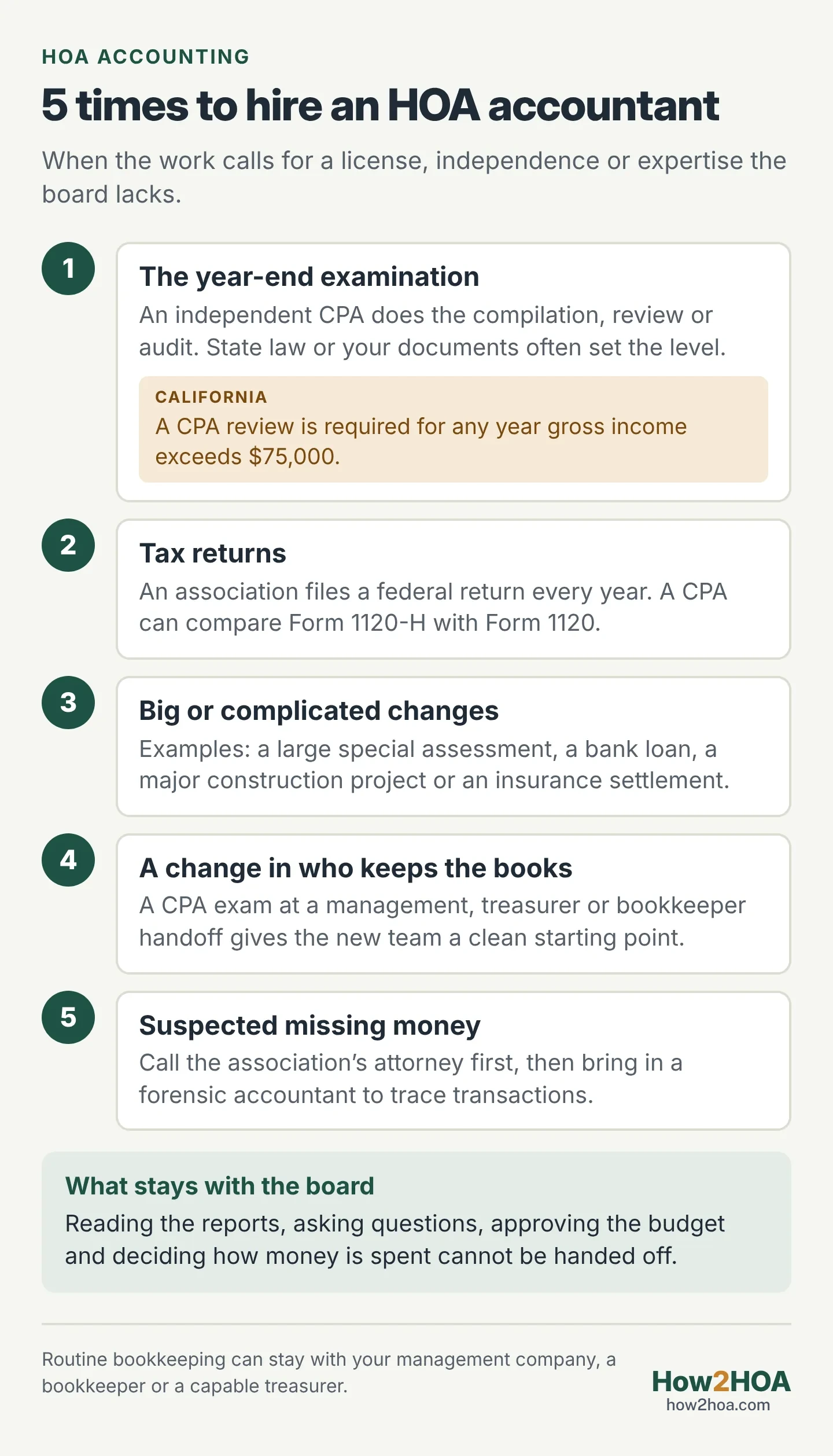
The year-end compilation, review or audit
Most associations have an outside CPA look at the books once a year. State law or your governing documents often set the minimum level, and it frequently depends on the association’s size or income. The three levels are a compilation (the CPA presents the association’s numbers as financial statements and gives no assurance), a review (limited assurance, based on inquiries and analytical procedures) and an audit (a high level of assurance, based on testing and outside confirmation). Our article on HOA financial reviews explains each one.
Under the accounting profession’s standards, a CPA must be independent of the association to perform a review or audit. That matters if your management company keeps the books and also has an accountant on staff, because that person is not independent of the records the company produces. Hire a separate CPA firm that reports to the board.
If no law or document tells you which level to choose, a CPA can help the board decide, taking into account the size of the budget and reserves, how many people handle money, and anything unusual that happened during the year. A common approach is a review in most years and an audit periodically or after a change in management.
Tax returns
An association has to file a federal income tax return every year, and many states require one as well. Most associations can choose between Form 1120-H and Form 1120, and the IRS instructions for Form 1120-H say an association should compare its tax under both and may file the one that results in the lower tax. That comparison, and the rules behind it, are a good reason to use a CPA who prepares association returns regularly. See homeowners association taxes for how the two forms work.
Budgets, reserves and big changes
You do not need a CPA to prepare a routine budget, but one can help when the numbers get complicated: a large special assessment, a bank loan, a major construction project, an insurance settlement, a change in how reserves are funded or invested, or a dispute with owners over the finances. A CPA can also explain the tax effect of income from sources other than assessments.
A change in management, treasurer or bookkeeper
Turnover is when records get lost and errors go unnoticed. Asking a CPA to examine the books at the handoff gives the incoming team a clean starting point and protects the outgoing one. It is also a good moment to have the CPA look at your internal controls: who can sign checks or release electronic payments, who reconciles the accounts, and whether those are different people.
How to choose a CPA
Treat the search the way you would for any important vendor:
- Look for experience with community associations. Fund accounting, reserves and association tax rules are a specialty.
- Verify the license with your state board of accountancy.
- Confirm independence. The CPA should have no financial or family ties to board members, the manager or the management company.
- Ask two or three firms for written proposals covering the same scope, so you can compare them.
- Call references at associations of a similar size.
- Get an engagement letter that states the level of service, the fee, the deadline and what the association must provide.
The CPA works for the association and should report to the board, not to management. Invite the CPA to present the year-end report at a board meeting so directors can ask questions directly.
When to hire a forensic accountant
A regular audit or review is not a fraud investigation. When there is a real suspicion that something is wrong, such as unexplained withdrawals, missing records, payments to vendors nobody recognizes, or bank statements that do not match the reports the board receives, it is time for a forensic accountant.
Forensic accountants specialize in investigating suspected financial wrongdoing. They trace transactions back to bank records and original documents, look for altered or fabricated paperwork, measure the loss, and document their findings so they can be used in an insurance claim, a civil case or a criminal referral. Many are CPAs who hold an added credential such as the AICPA’s Certified in Financial Forensics (CFF), and some are Certified Fraud Examiners (CFE).
A general-practice CPA is a little like a family doctor: the right choice most of the time, and the first to tell you when you need a specialist. If you suspect theft, take these steps before or alongside hiring one:
- Call the association’s attorney first. The attorney can retain the forensic accountant, which may help keep the work confidential, and will advise on reporting the matter to law enforcement.
- Secure the accounts. Change online banking access and authorized signers, and require two approvals for payments.
- Preserve the records. Do not confront the person involved, and do not let anyone delete, alter or remove files.
- Notify the insurance carrier. Policies that cover employee dishonesty or crime usually have deadlines for reporting a loss. See the five core HOA insurance policies for the coverages a board should carry.
In California
Civil Code section 5305 requires a review of the association’s financial statement by a licensee of the California Board of Accountancy for any fiscal year in which the association’s gross income exceeds $75,000, unless the governing documents set a more stringent standard. A copy goes to the members within 120 days after the close of the fiscal year. You can check a license on the California Board of Accountancy website.
Hiring a CPA does not take the monthly work off the board. Civil Code section 5500 requires the board to review, on a monthly basis, the reconciliations for the operating and reserve accounts, actual results against the budget, the latest bank statements, an income and expense statement, and the check register, general ledger and delinquency reports.
California also requires associations to carry fidelity coverage. Under Civil Code section 5806, unless the governing documents require more, the coverage must at least equal the association’s reserves plus three months of assessments, must include computer fraud and funds transfer fraud, and must cover dishonest acts by a managing agent or management company and its employees if the association uses one.
What it costs
Professional help costs money, and fees vary with the size of the association, the condition of the records and the level of service, so ask for written proposals. Weigh the fee against what is at stake: the board is responsible for every dollar the owners pay in, and a mistake or theft that runs for years costs far more than an annual examination. For more on budgets, reserves and reporting, see our HOA finances section.
The Law Behind This Article
Every legal point in this article comes from the official text. Each link below opens it in a new tab.
Civil Code sections: 5305 · 5500 · 5806
Other official sources: IRS instructions for Form 1120-H
This article is general educational information, not legal or financial advice. Laws vary by state and your association’s governing documents control many of these questions, so check with your association’s attorney or another qualified professional about your situation.