
Yes, your HOA has to file a federal income tax return every year, even in years when it owes nothing. For homeowners association taxes, most associations choose between two returns: Form 1120-H, which taxes only income from sources other than member assessments at a flat 30 percent, and Form 1120, the regular corporate return, which has a 21 percent rate and more complicated rules. Many states, including California, have their own filing requirements on top of that.
Most boards hand the returns to a CPA, and that is usually the right call. It still helps to understand the basics, because an officer signs the return, the board chooses which form to file each year, and decisions made during the year change the result.
How the IRS treats homeowners association taxes
For federal income tax purposes, a homeowners association is generally taxed as a corporation. Being organized as a nonprofit under state law does not change that. A nonprofit corporation is not exempt from federal income tax unless it qualifies under the Internal Revenue Code, and IRS Publication 542 says that, unless it is exempt, a corporation must file a return whether or not it has taxable income.
A small number of associations qualify as tax-exempt social welfare organizations under section 501(c)(4). The IRS explains that such an association must be operated for the benefit of the whole community, which generally means showing that the roads and parks it maintains are open to the general public and not only to its members, and that it does not maintain the exteriors of private homes. Most associations do not fit that description, so the rest of this article covers the two returns that associations normally use.
Form 1120: the regular corporate return
Form 1120 is the U.S. Corporation Income Tax Return. Any association may file it, and an association that does not qualify for Form 1120-H in a given year has to. Corporations pay a flat 21 percent on taxable income.
The lower rate comes with trade-offs:
- It is harder to prepare. The tax rules for membership organizations (Internal Revenue Code section 277) generally allow the cost of serving members to be deducted only against income from members, so member and non-member activity has to be tracked separately.
- Leftover assessments can become taxable. If the association collects more from owners than it spends in a year, the excess may be taxable income. Under IRS Revenue Ruling 70-604, the owners can vote each year to apply the excess to the following year’s assessments or to refund it. The IRS has said in a published information letter that the ruling was not intended to let an association build up a reserve, so this is not an open-ended rollover. How reserve contributions are treated is a separate question to settle with your CPA.
- Estimated taxes may apply. According to the Form 1120 instructions, a corporation generally has to make installment payments of estimated tax if it expects its tax for the year to be $500 or more.
Form 1120 tends to make sense when an association has a lot of income from sources other than assessments, such as substantial interest on reserves, and the 21 percent rate outweighs the extra accounting work and risk.
Form 1120-H: the return designed for homeowners associations
Section 528 of the Internal Revenue Code was written for associations, and Form 1120-H is how an association elects to use it. Under this election, the dues, fees and assessments the association collects from owners as members (the IRS calls this exempt function income) are left out of taxable income entirely. Only the remaining income is taxed.
Who qualifies
The Instructions for Form 1120-H list the tests. For the tax year, the association must meet all of these:
- Type of association. It is a condominium management association, a residential real estate management association or a timeshare association.
- Residential use. Substantially all of its units, lots or buildings are used as homes. The instructions refer to Treasury Regulations section 1.528-4 for how that is measured, so ask your CPA to check the test if the community includes commercial space.
- The 60 percent income test. At least 60 percent of the association’s gross income for the year is exempt function income.
- The 90 percent expenditure test. At least 90 percent of the association’s expenses for the year go to acquiring, building, managing, maintaining and caring for association property.
- No private benefit. No private shareholder or individual profits from the association’s net earnings, other than through the upkeep of association property or a rebate of excess dues, fees or assessments.
What is taxed, and at what rate
Taxable income on Form 1120-H is the association’s gross income other than exempt function income, minus the deductions directly connected with producing that income, minus a specific $100 deduction. The result is taxed at a flat 30 percent (32 percent for timeshare associations). Common kinds of non-exempt income are:
- Interest earned on reserve funds and other accounts
- Payments from people who are not members, such as an outside group renting the clubhouse
- Charges to members for special use of a facility, such as reserving the clubhouse for a private party
- Payments for work done on property that does not belong to the association
Here is a simple illustration. Say an association’s only non-exempt income is $2,500 of interest on its reserves, and it has no expenses tied directly to earning that interest. Subtract the $100 deduction and taxable income is $2,400. At 30 percent, the tax is $720. If the association also rented its clubhouse to outside groups, it could deduct the costs directly connected with those rentals, such as cleaning after each event, before applying the rate.
Two more points from the instructions. A net operating loss deduction is not allowed on Form 1120-H, and the estimated tax requirements do not apply to an association that elects to file it.
An association with little non-exempt income may owe little or nothing. An association with large reserves earning interest will usually owe some tax and should budget for it.
Which form should your HOA file?
The election is made one year at a time, by filing a properly completed Form 1120-H by the due date, including extensions. The IRS instructions say an association should compare its total tax under Form 1120-H with its total tax under Form 1120, and that it may file the form that results in the lower tax. Once Form 1120-H is filed for a year, the election cannot be revoked for that year without the IRS’s consent.

Share this infographic: Pinterest · Facebook · LinkedIn · Email · Download
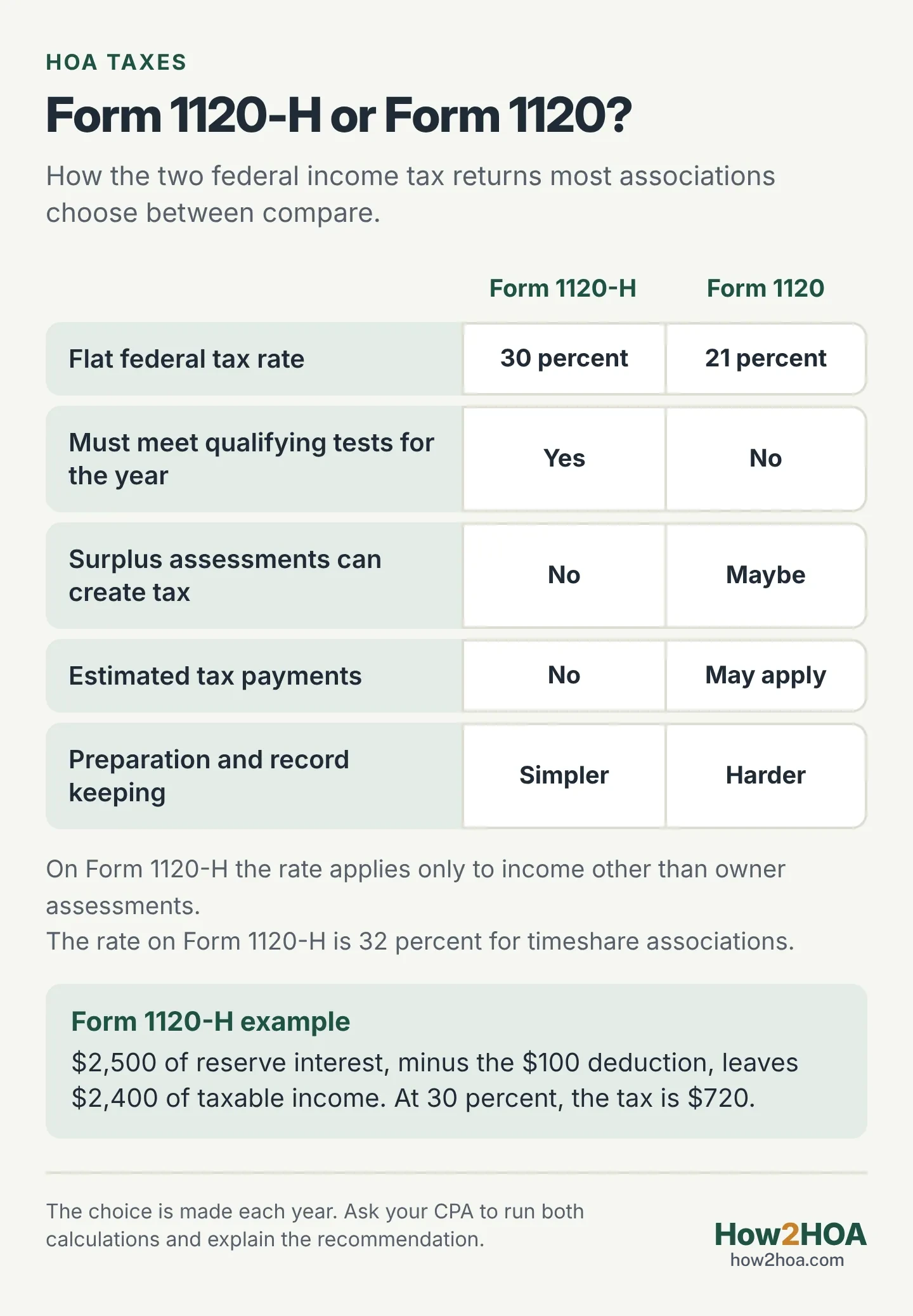
In practice the choice comes down to this:
- Form 1120-H is simpler and more predictable. Assessments are excluded, a year-end surplus of assessments does not create tax, and there are no estimated payments. The cost is the higher 30 percent rate on non-exempt income.
- Form 1120 has the lower 21 percent rate but more rules, more record keeping and more that can go wrong if the member and non-member numbers are not handled correctly.
Ask your CPA to run both calculations each year and explain the recommendation to the board.
Filing deadlines and penalties
Form 1120-H is generally due by the 15th day of the fourth month after the end of the association’s tax year. For a calendar-year association that is April 15. An association whose fiscal year ends June 30 must file by the 15th day of the third month after year end, which is September 15. If you need more time, file Form 7004 by the regular due date to request an extension. An extension gives more time to file, not more time to pay.
A late return can be penalized 5 percent of the unpaid tax for each month or part of a month it is late, up to 25 percent, and the instructions set a minimum penalty for returns more than 60 days late. Because the Form 1120-H election is generally made by filing on time, missing the deadline can complicate the election as well. If the association has missed returns in past years, raise it with a CPA right away.
In California
California does not automatically treat a homeowners association as tax-exempt, and filing federal Form 1120-H does not create a state exemption. According to the Franchise Tax Board’s Publication 1028, Guidelines for Homeowners’ Associations, an association must apply for exemption under Revenue and Taxation Code section 23701t and receive a determination letter. The application is Form 3500, Exemption Application, and the FTB’s instructions say there is no fee to file it.
Publication 1028 lists tests that resemble the federal ones: at least 85 percent residential use, at least 60 percent of gross income from membership dues, fees and assessments, at least 90 percent of expenses spent on acquiring, managing, maintaining and caring for association property, and no private benefit from net earnings. The FTB also looks for specific language in the association’s organizing documents.
Once exempt, an association may have two California filings each year:
- Form 199 or FTB 199N. This is the annual information return. Associations whose gross receipts are normally $50,000 or less file the electronic FTB 199N, and larger ones file Form 199. It is due by the 15th day of the fifth month after the close of the tax year, which is May 15 for calendar-year associations.
- Form 100. If the association’s non-exempt function income subject to tax is more than $100 for the year, it must also file Form 100, the California corporation return, and pay tax on that income at the general corporate rate. Form 100 is due by the 15th day of the fourth month after the close of the tax year.
Exempt associations are not subject to California’s minimum franchise tax. An incorporated association that has not obtained the exemption files Form 100 and pays the minimum franchise tax ($800, according to the FTB) or the tax measured on its income, whichever is greater. If your association has never applied, or is not sure of its status, ask your CPA to check. The FTB revises its forms and thresholds from time to time, so confirm the current ones with the FTB or your CPA before relying on them.
Tips for staying on top of HOA taxes
- Put the federal and state due dates on the board calendar, and confirm each year that the returns were filed. Keep copies with the association’s permanent records.
- Track member and non-member income separately in the books. Your CPA needs that split for either federal form.
- Before starting a new income source, such as renting the clubhouse to outside groups or selling advertising, ask how it will be taxed and whether it could affect the 60 percent test. Our article on raising money beyond assessments has more on this.
- Budget for the tax on reserve interest so it is not a surprise.
- Use a CPA who works with associations. See when to hire an accountant for your HOA.
This article covers income tax only. Payroll, sales and property taxes follow different rules. For more on budgets, reserves and reporting, visit our HOA finances section.
The Law Behind This Article
Every legal point in this article comes from the official text. Each link below opens it in a new tab.
Other official sources: IRS Publication 542 · IRS explains · published information letter · Form 1120 instructions · Form 1120-H · Instructions for Form 1120-H · Publication 1028, Guidelines for Homeowners’ Associations · Form 3500, Exemption Application · $800, according to the FTB
This article is general educational information, not legal or tax advice. Laws vary by state and your association’s governing documents control many of these questions, so check with your association’s attorney or another qualified professional about your situation.