
An HOA can raise money beyond assessments by renting out common facilities, charging user fees for optional amenities, selling newsletter advertising or sponsorships, hosting vendors and events, and cutting operating costs. This kind of HOA income is usually a modest supplement, not a replacement for adequate assessments. Before starting any of it, check three things: whether your governing documents allow it, how the income will be taxed, and whether your insurance covers it.
This article first explains how assessments and the budget work, since that is where most of the association’s money comes from, and then walks through eight ways to bring in more.
How HOA fees work
Each year the board adopts a budget that estimates what it will cost to run the community, and that budget determines the regular assessment each owner pays. Part of every assessment pays for day-to-day operating costs such as landscaping, utilities, insurance and management. The rest goes into reserves, the savings set aside for big-ticket repairs and replacements like roofs, paving and pool equipment.
A reserve study estimates how long each major component will last and what it will cost to repair or replace, so the board knows how much to set aside each year. How often a study is required depends on state law. When reserves are adequately funded, the money is there when the roof wears out. When they are not, usually because assessments were held too low for too long or an unexpected cost came up, the board has to turn to a special assessment, a loan or both. Extra income can ease that pressure a little, but it will not fix an underfunded budget.
How to begin handling the HOA budget
Look at where the money comes from and where it goes before you look for new income. These six steps are a sound way to build the budget each year, and our guide to planning your HOA budget goes deeper.
- Review past budgets, income and expenses. Compare what was budgeted with what was actually spent over the last few years. The gaps show where estimates were off and where costs are creeping up.
- Assess vendor contracts and ask about expected increases. Call your vendors, ask what they plan to charge next year, and read the renewal and price-increase terms in each contract. Put the larger contracts out to bid from time to time so you know you are paying a fair price.
- Fund your reserves. Use the reserve study to set the annual contribution. If there is no study, getting one is the first step toward knowing what the community’s future repairs will cost.
- Decide on upcoming projects. Rank repair and replacement projects by urgency, with safety items first. If reserves cannot cover a project, plan how to pay for it instead of putting it off indefinitely.
- Budget for the unexpected. Insurance premiums, utility rates and emergency repairs rarely come in exactly as planned. Build in a reasonable contingency.
- Set the assessment. Total the operating costs and the reserve contribution, subtract any reliable income from other sources, and divide the remainder among the owners the way your governing documents require. Explain the numbers to owners when you send out the budget.
Budgeting gets easier with practice. The first year or two on a board can be rough, especially if you inherit thin reserves, but careful records and an annual routine make each cycle more accurate than the last.
Three checks before you add a new source of HOA income
Check your governing documents
Your CC&Rs, bylaws and rules decide what the association may do with the common area and what it may charge. Some governing documents prohibit commercial activity in the community, limit use of the facilities to owners and their guests, or require an owner vote before common area is leased, altered or given over to one owner’s exclusive use. Local zoning and permit rules can also apply to events and rentals. If the documents are silent or unclear, ask the association’s attorney before you sign anything.
Understand the tax consequences
Assessments paid by owners are generally not taxed when the association files federal Form 1120-H. Most other income is. Interest on reserves, rent from outside groups, advertising revenue and vendor fees are non-exempt income, and on Form 1120-H the net amount, after directly connected expenses and a $100 deduction, is taxed at a flat 30 percent, according to the IRS instructions for Form 1120-H. Charges to members are not automatically exempt either: a fee for special use of a facility, such as reserving the clubhouse for an evening, is treated as non-exempt income.
There is a second issue. To use Form 1120-H, among other tests, at least 60 percent of the association’s gross income must come from owners’ dues, fees and assessments, and at least 90 percent of its expenses must go to acquiring, building, managing and maintaining association property, so a large new revenue stream could push an association toward the 60 percent line. See homeowners association taxes for the details, and talk to your CPA before launching anything substantial. State income tax can apply too.
Talk to your insurance agent
Opening the clubhouse, pool or grounds to outside groups, or adding activities with a real risk of injury, changes the association’s exposure. Ask your insurance agent whether the current policies cover the activity, and require renters and vendors to carry their own liability insurance and name the association as an additional insured. A signed rental or vendor agreement and a damage deposit should be standard.
Eight ways to raise HOA income without raising assessments

Share this infographic: Pinterest · Facebook · LinkedIn · Email · Download
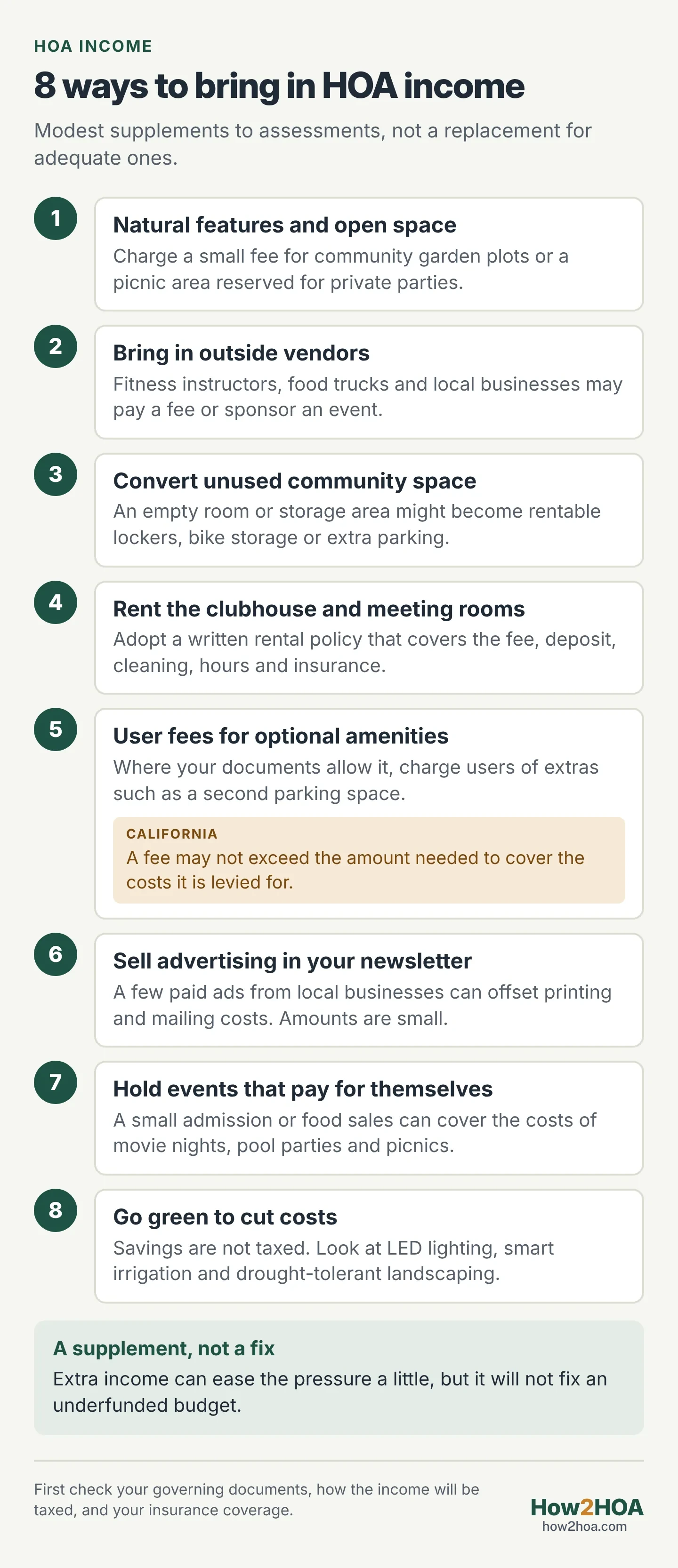
1. Put natural features and open space to work
If the community has open land, a pond or a hillside, think about uses that owners would pay a small fee for, such as plots in a community garden or a picnic area that can be reserved for private parties. Free amenities like a dog park or a walking trail will not produce income, but they add value that owners can see. Be cautious with boating, swimming and anything else that carries a real risk of injury, and clear it with your insurer first.
2. Bring in outside vendors
Fitness instructors, food trucks and local service providers will sometimes pay a fee to use a facility or to take part in a vendor fair for residents, and local businesses may sponsor a community event. Keep the terms in writing, make it clear that the association is not endorsing anyone, and remember that money from non-members is taxable income.
3. Convert unused community space
An empty basement room, an unused corner of a garage or a neglected storage area might become rentable storage lockers, bike storage, extra parking or a room for classes. Add up the conversion cost and compare it with realistic income before you commit. Changing how common area is used, or assigning part of it to individual owners, may require an owner vote under your documents or state law.
4. Rent out the clubhouse and meeting rooms
Clubhouses, kitchens and meeting rooms that sit empty most of the week can be rented to owners for private events and, if your documents allow it, to outside groups. Adopt a written rental policy that covers the fee, the deposit, cleaning, hours and insurance. Rentals produce taxable income and more wear on the building, so set the price with both in mind.
5. Charge user fees for optional amenities
Where the governing documents allow it, the association can charge the owners who use an optional extra, such as a second reserved parking space, a storage unit, a locker at the pool or gym, bike storage or a garden plot. This puts the cost on the people who benefit and can help pay for upkeep and improvements. Make sure the board has clear authority to charge the fee and that it applies to everyone on the same terms. Some states limit what an association may charge, and California’s rule is described below.
6. Sell advertising in your newsletter
A newsletter, website or community email can carry a few paid ads from local businesses. The amounts are usually small, though they can offset printing and mailing costs. Adopt a simple advertising policy, include a line saying that ads are not endorsements, and report the revenue to your CPA.
7. Hold events that pay for themselves
Movie nights, pool parties, picnics and baking contests organized by a social committee can charge a small admission or sell food. The realistic goal is to cover costs and bring neighbors together, with anything left over going toward the next event. Keep event money in the association’s accounts and under the same controls as any other funds: receipts, two people counting cash and a report to the treasurer. Check local permit rules before selling food, and talk to your insurance agent before alcohol is served. Raffles and other games of chance are regulated in many states, so ask the association’s attorney before adding one.
8. Go green to cut costs
A dollar saved does the same work as a dollar earned, and savings are not taxed. Look at LED lighting in the common areas, smart irrigation controllers, drought-tolerant landscaping and recycling programs that reduce trash hauling. Larger projects, such as solar panels on a clubhouse, need a careful payback analysis and may need owner approval. Ask your utility whether rebates are available.
In California
California boards face firm limits on raising assessments, which is one reason they look for other income. Under Civil Code section 5605, the board may not raise the regular assessment more than 20 percent above the prior fiscal year’s, or levy special assessments that total more than 5 percent of the year’s budgeted gross expenses, without the approval of a majority of a quorum of the members. For this purpose a quorum is more than 50 percent of the members. Section 5610 makes an exception for defined emergencies.
Fees are limited as well. Civil Code section 5600 says an association shall not impose or collect an assessment or fee that exceeds the amount necessary to defray the costs for which it is levied. That restricts using charges to owners as a source of profit, so have the association’s attorney review any new fee. Granting a member exclusive use of part of the common area generally requires approval by the owners of at least 67 percent of the separate interests, unless the governing documents set a different percentage, with the exceptions listed in Civil Code section 4600.
On reserves, Civil Code section 5550 requires the board to have a reserve study that includes a visual inspection of the major components at least once every three years, where the replacement value of those components is at least half of the association’s gross budget excluding reserves, and to review the study every year. On taxes, a California association must apply to the Franchise Tax Board for its state exemption, and an exempt association must still file Form 100 if its taxable non-exempt income for the year is more than $100. An exempt association also files an annual information return, Form 199 or the 199N e-postcard, depending on its gross receipts. See the FTB’s Publication 1028.
Where to start
Bring these questions to your next board meeting:
- Which amenities and spaces are underused?
- What do our governing documents say about rentals, fees and commercial activity?
- Which vendor contracts are coming up for renewal, and when did we last get competing bids?
- What would a new income source net after taxes, insurance, wear and volunteer time?
Start with the lowest-risk ideas, such as cost savings and a clear clubhouse rental policy, measure the results for a year, and build from there. For more on budgets, reserves and reporting, visit our HOA finances section.
The Law Behind This Article
Every legal point in this article comes from the official text. Each link below opens it in a new tab.
Civil Code sections: 4600 · 5550 · 5600 · 5605 · 5610
Other official sources: IRS instructions for Form 1120-H · Publication 1028
This article is general educational information, not legal or financial advice. Laws vary by state and your association’s governing documents control many of these questions, so check with your association’s attorney or another qualified professional about your situation.