
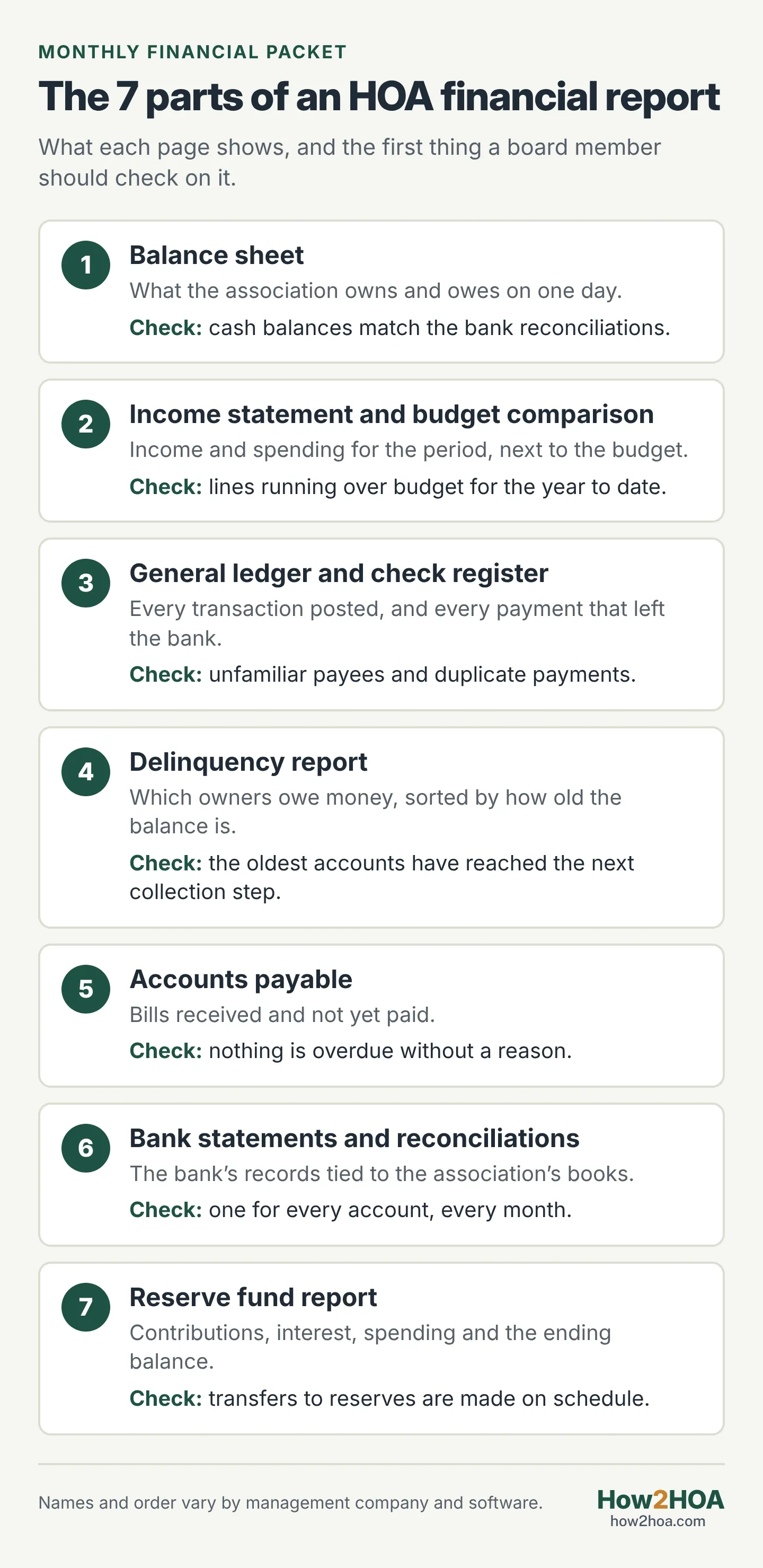
An HOA financial report is the packet of statements your manager, bookkeeper or treasurer prepares each month to show what the association owns, what it owes, what came in and what went out. Most packets contain the same core pieces: a balance sheet, an income statement with a budget comparison, a general ledger, a delinquency report, a payables list, bank reconciliations and a reserve fund report. You do not need an accounting background to review them. You need to know what each page is for and the two or three things to check on it.
What is in a monthly HOA financial report
The order and the names vary by management company and software, but the parts below show up in almost every packet. If you are new to the terms, our HOA accounting guides cover the basics.

Share this infographic: Pinterest · Facebook · LinkedIn · Email · Download
Balance sheet
The balance sheet is a snapshot of one day, usually the last day of the month. It lists assets (operating cash, reserve cash, assessments owners owe, prepaid items such as insurance), liabilities (unpaid bills, assessments owners paid in advance) and the fund balances left over, normally split between the operating fund and the reserve fund. For more on the asset side, see what counts as an HOA asset.
What to look for:
- Each cash balance matches the ending balance on that account’s bank reconciliation.
- Reserve money sits in its own accounts and is not mixed with operating cash.
- Assessments receivable is not growing month after month.
- Any “due to” or “due from” line between the operating and reserve funds has an explanation.
Income statement and budget comparison
The income statement, also called the statement of revenues and expenses, shows what the association earned and spent during the period. Most packets present it as a budget comparison with columns for the month, the year to date, the budget for each and the variance.
The variance column is where your attention belongs. A small overage in one month is often timing, such as an insurance premium paid in a single installment. A line that runs over budget for the year to date is a trend, and the board should ask why and decide what to adjust. Underspending deserves a question too, because it can mean work that was budgeted is not getting done.
Ask whether the report is on a cash, accrual or modified accrual basis. Cash basis records money when it moves. Accrual records income when it is billed and expenses when they are incurred. A cash-basis check register and an accrual-basis income statement will not match line for line, and that is normal.
General ledger and check register
The general ledger lists every transaction posted to every account during the period. Use it to trace anything on the income statement that looks odd. The check register, or cash disbursements report, is the shorter list of payments that left the bank.
On the check register, scan for payees you do not recognize, duplicate payments, round-number amounts with no invoice, and payments to anyone related to a board member or the manager. Ask to see the invoice behind anything unclear.
Accounts receivable or delinquency report
This report, often called the aged receivables report, lists each owner who owes money and sorts the balances by age, typically current, 30, 60 and 90 or more days. It tells the board whether the collection policy is being followed. Look at the total, at the direction it is moving, and at whether each account in the oldest column has reached the next step in your policy. Our article on late fees and notices explains those steps. Because the report names individual owners, handle it with care and follow your state’s rules on where delinquencies may be discussed.
Accounts payable
The payables report lists bills the association has received and not yet paid, usually with their age. Check that nothing is overdue without a reason, that no vendor is being held because cash is short, and that large invoices match an approved contract or a board decision.
Bank statements and reconciliations
A bank reconciliation ties the balance on the bank statement to the balance in the association’s books by listing deposits in transit and checks that have not cleared. It is the best single control a volunteer board has, because it compares the association’s records with an outside source.
What to look for:
- A reconciliation for every account, operating and reserve, every month.
- The actual bank statement attached, not only a summary of it.
- Outstanding checks or uncleared deposits more than a couple of months old.
- Transfers between accounts that the board did not approve.
Reserve fund reporting
Reserves pay for the big, predictable replacements: roofs, paving, paint, pool equipment. The reserve report should show the opening balance, contributions, interest earned, what was spent and on which component, and the ending balance by account. Compare the contributions with the budget to confirm the transfer to reserves is being made on schedule, and compare the balance with the funding plan in your reserve study. Reserve spending should match a component in that study.
The yearly reports
Once a year the monthly packet is joined by a few larger documents:
- The annual budget, which sets assessments for the coming year.
- Year-end financial statements, which many associations have compiled, reviewed or audited by an outside CPA. See what a financial review involves and how it differs from an audit.
- The association’s tax returns, which are generally due even when little or no tax is owed.
- The reserve study or its annual update.
If the board is unsure which level of CPA service it needs, our article on when to hire an accountant can help.
In California
California turns much of this good practice into a legal duty. This is a summary, and the linked statutes control.
- Unless the governing documents are stricter, the board must review the following every month: current reconciliations of the operating and reserve accounts, actual operating revenues and expenses compared with the budget, the latest bank statements for the operating and reserve accounts, an income and expense statement for those accounts, and the check register, monthly general ledger and delinquent assessment receivable reports (Civil Code 5500).
- That review can happen outside a meeting, either by every director individually or by a subcommittee of the treasurer and at least one other director, if it is ratified at the next board meeting and noted in the minutes (Civil Code 5501).
- Transfers from operating or reserve accounts at or above a set amount need prior written board approval. The amount is the lesser of $5,000 or 5 percent of estimated income in the annual operating budget for associations with 50 or fewer separate interests, and the lesser of $10,000 or 5 percent for larger ones (Civil Code 5502).
- Reserve withdrawals require two signatures, from two directors or from one director and one officer who is not a director (Civil Code 5510).
- In any fiscal year when gross income exceeds $75,000, a licensee of the California Board of Accountancy must prepare a review of the financial statement, and a copy goes to members within 120 days after the fiscal year ends (Civil Code 5305).
- The annual budget report, including a reserve summary and a summary of the association’s insurance, is distributed 30 to 90 days before the fiscal year ends (Civil Code 5300).
- The reserve study must include a visual inspection of accessible major components at least once every three years when their replacement value is at least half of the gross budget excluding reserves, and the board must review the study every year (Civil Code 5550).
A short monthly routine
Read the packet before the meeting, not during it. Start with the bank reconciliations, then check that the balance sheet cash agrees with them. Move to the year-to-date variances, scan the check register, and finish with the delinquency and reserve reports. Write down your questions, send them to the manager or treasurer ahead of time, and make sure the minutes show the board reviewed the financials.
The Law Behind This Article
Every legal point in this article comes from the official text. Each link below opens it in a new tab.
Civil Code sections: 5300 · 5305 · 5500 · 5501 · 5502 · 5510 · 5550
This article is general educational information, not legal, financial or insurance advice. Laws vary by state and your association’s governing documents control many of these questions, so check with your association’s attorney, accountant or insurance professional about your situation.