
A California HOA board can raise regular assessments (dues) by up to 20 percent over the prior fiscal year’s regular assessment without a vote of the members, as long as it has sent the required annual budget report. An increase of more than 20 percent needs approval from a majority of a quorum of the members, unless it qualifies as an emergency. The rule is in Civil Code section 5605, part of the Davis-Stirling Common Interest Development Act.
The 20 percent rule in Civil Code section 5605
Civil Code section 5605 contains two separate conditions, and a board has to satisfy both.
Condition one: the annual budget report
The board may not impose any annual increase in regular assessments for a fiscal year unless it has either complied with specified parts of the annual budget report requirement for that year, or obtained member approval. Under Civil Code section 5300, the annual budget report must be distributed 30 to 90 days before the end of the fiscal year. It includes the operating budget, the reserve summary and reserve funding plan, and statements about deferred repairs, anticipated special assessments and how reserves will be funded.
The practical point: a board that sends the budget report late, or leaves out required pieces, has put even a small increase at risk. A missed mailing window can mean no increase at all that year without a member vote. Our California annual disclosure calendar shows where this deadline falls.
Condition two: the 20 percent ceiling
Even with a proper budget report, the board may not impose a regular assessment that is more than 20 percent greater than the regular assessment for the association’s preceding fiscal year without member approval.
- It is measured year over year. If dues were $400 a month last fiscal year, the board can set them as high as $480 this year on its own authority. This is an illustration, not a typical figure.
- It compounds. The statute does not limit how many years in a row the board may use the full 20 percent.
- It is a ceiling, not a target. Civil Code section 5600 requires the association to levy assessments sufficient to meet its obligations, and also bars any assessment that exceeds the amount necessary to defray the costs for which it is levied. The budget has to justify the number.
- Special assessments have their own limit. The same section caps board-approved special assessments at 5 percent of budgeted gross expenses for the year.
What member approval requires
To go above 20 percent, the board needs the approval of a majority of a quorum of the members at a member meeting or election. For this purpose the statute defines quorum as more than 50 percent of the members. That is a higher bar than it sounds: more than half of all owners have to cast a ballot, and a majority of those must vote yes.
Under Civil Code section 5100, an assessment vote that the law requires must be conducted by secret ballot under the Act’s election rules, with ballots delivered at least 30 days before the voting deadline (Civil Code section 5115). As of this writing, Civil Code section 5105 does not allow electronic secret ballots for votes on regular or special assessments, so plan for paper ballots. If the vote fails or falls short of quorum, the increase is limited to 20 percent.
The emergency exception
Civil Code section 5610 says section 5605 does not limit assessment increases necessary for emergency situations. An emergency is one of the following:
- A court order. An extraordinary expense required by an order of a court.
- A health or safety threat. An extraordinary expense necessary to repair or maintain the development where a threat to personal health or safety is discovered.
- An unforeseeable repair. An extraordinary repair or maintenance expense the board could not reasonably have foreseen when preparing the annual budget report. Here the board must first pass a resolution with written findings on the necessity of the expense and why it was not or could not have been foreseen, and distribute it to members with the notice of assessment.
Rising insurance premiums, inflation and underfunded reserves are real pressures, but whether any of them fits one of these three categories is a legal question. Get the association attorney’s opinion in writing before using the emergency exception to exceed 20 percent.
Notice of the increase
Civil Code section 5615 requires individual notice to each member of any increase in regular or special assessments, not less than 30 and not more than 60 days before the increased assessment becomes due. This is a separate requirement from the annual budget report, although many associations time the budget mailing so that one package satisfies both. Check the dates carefully if you do.
| Increase over last year’s regular assessment | Who approves | Conditions |
|---|---|---|
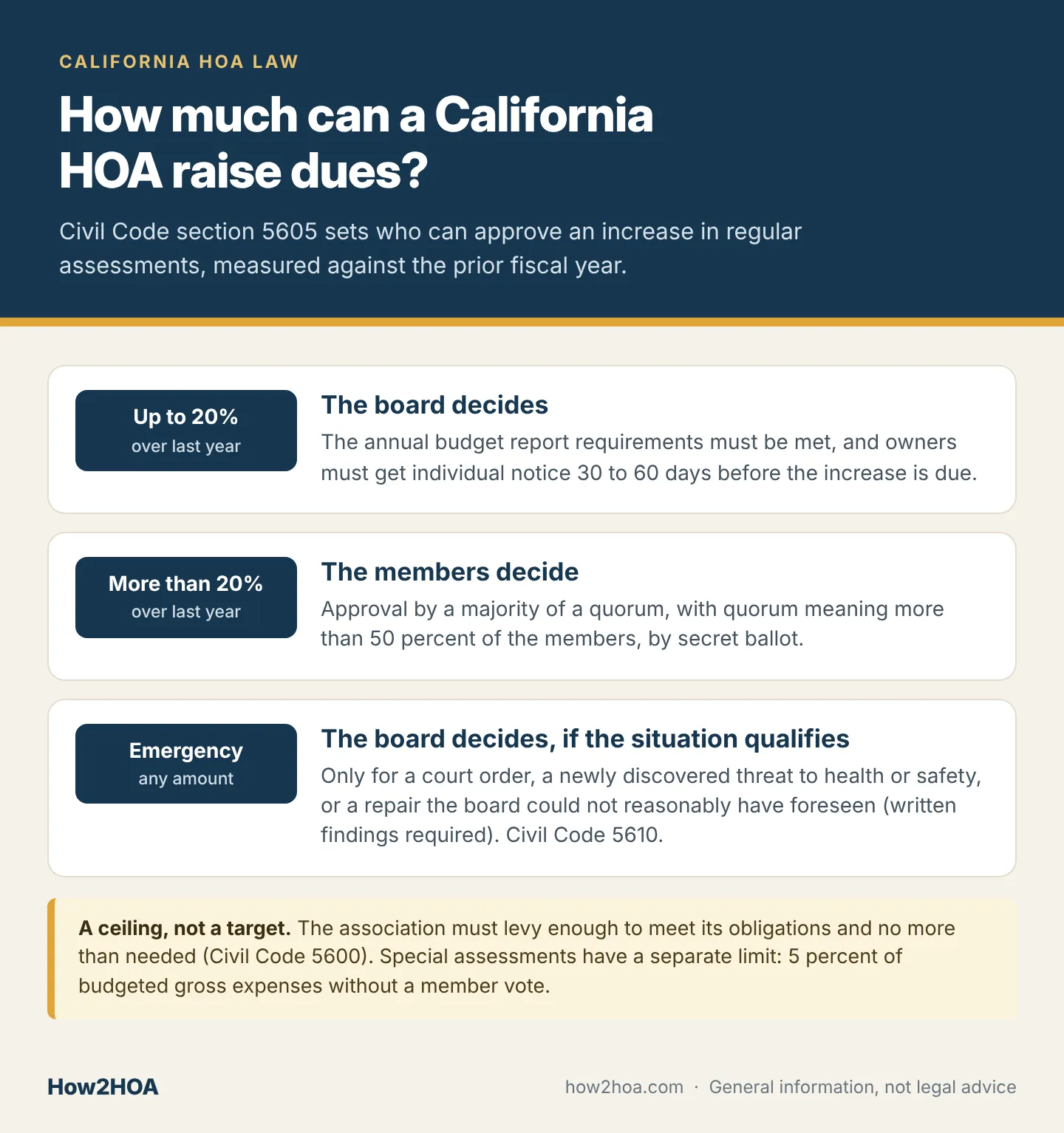
| Up to 20 percent | The board | Annual budget report requirements met, and 30 to 60 days’ individual notice. |
| More than 20 percent | The members | Majority of a quorum, with quorum meaning more than 50 percent of members, by secret ballot. |
| Any amount, in an emergency | The board | Must fit a section 5610 category. Written findings required for unforeseen expenses. |

Share this infographic: Pinterest · Facebook · LinkedIn · Email · Download
The lower cap for deed-restricted affordable units
Assembly Bill 572, effective January 1, 2024, added a narrower limit to section 5605. It applies only to associations that record their original declaration on or after January 1, 2025, so existing communities are not affected.
In those newer associations, the board may not raise the regular assessment on the owner of a deed-restricted affordable housing unit by more than 5 percent plus the percentage change in the cost of living, and never by more than 10 percent over the preceding year’s regular assessment. The board may also set a lower assessment for those units than for the other owners. The statute lists exemptions, including developments of 20 units or fewer and certain developments where the share of affordable units is above specified thresholds. A board in a mixed-income community built under these rules should have counsel confirm which limit applies to which units.
What your CC&Rs can add
Section 5605 states that its limits apply “notwithstanding more restrictive limitations placed on the board by the governing documents.” Many older CC&Rs (covenants, conditions and restrictions) contain a lower cap, or tie increases to an inflation index. The statutory wording indicates the board keeps its authority to go up to 20 percent anyway, but if your documents have such a clause, ask the association’s attorney how it interacts with the statute before relying on either number.
The governing documents still control other things the statute leaves alone: how assessments are allocated among units (equally, by square footage or by another formula), when they are due, and any late charge lower than the statutory maximum. Our guide to governing documents explains where to look.
Is the cap changing?
A 2026 bill, Senate Bill 1007, proposed a much lower limit on increases without a member vote. According to the Community Associations Institute’s end-of-session report, it did not pass. As of October 2026 the 20 percent limit is still the law. Proposals like this tend to return, so check the current text of section 5605 before each budget season.
Outside California
Most states do not set a statutory cap on how much an HOA can raise regular assessments. The limit, if there is one, comes from the community’s declaration or bylaws, which may cap annual increases or require an owner vote on the budget. A few states do legislate a number. Arizona’s planned community statute, A.R.S. section 33-1803, also uses 20 percent over the prior year unless a majority of members approves. If you live elsewhere, read your governing documents first and then your state’s HOA or condominium act.
Good practice for boards
None of the following is required by section 5605, but it is how boards avoid needing a large increase in the first place.
- Raise a little every year. Small annual adjustments that track real costs are easier on owners than a freeze followed by a jump.
- Budget from actual numbers. Use current contracts, insurance quotes and the reserve study, not last year’s budget plus a guess. Our guide to planning your HOA budget walks through the process.
- Explain the increase. Show owners which line items moved and why. If you are a homeowner on the receiving end, our tips for handling rising HOA fees may help.
Frequently asked questions
Do California homeowners vote on the HOA budget?
Generally no. The board adopts the budget. State law requires a member vote only when a regular assessment increase exceeds 20 percent or special assessments exceed 5 percent of budgeted gross expenses, outside of an emergency. Some governing documents add their own voting requirements.
Can the board raise dues by 20 percent every year?
The statute allows it, provided each year’s budget supports the amount and the notice and budget report requirements are met.
What if the board raised dues without sending the budget report?
The increase may be open to challenge under section 5605. Raise it with the board in writing and, if needed, use the association’s dispute resolution process.
For more on budgets, reserves and collections, visit the HOA finances hub.
The Law Behind This Article
Every legal point in this article comes from the official text. Each link below opens it in a new tab.
Civil Code sections: 5100 · 5105 · 5115 · 5300 · 5600 · 5605 · 5610 · 5615
Other sources: CAI: 2026 California End of Legislative Session Report · Arizona Revised Statutes section 33-1803
This article is general educational information, not legal or financial advice. Laws vary by state and your association’s governing documents control many of these questions, so check with your association’s attorney or another qualified professional about your situation.