
Most HOA disputes can and should be settled without a lawsuit. In California, the law builds in three steps before court: a board hearing before any fine or discipline, internal dispute resolution (IDR, an informal “meet and confer” between the owner and a board member), and alternative dispute resolution (ADR, such as mediation or arbitration with a neutral third party). For many kinds of lawsuits, offering ADR first is required, and refusing it can reduce the attorney fees a party recovers if it later wins in court.
Why try to resolve it first
- Cost. Litigation over a fence, a paint color or a parking space can cost far more than the issue is worth, and in many states the loser pays the winner’s attorney fees.
- Time. A meeting can happen in weeks. A lawsuit can take years.
The general options, from least to most formal
- Direct conversation. A phone call or a courtesy letter resolves many violations before they become disputes. See our guide to HOA rules and enforcing violations.
- Internal meeting. The owner meets with the board or a board representative to explain each side and look for a solution. No outside neutral is involved.
- Mediation. A trained neutral helps the parties negotiate. The mediator does not decide anything, and there is no agreement unless both sides sign one.
- Arbitration. A neutral hears evidence and issues a decision. It can be binding or non-binding depending on what the parties or the governing documents provide.
- Court. Small claims court for smaller money disputes, or a civil lawsuit.
Outside California, check your state’s HOA or condominium act and your governing documents. Some states require notice and a chance to be heard, or mediation, before certain lawsuits. The rest of this article covers California’s rules under the Davis-Stirling Common Interest Development Act.
In California: the hearing before a fine (sections 5850 and 5855)
Many disputes start with a violation notice, so the first required step is the board hearing. Civil Code section 5855, as amended by AB 130 in 2025, requires the following before the board imposes discipline or a monetary charge for damage to the common area:
- Written notice at least 10 days before the meeting, stating the date, time and place, the nature of the alleged violation (or the damage), and that the member may attend and address the board. The board must meet in executive session if the member asks.
- An opportunity to cure. The board may not impose discipline if the member cures the violation before the meeting. If curing would take longer than the time between the notice and the meeting, the board may not impose discipline if the member makes a financial commitment to cure.
- A path forward after the meeting. If the board and member do not agree, the member may request IDR. If they do agree, the board must draft a written resolution, which once signed by both is binding and judicially enforceable.
- Written notice of the decision within 14 days.
Discipline is not effective against a member unless the board follows these steps.
AB 130 also changed the amounts. Under Civil Code section 5850, a monetary penalty may not exceed the lesser of the amount in the association’s published fine schedule or $100 per violation. The board may impose a penalty above $100 only if the violation may result in an adverse health or safety impact on the common area or another member’s property, and only after making a written finding that specifies the impact, in a board meeting open to the members. Late charges and interest may not be added to fines.
With fines limited, boards have more reason to use IDR and ADR to get compliance. Our article on how to enforce the rules in your association covers the enforcement side.
In California: internal dispute resolution (sections 5900 to 5920)
IDR applies to a dispute between an association and a member involving rights, duties or liabilities under the Davis-Stirling Act, the Nonprofit Mutual Benefit Corporation Law, or the governing documents (section 5900). Every association must provide a fair, reasonable and expeditious procedure (section 5905). An association may write its own procedure if it meets the minimum standards in section 5910. If it has not, the default “meet and confer” procedure in Civil Code section 5915 applies.
How the default meet and confer works
- Either party may request, in writing, that the other meet and confer.
- A member may refuse a request from the association. The association may not refuse a request from a member.
- The board designates a director to meet and confer.
- The parties meet promptly at a mutually convenient time and place, explain their positions, and confer in good faith to resolve the dispute.
- Either party may be assisted by an attorney or another person, at that party’s own cost.
- Any resolution is put in writing and signed by the parties, including the board’s designee on behalf of the association.
Three more rules apply:
- The written agreement is binding. A signed agreement binds the parties and is judicially enforceable if it does not conflict with the law or the governing documents and it is either within the authority the board gave its designee or ratified by the board.
- No fee. A member may not be charged a fee to participate.
- No lawsuit around it. Under section 5910.1, an association may not file a civil action over a dispute in which the member has requested dispute resolution unless the association has complied with section 5910 by engaging in good faith in the IDR process.
The association’s annual policy statement must describe its IDR process (section 5920).
In California: ADR before filing an enforcement action (sections 5925 to 5965)
ADR is the next step up. Under section 5925 it means mediation, arbitration, conciliation or another nonjudicial procedure that involves a neutral party. It may be binding or non-binding, with the voluntary consent of the parties.
When it is required
Civil Code section 5930 says an association or a member may not file an enforcement action in superior court unless the parties have endeavored to submit their dispute to ADR. An enforcement action is a civil action to enforce the Davis-Stirling Act, the Nonprofit Mutual Benefit Corporation Law or the governing documents. The requirement applies only to actions:
- Solely for declaratory, injunctive or writ relief, or
- For that relief together with a claim for money damages that does not exceed the small claims court limits.
It does not apply to small claims actions, and, except as otherwise provided by law, it does not apply to assessment disputes. (Assessment collection has its own procedures. See pursuing collection through small claims court.)
The Request for Resolution and the timeline
- Serve a Request for Resolution (section 5935). It must include a brief description of the dispute, a request for ADR, and a notice that the recipient must respond within 30 days of receipt or the request will be deemed rejected. If the recipient is a member, a copy of the ADR article of the Civil Code must be attached. Service may be by personal delivery, first-class mail, express mail, fax or other means reasonably calculated to give actual notice.
- 30 days to accept. If the other party does not accept within 30 days, the request is deemed rejected.
- 90 days to complete. If the request is accepted, ADR must be completed within 90 days after the requesting party receives the acceptance, unless both parties extend the period in a signed writing (section 5940). The parties share the cost.
- Deadlines are paused. If the request is served before the time to sue runs out, the limitation period is tolled during the 30-day response period and, if accepted, the 90-day ADR period and any agreed extension (section 5945).
- File a certificate with the lawsuit. A party that files an enforcement action must file a certificate stating that ADR was completed, that another party refused ADR, or that preliminary or temporary injunctive relief is necessary. Without it, the complaint is open to a demurrer or motion to strike (section 5950).
Attorney fees: why refusing ADR is risky
Under Civil Code section 5975, the prevailing party in an action to enforce the governing documents is awarded reasonable attorney fees and costs. Section 5960 adds that when a court sets the amount of a fee award in an enforcement action, it may consider whether a party’s refusal to participate in ADR before the lawsuit was reasonable. A party that wins in court after unreasonably refusing mediation may recover less.
The annual summary
Civil Code section 5965 requires the association to give members a summary of the ADR provisions each year, in the annual policy statement. The summary must include the statutory warning that a member who fails to comply with the ADR requirements of section 5930 may lose the right to sue the association or another member regarding enforcement of the governing documents or the applicable law. Copy that sentence from the statute. Our annual disclosure calendar shows when the policy statement is due.
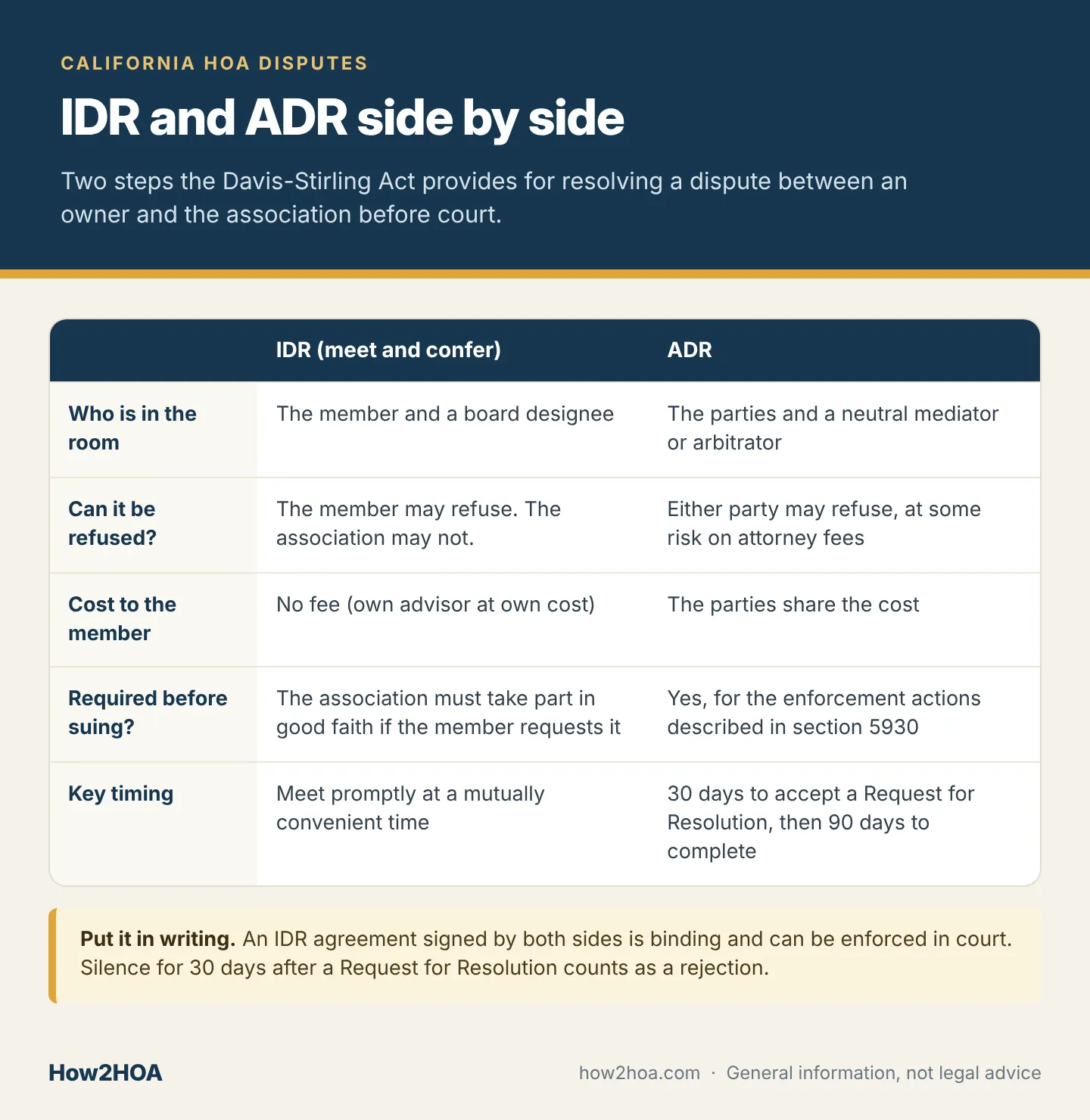
IDR and ADR side by side
| IDR (meet and confer) | ADR | |
|---|---|---|
| Who is in the room | Member and a board designee | The parties and a neutral mediator or arbitrator |
| Can it be refused? | Member may refuse. Association may not. | Either party may refuse, at some risk on fees |
| Cost to the member | No fee (own advisor at own cost) | Parties share the cost |
| Required before suing? | Association must take part in good faith if the member requests it | Yes, for the enforcement actions described in section 5930 |

Share this infographic: Pinterest · Facebook · LinkedIn · Email · Download
Practical tips
For boards
- Respond to every IDR request in writing and quickly. The association cannot say no.
- Give your designee clear authority by board vote before the meeting, or plan to ratify any agreement at the next meeting.
- Listen first. Many owners want to be heard more than they want to win. Our guide to managing conflict has techniques that work here too.
- Call the association’s attorney before serving or answering a Request for Resolution. The 30-day clock is short.
For owners
- Put your request in writing and say that you are requesting internal dispute resolution under the Civil Code.
- Do not ignore a Request for Resolution. Silence for 30 days counts as a rejection and can be raised later when fees are decided.
- Get any agreement in writing and signed. Our overview of member rights explains what else you are entitled to.
For more on rules, enforcement and governing documents, visit the rules and governing documents hub.
The Law Behind This Article
Every legal point in this article comes from the official text. Each link below opens it on the California Legislature’s website in a new tab.
Civil Code sections: 5850 · 5855 · 5900 · 5905 · 5910 · 5910.1 · 5915 · 5920 · 5925 · 5930 · 5935 · 5940 · 5945 · 5950 · 5960 · 5965 · 5975
This article is general educational information, not legal or financial advice. Laws vary by state and your association’s governing documents control many of these questions, so check with your association’s attorney or another qualified professional about your situation.