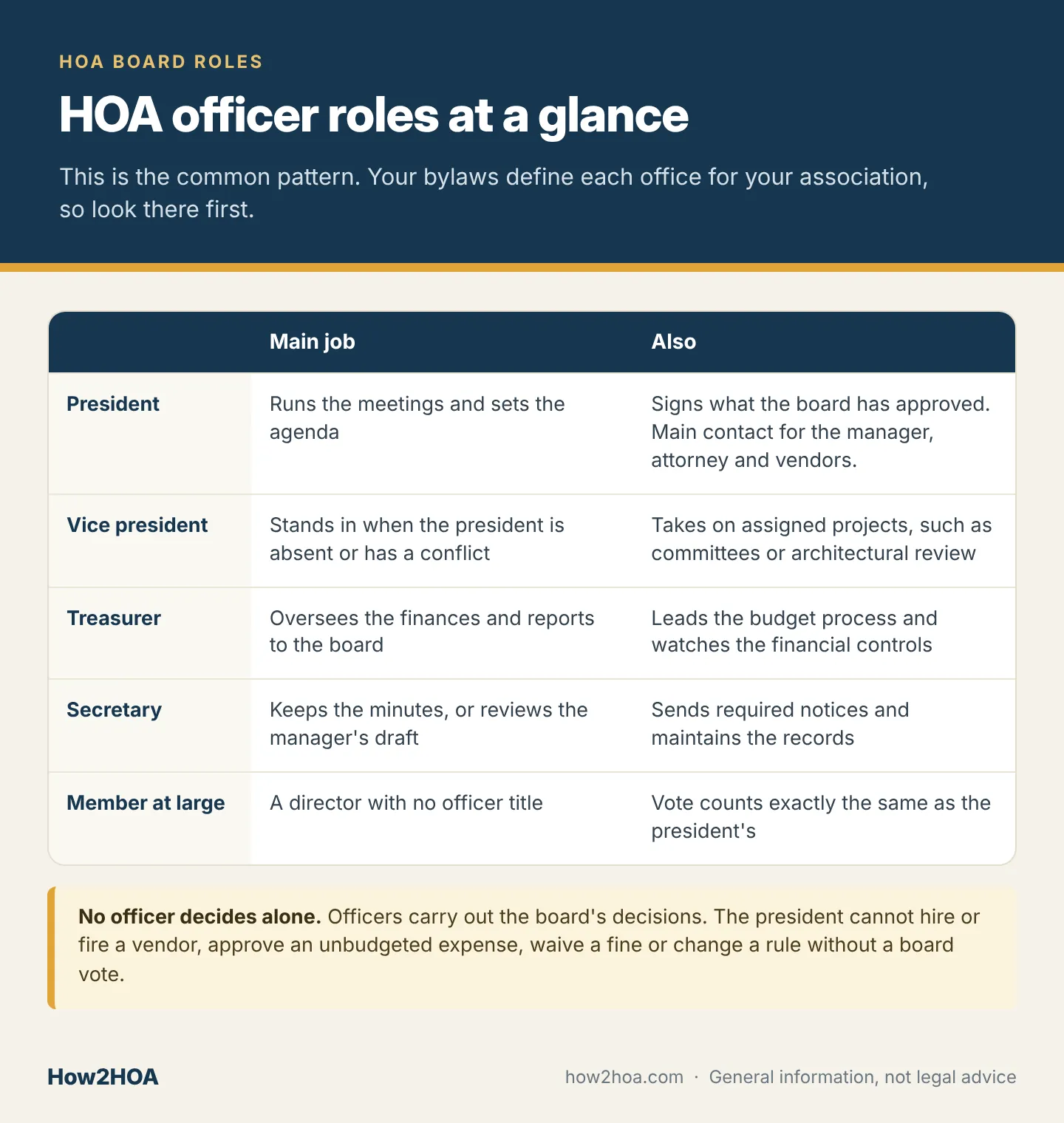
An HOA’s officers (usually a president, vice president, treasurer and secretary) carry out the decisions of the board of directors. They do not replace it. The president runs the meetings and signs what the board has approved, the treasurer oversees the money, the secretary keeps the records, and the vice president fills in for the president. No officer, including the president, can commit the association to anything on their own unless the board or the governing documents gave them that authority.
Directors and officers are two different jobs
Most volunteers hold both titles at once, which is why the two get blurred. They are separate roles with separate sources of power.
- Directors are elected by the members to sit on the board. The board acts as a group, by vote, at a properly called meeting. A single director has no individual authority.
- Officers are usually chosen by the board, from among the directors, to handle specific tasks between meetings. An officer’s authority comes from the bylaws and from whatever the board delegates.
In practice, a board of five might have four officers and one “member at large” who is a director with no officer title. That director’s vote counts exactly the same as the president’s. For the broader list of what directors owe the community, see what an HOA board member is responsible for.
What each officer does
Your bylaws are the first place to look, because they define each office for your association. The descriptions below are the common pattern.
President
- Runs the meetings. Sets the agenda (often with the manager), keeps discussion on track and makes sure every director is heard.
- Signs for the association. Contracts, letters and legal documents, after the board has approved them.
- Serves as the main contact. For the manager, the attorney and vendors between meetings.
- Does not decide alone. The president cannot hire or fire a vendor, approve an unbudgeted expense, waive a fine or change a rule without a board vote. In most associations the president votes like any other director, but check your bylaws.
Vice president
- Stands in for the president. Chairs the meeting and signs documents when the president is absent or has a conflict.
- Takes on assigned projects. Many boards give the vice president a standing area such as committees, architectural review or a major project.
- Has no extra authority otherwise. When the president is available, the vice president is one vote on the board.
Treasurer
- Oversees the finances. Reviews the monthly financial statements, bank statements and reconciliations, and reports to the board.
- Leads the budget process. Works with the manager or bookkeeper on the draft budget and the reserve funding plan.
- Watches the controls. Who can sign checks, who can move money online and who reconciles the accounts.
- Does not carry the duty alone. The treasurer is the board’s point person, but the whole board remains responsible for the association’s finances. A treasurer should also never be the only person who sees the bank statements.
Secretary
- Keeps the minutes. Or reviews the draft prepared by the manager, so there is an accurate record of every vote. See how to handle HOA meeting minutes.
- Sends required notices. Meeting notices, election notices and other mailings the law or bylaws require.
- Maintains the records. The membership list, governing documents, contracts and corporate filings, and often certifies documents and signs alongside the president.

Share this infographic: Pinterest · Facebook · LinkedIn · Email · Download
How officers are chosen and removed
In most associations the members elect directors, and the directors then elect the officers from among themselves, usually at the first board meeting after the annual election. A few sets of bylaws have members vote directly for specific offices, so read yours.
Removal works on two levels, and mixing them up causes a lot of board conflict:
- Removing someone from an office. Where the board appoints officers, the board can generally replace an officer by majority vote at a properly noticed meeting. The former president is still a director with a vote.
- Removing someone from the board. That usually takes a vote of the members. See how to recall an HOA board member.
An officer can also resign the office and stay on the board. Whatever happens, record it in the minutes and update the bank signature cards and any state filings right away.
Working with a manager
A manager or management company handles day-to-day tasks: paying approved bills, preparing financial reports, getting bids, sending notices and drafting minutes. That changes what officers do with their time. It does not change who is responsible.
- The board still decides. A manager carries out board decisions and works within the limits in the management contract.
- The treasurer still reviews. Reports prepared by a manager need to be read, questioned and compared against the bank statements.
- The secretary still verifies. Draft minutes prepared by a manager are the board’s minutes once approved, so they need a careful read.
- One point of contact helps. Many boards route day-to-day direction to the manager through the president, so the manager is not getting five sets of instructions.
Common problems and how to fix them
- A president who acts alone. Signing contracts, directing vendors or making promises to owners without a vote. The fix is a written spending and signing policy, plus a habit of asking “when did the board approve this?” Unauthorized decisions can expose the association and the individual. See fiduciary duty and the business judgment rule.
- A treasurer who never sees the bank statements. If the treasurer only receives a summary report, no one on the board is verifying that the report matches the bank. Get read-only online access to every account for at least two directors. Our article on financial controls that prevent HOA fraud has a full checklist.
- One person doing everything. The same volunteer writes the checks, records them and reconciles the account. Split those tasks.
- Officers deciding by email. Two or three officers settling matters privately leaves the rest of the board out and, in many states, violates open meeting rules.
- Titles with no handoff. A new secretary or treasurer inherits nothing in writing. Keep a one-page description of each office and a shared records folder.
In California
California associations are usually incorporated as nonprofit mutual benefit corporations, so both the Corporations Code and the Davis-Stirling Common Interest Development Act apply. An unincorporated association follows its governing documents and Davis-Stirling.
- Board authority. Corporations Code section 7210 says the corporation’s activities are conducted and its powers exercised by or under the direction of the board. The board may delegate management to a person, a management company or a committee, but only under the board’s “ultimate direction.”
- Required officers. Corporations Code section 7213 requires a chair of the board or a president (or both), a secretary, and a treasurer or chief financial officer (or both). A vice president is not required by statute. It is common because bylaws call for one.
- One person, several offices. Under section 7213, one person may hold any number of offices unless the articles or bylaws say otherwise. That is legal for a small board. It is also the opposite of good financial control, so avoid combining president and treasurer where you can.
- Selection and removal. Unless the articles or bylaws provide otherwise, section 7213 says officers are chosen by the board and serve at the pleasure of the board. An officer may resign at any time by written notice.
- Monthly financial review is a board duty. Civil Code section 5500 requires the board to review, on a monthly basis, current reconciliations of the operating and reserve accounts, actual revenues and expenses compared to budget, the latest bank statements, income and expense statements, and the check register, general ledger and delinquency report. The duty sits with the board, not just the treasurer.
- The review can happen between meetings. Civil Code section 5501 lets the directors review the documents individually, or lets a subcommittee of the treasurer and at least one other director do it, if the review is ratified at the next board meeting and reflected in the minutes.
- Transfers need board approval. Under Civil Code section 5502, a transfer from the operating or reserve accounts requires prior written board approval unless it is less than the lesser of $5,000 or 5 percent of estimated annual operating income (associations with 50 or fewer separate interests), or the lesser of $10,000 or 5 percent (51 or more).
- Reserve withdrawals need two signatures. Civil Code section 5510 requires the signatures of two directors, or one director and one officer who is not a director, to withdraw reserve funds.
These are minimums. Your bylaws can be stricter, and stricter governing documents control.
Frequently asked questions
Can the HOA president make decisions without the board?
Only within authority the bylaws or a board resolution already gave the president, such as signing an approved contract or handling a true emergency under a board policy. Everything else needs a board vote.
Can one person be both president and treasurer?
Many state laws and bylaws allow it, including California’s default rule. It removes an important check on the money, so use it only as a short-term fix and add other controls, such as a second director reviewing the bank statements.
Does an officer have to be a board member?
Usually the bylaws say yes for the president, and often for all officers. Some bylaws allow a non-director secretary or treasurer. Check your documents.
Can the board remove the president?
Where officers serve at the pleasure of the board, a majority of directors can elect a different president. The former president stays on the board as a director unless the members recall them or they resign.
New to the board? Start with the board member hub. If your officers are stretched thin, you can also compare management options to see what a manager would take off their plates.
Each officer role also has its own free training track. See the officer certificates for short lessons on every office.
Our free HOA Delegation Plan Template can help your board put this into practice.
The Law Behind This Article
Every legal point in this article comes from the official text. Each link below opens it in a new tab.
Civil Code sections: 5500 · 5501 · 5502 · 5510
Corporations Code sections: 7210 · 7213
This article is general educational information, not legal or financial advice. Laws vary by state and your association’s governing documents control many of these questions, so check with your association’s attorney or another qualified professional about your situation.