Developer transition (also called turnover) is the point when control of a homeowners association passes from the builder to a board elected by the owners. From then on, the owners’ board is responsible for the money, the contracts and the condition of the common areas, including any construction problems the builder left behind. The first owner-controlled board should collect the association’s records, get an independent look at the finances and the buildings, and get its own legal advice early, because the deadlines for construction defect claims are already running.
How developer control works and how it ends
When a community is new, the developer owns most of the homes and writes the governing documents. Those documents usually give the developer the power to appoint or elect most of the board during the sales period. Control then ends in one of several ways, depending on state law and the documents:
- A sales threshold. Control ends when a stated share of the homes has been sold.
- A time limit. Control ends a set number of years after the first sale, even if homes remain unsold.
- Voluntary turnover. The developer gives up control earlier.
Many states have their own turnover statutes that set these thresholds, require the developer to hand over specific records, and sometimes require an audit at turnover. Check your state’s condominium or common interest community act and your declaration. California handles the subject differently, mostly through Department of Real Estate regulations, covered below.
Transition is a process more than a date. Owners often join the board one seat at a time while the developer still holds a majority. Those early owner directors should use the time to learn how the association runs. Our new board member guide is a good starting point.
Transition checklist for the first owner-controlled board
1. Collect the records
- Governing documents. Recorded CC&Rs (covenants, conditions and restrictions) with all amendments and annexations, articles, bylaws, rules and architectural guidelines.
- Maps and plans. Recorded subdivision maps, the condominium plan, deeds and easements for the common area, and approved plans for the facilities the association maintains. Ask for as-built plans too. They are valuable, though the developer may not be required to provide them.
- Financial records. Budgets, books of account, bank statements, tax returns, reserve studies and assessment records for every home, including the developer’s own payments.
- Corporate records. Minutes of member, board and committee meetings, and the membership register.
- Contracts and leases the association is a party to.
- Warranties, notices of completion and bonds for common area improvements and equipment.
- Insurance policies and loss history.
Make the request in writing, keep a log of what arrives, and store everything where the next board can find it. See maintaining your HOA records.
2. Take control of the money
- Bank accounts. Replace developer signers with the new officers and confirm that operating and reserve funds are held in the association’s name in separate accounts.
- Independent financial review. Hire a CPA with HOA experience to review or audit the developer period. Key questions: did the developer pay assessments on the homes it owned, were reserves funded as budgeted, and were association funds used for developer expenses? Our guide to financial reviews explains the options.
- Independent reserve study. Developer budgets are prepared before the buildings exist and are sometimes set low to keep assessments attractive to buyers. Commission a new study with a site inspection by a reserve specialist the board selects (see understanding reserve studies).
3. Inspect the common areas
Hire independent consultants, not the builder’s, to inspect what the association is responsible for: roofs, building exteriors, waterproofing, balconies and decks, drainage, paving, plumbing and mechanical systems, pools and landscaping irrigation. Ask for a written report with photos. Compare what was built with the approved plans and with what the sales documents promised. Report any problems to the association’s attorney before writing to the builder, because the form and timing of notice can matter.
4. Review developer-signed contracts
The developer-controlled board may have signed management, landscaping, cable, laundry or telecommunications agreements. Look for long terms, automatic renewals, termination fees and vendors affiliated with the developer. Ask counsel which contracts the association can end or renegotiate. If the developer chose the management company, the owner board is free to decide whether to keep it. Our articles on management contracts and comparing management options can help.
5. Check insurance and hire independent advisors
Confirm that property, liability, directors and officers, and fidelity coverage are in force in the association’s name, and have an independent broker review limits. Then retain an attorney who represents associations and has never represented the developer. The developer’s lawyers wrote the governing documents to protect the developer.
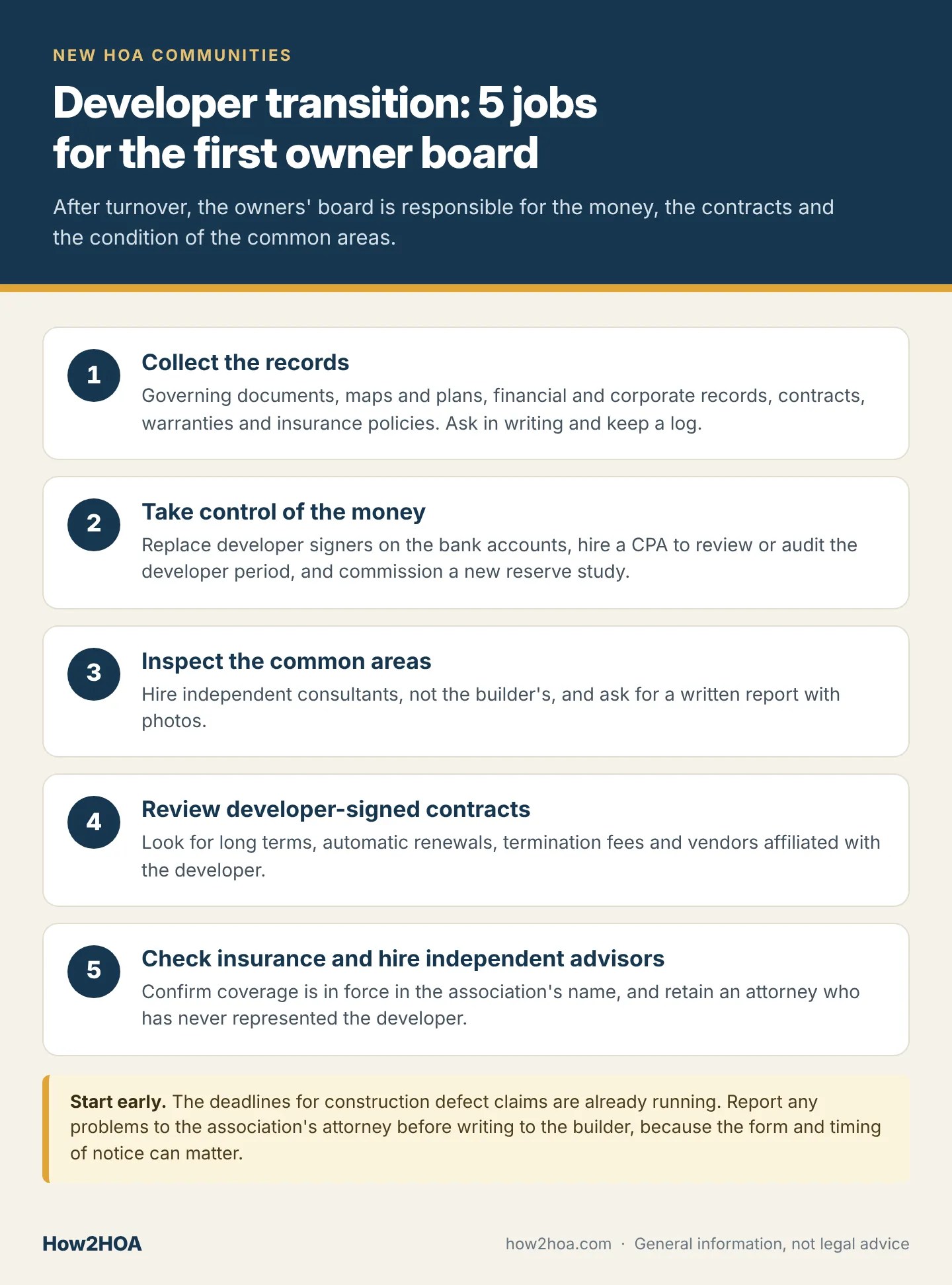
Share this infographic: Pinterest · Facebook · LinkedIn · Email · Download

In California
Developer control and records: Department of Real Estate regulations
California has no single turnover statute. The Department of Real Estate (DRE) regulations in Title 10 of the California Code of Regulations set standards that the governing documents of most new subdivisions must meet to obtain a public report. Check your own documents for the terms that actually apply. The regulations include:
- Voting classes (section 2792.18). An association may have two classes of voting membership, with the developer holding Class B and up to three votes per home it owns. In a single-phase project, Class B converts to Class A when Class A votes equal Class B votes or on a set date no later than the second anniversary of the first sale, whichever comes first. Phased projects have their own outside dates (the second anniversary of the first sale in the most recent phase, or the fourth anniversary of the first sale in the first phase).
- Owner-elected directors (section 2792.19). From the first election, at least 20 percent of the directors must be elected solely by owners other than the developer, for as long as the developer holds a majority of the voting power or two classes of membership exist.
- Document delivery (section 2792.23). Starting no later than 90 days after the first close of escrow, the developer must deliver copies of a list of records to the board as they become available. The list closely matches the records checklist above: recorded maps, the condominium plan, CC&Rs, articles, bylaws, rules, common area deeds, approved plans (which need not be as-built), notices of completion, bonds, warranties, insurance policies, contracts, the membership register, books of account and minutes.
- Subsidies (section 2792.10). If the developer agrees to subsidize assessments or provide goods or services to the association, it must have a written contract with the association, give the association monthly accountings, and post a bond or other security. A new board should ask for that agreement and the accountings.
Construction defects: the Right to Repair Act (SB 800)
For new homes where the seller signed the purchase agreement on or after January 1, 2003, construction defect claims are governed by the Right to Repair Act, Civil Code section 895 and the sections that follow. An association is a “claimant” under the act. Points every transition board should know:
- The general outside limit is 10 years. Under Civil Code section 941, unless the act provides a shorter period, no action may be brought more than 10 years after substantial completion of the improvement.
- Many items have much shorter periods. Civil Code section 896 sets, for example, one year for irrigation and drainage systems, two years for landscaping systems and dryer ducts, four years for plumbing and sewer systems, electrical systems, and exterior hardscape such as driveways, sidewalks and patios, and five years for paint and stains. These generally run from close of escrow.
- “Close of escrow” is defined differently for associations. For an association’s claims, section 895 defines it as the later of substantial completion or the date the builder relinquishes control over the association’s ability to decide whether to bring a claim.
- Notice comes before a lawsuit. Civil Code section 910 requires written notice of the claim to the builder before filing, which starts a process giving the builder a chance to inspect and offer repairs.
Outside the act, Code of Civil Procedure section 337.15 bars actions for latent construction defects more than 10 years after substantial completion, with an exception for willful misconduct or fraudulent concealment. Section 941 says section 337.15 does not apply to claims under the act, so which statute governs depends on the project and the claim. Calculating these deadlines is a job for a construction defect attorney. The practical lesson is to inspect early, well before the first anniversaries pass.
Section 6000 has expired
Older guides describe a separate pre-litigation process for associations in Civil Code section 6000 (the Calderon process). By its own terms that section became inoperative on July 1, 2024 and was repealed as of January 1, 2025, and we found no later statute extending it. Ask counsel what pre-litigation steps apply to your claim today.
Member notice and board authority (sections 6150 and 5986)
- Notice to members. Under Civil Code section 6150, at least 30 days before filing a civil action against the declarant or developer for damage to the common areas (or to separate interests the association must maintain or repair), the board must give each member written notice of a meeting to discuss the problems that may lead to the suit, the options available and the potential impacts, including financial ones. If the statute of limitations is about to expire, the notice may be given within 30 days after filing.
- The developer cannot block the claim. Civil Code section 5986 gives the board authority to pursue claims against the declarant, developer or builder regardless of contrary provisions in the governing documents. Developer-written provisions that require a member vote first or otherwise limit that authority are unenforceable, unless the limit was adopted solely by the non-developer members through the normal amendment procedure. If some directors are appointed by or affiliated with the developer, the decision belongs to the unaffiliated directors. The section does not extend any limitation period or override arbitration or other dispute resolution provisions in the documents.
- Deciding is part of the job. Civil Code section 5800 lists, among a director’s duties, deciding whether to investigate latent defects before the limitation period expires and whether to sue the builder. Whatever the board decides, document the investigation and reasoning (see fiduciary duty and the business judgment rule).
For more guidance for new directors, visit the board member hub.
The Law Behind This Article
Every legal point in this article comes from the official text. Each link below opens it in a new tab.
Civil Code sections: 895 · 896 · 910 · 941 · 5800 · 5986 · 6150
Code of Civil Procedure sections: 337.15
This article is general educational information, not legal or financial advice. Laws vary by state and your association’s governing documents control many of these questions, so check with your association’s attorney or another qualified professional about your situation.